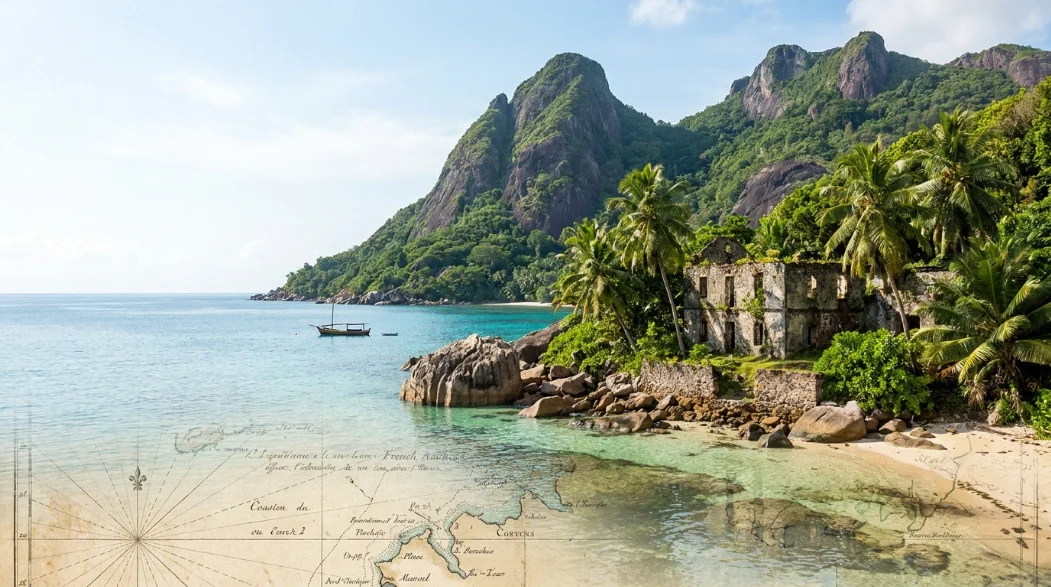
The Seychelles meaning is closely connected to French history. The name Seychelles was given to the islands in the 18th century in honor of Jean Moreau de Séchelles, a French official who served as Controller-General of Finances under King Louis XV. So, unlike names that describe a landscape, animal, or local tradition, Seychelles is essentially a historical surname that became the name of an island nation.
Today, Seychelles refers to an island country in the western Indian Ocean, northeast of Madagascar and off the eastern coast of Africa. It is an archipelago made up of numerous islands, with Mahé, Praslin, and La Digue among its best-known inhabited islands. The country’s official languages are Seychellois Creole, English, and French.
Understanding the name becomes more interesting when you look at its history. The word is not simply a label for a tropical paradise. It carries a small piece of French colonial history and helps explain how the modern country received its identity.
What Does Seychelles Mean?
Seychelles is a place name derived from the surname of Jean Moreau de Séchelles, a French government official.
In simple terms:
| Term | Meaning |
|---|---|
| Seychelles | Name of an island country and archipelago |
| Name origin | French historical origin |
| Named after | Jean Moreau de Séchelles |
| Region | Western Indian Ocean |
| Country type | Island nation / archipelago |
| Capital | Victoria |
| Main island | Mahé |
| Official languages | Seychellois Creole, English, French |
| Currency | Seychellois rupee |
The name therefore has a historical rather than literal meaning. It does not translate into a word such as “beautiful islands” or “peaceful place.” Its significance comes from the person whose name was attached to the islands during French rule.
Where Does the Name Seychelles Come From?
The name dates to the period when France established control over the islands in the 18th century.
In 1756, French forces formally claimed the Seychelles archipelago. The islands were named Séchelles in honor of Jean Moreau de Séchelles, who was associated with the French financial administration under Louis XV. The spelling later developed into the modern form Seychelles.
This is why the name has a distinctly French historical connection.
The naming also reflects the political history of the Indian Ocean at the time. European powers were competing for influence over important maritime routes, and islands positioned along those routes could have strategic value.
So the word Seychelles is more than a geographic label. It is a reminder of the period when French exploration, administration, and colonial expansion shaped the islands’ recorded history.
Who Was Jean Moreau de Séchelles?
Jean Moreau de Séchelles was a French government official whose name became permanently associated with the islands.
He served as a senior financial administrator under King Louis XV of France. The islands received the name Séchelles in his honor when France formally claimed the archipelago in 1756.
That makes Seychelles an example of a geographic name created from a person’s surname.
Similar naming patterns can be found in many parts of the world. A person may become associated with a city, island, region, or landmark because of exploration, political authority, patronage, or historical events.
In the case of Seychelles, a French official’s surname eventually became the internationally recognized name of an independent country.
Is Seychelles a Country or an Island?
Seychelles is a country made up of islands.
It is officially known as the Republic of Seychelles and is located in the western Indian Ocean. The country consists of an archipelago rather than one single island.
Mahé is the largest and most important island, while Praslin and La Digue are two other well-known inhabited islands. Official and tourism sources describe Seychelles as an archipelago of numerous islands, with the country’s total land area around 455 square kilometers.
This distinction matters because people sometimes use “Seychelles” to mean a particular island. Technically, Seychelles refers to the country and its island groups, not just Mahé.
Seychelles at a Glance
- Official name: Republic of Seychelles
- Capital: Victoria
- Location: Western Indian Ocean
- Largest island: Mahé
- Other major islands: Praslin and La Digue
- Official languages: Seychellois Creole, English, and French
- Currency: Seychellois rupee
- Independence: June 29, 1976
- Country type: Island nation and archipelago
Seychelles became an independent republic in 1976 after a period of British colonial rule.
Why Is Seychelles Called Seychelles?
The short answer is because the islands were named in honor of Jean Moreau de Séchelles during French rule.
The naming took place after France claimed the islands in 1756. Historical records from the Seychelles National Museum identify the naming of the island group as an honor to the French finance official.
There is an interesting detail here.
The main island is now called Mahé, but it was not originally named that way by the French at the moment of the 1756 claim. Mahé received its name in honor of Bertrand-François Mahé de La Bourdonnais, the former governor of the French island of Mauritius, during an earlier French expedition.
That gives the region a layered naming history:
La Bourdonnais → Mahé
Jean Moreau de Séchelles → Seychelles
The names preserve different parts of the islands’ French-era history.
Seychelles Name Origin Explained Simply
If you need a one-sentence explanation for Seychelles name origin, you can say:
The name Seychelles comes from Jean Moreau de Séchelles, a French financial official whose surname was used for the islands after France claimed them in 1756.
That is the clearest answer for someone searching specifically for the meaning of the word.
It is also important not to confuse name origin with literal translation. Seychelles does not have a commonly accepted English translation that means something like “paradise,” “beautiful islands,” or “blue sea.”
Those descriptions may fit the country’s scenery, but they are not the linguistic meaning of the name.
What Does Seychelles Mean in English?
In English, Seychelles is primarily a proper geographical name.
It refers to the Republic of Seychelles, an island country in the Indian Ocean.
The word itself is not normally translated into another English word. Its historical origin comes from the French name Séchelles.
For example:
- “I am visiting Seychelles” means the person is visiting the country.
- “Seychelles is an island nation” describes its geographical identity.
- “Seychellois culture” refers to the culture and people of the country.
So, if someone asks, “What does Seychelles mean in English?”, the most accurate response is that Seychelles is the name of a country and archipelago, derived from the surname of a French official.
Where Is Seychelles Located?
Seychelles is located in the Indian Ocean, northeast of Madagascar and off the eastern coast of Africa.
Its location helps explain some of the country’s distinctive cultural history. The islands developed through contact among African, European, Asian, and other communities, producing a culture that is strongly associated with the wider Creole world.
The country is relatively small in land area, but its maritime territory is enormous. France’s current country profile gives Seychelles a land area of about 455 square kilometers and an Exclusive Economic Zone of roughly 1.3 million square kilometers.
This contrast is easy to miss.
Seychelles is small when viewed on a land map, yet its position in the Indian Ocean gives it a much larger maritime presence.
What Is the Capital of Seychelles?
The capital of Seychelles is Victoria, located on Mahé Island.
Victoria developed as an administrative center during the colonial period and later became the capital of the independent Republic of Seychelles. Historical sources from the Seychelles National Museum note that the settlement was renamed Victoria in 1841 during British rule, in honor of Queen Victoria.
Victoria is also an important cultural and economic center.
For someone learning about the meaning of Seychelles, knowing the capital helps place the country in context:
Seychelles → Indian Ocean → Mahé → Victoria
What Language Is Spoken in Seychelles?
Seychelles has three official languages:
- Seychellois Creole
- English
- French
This language combination reflects the country’s complex history and cultural development. Seychellois Creole has strong French foundations while also containing influences from African and Malagasy languages.
French is especially relevant to the meaning and origin of the country’s name because Seychelles received its name during the French colonial period.
English became important during British rule, while Creole developed as an important everyday language among the population.
This makes Seychelles a good example of how language, geography, and history can remain connected long after political control changes.
What Does Seychellois Mean?
Seychellois is the adjective and noun associated with Seychelles.
It can refer to:
- A person from Seychelles
- The people of Seychelles
- Something relating to the country
- Seychellois culture
- Seychellois Creole
For example:
“She is Seychellois.”
means she is from Seychelles.
You may also see phrases such as Seychellois culture, Seychellois cuisine, or Seychellois Creole.
The distinction is useful because Seychelles identifies the country, while Seychellois identifies people or things connected to that country.
Seychelles and Its French Connection
The French influence on Seychelles is visible in more than the country’s name.
French settlers arrived during the 18th century, and permanent settlement began in 1770. The islands later came under British control, creating another major layer of historical influence.
That history helps explain why modern Seychelles has three official languages and a culture shaped by several different traditions.
The country’s identity is therefore not purely French or British. It developed into something distinctively Seychellois.
This is one of the most interesting things about the name. A French surname eventually became attached to a country whose modern culture grew from many different influences.
A Short History Behind the Name Seychelles
The story can be understood through a simple timeline:
| Period | Event |
|---|---|
| 1500s | Portuguese navigators recorded the islands in their charts |
| 1609 | First recorded landing by an English East India Company expedition |
| 1740s | French exploration of the islands increased |
| 1756 | France formally claimed the islands and used the name Séchelles |
| 1770 | Permanent French settlement began |
| 1811 | British control was established |
| 1841 | The main settlement was renamed Victoria |
| 1976 | Seychelles became an independent republic |
The exact details of early exploration vary across historical sources, but there is broad agreement on the important point for this article: the modern name Seychelles emerged during the French period in the 18th century.
Seychelles Meaning vs. What People Assume It Means
Because Seychelles is famous for beaches, clear water, and tropical scenery, people sometimes assume the name itself means something poetic.
That is not the case.
| Common assumption | Historical meaning |
|---|---|
| “Paradise” | Not the literal meaning |
| “Beautiful islands” | Not the literal meaning |
| “Tropical paradise” | A description, not the name’s origin |
| “Island of beauty” | Not the documented etymology |
| Seychelles | A name derived from Séchelles, a French surname |
This distinction is important for accurate writing.
A destination can have a beautiful reputation without that reputation being the source of its name.
Why the Meaning of Seychelles Is Historically Interesting
Place names often preserve history in ways ordinary words cannot.
When people hear “Seychelles,” they may immediately think about tropical beaches, coral reefs, luxury travel, or the Indian Ocean.
But the name itself points backward to 18th-century French administration.
That creates an interesting contrast:
Modern image: tropical island nation.
Historical name origin: French official and colonial history.
Both are part of the story.
The name also shows how geographical vocabulary can outlive the circumstances that created it. Modern Seychelles is an independent republic, yet its name still carries an imprint of the colonial era.
How to Pronounce Seychelles
The English pronunciation is commonly represented approximately as:
say-SHELZ
The final sound is closer to “shelz” than a pronunciation that attempts to pronounce every letter individually.
The French spelling and pronunciation have their own characteristics, but English speakers commonly use the anglicized pronunciation in everyday speech.
A simple way to remember it is:
Seychelles → say-SHELZ
Seychelles as an Island Nation
Seychelles is often associated with tourism, but reducing the country to beaches misses much of its identity.
It is a sovereign island state with its own government, population, languages, currency, history, culture, and institutions. Its economy has strong connections to tourism and fishing, while its location gives it an important maritime role.
The country is also geographically unusual.
Its islands include both granitic and coral islands, creating different landscapes and ecosystems across the archipelago. A National Assembly historical overview describes Seychelles as a group of 115 islands, including 41 granitic and 74 coralline islands.
That diversity is one reason the word “Seychelles” represents much more than one beach or one island.
What Is Seychelles Known For?
Seychelles is particularly known for:
- Tropical islands
- Beaches and clear ocean waters
- Mahé, Praslin, and La Digue
- Marine and coastal environments
- Creole culture
- French, British, African, and Asian cultural influences
- Tourism
- Fishing
- Unique island ecosystems
Its natural environment is a major part of its international identity, but its history is equally important for understanding the country’s name.
Is Seychelles in Africa?
Yes.
Seychelles is generally considered an African island country because it is geographically and politically part of the African region, even though it lies far out in the Indian Ocean.
It is northeast of Madagascar and approximately 1,600 kilometers from the eastern African coast.
This can surprise people because Seychelles feels geographically distant from mainland Africa.
Its location demonstrates why “Africa” does not only mean the continental mainland. The African region also includes island states such as Seychelles.
Is Seychelles French?
No. Seychelles is an independent country, not part of France.
The islands were claimed and settled by France during the 18th century and later came under British control. Seychelles became an independent republic on June 29, 1976.
French influence remains visible in language, names, food, culture, and historical records.
That is why someone researching the Seychelles meaning may encounter French names and terminology even though modern Seychelles is its own sovereign state.
The Meaning of Seychelles in Modern Use
Today, the word Seychelles carries several layers of meaning depending on context.
Geographical meaning
It refers to the island country and archipelago in the Indian Ocean.
Historical meaning
It connects to the French period and the surname Séchelles.
Cultural meaning
It can evoke Seychellois Creole culture and the blend of African, European, and Asian influences found in the islands.
Travel meaning
For travelers, Seychelles often represents tropical landscapes, beaches, marine life, and island tourism.
These meanings can coexist without contradicting one another.
The historical meaning explains where the word came from. The modern meanings explain what the word represents today.
Common Questions
What does Seychelles mean?
Seychelles is the name of an island country and archipelago in the Indian Ocean. The name comes from the surname of French official Jean Moreau de Séchelles, in whose honor the islands were named during French rule.
Is Seychelles a French word?
The name has a French historical origin, but Seychelles is now the name of an independent country. The original form was associated with the French surname Séchelles.
Why is Seychelles called Seychelles?
The islands were named in honor of Jean Moreau de Séchelles after France formally claimed the archipelago in 1756.
Does Seychelles mean paradise?
No. “Paradise” is a popular description of the country’s natural beauty, but it is not the historical or literal meaning of Seychelles.
Is Seychelles a country?
Yes. Seychelles is an independent island country officially known as the Republic of Seychelles.
What is the capital of Seychelles?
The capital is Victoria, located on Mahé Island.
What language do people speak in Seychelles?
The three official languages are Seychellois Creole, English, and French.
What does Seychellois mean?
Seychellois refers to a person from Seychelles or to something connected with Seychelles, such as Seychellois culture or Seychellois Creole.
Where is Seychelles located?
Seychelles is an island country in the western Indian Ocean, northeast of Madagascar and off the eastern coast of Africa.
Final Answer:
The simplest answer to “What does Seychelles mean?” is this:
Seychelles is the name of an island country in the Indian Ocean, and the name comes from Jean Moreau de Séchelles, a French financial official honored when France claimed the islands in 1756.
The name does not literally mean “paradise” or “beautiful islands.” Those descriptions come from the country’s spectacular natural scenery, not from the word’s etymology.
Today, Seychelles is an independent African island nation known for its distinctive Creole culture, multilingual population, diverse islands, and important maritime location. Its name is a small but fascinating reminder of the French history that helped shape the country.
Read More Related Articles:
- Contingent Meaning | What It Really Means When Everything …
- What Does Zionist Really Mean? History, Beliefs & the Story …
- Demisexual Meaning | What It Really Means to Feel Attraction …

8 thoughts on “Seychelles Meaning | What the Name Really Represents, Its Origins, Culture, and Island Story in 2026”