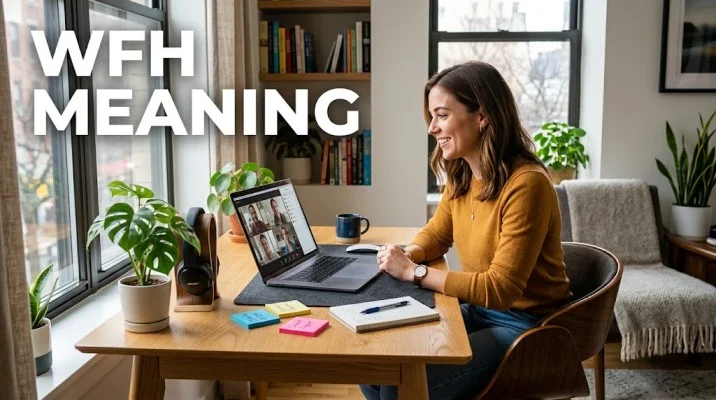
WFH meaning is “Work From Home.” It describes a work arrangement where someone performs their job from home instead of working from a traditional office.
You may see WFH in emails, workplace chats, job listings, calendars, or casual messages. For example, someone might write, “I’m WFH today,” meaning they are working from home today.
The abbreviation became especially common as remote and flexible work became part of everyday workplace communication. Today, WFH can describe a regular work arrangement, an occasional remote day, or simply a temporary decision to work from home.
What Does WFH Mean?
WFH stands for “Work From Home.”
It is commonly used as a short form in professional and casual communication.
For example:
“I’ll be WFH tomorrow.”
This means:
“I’ll be working from home tomorrow.”
The phrase can refer to the physical location where a person works, but it can also describe a broader work arrangement. A person might work from home every day, a few days each week, or only when circumstances make office attendance difficult.
WFH Full Form
| Abbreviation | Full Form | Meaning |
|---|---|---|
| WFH | Work From Home | Working from your home instead of a traditional office |
| WFO | Work From Office | Working from a company’s physical office |
| WFH day | Work From Home day | A scheduled or approved day spent working remotely from home |
| Remote work | Remote Work | Working outside a traditional office, often from different locations |
WFH Meaning in Text and Chat
In texting and workplace chats, WFH usually means Work From Home.
Its meaning is straightforward, but the exact situation can depend on the conversation.
For example:
Manager: “Are you coming into the office tomorrow?”
Employee: “No, I’m WFH.”
Here, WFH means the employee plans to work from home.
Another example:
Friend: “Want to grab lunch?”
Reply: “I’m WFH today, so I can meet during my lunch break.”
In this context, the abbreviation is being used casually rather than as a formal business term.
WFH Meaning at Work
At work, WFH usually refers to an employee completing their normal duties from home.
A company might allow WFH as part of its regular work policy. For some employees, it can be a fixed arrangement. Others, it may happen on selected days.
For example:
- “I have a WFH day on Friday.”
- “Our team is WFH this week.”
- “Can I WFH tomorrow?”
- “She works WFH three days a week.”
- “The company offers WFH options.”
The important point is that WFH describes where the work is being performed, not necessarily what kind of job the person has.
A software developer, writer, accountant, designer, customer-support representative, or consultant may all have a WFH arrangement if their work can be completed from home.
WFH Meaning in an Email
WFH is common in workplace emails, especially when the people involved already understand the abbreviation.
For example:
Subject: WFH Tomorrow
Hi Sarah,
I’ll be WFH tomorrow and will be available on Slack and email throughout the day.
Thanks,
James
A more formal workplace may prefer the full phrase:
“I’ll be working from home tomorrow.”
This is especially useful when communicating with clients, new employees, external partners, or people who may not know the abbreviation.
Common Email Examples
Simple:
“I’ll be WFH on Monday.”
Professional:
“I’ll be working from home on Monday but will remain available by email and phone.”
Team update:
“Just a quick note that I’ll be WFH today. I’ll join all scheduled meetings online.”
WFH Meaning on Social Media
On social media, WFH is often used casually to describe someone’s daily routine or lifestyle.
You might see captions such as:
- “WFH and coffee.”
- “Another WFH morning.”
- “WFH setup is finally complete.”
- “WFH means no commute today.”
- “A productive WFH day.”
In these situations, WFH still means Work From Home, but the tone is usually more personal.
People may use the abbreviation while talking about home offices, productivity, coffee, video meetings, flexible schedules, or the experience of working remotely.
WFH vs. Remote Work
- WFH and remote work are closely related, but they are not always identical.
- WFH specifically points to working from home. Remote work is broader.
A remote employee may work from a home office, coworking space, library, hotel, or another suitable location.
| Term | Basic Meaning | Typical Location |
|---|---|---|
| WFH | Work From Home | Home |
| Remote work | Work performed away from a traditional office | Home or another remote location |
| Hybrid work | Combination of office and remote work | Office + remote locations |
| WFO | Work From Office | Company office |
This distinction matters in job descriptions.
A company advertising a remote position may allow employees to work from various locations. A company describing a position as WFH may specifically be referring to home-based work.
Still, companies sometimes use these terms differently, so the exact workplace policy is more important than the label.
WFH vs. Hybrid Work
WFH and hybrid work describe different arrangements.
A WFH arrangement can mean an employee works from home, while a hybrid arrangement combines office work with remote work.
For example:
WFH arrangement:
Monday through Friday from home.
Hybrid arrangement:
Monday, Wednesday, and Thursday in the office, Tuesday and Friday from home.
Hybrid work gives employees a combination of workplace settings. WFH focuses specifically on working from home.
How to Use WFH Correctly
WFH is simple to use because it functions as a workplace abbreviation.
You can place it before or after information about a person’s work schedule.
- Talking About Yourself
“I’m WFH today.”
“I’ll be WFH tomorrow.”
“I usually WFH on Fridays.”
- Talking About Another Person
“Maria is WFH today.”
“John has been WFH all week.”
- Talking About a Team
“Our team is WFH today.”
“Everyone will be WFH during the office renovation.”
Asking About WFH
“Are you WFH tomorrow?”
“Can I WFH on Friday?”
“Does your company allow WFH?”
The abbreviation works best when the audience is familiar with workplace terminology.
WFH Examples in Everyday Communication
Here are some realistic examples of how people use WFH in different situations.
Casual Text
“I’m WFH today, so I can call after lunch.”
Workplace Chat
“Morning! I’m WFH today and will be online from 9.”
Manager Message
“The office will be closed tomorrow, so everyone will be WFH.”
Job Description
“This position offers flexible WFH options.”
Social Media Caption
“WFH, coffee, and a quiet morning.”
Calendar Note
“WFH: Available online from 9 AM to 5 PM.”
Team Announcement
“The team will be WFH on Friday while maintenance is being completed at the office.”
These examples show an important pattern: WFH is usually used as a practical abbreviation, not as a complicated piece of slang.
Is WFH Formal or Informal?
WFH sits somewhere between formal workplace language and casual shorthand.
It is widely understood in many professional environments, but the best choice depends on your audience.
Use WFH when:
- Talking with coworkers
- Updating a workplace chat
- Writing an internal message
- Adding a calendar note
- Talking casually about your work schedule
- Writing a short workplace update
Use Work From Home when:
- Explaining the term to a new audience
- Writing for people unfamiliar with workplace abbreviations
- Creating formal documentation
- Writing an important client-facing message
- You want maximum clarity
For example, this is perfectly natural in an internal chat:
“I’m WFH today.”
For a formal policy, this may be clearer:
“Employees may work from home with prior approval from their manager.”
Is WFH the Same as Working Remotely?
Not exactly.
Working from home is one form of remote work.
Remote work describes a wider concept. Someone working remotely does not necessarily have to work from their house.
For example, imagine a freelance designer who spends Monday working from home and Thursday working from a coworking space. Both days can be considered remote work, but only Monday would specifically fit the literal idea of WFH.
This difference becomes useful when reading job advertisements.
A position described as remote may offer location flexibility. A WFH arrangement can place more emphasis on the employee’s home as the workplace.
Why Has WFH Become So Common?
WFH became a familiar part of workplace vocabulary because digital tools make many jobs possible without a person sitting inside a traditional office.
Laptops, cloud software, video calls, instant messaging, project-management platforms, and online document systems allow employees to collaborate from different locations.
The language naturally became shorter too.
Instead of writing:
“I will be working from home today.”
Someone can simply write:
“I’m WFH today.”
That small abbreviation saves time in fast-moving workplace conversations.
Common WFH Abbreviations You May See
WFH is part of a larger group of workplace abbreviations.
| Abbreviation | Meaning |
|---|---|
| WFH | Work From Home |
| WFO | Work From Office |
| OOO | Out of Office |
| PTO | Paid Time Off |
| OOO message | Out-of-office message |
| EOD | End of Day |
| EOW | End of Week |
| FYI | For Your Information |
| ASAP | As Soon As Possible |
| ETA | Estimated Time of Arrival |
These abbreviations are especially common in emails, workplace chats, project updates, and calendars.
Common Mistakes With WFH
WFH is easy to understand, but a few usage mistakes are worth avoiding.
1. Treating WFH as a Job Title
WFH is not a job title.
You would not normally say:
“My job is WFH.”
Instead, say:
“I work from home.”
or:
“My job allows me to WFH.”
2. Assuming WFH Always Means Full-Time Remote Work
Someone saying “I’m WFH today” does not necessarily mean they permanently work remotely.
They could simply be working from home for one day.
3. Using It With an Audience That May Not Know It
Abbreviations save space, but they can create confusion.
If you are writing to a client who may not know workplace shorthand, writing Work From Home the first time is clearer.
4. Confusing WFH With Hybrid Work
A hybrid employee may WFH on certain days, but hybrid work includes both remote and office-based work.
The terms are related, but they describe different things.
WFH in Job Descriptions
You may encounter WFH while searching for employment.
For example:
Customer Support Specialist | WFH Position
This generally indicates that the role can be performed from home.
You may also see:
- WFH opportunity
- WFH job
- WFH position
- WFH role
- WFH employee
- WFH schedule
- WFH available
- Flexible WFH arrangement
However, the abbreviation alone does not tell you the full working arrangement.
Before applying, check the actual job description for details such as working hours, location requirements, equipment, internet requirements, office visits, and time-zone expectations.
WFH Does Not Automatically Mean Flexible Hours
This is an important distinction.
Working from home describes location. It does not automatically describe working hours.
An employee could work from home from 9 AM to 5 PM every weekday.
Another employee might have flexible working hours.
These are separate concepts.
For example:
“I WFH from 9 AM to 5 PM.”
This tells you the location and schedule.
By contrast:
“I have flexible working hours.”
This tells you about scheduling, not necessarily location.
A person can have WFH without flexible hours, and flexible hours without WFH.
What Does “WFH Today” Mean?
“WFH today” means “working from home today.”
It usually tells coworkers that the person is not physically present at the office but is still working.
For example:
“I’m WFH today, but I’ll join the 2 PM meeting online.”
The phrase does not mean the person is taking a day off.
That distinction is important. WFH is a workday, not automatically a vacation or day off.
What Does “WFH Tomorrow” Mean?
“WFH tomorrow” means the person plans to work from home the following day.
For example:
“I’ll be WFH tomorrow, so please send the documents by email.”
The person is still working, but they expect to perform their duties from home.
WFH Meaning in a Sentence
Here are several natural sentence examples:
- I’m WFH today because the office is closed.
- She usually WFHs on Fridays.
- Our company allows employees to WFH twice a week.
- I’ll be WFH tomorrow, but I’ll attend the meeting online.
- Does your new job offer WFH options?
- The team is WFH while the office is being renovated.
- He prefers WFH because it removes his daily commute.
- My manager approved my WFH request for Monday.
The first six examples use WFH as a standard abbreviation. In ordinary writing, it can be more natural to use work from home as a verb phrase rather than forcing the abbreviation into every sentence.
For example:
“She usually works from home on Fridays.”
often sounds more natural than:
“She usually WFHs on Fridays.”
WFH:
If you only need the short answer:
WFH means “Work From Home.”
It refers to working from your home rather than a traditional office. You may see it in workplace chats, emails, job listings, social media posts, calendars, and everyday conversations.
Example:
“I’m WFH today” = “I’m working from home today.”
Frequently Asked Questions About WFH
What does WFH stand for?
WFH stands for Work From Home. It describes working from home instead of working from a traditional office.
What does WFH mean in texting?
In texting, WFH usually means Work From Home. For example, “I’m WFH today” means “I’m working from home today.”
What does WFH mean in a job?
In a job context, WFH means an employee performs their work from home. It can describe a permanent, temporary, or occasional work arrangement.
Is WFH the same as remote work?
They are closely related, but WFH specifically refers to working from home. Remote work is a broader term that can include working from home or another location outside a traditional office.
What does WFH mean on social media?
On social media, WFH usually means Work From Home. People often use it when discussing their home office, daily routine, productivity, or remote-work lifestyle.
Is WFH formal or informal?
WFH is common professional shorthand, especially in internal workplace communication. For formal documents or unfamiliar audiences, writing Work From Home in full can provide greater clarity.
What does “WFH today” mean?
“WFH today” means the person is working from home that day instead of working from their usual office location.
What is the difference between WFH and hybrid work?
WFH focuses on working from home. Hybrid work combines remote work with office-based work, often across different days of the week.
Can WFH mean working remotely from anywhere?
Usually, WFH specifically points to home. A broader arrangement that permits work from different locations is generally described as remote work.
How do you use WFH in a sentence?
A common example is: “I’m WFH today.” This means “I’m working from home today.”
Final Takeaway
WFH means “Work From Home,” and it is one of the most common abbreviations used to describe home-based work.
You can encounter it in workplace chats, emails, calendars, job descriptions, and social media posts. The meaning is usually simple, but the surrounding context can tell you more about the arrangement.
The key distinction to remember is this: WFH describes working from home, while remote work can cover a wider range of locations. Hybrid work goes a step further by combining remote and office-based work.
So when someone says, “I’m WFH today,” they are simply telling you that they are working from home that day.