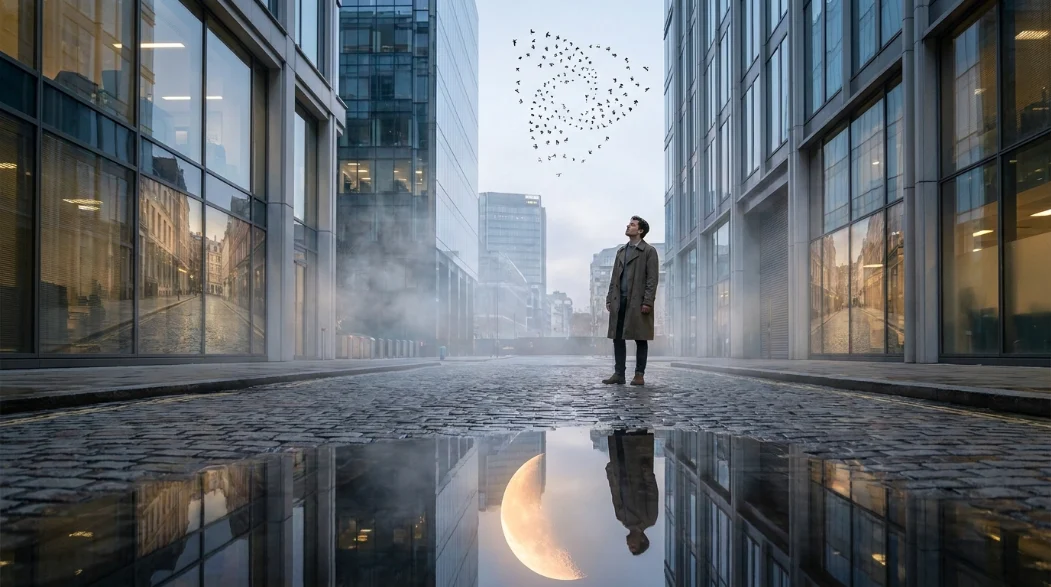
Have you ever experienced a moment that felt too strange, beautiful, or unreal to be true? You may have looked around and thought, “This feels surreal.” The word surreal meaning is closely connected to experiences that seem dreamlike, bizarre, or disconnected from ordinary reality. It can describe a breathtaking scene, an unexpected event, an unusual piece of art, or even a personal moment that feels impossible to process. Understanding the word becomes easier when you see how people actually use it in everyday conversations, writing, and culture.
In this guide, we explore the surreal meaning in simple language, along with its origins, examples, synonyms, antonyms, pronunciation, and common uses. You will also learn the subtle difference between something being merely strange and genuinely surreal.
What Does Surreal Mean?
Surreal is an adjective used to describe something that seems dreamlike, bizarre, strange, or disconnected from normal reality.
In simple words, surreal means so unusual or unexpected that it feels almost like a dream.
Consider this situation:
You walk into a familiar street and find it completely empty during a normally busy festival.
Nothing supernatural has happened. The street is still real. Yet the unusual silence and empty surroundings can make the moment feel surreal.
This is an important part of the word. Surreal does not necessarily mean something is literally unreal. It often describes the feeling created when reality becomes difficult to process.
Surreal Meaning in Simple Words
| Word | Simple meaning |
|---|---|
| Surreal | Dreamlike or strangely unreal |
| Dreamlike | Similar to the feeling of a dream |
| Bizarre | Very unusual or strange |
| Unreal | Not seeming real |
| Absurd | So unreasonable that it seems ridiculous |
| Fantastical | Extremely imaginative or extraordinary |
These words overlap, but they are not identical. A bizarre event can simply be strange, while a surreal event often creates a feeling that reality has somehow become unfamiliar.
What Does It Mean When Something Feels Surreal?
When people say “this feels surreal,” they usually mean that an experience is so unusual, emotional, unexpected, or significant that it does not feel completely real.
For example:
- Winning an award after years of work may feel surreal.
- Meeting a celebrity you have admired for years can feel surreal.
- Returning to your childhood home after decades may feel surreal.
- Watching a city change dramatically after a major event can feel surreal.
- Seeing an unexpected natural phenomenon can feel surreal.
The key idea is the contrast between what is actually happening and how the experience feels inside your mind.
That is why surreal moments are often connected with strong emotions such as excitement, shock, nostalgia, fear, wonder, or disbelief.
Surreal Examples in Everyday Life
You do not need to be looking at strange artwork to experience something surreal. Ordinary life can produce surreal moments too.
A Long-Awaited Achievement
Imagine studying for years and finally walking across a graduation stage.
You know you earned the achievement, but the moment may still feel unreal because you spent so long imagining it.
Example:
“Standing on that stage after everything I went through felt surreal.”
An Unexpected Reunion
Imagine meeting a childhood friend after twenty years without contact.
The person is real, the meeting is real, and the surroundings are ordinary. Still, the combination of memories and present reality can create a dreamlike feeling.
Example:
“Seeing him again after all those years was a surreal experience.”
A Dramatic Change in a Familiar Place
You visit a neighborhood you knew as a child and discover that almost everything has changed.
The streets are familiar, but the buildings, shops, and surroundings look completely different.
Example:
“Walking through my old neighborhood felt surreal.”
An Unusual Natural Scene
Imagine watching the northern lights for the first time. The colors move across the sky in a way that seems almost impossible.
Example:
“The sky looked so surreal that I kept wondering if I was dreaming.”
Surreal Meaning in a Sentence
Here are several natural examples of how surreal can be used:
- “It was surreal to see my name on the big screen.”
- “The empty city looked surreal at midnight.”
- “Meeting my childhood hero felt surreal.”
- “The sunset created a surreal atmosphere.”
- “After years of planning, the wedding day felt surreal.”
- “The painting shows a surreal world filled with impossible images.”
- “Everything happened so quickly that the whole experience felt surreal.”
- “Walking through the abandoned building was strangely surreal.”
Notice that surreal can describe both positive and negative experiences.
Is Surreal a Positive or Negative Word?
Surreal is neither strictly positive nor negative. Its meaning depends on the situation.
A surreal moment can be:
Positive
- “Winning the competition was surreal.”
- “Watching the sunrise from the mountain was surreal.”
Negative
- “The disaster left the entire city in a surreal state.”
- “The empty hospital felt surreal.”
Neutral or strange
- “The quiet airport at 3 a.m. felt surreal.”
The word mainly communicates a sense of strangeness, unreality, or dreamlike perception. The surrounding context tells the reader how the speaker feels about it.
Surreal vs. Unreal
These words are closely related, but they are not interchangeable in every sentence.
Unreal can mean something is actually not real, or it can express disbelief.
Surreal usually describes something that is real but feels strange, dreamlike, or disconnected from normal experience.
Compare:
“The creature in the movie was unreal.”
This could mean the creature was fictional.
“Seeing the creature-like clouds above the city felt surreal.”
Here, the clouds are real, but their appearance creates an unusual feeling.
A simple distinction is:
Unreal = not real or seemingly impossible.
Surreal = real or imagined in a way that feels dreamlike and strange.
Surreal vs. Bizarre
Bizarre focuses strongly on unusualness.
Surreal focuses more on the strange relationship between reality and perception.
For example, someone wearing an extremely unusual outfit might be described as bizarre.
A normal shopping mall with completely silent crowds, floating-looking architecture, strange lighting, and an unfamiliar atmosphere might be described as surreal.
Something can be both bizarre and surreal, but the words emphasize different qualities.
Surrealism and the Meaning of Surreal
The word surreal is closely connected to surrealism, an artistic and cultural movement that became prominent in the early twentieth century.
Surrealist artists and writers explored dreams, the subconscious mind, unexpected combinations, and ideas that challenged ordinary logic.
One famous example is Salvador Dalí’s The Persistence of Memory, known for its melting clocks and dreamlike landscape.
The movement was strongly associated with André Breton, whose writings helped define surrealism as an artistic and literary approach.
However, surreal and surrealism should not be treated as exactly the same thing.
- Surreal is a descriptive adjective.
- Surrealism refers to a specific artistic and literary movement as well as its broader ideas.
- Surrealist describes a person, work, or style associated with surrealism.
You can call a modern photograph surreal without calling it a work of historical surrealism.
What Makes Something Feel Surreal?
Several elements can make an experience or scene feel surreal.
1. Unexpected Contrast
Something ordinary becomes strange when it appears in an unexpected setting.
A child holding an umbrella in the middle of a completely dry desert might create a surreal image.
2. Dreamlike Atmosphere
Soft light, unusual landscapes, fog, reflections, distorted spaces, or unfamiliar surroundings can create a dreamlike quality.
3. Emotional Disconnection
Sometimes the surroundings are ordinary, but your emotional state makes them feel unfamiliar.
A person receiving life-changing news may look around a normal room and suddenly feel as if everything has become distant.
4. Impossible Combinations
Putting familiar things together in an impossible way can create surreal imagery.
For example, a staircase leading into a cloudy sky is physically impossible, but the image immediately communicates a dreamlike idea.
5. Disrupted Expectations
Our brains constantly predict what should happen next. When reality breaks those expectations, the result can feel strange.
This is one reason major life events often produce surreal feelings.
Surreal Feeling vs. Surreal Art
The word has two common uses that are worth separating.
Surreal Feeling
A surreal feeling happens when a real experience feels dreamlike or difficult to process.
Example:
“After hearing the unexpected news, I walked home in a surreal state.”
Surreal Art
Surreal art intentionally creates unusual or dreamlike imagery.
It might combine objects that normally have nothing to do with each other, distort familiar environments, or create scenes that ignore ordinary physical rules.
The first describes a personal experience. The second describes an artistic style or effect.
Surreal Meaning in Different Contexts
The meaning can shift slightly depending on where the word appears.
| Context | What surreal usually suggests | Example |
|---|---|---|
| Everyday conversation | Hard to believe or strangely real | “It feels surreal.” |
| Emotional experience | Overwhelming or dreamlike | “The moment was surreal.” |
| Photography | Unusual visual atmosphere | “The photograph has a surreal quality.” |
| Film | Dreamlike or reality-bending scenes | “The movie becomes surreal.” |
| Literature | Strange imagery or disrupted reality | “The novel creates a surreal world.” |
| Art | Imagery influenced by surrealism or dream logic | “It is a surreal painting.” |
| Social media | An extraordinary or unbelievable moment | “This whole day feels surreal.” |
Why Do People Say “It Feels Surreal”?
The phrase “it feels surreal” has become especially common when people experience major moments.
There is a useful reason for this.
Human beings build expectations from repeated experience. Most days follow familiar patterns. We wake up, travel, work or study, communicate with others, eat, rest, and repeat familiar routines.
A major event interrupts that pattern.
The mind recognizes that the event is real, but the emotional response may take longer to catch up. That gap can produce the feeling people describe as surreal.
For instance, someone may spend years dreaming about moving abroad. On the day they finally arrive, they might look around their new city and say:
“I can’t believe I’m actually here. This feels surreal.”
The statement does not necessarily mean they think they are dreaming. It means the reality of the moment feels unusually difficult to absorb.
Surreal Meaning in Writing
Writers often use surreal to create atmosphere without explaining every detail.
Instead of writing:
“The place felt strange and unfamiliar.”
A writer might say:
“The empty hotel had a surreal silence.”
The second version creates a stronger mood.
Surreal language works particularly well in:
- Fiction
- Poetry
- Creative nonfiction
- Personal essays
- Film reviews
- Travel writing
- Descriptive writing
- Photography captions
It can help readers imagine a scene that feels familiar and unfamiliar at the same time.
How to Use “Surreal” Naturally
Use surreal when you want to communicate more than simple strangeness.
A useful test is:
Does the situation feel dreamlike, strangely unreal, or difficult to process as normal reality?
If yes, “surreal” may be a good choice.
Natural combinations
Some common phrases include:
- surreal experience
- surreal moment
- surreal feeling
- surreal atmosphere
- surreal scene
- surreal world
- surreal image
- surreal situation
- surreal dream
- surreal reality
For example:
“The sudden silence created a surreal atmosphere.”
“Seeing my childhood home again was a surreal experience.”
These combinations sound natural because they connect the word with experiences or settings that can carry a dreamlike quality.
Can Surreal Describe Something Beautiful?
Yes.
Surreal does not automatically mean ugly, frightening, or negative.
A beautiful landscape can be surreal if it looks so extraordinary that it seems impossible.
For example:
“The mountains reflected perfectly in the still lake, creating a surreal scene.”
Here, surreal communicates beauty mixed with unreality.
This is common in travel writing, photography, cinema, and descriptions of unusual natural phenomena.
Can Surreal Describe Something Scary?
Yes.
A dark or unsettling situation can also feel surreal.
For example:
“The deserted amusement park looked surreal in the fog.”
The scene is not necessarily supernatural. Its unusual combination of familiar objects and strange surroundings creates a dreamlike, unsettling effect.
This makes surreal useful for horror, psychological fiction, mystery, and suspense.
Common Synonyms for Surreal
The best synonym depends on the exact meaning you want.
- Dreamlike: emphasizes similarity to a dream
- Unreal: emphasizes a lack of apparent reality
- Bizarre: emphasizes unusualness
- Strange: broad and neutral
- Absurd: emphasizes irrationality or ridiculousness
- Fantastical: emphasizes imagination
- Otherworldly: suggests something beyond ordinary experience
- Eerie: emphasizes an unsettling atmosphere
- Extraordinary: emphasizes something far beyond the ordinary
“Dreamlike” is often the closest simple replacement, but it cannot replace “surreal” in every context.
Frequently Asked Questions
What is the simplest meaning of surreal?
Surreal means strangely dreamlike or unreal-feeling. It describes something so unusual that it seems difficult to connect with ordinary reality.
What does “this feels surreal” mean?
“This feels surreal” means an experience feels unusually strange, dreamlike, unbelievable, or difficult to process, even though the event may be completely real.
Is surreal the same as unreal?
No. Unreal can mean something is not real. Surreal usually describes something that feels dreamlike, strange, or disconnected from normal reality.
Is surreal a positive word?
Surreal can be positive, negative, or neutral. A beautiful achievement and an unsettling event can both be described as surreal.
What is an example of a surreal experience?
Winning an important award after years of hard work can feel surreal because the achievement is real, but the moment may seem dreamlike after imagining it for so long.
What is the difference between surreal and bizarre?
Bizarre mainly means very strange or unusual. Surreal suggests a stronger sense of dreamlike unreality or a break from ordinary perception.
What is surrealism?
Surrealism is an artistic and literary movement associated with dream imagery, the subconscious, unexpected combinations, and challenges to conventional logic.
Can a real event be surreal?
Yes. In fact, many everyday uses of surreal describe real events. A major achievement, unexpected reunion, dramatic change, or extraordinary natural scene can all feel surreal.
How do you use surreal in a sentence?
You can use it to describe a dreamlike or unusually strange experience: “Standing in the empty stadium after the final match felt surreal.”
Final Thoughts on Surreal Meaning
The easiest way to remember surreal meaning is this: something can be completely real but still feel like a dream.
That is what gives the word its power. Surreal describes the strange space between reality and perception. It can capture the excitement of a life-changing achievement, the beauty of an extraordinary landscape, the discomfort of an unfamiliar situation, or the dreamlike quality of a piece of art.
When you use surreal, you are usually telling the reader more than “this is strange.” You are suggesting that the experience feels so unusual, unexpected, or emotionally powerful that ordinary reality seems temporarily unfamiliar.
Read More Related Articles:
- Seychelles Meaning | What the Name Really Represents, Its …
- Humility Meaning | The Quiet Strength Behind Confidence …
- Demisexual Meaning | What It Really Means to Feel Attraction …
