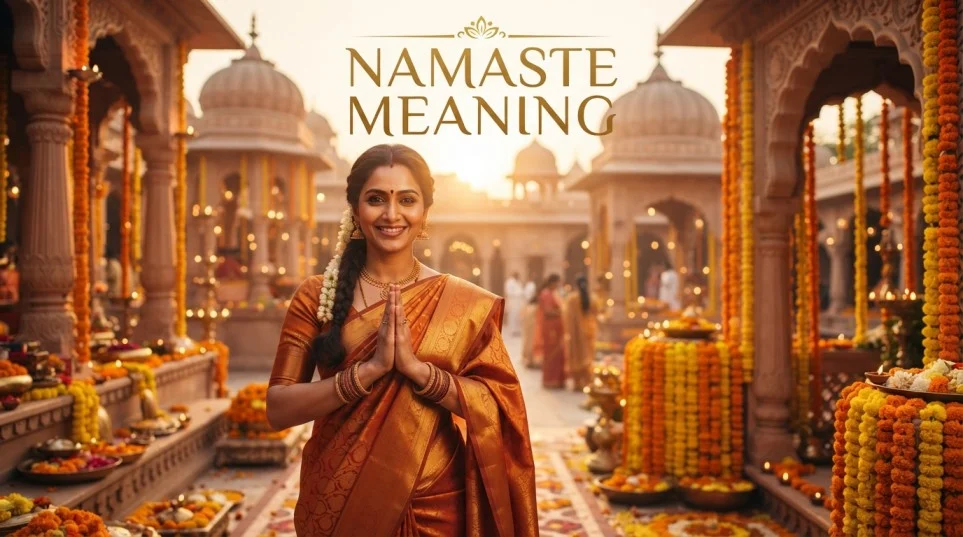
The namaste meaning is commonly understood as “I bow to you” or “I bow to you with respect.” It comes from Sanskrit and is formed from namas, meaning a bow, salutation, or respectful gesture, and te, meaning “to you.” In everyday use, namaste is a respectful greeting commonly associated with India, Nepal, and other South Asian cultural settings.
You may hear someone say namaste when greeting another person, meeting an elder, welcoming a guest, finishing a formal interaction, or showing respect. The familiar gesture involves bringing the palms together near the chest and slightly bowing the head.
But there is more to the word than a simple translation. Its meaning changes slightly with context, relationship, tone, and cultural setting. Understanding that difference makes it easier to use namaste naturally and respectfully.
What Does Namaste Mean?
At its simplest, namaste means “I bow to you” or “salutations to you.”
It is traditionally connected with the Sanskrit expression namas te:
- Namas = bow, salutation, reverence, respectful acknowledgment
- Te = to you
Together, the expression conveys a respectful acknowledgment of another person.
In everyday conversation, however, people do not normally stop to translate the word literally. Namaste functions as a greeting, much like saying hello, greetings, or respectful salutations, depending on the situation.
For example:
“Namaste, Auntie. It is good to see you.”
Here, the speaker is not making a philosophical statement. They are simply greeting the person respectfully.
That distinction is important because many modern explanations give namaste an elaborate spiritual meaning that is not always part of ordinary conversation.
Namaste Meaning in English
There is no single English word that captures every use of namaste perfectly.
Common translations include:
- I bow to you
- Greetings to you
- Salutations
- I respectfully greet you
- My respects to you
The literal translation and everyday meaning are slightly different.
“I bow to you” explains the structure and traditional sense of the Sanskrit expression. “Hello” can describe its practical function in an everyday greeting.
Think of it this way:
| Context | Natural interpretation |
|---|---|
| Meeting someone | Hello / greetings |
| Greeting an elder | Respectful greeting |
| Formal introduction | Salutations / greetings |
| Showing reverence | I bow to you |
| Traditional setting | A respectful salutation |
| Yoga or spiritual setting | A respectful closing or greeting |
The surrounding situation tells you how the word should be understood.
What Is the Literal Meaning of Namaste?
The literal meaning comes from the Sanskrit components namas and te.
Namas is related to bowing, bending, or offering a respectful salutation. Te means “to you.”
So the expression can be understood as:
“A bow to you.”
This is more precise than saying that namaste simply means “hello.”
At the same time, literal meaning does not always equal everyday meaning. English expressions have the same pattern. For instance, “goodbye” has a historical meaning that modern speakers do not consciously think about every time they say it.
Namaste works similarly. Its linguistic roots carry a deeper sense of respectful acknowledgment, while ordinary speakers may simply use it as a greeting.
Namaste Meaning in Sanskrit
The Sanskrit background is central to understanding the word.
Namaste is commonly analyzed as namas + te.
The element namas is associated with bowing, paying respect, or making a salutation. The pronoun te means “to you.”
This gives the expression its basic sense of directing respect toward another person.
The word is closely connected to the broader Sanskrit tradition of expressing respect through words and physical gestures.
It is also important to avoid treating every modern explanation of namaste as an exact Sanskrit translation. Statements such as “the divine in me honors the divine in you” are popular in modern spiritual and yoga communities, but they are best understood as a spiritual interpretation, not the straightforward literal translation of the word.
That difference makes the explanation more accurate.
Why Do People Say Namaste?
People say namaste for several reasons, depending on their culture and situation.
1. As a Greeting
Namaste can be used when meeting someone.
For example:
“Namaste, how are you?”
In this situation, it works as a greeting.
2. To Show Respect
Namaste can carry a respectful tone, particularly when addressing elders, teachers, guests, or people in formal settings.
The gesture can reinforce that feeling of respect.
3. In Traditional or Cultural Settings
You may encounter namaste during cultural ceremonies, traditional events, religious settings, or formal introductions.
Its use can communicate courtesy without requiring physical contact.
4. In Yoga and Meditation
Many people outside South Asia became familiar with namaste through yoga classes.
A teacher may say namaste at the end of a class as a respectful closing. However, this modern yoga usage does not represent every traditional South Asian use of the word.
5. As a Non-Contact Greeting
The palms-together gesture can communicate warmth and respect without a handshake or physical contact.
This has made the gesture recognizable internationally.
What Does the Namaste Hand Gesture Mean?
The familiar namaste hand gesture involves bringing both palms together, usually in front of the chest, with the fingers pointing upward.
A slight bow of the head may accompany the gesture.
The gesture is often associated with:
- Respect
- Greeting
- Courtesy
- Humility
- Acknowledgment
- Peaceful interaction
The exact posture can vary by person and context.
It is also important to distinguish the everyday greeting from Anjali Mudra, a broader yogic and Indian gesture involving joined palms. The two are closely associated in modern usage, but they are not automatically identical in every cultural or historical context.
How Do You Say Namaste?
The pronunciation is generally close to:
nuh-muh-stay
You may also hear pronunciations that sound closer to:
na-mah-stay
Regional pronunciation can vary.
The final part sounds similar to “stay” in English, although natural pronunciation may differ depending on the speaker’s language and accent.
If you are using the word in conversation, a simple and natural pronunciation is more important than trying to produce an exaggerated accent.
How to Use Namaste in a Sentence
Namaste is easy to use when the context calls for a respectful greeting.
Casual Example
“Namaste! How have you been?”
Greeting an Elder
“Namaste, Grandma. It is lovely to see you.”
Meeting a Teacher
“Namaste, sir. Thank you for having me.”
Cultural Event
“She welcomed the guests with a warm namaste.”
Yoga Setting
“The instructor ended the class with a quiet namaste.”
These examples show how the same word can feel casual, respectful, formal, or reflective depending on the situation.
Is Namaste a Religious Greeting?
Namaste can appear in religious and spiritual contexts, but it is not limited to religion.
People may use it as an everyday greeting without intending a religious message.
It can also appear in Hindu, Buddhist, Jain, yoga, meditation, and other South Asian cultural environments, although the specific meaning and importance can vary.
This is why describing namaste as simply “a Hindu word” can be too narrow.
It has a broader linguistic and cultural history, and its everyday use can be secular.
Is Namaste a Hindu Word?
Namaste has Sanskrit roots and has a long association with Indian religious and cultural traditions, including Hindu contexts.
However, its use is not restricted to Hindus.
People from different religious backgrounds may use namaste as a cultural greeting or respectful salutation. It is also common in Nepal and can be encountered in many South Asian settings.
So a more useful explanation is:
Namaste is a Sanskrit-derived South Asian greeting with strong cultural and traditional associations, including Hindu contexts, but its everyday use is not limited to one religion.
Is Namaste Used in Nepal?
Yes.
Namaste is widely recognized and used in Nepal as a respectful greeting. You may hear it when people meet, welcome guests, or interact politely.
Nepali culture also has other forms of respectful greetings and salutations, so namaste should not be treated as the only traditional greeting in Nepal.
The same word can also appear in tourism, international communication, and formal settings.
Namaste vs. Namaskar
Namaste and namaskar are closely related terms and can both function as respectful greetings.
In everyday English discussions, they are often treated as interchangeable.
However, their usage can vary by region, language, community, formality, and personal preference.
A simple comparison is:
| Namaste | Namaskar |
|---|---|
| Common respectful greeting | Common respectful greeting |
| Widely recognized internationally | Strongly associated with Indian languages and traditions |
| Often heard in casual and cultural settings | Can have a more formal or traditional feel |
| Familiar through yoga and global culture | Common in several South Asian linguistic contexts |
The distinction is not absolute. Local usage matters.
Namaste vs. Pranam
Pranam is another respectful South Asian expression connected with bowing or paying respects.
The terms overlap in the broader idea of showing respect, but they are not simply identical words.
Namaste commonly works as a greeting.
Pranam can carry a stronger sense of paying respects, especially toward elders, teachers, or revered people, depending on the regional and cultural context.
For someone learning the vocabulary, the easiest approach is to understand both as respectful expressions while remembering that their use can vary across communities.
Does Namaste Mean Hello or Goodbye?
Namaste is primarily recognized as a greeting, but it can also be used when ending an interaction in some contexts.
Its use as a closing is particularly familiar to people who encounter it through yoga or spiritual settings.
So if someone asks:
“Does namaste mean hello or goodbye?”
The most accurate short answer is:
It can function as a respectful greeting and, in some contexts, a respectful farewell. Its exact use depends on the situation.
It is not necessary to force it into only one English category.
What Is the Spiritual Meaning of Namaste?
The spiritual meaning associated with namaste often goes beyond its basic linguistic meaning.
A popular modern interpretation is that namaste expresses recognition of something sacred or divine within another person.
You may encounter phrases such as:
“The divine in me honors the divine in you.”
This idea is common in modern yoga and spiritual writing.
However, it should be presented as an interpretive or spiritual explanation, not as the literal dictionary translation of namaste.
The basic linguistic sense remains connected to bowing, salutation, and respectful acknowledgment.
That distinction helps separate traditional language from modern spiritual interpretation.
What Does Namaste Mean in Yoga?
In yoga, namaste is often used at the end of a class.
A teacher may bring their palms together, bow slightly, and say namaste. Students may respond in the same way.
In this setting, the word can create a moment of respectful closure after practice.
For many yoga practitioners, it represents gratitude, acknowledgment, or mutual respect.
Still, yoga traditions are diverse. Not every teacher or school uses namaste, and its use in contemporary yoga should not be assumed to represent all historical South Asian practices.
What Is the Proper Response to Namaste?
There is no complicated response required.
You can simply say:
“Namaste.”
You can also return the accompanying gesture by bringing your palms together and slightly bowing your head.
In a casual situation, a person may simply respond verbally.
For example:
Person A: “Namaste.”
Person B: “Namaste. It is nice to meet you.”
The goal is respectful communication, not perfect performance.
Is It Appropriate for Anyone to Say Namaste?
Namaste is a widely recognized greeting, and people outside South Asia may encounter and use it in cultural, travel, yoga, or interpersonal settings.
The important point is context and respect.
Using a cultural greeting sincerely is very different from exaggerating the gesture, using an accent for entertainment, or treating the culture behind the word as a costume.
If you are visiting India or Nepal, learning a few local greetings can be a thoughtful way to communicate. At the same time, local language preferences vary, so observing how people around you communicate is often the simplest guide.
Common Misunderstandings About Namaste
Several popular claims about namaste are repeated online without enough context.
“Namaste Only Means Hello”
Not quite.
It can function as a greeting, but its linguistic roots carry the sense of salutation, bowing, and respect.
“Namaste Always Means the Divine in Me Honors the Divine in You”
This is a popular spiritual interpretation, especially in modern yoga culture.
It should not be presented as the literal translation.
“Namaste Is Only Religious”
Not necessarily.
It can be used in religious settings, but it can also function as a cultural or everyday respectful greeting.
“Namaste Is Only Used in India”
No.
It is also used and recognized in Nepal and appears across wider South Asian cultural contexts.
“The Gesture Has Only One Meaning”
The palms-together gesture can communicate different things depending on the situation. Context, posture, relationship, and setting all matter.
Namaste in Modern Global Culture
Namaste has traveled far beyond the regions where it originated.
Today, people may encounter the word on:
- Yoga studio signs
- Wellness websites
- Meditation programs
- Travel content
- Clothing and artwork
- Restaurants
- Cultural events
- Social media
- International greetings
This global popularity has made the word familiar to millions of people who have never used it in a South Asian setting.
That popularity has also created some confusion.
Modern wellness culture sometimes gives namaste highly specific spiritual meanings that are not identical to its basic Sanskrit sense. A good explanation should keep those ideas separate rather than presenting every modern interpretation as historical fact.
Why the Namaste Gesture Feels So Distinctive
The gesture is visually simple.
Two hands come together. The body becomes still. The head may lower slightly.
There is no handshake, hug, or elaborate movement.
That simplicity can make the gesture feel formal and intentional.
It also creates a clear social signal: I acknowledge you respectfully.
This is one reason namaste has remained recognizable even as it has entered international culture.
Examples of Namaste in Real Conversations
Here are some natural examples.
Example 1: Meeting an Elder
“Namaste, Uncle. How are you?”
The word carries a respectful tone.
Example 2: Meeting Someone for the First Time
“Namaste. My name is Sara. It is nice to meet you.”
Here it works much like a polite greeting.
Example 3: At a Cultural Event
“The host greeted everyone with namaste.”
This describes the gesture and the greeting together.
Example 4: At a Yoga Class
“The teacher smiled, brought her palms together, and said namaste.”
Here the word functions as part of the class’s closing ritual.
Example 5: In Writing
“He folded his hands in namaste before entering the temple.”
In this sentence, the word communicates both the gesture and the respectful context.
Namaste Meaning at a Glance
| Question | Short Answer |
|---|---|
| What does namaste mean? | A respectful salutation or greeting |
| What does namaste literally mean? | “I bow to you” or “salutations to you” |
| What language does namaste come from? | Sanskrit |
| What does te mean? | “To you” |
| What does namas mean? | Bowing, salutation, or respectful acknowledgment |
| Is namaste religious? | It can be used in religious settings, but it is not exclusively religious |
| Is namaste used in Nepal? | Yes |
| How do you respond to namaste? | You can simply say “namaste” back |
| What is the hand gesture? | Usually palms together near the chest, sometimes with a slight bow |
| Is namaste used in yoga? | Yes, particularly as a greeting or closing in some yoga settings |
| Does namaste mean hello? | It can function as a greeting equivalent to hello in context |
How to Remember the Meaning of Namaste
A simple way to remember it is:
Namaste = a respectful greeting rooted in the idea of bowing or offering a salutation to another person.
You do not need to memorize a long spiritual explanation.
Remember three ideas:
Greeting + Respect + Salutation
That captures the central meaning while leaving room for cultural and spiritual contexts.
Frequently Asked Questions
What does namaste mean in simple words?
Namaste is a respectful greeting. Its traditional linguistic sense is connected with the idea of “I bow to you” or “salutations to you.”
What does namaste mean literally?
Namaste is commonly explained through the Sanskrit elements namas and te. Together, they convey the sense of offering a bow or salutation to you.
Is namaste a Hindu word?
Namaste has Sanskrit roots and strong connections with Indian religious and cultural traditions, including Hindu traditions. Its everyday use, however, is not limited to Hindus.
Is namaste a greeting?
Yes. Namaste is widely used as a respectful greeting, particularly in South Asian cultural contexts.
How do you respond when someone says namaste?
You can simply say “Namaste” in return. You may also bring your palms together and give a slight bow if the situation calls for the gesture.
What does the namaste hand gesture mean?
The palms-together gesture generally communicates greeting, respect, courtesy, or acknowledgment. Its exact meaning depends on the cultural and social context.
Does namaste mean hello or goodbye?
Namaste is primarily used as a greeting, but it can also serve as a respectful farewell in some contexts, particularly in spiritual or yoga settings.
What is the difference between namaste and namaskar?
Both can function as respectful greetings, but their usage varies by region, language, community, and context. They should not always be treated as perfectly interchangeable.
What does namaste mean in yoga?
In yoga, namaste is often used at the end of a class as a respectful closing. Some teachers use it to express gratitude or acknowledgment, while others do not use it at all.
Is “the divine in me honors the divine in you” the real meaning of namaste?
That phrase is a popular modern spiritual interpretation. It is not the straightforward literal translation of the Sanskrit word. The basic linguistic sense relates to bowing, salutation, and respectful acknowledgment.
Final Takeaway
The namaste meaning is best understood as a respectful salutation or greeting, traditionally connected with the Sanskrit idea of bowing to or offering respect to another person.
Its everyday use can be as simple as saying hello. Its traditional context can carry a stronger sense of respect and acknowledgment. In yoga and modern spirituality, additional symbolic interpretations are common, but they should be distinguished from the word’s basic linguistic meaning.
The most useful way to understand namaste is not to reduce it to one English word. It is a greeting shaped by language, culture, gesture, and context.