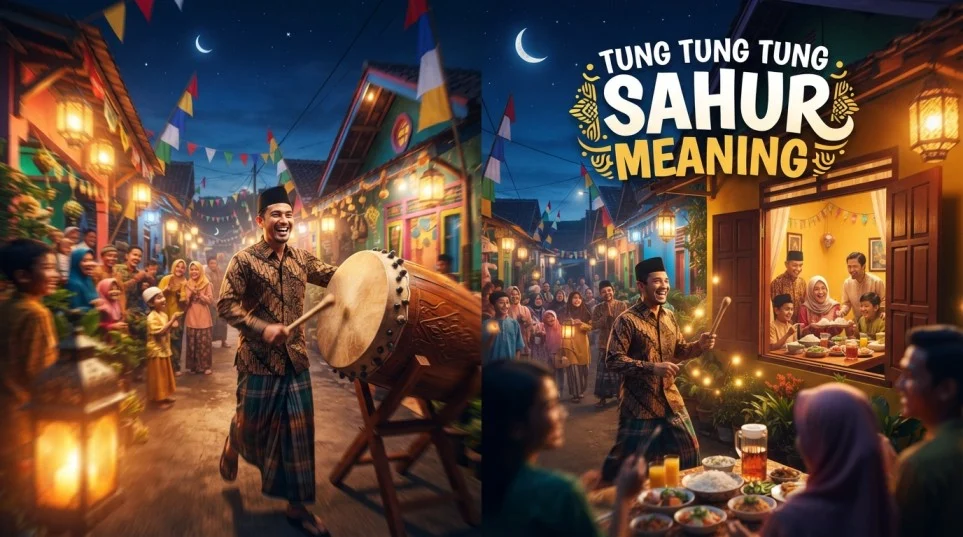
If you have seen “Tung Tung Tung Sahur” on TikTok, YouTube Shorts, or other social platforms, the phrase can sound completely random at first. It is actually connected to sahur, the pre-dawn meal eaten during Ramadan, and to the sound of percussion traditionally used in parts of Indonesia and Malaysia to wake people before dawn.
The viral meme came later. In February 2025, an AI-generated wooden creature called Tung Tung Tung Sahur, also nicknamed Triple T, appeared on Indonesian TikTok and turned an existing Ramadan wake-up phrase into an absurd internet character.
This guide separates the real cultural meaning from the fictional meme lore, so the phrase makes sense instead of looking like meaningless internet slang.
What Does Tung Tung Tung Sahur Mean?
“Tung Tung Tung Sahur” is essentially a rhythmic call to wake people for sahur.
The phrase has two important parts:
| Part | Meaning |
|---|---|
| Tung tung tung | An imitation of a repeated drum or wooden percussion sound |
| Sahur | The pre-dawn meal Muslims eat before beginning the day’s Ramadan fast |
| Tung Tung Tung Sahur | A rhythmic wake-up call meaning, roughly, “Wake up, it’s time for sahur” |
The repeated “tung” is not best understood as a normal English word with a dictionary definition. It works more like onomatopoeia, where a word imitates a sound.
In Indonesian and Malaysian cultural contexts, percussion instruments such as the bedug and wooden instruments such as the kentongan have been used in community settings, including signals connected with prayer times and Ramadan.
So when someone writes:
Tung tung tung… sahur!
the idea is much closer to a rhythmic knock-knock-knock, sahur! than to a sentence that needs a literal English translation.
What Does “Sahur” Mean?
Sahur, also spelled suhoor or suḥūr, refers to the meal eaten before dawn during Ramadan.
Muslims observing the Ramadan fast eat this meal before the fasting period begins for the day.
That cultural meaning matters because it explains why a drum-like sound is connected with the phrase.
Imagine a quiet neighbourhood before sunrise. Someone makes a repeated percussion sound to wake people. The sound announces that it is time to get up and eat before the day’s fast begins.
That is the basic idea behind the phrase.
The later meme takes this ordinary wake-up concept and turns it into something deliberately strange.
Why Does “Tung Tung Tung” Sound Like a Drum?
The simplest explanation is sound imitation.
“Tung tung tung” represents repeated percussion. It is similar to how English speakers might write sounds such as “knock knock” or “ding ding.”
The exact instrument and local practice can vary across communities. Sources describing the meme commonly connect its sound to Indonesian and Malaysian Ramadan traditions involving drums or wooden percussion used to signal or wake people for sahur.
This is an important distinction:
“Tung tung tung” is not the Indonesian word for “drum.”
It is a written representation of the sound.
That small difference makes the phrase much easier to understand.
Is Tung Tung Tung Sahur an Indonesian Phrase?
Yes, the phrase has an Indonesian cultural context, and the viral meme itself originated on Indonesian TikTok.
The phrase existed before the AI character became popular. Know Your Meme documents an online use dating back to July 13, 2013, years before the 2025 meme appeared.
That means the viral character did not invent the phrase itself.
Instead, the meme creators took a phrase associated with waking people for sahur and transformed it into an internet character.
This distinction is useful because many people encounter the meme first and assume the entire expression was invented as part of the brainrot trend.
It wasn’t.
Where Did the Tung Tung Tung Sahur Meme Come From?
The viral character emerged in February 2025.
According to Know Your Meme’s documented timeline, TikTok creator @noxaasht posted an AI-generated image/video of the character on February 28, 2025. The character appeared as an anthropomorphic wooden figure carrying a baseball bat, accompanied by an Indonesian voice-over.
The character was presented as a strange, scary creature that appears around sahur time.
The fictional story added an extra layer to the traditional wake-up call:
If someone was called for sahur three times and failed to respond, the creature supposedly came to their house.
That story is meme lore, not a religious teaching or traditional Islamic belief.
The original TikTok reportedly accumulated more than 31 million views and 2.4 million likes within a month, helping the character move rapidly beyond its initial audience.
Who Is the Tung Tung Tung Sahur Character?
The character is often called Triple T.
Visually, it is generally portrayed as a strange wooden humanoid creature with a stick-like body and a baseball bat or club.
Its design connects with the meme’s sound-based concept. The character looks like a physical embodiment of the wooden percussion sound behind the phrase.
Know Your Meme describes it as an AI-generated anthropomorphic wooden creature and places it within the broader Italian Brainrot / AI meme ecosystem, although its language and cultural concept are Indonesian.
That combination is part of the joke:
a real cultural reference + AI imagery + absurd character lore + internet meme culture.
Is Tung Tung Tung Sahur an Italian Brainrot Meme?
This needs a little clarification.
Tung Tung Tung Sahur is commonly grouped with Italian Brainrot memes, but the character itself is Indonesian in language and cultural context.
The Italian Brainrot label refers to a broader 2025 internet meme style involving bizarre AI-generated characters, unusual names, synthetic voices, exaggerated stories, and intentionally nonsensical humor.
Characters such as Tralalero Tralala and Bombardiro Crocodilo belong to that broader meme ecosystem. Tung Tung Tung Sahur entered the same ecosystem even though its name and central cultural reference come from Indonesia.
So saying simply “it is an Italian phrase” would be misleading.
A better description is:
Tung Tung Tung Sahur is an Indonesian meme character that became part of the wider Italian Brainrot-style internet culture.
What Is the Story Behind the Meme?
The meme’s fictional story is intentionally simple and ridiculous.
The basic version goes like this:
- It is time for sahur.
- Someone calls you to wake up.
- The call is associated with the repeated tung tung tung sound.
- You ignore the call.
- You supposedly get called three times.
- If you still do not respond, Tung Tung Tung Sahur comes to your house.
That last part is where the ordinary Ramadan wake-up concept turns into absurd horror comedy.
It works because the character transforms something familiar into something exaggerated.
A normal wake-up call becomes a monster.
A drum sound becomes a creature.
A Ramadan routine becomes brainrot lore.
That contrast is the heart of the joke.
Is the Tung Tung Tung Sahur Monster Real?
No. The viral monster is fictional.
The AI-generated wooden character is an internet meme, not a real creature and not a supernatural figure established by Islam.
The original meme’s scary story was presented as humorous fictional lore. The idea that the character comes to your home if you ignore three calls is part of the joke.
This distinction matters because someone unfamiliar with Indonesian culture or Ramadan might encounter the meme without knowing where the original phrase came from.
The sahur tradition is real.
The Tung Tung Tung Sahur monster is meme fiction.
Tung Tung Tung Sahur vs. Real Sahur Tradition
The easiest way to understand the meme is to separate these two layers.
| Real cultural element | Internet meme element |
|---|---|
| Sahur is a pre-dawn Ramadan meal | Tung Tung Tung Sahur is a fictional character |
| Communities may use percussion as a wake-up signal | The percussion sound becomes the character’s name |
| The wake-up call happens before dawn | The meme turns it into absurd horror |
| Ramadan is a religious observance | The monster story is fictional entertainment |
| “Tung tung” imitates percussion | The character is an AI-generated wooden creature |
The meme borrows from something recognizable and then exaggerates it.
That is why the joke can feel confusing if you only see the character without understanding sahur.
Why Did Tung Tung Tung Sahur Become So Popular?
Several things came together at exactly the right time.
1. The name is instantly recognizable
“Tung Tung Tung Sahur” has a strong rhythm.
The repetition makes it easy to remember, quote, remix, and turn into audio.
2. The character is visually strange
A wooden creature carrying a baseball bat is unusual enough to stop someone while scrolling.
Internet memes often benefit from images that can be understood in a second.
This character does that.
3. It connects to a real cultural idea
The meme is not built from completely random material.
The audience can connect the sound to waking up for sahur, giving the absurd character a simple narrative foundation.
4. AI made variations easy
Once the character became recognizable, creators could place it in different situations and generate new versions.
That helped the meme travel across TikTok and other platforms.
5. Brainrot culture rewards repetition
The phrase itself is almost designed for meme culture.
Say it once and it sounds unusual.
Say it three times and it becomes the joke.
The repetition is part of the entertainment.
How Do People Use “Tung Tung Tung Sahur” Online?
People generally use the phrase in a few different ways.
As a meme reference
Someone might simply comment:
“Tung tung tung sahur!”
The phrase can work as a reference to the character without requiring a complete sentence.
As a reaction
A creator may add the sound or character to a video involving someone sleeping, waking up late, or being difficult to get out of bed.
As a joke about Ramadan
During Ramadan-related content, the phrase can be used as a playful reference to waking up for sahur.
As brainrot humor
The phrase can also appear completely outside its original context.
That is common with viral memes. Once a phrase becomes recognizable, users may use it simply because the sound itself is funny.
What Does Tung Tung Tung Sahur Mean in English?
There is no perfect one-word English translation.
A useful explanation would be:
“Tung tung tung” imitates the sound of repeated percussion, while “sahur” refers to the pre-dawn Ramadan meal. Together, the phrase functions like a rhythmic call telling people to wake up for sahur.
A loose English interpretation could be:
“Knock, knock, knock, it’s time for sahur.”
That is an explanation of the idea, not a literal word-for-word translation.
Is “Tung Tung Tung Sahur” a Religious Phrase?
The phrase has a Ramadan-related cultural context, but the viral monster and its lore are not religious teachings.
“Sahur” itself is an important part of Ramadan practice for Muslims who observe the fast.
The meme simply uses that familiar context as the foundation for comedy.
This is why it is useful to avoid treating every part of the viral meme as part of Islamic tradition.
The wooden monster, baseball bat, scary lore, and AI imagery belong to internet culture, not religious doctrine.
Why Is It Called Triple T?
The character is sometimes called Triple T because of the repeated “T” sound at the beginning of its name:
Tung
Tung
Tung
That gives the meme a short nickname that is easier to type and remember.
“Triple T” is therefore a meme nickname, not a separate Indonesian religious term.
Tung Tung Tung Sahur and AI Meme Culture
One of the most interesting parts of this meme is how quickly a culturally specific phrase was transformed into a globally recognizable digital character.
The original concept combines several layers:
Indonesian culture → Ramadan → sahur → percussion sound → AI image → fictional monster → brainrot meme.
That chain explains why the meme can look completely nonsensical to someone who encounters only the final image.
There is actually a small story underneath it.
And that story is what gives the meme its identity.
What Happened to the Meme After It Went Viral?
The character did not remain limited to the original format.
Creators produced animations, drawings, remixes, reaction memes, battles, dances, songs, and other variations.
For example, later meme formats included baseball-themed edits and other recurring scenarios featuring the character.
By 2026, fan-created versions had also developed outside the original AI format. Know Your Meme documented an AI-free Tung Tung Tung Sahur art trend that began circulating in early 2026, showing how recognizable the character had become as a meme symbol.
This is a useful lesson about internet memes: once a character becomes recognizable, people can reuse the basic visual identity far beyond the original joke.
A Simple Example of the Meme’s Meaning
Imagine someone sleeping through their alarm during Ramadan.
A friend jokes:
“You ignored sahur three times. Triple T is coming.”
Then they add an image of the wooden Tung Tung Tung Sahur character.
The humor comes from combining a real-life situation with the fictional meme lore.
The person is not literally being warned about a supernatural creature.
The joke is simply:
“Wake up for sahur, or the meme monster gets you.”
Common Misunderstandings About Tung Tung Tung Sahur
Misunderstanding 1: “Tung tung” is a normal Indonesian word
Not exactly.
Here, it primarily functions as sound imitation for percussion.
Misunderstanding 2: The monster is an Indonesian religious figure
No.
The monster is a fictional AI-generated meme character.
Misunderstanding 3: The meme created sahur
No.
Sahur is a long-established Ramadan practice. The meme appeared much later.
Misunderstanding 4: The phrase was invented in 2025
The viral character appeared in 2025, but documented online use of the phrase predates the meme by more than a decade.
Misunderstanding 5: Tung Tung Tung Sahur is literally an Italian phrase
No.
The meme became associated with the wider Italian Brainrot trend, but the phrase itself has an Indonesian cultural and linguistic context.
Why the Phrase Works So Well as a Meme
There is something clever about the structure of Tung Tung Tung Sahur.
It already contains a tiny piece of storytelling.
Sound → event → action.
First you hear the repeated percussion.
Then you recognize sahur.
Then you know someone is supposed to wake up.
The meme simply adds a ridiculous character to that sequence.
That makes the joke easy to understand even without a long explanation.
It also gives creators several things to remix: the sound, the character, the story, the Ramadan setting, and the exaggerated monster concept.
Quick Facts About Tung Tung Tung Sahur
| Question | Answer |
|---|---|
| What does it mean? | A rhythmic wake-up call associated with sahur |
| What is sahur? | The pre-dawn meal during Ramadan |
| What does “tung tung tung” represent? | Repeated percussion sounds |
| Where is the meme rooted? | Indonesia |
| When did the viral character appear? | February 2025 |
| Who is the character? | An AI-generated wooden meme creature |
| What is its nickname? | Triple T |
| Is the monster real? | No |
| Is the scary story religious teaching? | No |
| Is it connected to Italian Brainrot? | Yes, as part of the broader meme ecosystem |
| Is the original phrase itself new? | No, documented online uses predate the meme |
Frequently Asked Questions
What does Tung Tung Tung Sahur mean?
It refers to a rhythmic wake-up call connected with sahur, the pre-dawn meal during Ramadan. “Tung tung tung” imitates repeated percussion sounds, while “sahur” identifies the meal.
What does Tung Tung Tung Sahur mean in English?
A natural explanation is “knock, knock, knock, it’s time for sahur.” It is an interpretation of the phrase rather than a strict word-for-word translation.
Who created Tung Tung Tung Sahur?
The viral AI character is credited to Indonesian TikTok creator @noxaasht, who posted the character on February 28, 2025, according to Know Your Meme’s documented timeline.
Is Tung Tung Tung Sahur a real creature?
No. The wooden creature is a fictional AI-generated meme character.
Why does Tung Tung Tung Sahur have a baseball bat?
The bat is part of the character’s meme design. It helps create the exaggerated, slightly threatening appearance used in the fictional story.
Is Tung Tung Tung Sahur related to Ramadan?
Yes. The meme is built around sahur, the pre-dawn meal during Ramadan, and the tradition of waking people before dawn. The fictional monster itself is not part of Ramadan religious practice.
Is Tung Tung Tung Sahur an Italian Brainrot character?
It is commonly grouped with the wider Italian Brainrot meme ecosystem because of its absurd AI-generated style and circulation alongside other brainrot characters. Its name and cultural reference, however, are Indonesian.
Is “tung tung tung” an Indonesian word?
In this phrase, it is better understood as onomatopoeia, meaning a written imitation of a sound. It represents repeated percussion rather than functioning as a standard word meaning “drum.”
Why is Tung Tung Tung Sahur so popular?
Its popularity comes from a memorable repeated name, an unusual AI-generated character, a simple fictional story, and its connection to the broader brainrot meme culture. The original 2025 TikTok helped push the character into wider circulation.
Final Takeaway
Tung Tung Tung Sahur has two layers of meaning.
The first is cultural: “tung tung tung” imitates a repeated percussion sound associated with waking people for sahur, the pre-dawn Ramadan meal.
The second is internet culture: Tung Tung Tung Sahur became the name of an absurd AI-generated wooden character that appeared on Indonesian TikTok in 2025 and spread through the broader brainrot meme ecosystem.
So if you see the phrase online, it is usually a meme reference, not a mysterious Indonesian expression with a complicated hidden meaning.
The real story behind it is actually simpler: a familiar Ramadan wake-up sound became the identity of one of the internet’s strangest viral characters.