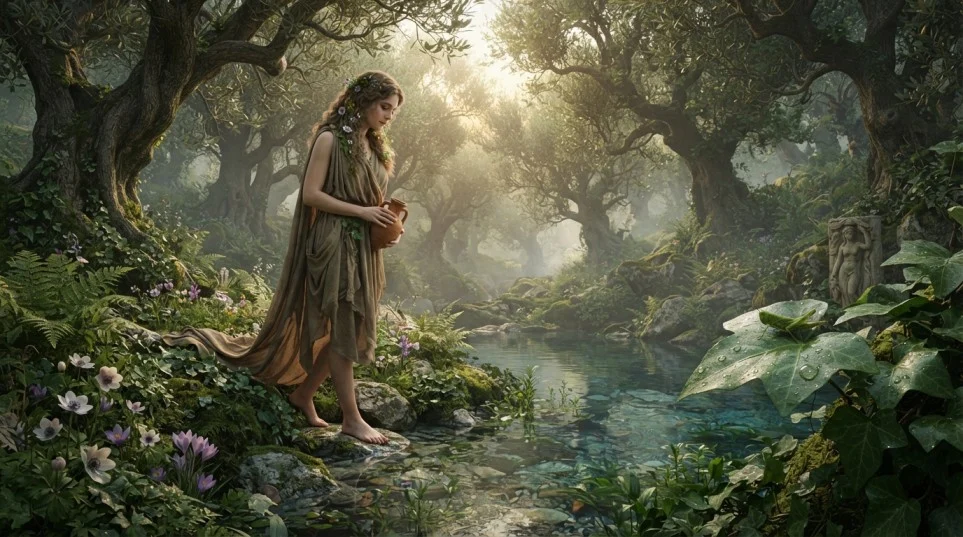
A nymph is a word with two very different meanings. In mythology, a nymph is a supernatural female nature spirit connected with places such as forests, springs, rivers, mountains, trees, and the sea. In biology, a nymph is an immature insect that looks broadly like a smaller version of its adult form but has not yet reached maturity.
The mythological meaning is the one most people encounter in stories about ancient Greece. Greek nymphs were not simply beautiful women living in forests. They were closely tied to the natural world and were often imagined as spirits of particular landscapes or natural features.
The biological meaning belongs to entomology. Grasshoppers, cockroaches, aphids, and some other insects pass through a nymph stage as they develop.
Understanding which meaning is intended makes the word much easier to interpret.
Nymph Meaning in Simple English
In simple English, nymph can mean a nature spirit from ancient mythology or a young insect that has not yet become an adult.
Here is the easiest way to remember the difference:
| Meaning | What it refers to |
|---|---|
| Mythology | A female nature spirit or minor supernatural being |
| Biology | An immature insect that resembles its adult form |
| Common literary use | A beautiful, youthful, nature-associated female figure |
For example:
- Mythology: “The nymph lived beside a sacred spring.”
- Biology: “The insect remained a nymph until its final molt.”
The surrounding words usually tell you which meaning is intended.
What Is a Nymph in Greek Mythology?
In Greek mythology, a nymph is generally a female nature spirit associated with a particular part of the natural world.
Nymphs could be connected with:
- Forests
- Trees
- Springs
- Rivers
- Mountains
- Meadows
- Seas
- Islands
- Caves
They were often described as youthful and beautiful, but their importance went beyond appearance. A nymph represented a living connection between the natural landscape and the supernatural world.
A forest was not simply a collection of trees in many ancient stories. A spring was not merely a source of water. Such places could have a spiritual presence, and nymphs helped give that presence a human form.
This makes the idea of a nymph particularly interesting. The character and the landscape are often closely connected.
What Did Nymphs Represent?
Nymphs were commonly associated with nature, beauty, youth, fertility, water, wilderness, and the life of the landscape.
Their symbolism could change depending on the type of nymph and the story.
For example, a water nymph could symbolize the movement and life-giving quality of water, while a tree nymph could be connected to the life of a particular tree.
This gives nymphs a useful role in literature too. A writer can use a nymph-like character to suggest more than physical beauty. The character may also represent freedom, wilderness, mystery, or a deep relationship with nature.
Were Nymphs Goddesses?
Nymphs and goddesses are not exactly the same.
Greek mythology contains many different kinds of divine and supernatural beings, and nymphs generally occupy a lower level than the major Olympian gods and goddesses.
A nymph could possess supernatural qualities and live for an extremely long time, but that does not automatically make her one of the major gods.
This distinction matters because modern books, films, and games sometimes use the word goddess loosely for powerful female supernatural characters.
In classical mythology, the category of nymph is more specific.
Types of Nymphs in Greek Mythology
Greek mythology includes several groups of nymphs. Their names often reveal the part of nature with which they were associated.
| Type | Association | Simple description |
|---|---|---|
| Dryads | Trees and forests | Tree-associated nymphs |
| Naiads | Fresh water | Springs, rivers, streams, and fountains |
| Nereids | Sea | Sea nymphs associated with the Mediterranean |
| Oceanids | Ocean and bodies of water | Daughters of the ancient water deity Oceanus |
| Oreads | Mountains | Mountain nymphs |
| Hamadryads | Individual trees | Nymphs closely linked to particular trees |
These categories can overlap in broader retellings, so modern descriptions do not always use the terminology with complete consistency.
Dryad Meaning
A dryad is a tree nymph in Greek mythology.
Dryads are especially interesting because their identity is strongly connected to trees and woodland.
In later storytelling, dryads are often portrayed as beautiful female spirits living among trees. Fantasy literature has expanded this idea considerably, but its roots lie in ancient Greek mythology.
Naiad Meaning
A naiad is a freshwater nymph.
Naiads were associated with places such as:
- Springs
- Rivers
- Streams
- Fountains
- Lakes
The association with freshwater gives naiads a different character from sea nymphs.
A story featuring a naiad might use flowing water as part of the character’s identity, atmosphere, or symbolism.
Nereid Meaning
A Nereid is a sea nymph, traditionally associated with Nereus, an ancient sea deity.
Nereids appear in Greek mythology as daughters of Nereus and Doris. One of the best-known Nereids is Thetis, who is the mother of Achilles in Greek mythology.
Oread Meaning
An oread is a mountain nymph.
Oreads are associated with mountainous landscapes, rocky slopes, and wild high places.
The word is useful when a story specifically wants to connect a female nature spirit with mountains rather than forests or water.
Oceanid Meaning
An Oceanid belongs to a large group of water-associated nymphs who were traditionally described as daughters of Oceanus and Tethys.
Oceanids are often connected with bodies of water and natural features associated with water.
They are distinct from Nereids, even though both groups have a strong connection with the sea or water.
Nymph vs Goddess
The terms can sound similar in modern fantasy, but they describe different categories in classical mythology.
| Nymph | Goddess |
|---|---|
| Usually a nature spirit | A major divine figure or deity |
| Often linked to a specific natural place | May rule or influence broad aspects of life or nature |
| Generally lower in divine status | Typically higher divine status |
| Often appears in groups or local traditions | Often has a larger mythological role |
| Examples include dryads and naiads | Examples include Athena, Artemis, and Aphrodite |
The distinction is useful when reading mythology because calling every supernatural female character a goddess can erase important differences between mythological beings.
Are Nymphs Immortal?
The answer is more complicated than simply saying yes or no.
Ancient stories do not treat every nymph in exactly the same way. Some were described as long-lived or deathless, while others could have a much closer relationship with the lifespan of the natural feature they represented.
This is especially important for hamadryads, whose existence was traditionally connected closely with particular trees.
Modern fantasy often gives nymphs complete immortality because it makes storytelling easier. Ancient mythology can be more varied.
Nymphs in Greek Stories
Nymphs appear throughout Greek mythology rather than belonging to a single story.
They can interact with:
- Gods
- Heroes
- Hunters
- Kings
- Other spirits
- Human travelers
Sometimes they help a hero. In other stories, they become objects of desire or are caught in conflicts involving gods and humans.
Their presence often strengthens the connection between the character and the natural environment.
For example, a story about a sacred spring becomes more meaningful when the spring is treated as a place with a supernatural guardian or personality.
Famous Nymphs in Greek Mythology
Several mythological figures are associated with the broader tradition of nymphs.
Echo
Echo is traditionally described as an Oread, or mountain nymph.
Her story is connected with the origin of the phenomenon of an echo. In the myth, she becomes unable to speak freely and can only repeat the words of others.
This is a good example of how mythology can turn a natural phenomenon into a character-driven story.
Calypso
Calypso is traditionally associated with the island of Ogygia and is often described in later sources as a nymph.
She is best known from Homer’s Odyssey, where she keeps Odysseus on her island.
Her story shows how nymphs could occupy a significant role in epic storytelling.
Daphne
Daphne is closely connected with the world of nymphs in Greek mythology and is often described as a naiad or nymph in later traditions.
Her story involves Apollo and her transformation into a laurel tree.
The transformation is particularly important because it connects the character directly to nature.
Thetis
Thetis is one of the Nereids.
She is famous as the mother of Achilles and plays an important role in the mythology surrounding the Trojan War.
Her story demonstrates that a nymph could be an important mythological figure rather than merely a background character.
Nymph Meaning in Biology
In biology, nymph has nothing to do with Greek mythology.
A nymph is an immature stage of an insect that undergoes incomplete metamorphosis.
Instead of passing through a separate larval and pupal stage, these insects develop through several stages that gradually lead to adulthood.
A young grasshopper, for example, can look like a miniature version of an adult grasshopper. It may have a similar body shape but lacks some adult features, such as fully developed wings.
That young stage is called a nymph.
What Is an Insect Nymph?
An insect nymph is a young insect that has not reached its adult form.
Nymphs generally:
- Hatch from an egg.
- Begin feeding and growing.
- Shed their outer covering through molting.
- Become progressively more adult-like.
- Reach adulthood after the final molt.
The exact process differs among insect groups.
Common insects with nymph stages include:
- Grasshoppers
- Crickets
- Cockroaches
- Aphids
- True bugs
- Dragonflies
- Damselflies
Not all insects have nymphs.
Nymph vs Larva
This is one of the most important biological distinctions.
A nymph usually resembles the adult form, while a larva often looks substantially different from the adult.
Consider a butterfly.
A caterpillar is a larva, not a nymph. It looks very different from the adult butterfly and eventually enters a pupal stage before becoming an adult.
A young grasshopper, by contrast, already resembles a grasshopper. It simply has not completed its development.
| Nymph | Larva |
|---|---|
| Usually resembles the adult | Often looks very different from the adult |
| No pupal stage | Many insects later form a pupa |
| Common in incomplete metamorphosis | Common in complete metamorphosis |
| Grows through molts | Develops through larval stages |
| Example: grasshopper | Example: butterfly caterpillar |
This difference makes the biological meaning of nymph much easier to remember.
What Does a Nymph Look Like?
A mythological nymph has no single physical appearance because descriptions vary from one story to another.
Art and literature often portray mythological nymphs as youthful, beautiful women surrounded by natural scenery. This is a traditional artistic interpretation, not a biological description.
An insect nymph is much easier to define physically.
It generally resembles the adult insect but is smaller and less developed.
For example, a young grasshopper may have:
- A similar body shape to the adult
- Developing wings or wing pads
- Similar legs
- Similar feeding behavior
- A smaller body
As it molts, it becomes increasingly similar to the adult.
Why Is the Word Nymph Used for Young Insects?
The biological term comes from the older mythological word.
The connection is largely based on the idea of a young or developing form rather than the insect literally having anything to do with mythology.
Scientific vocabulary often contains words borrowed from mythology, history, Latin, or Greek. Nymph is one example of an old cultural term gaining a specialized scientific meaning.
This is why the same word can appear in a mythology article and an entomology textbook without referring to the same thing.
Nymph Meaning in Literature
Writers sometimes use nymph in a more figurative way.
In literary or poetic contexts, the word can evoke ideas such as:
- Youth
- Beauty
- Nature
- Freedom
- Mystery
- Wilderness
- Grace
- Untamed femininity
For example:
“She moved through the garden like a nymph among the trees.”
Here, the writer is not necessarily claiming that the woman is literally a mythological being. The comparison creates an image of someone graceful, youthful, and closely connected with nature.
This literary use should be understood from context.
Is “Nymph” a Compliment?
It depends on context.
In a literary sentence, calling someone a nymph may suggest beauty, youth, grace, or a strong connection with nature.
In modern everyday conversation, however, the word can sound unusual, old-fashioned, poetic, or suggestive.
The safest interpretation comes from the surrounding language.
For example:
Literary:
“The dancer looked like a woodland nymph.”
This creates a fantasy-like image.
Scientific:
“The researcher observed the nymph under a microscope.”
Here, the word clearly refers to an immature insect.
Nymph Meaning in Modern Fantasy
Modern fantasy has borrowed heavily from Greek mythology and developed the idea of nymphs in new directions.
Books, games, films, and fantasy worlds may portray nymphs as:
- Magical forest beings
- Guardians of nature
- Immortal spirits
- Elemental creatures
- Tree guardians
- Water spirits
- Enchanted women
- Protectors of sacred places
These modern versions can be imaginative, but they should not automatically be treated as descriptions of ancient Greek beliefs.
That distinction is important when researching the historical meaning of the word.
Nymph vs Nature Spirit
The two ideas overlap, but they are not identical.
A nature spirit is a broad category describing a supernatural being associated with nature.
A nymph is a more specific term rooted in ancient Greek mythology and later literary traditions.
So, every nymph can be described as a type of nature spirit, but the phrase nature spirit can refer to many beings outside Greek mythology.
How to Use “Nymph” in a Sentence
Here are examples showing the different meanings.
Mythological Examples
Simple:
The nymph lived near a quiet spring.
Literary:
Moonlight made the forest look like the home of an ancient nymph.
Fantasy:
The woodland nymph guarded the hidden path.
Biological Examples
Simple:
The grasshopper was still a nymph.
Scientific:
The insect passes through several nymphal stages before becoming an adult.
Everyday explanation:
That small insect is a nymph, not a fully grown adult.
Common Confusion About the Word Nymph
The biggest mistake is assuming that nymph always refers to mythology.
It does not.
The word can describe either a mythological nature spirit or an immature insect.
Another common mistake is treating nymphs as identical to fairies. Modern fantasy sometimes blends these ideas, but they come from different traditions.
A third mistake is assuming every nymph is a goddess. Classical mythology generally places nymphs in a different category from the major gods and goddesses.
Nymph vs Fairy
| Nymph | Fairy |
|---|---|
| Strongly associated with Greek mythology | Strongly associated with European folklore |
| Often connected to a natural feature | Can have many different roles |
| Includes dryads, naiads, and other groups | Includes many different folkloric beings |
| Often portrayed as female | Fairies can vary greatly by tradition |
| Strong nature connection | Nature connection varies |
Modern fantasy frequently combines features from both traditions, so fictional portrayals may not follow historical distinctions.
Nymph vs Mermaid
A nymph and a mermaid are also different mythological concepts.
A mermaid is generally imagined as a human-like being with a fish tail.
A nymph is a nature spirit that can be associated with trees, mountains, freshwater, or the sea.
Some sea nymphs, particularly Nereids, may appear in stories involving the ocean, but that does not make them mermaids.
The distinction is mainly one of mythological identity and form.
Why the Nymph Meaning Still Matters Today
The word survives because it works remarkably well across different fields.
- In mythology, it gives nature a personality.
- In literature, it creates an image of beauty and wildness.
- In fantasy, it provides a foundation for magical nature beings.
- In biology, it describes a specific developmental stage in insects.
One word therefore connects ancient mythology, modern storytelling, and scientific terminology.
That is also why context matters so much when searching for the meaning of nymph.
Quick Definition of Nymph
If you need the answer in one sentence:
A nymph is either a female nature spirit in Greek mythology or an immature insect that resembles its adult form and develops through molting.
The mythology meaning is associated with nature and places such as forests, springs, mountains, and seas. The biological meaning describes a stage in the life cycle of insects that undergo incomplete metamorphosis.
FAQs
1. What is the simplest meaning of nymph?
A nymph can mean a nature spirit in Greek mythology or a young insect that has not yet reached adulthood.
2. What does nymph mean in Greek mythology?
In Greek mythology, a nymph is generally a female nature spirit associated with natural places such as forests, trees, springs, rivers, mountains, or the sea.
3. Is a nymph a goddess?
Not usually. Nymphs are supernatural nature beings, but they are generally distinguished from the major gods and goddesses of Greek mythology.
4. What is a nymph in biology?
A nymph is an immature insect that generally resembles its adult form. It develops through repeated molts and does not pass through a pupal stage.
5. What is the difference between a nymph and a larva?
A nymph generally looks similar to the adult insect, while a larva often looks very different from the adult and may later pass through a pupal stage.
6. What are dryads and naiads?
Dryads are tree-associated nymphs, while naiads are freshwater nymphs associated with places such as springs, rivers, and streams.
7. Are nymphs fairies?
No. Nymphs and fairies come from different mythological and folkloric traditions. Modern fantasy sometimes combines their characteristics.
8. What does a nymph symbolize?
In mythology and literature, nymphs can symbolize nature, beauty, youth, freedom, wilderness, fertility, mystery, and the spiritual character of the natural world.
9. What insects have nymphs?
Many insects with incomplete metamorphosis have nymph stages. Examples include grasshoppers, crickets, cockroaches, aphids, dragonflies, and damselflies.
10. Is a caterpillar a nymph?
No. A caterpillar is the larval stage of a butterfly or moth. It is not a nymph.
Conclusion
The meaning of nymph depends on the context. In Greek mythology, a nymph is a female nature spirit connected with places such as forests, trees, springs, mountains, and the sea. In biology, a nymph is a young insect that resembles its adult form and develops through several molts.
Knowing this difference makes the word much easier to understand. From ancient myths to modern literature and scientific language, nymph remains an interesting word because it connects nature, transformation, storytelling, and the natural world in two completely different ways.