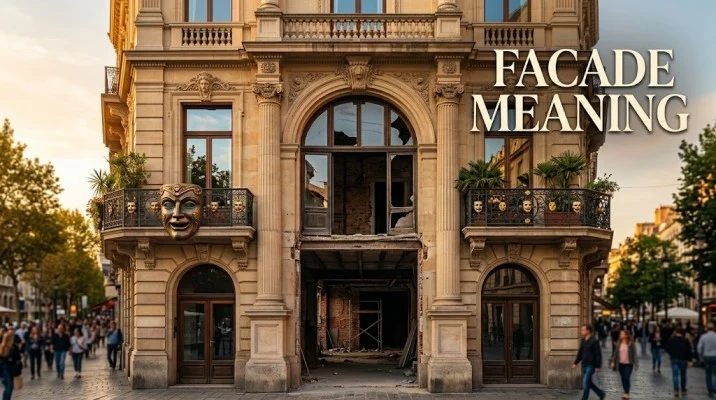
A facade is the front or outward face of something. Most commonly, it refers to the front exterior of a building, especially the side designed to face a street or public space. But the word has another important meaning: a facade can be a false or carefully controlled outward appearance that hides what is really happening underneath.
That second meaning is why you might hear someone say, “His confidence was just a facade.” The person appeared confident on the outside, but their real feelings were different.
So, facade meaning depends on context. In architecture, it describes a physical exterior. In everyday English, literature, and conversations about people, it often describes an outward image that does not reveal the full reality.
Facade Meaning in Simple Words
In simple English:
Facade means the front of a building, or an outward appearance that hides the reality underneath.
Here are the two main meanings:
| Meaning | Explanation | Example |
|---|---|---|
| Architecture | The front exterior of a building | The hotel has a beautiful glass facade. |
| Figurative | An outward appearance that hides the truth | Her cheerful facade hid her sadness. |
The architectural meaning is physical. The figurative meaning is about appearance, personality, emotions, or situations.
What Does Facade Mean in Architecture?
In architecture, a facade is the exterior face of a building.
It usually means the building’s front side, particularly the side that has been intentionally designed as the main visual face. A facade can contain windows, doors, balconies, decorative elements, stonework, glass, columns, signs, and other architectural features.
For example:
The old building has an impressive stone facade.
Common Types of Building Facades
Different buildings use different facade materials and designs.
- Glass facade: Common in modern offices and commercial buildings
- Brick facade: Often seen in traditional and residential architecture
- Stone facade: Associated with many historic and formal buildings
- Metal facade: Used in contemporary architectural designs
- Concrete facade: Common in modern and industrial structures
- Wood facade: Often used in homes and buildings designed around a natural aesthetic
The facade is not simply decoration. It can influence how a building interacts with its surroundings, including light, weather, ventilation, insulation, and the visual character of a street.
What Is the Front Facade of a Building?
The front facade is the principal exterior face of a building, usually the side that faces the main street, entrance, courtyard, or public area.
For example:
The architect redesigned the front facade to create a more welcoming entrance.
In many cases, people use facade and front of the building interchangeably. However, facade has a more architectural and descriptive tone.
Compare:
Simple:
The front of the building is painted white.
Architectural:
The building has a white stucco facade.
Both sentences describe the exterior, but the second sounds more specific to architecture and design.
What Does Facade Mean Figuratively?
The figurative meaning is more interesting.
A facade can describe an outward appearance that does not show the complete truth.
Imagine someone smiling at a party while feeling deeply upset inside. Their smile may be described as a facade if it is being used to hide their actual emotions.
For example:
His calm facade disappeared when he received the news.
This suggests that he appeared calm, but his real emotions were much stronger.
The figurative meaning can involve:
- A false appearance
- A public image
- A carefully controlled persona
- Hidden emotions
- Pretended confidence
- An appearance of happiness
- An image that conceals problems
- A surface that differs from reality
Facade Meaning When Describing a Person
When facade describes a person, it usually refers to the image that person presents to other people.
For example:
She maintained a confident facade during the interview.
This does not necessarily mean she was deliberately lying. She may simply have been hiding nervousness and trying to appear confident.
That distinction matters.
A facade can involve intentional deception, but it can also describe a protective emotional surface.
Someone might act cheerful because they do not want others to know they are struggling. Might appear fearless because they do not want to reveal anxiety. Someone might act uninterested because admitting their feelings feels uncomfortable.
In all these situations, the outward image can be called a facade.
Facade and Reality
The strongest figurative use of facade comes from the contrast between appearance and reality.
Think of it this way:
Facade = what people can see
Reality = what exists underneath
For example:
The company presented a facade of success, but its financial problems were growing.
The sentence creates a clear contrast. The public image suggested success, while the underlying situation was different.
This is why facade is common in journalism, novels, essays, films, and serious conversations. It gives writers a compact way to describe the gap between what something looks like and what it actually is.
Examples of Facade in Everyday English
Here are natural examples showing different contexts.
Architecture
The museum has a striking marble facade.
Workers are repairing the historic building’s facade.
The new office has a minimalist glass facade.
Personality
He put on a confident facade before walking onto the stage.
Behind her friendly facade, she was extremely nervous.
Emotions
His cheerful facade made it difficult to notice how upset he was.
She maintained a calm facade throughout the difficult conversation.
Social situations
Their perfect family image was only a facade.
The politician’s public facade did not reveal his private concerns.
Business
The company’s impressive website created a facade of success.
These examples show why context matters. The word can describe something as concrete as a building or something as invisible as a person’s emotional state.
Facade Examples in Sentences
If you are learning the word, these examples can make its usage easier to understand.
| Sentence | Meaning of facade |
|---|---|
| The castle has an elaborate facade. | The exterior front of the castle |
| The architect changed the building’s facade. | The building’s outer design |
| She hid her fear behind a confident facade. | An outward appearance |
| His smile was a facade. | A surface expression hiding his feelings |
| The business maintained a facade of stability. | An appearance of stability |
| The historic facade was carefully restored. | The building’s exterior |
| He created a friendly facade around strangers. | A presented personality |
| Their happy marriage was only a facade. | An appearance that hid reality |
What Does “Put Up a Facade” Mean?
The expression “put up a facade” means to create or maintain an outward appearance that hides what you really feel or what is really happening.
For example:
She put up a brave facade after losing the competition.
This means she tried to look brave even though she was probably disappointed.
Another example:
He put up a facade of confidence during the presentation.
He wanted others to see confidence, even if he felt nervous internally.
The phrase often appears when someone is protecting their emotions or managing how others perceive them.
What Does “Behind the Facade” Mean?
“Behind the facade” refers to what exists beneath an outward appearance.
For example:
Behind the facade of success, the business was struggling.
The visible image was successful, but the hidden reality was different.
You can also use it for people:
Behind his tough facade was a deeply sensitive person.
The sentence suggests that his tough appearance did not reveal his true personality.
This expression is especially useful in descriptive writing because it immediately creates a contrast between surface and depth.
Facade vs. Exterior
These words overlap, but they are not always interchangeable.
Exterior refers broadly to the outside of something.
Facade usually refers to a particular face or outward front, especially in architecture.
For example:
The exterior of the house needs painting.
This could include all outside surfaces.
But:
The facade of the house needs painting.
This more specifically suggests a particular exterior face, often the front.
The figurative meaning makes facade even more distinct because exterior does not normally carry the same idea of a deceptive or controlled appearance.
Facade vs. Front
Front is a very common everyday word.
The front of the house has three windows.
Facade sounds more architectural:
The house has a traditional brick facade.
There is also a figurative difference.
You can say:
He maintained a confident facade.
But saying:
He maintained a confident front.
is slightly different in tone. Front can mean a false appearance too, but facade often emphasizes a carefully presented surface hiding something underneath.
Facade Synonyms
The best synonym depends on which meaning you intend.
Architectural synonyms
- Exterior
- Front
- Front elevation
- Building front
- Outer face
- Exterior wall
Figurative synonyms
- Appearance
- Image
- Persona
- Mask
- Front
- Pretence
- Impression
- Public image
- False appearance
- Surface
These words are not perfect replacements in every sentence.
For example, mask strongly suggests concealment, while appearance is much broader. Persona focuses on the personality someone presents to others.
Facade Pronunciation
Facade is pronounced:
fə-SAHD
The stress falls on the second syllable.
The word is commonly written façade, with a cedilla under the letter c. The spelling facade without the cedilla is also widely used in English.
The word originally comes from French and is connected to the idea of a building’s face or front.
Is a Facade Always Fake?
No.
This is an important point.
In architecture, a facade is simply the visible exterior of a building. There is nothing deceptive about it.
Even in figurative English, calling something a facade does not automatically mean that someone is intentionally lying.
For example:
She wore a calm facade while dealing with the stressful situation.
This could simply mean that she kept her emotions private.
So the word can suggest concealment, presentation, or contrast with reality, but the surrounding sentence determines the exact meaning.
Facade in Literature and Writing
Writers often use facade to explore the difference between appearance and identity.
A character may appear confident but feel insecure. A wealthy family may appear perfect while dealing with serious conflict. A successful company may have major problems hidden behind its polished public image.
Instead of explaining this contrast in several sentences, a writer can use one strong word:
Facade.
For example:
Behind his polished facade was a man terrified of failure.
The word immediately creates two layers: the visible personality and the hidden emotion.
That makes facade especially useful in fiction, essays, character descriptions, speeches, and analytical writing.
How to Use Facade Correctly
Use facade when you want to emphasize an outward surface or appearance.
- Use it for buildings
The building’s stone facade was restored last year.
- Use it for public images
The organization maintained a facade of unity.
- Use it for emotional concealment
She hid her disappointment behind a cheerful facade.
- Use it for contrasting appearances
Behind the facade of luxury was a surprisingly modest home.
A useful test is to ask:
“Am I talking about a visible exterior or an outward appearance?”
If yes, facade may be the right word.
Common Mistakes With Facade
Mistake 1: Thinking facade only means a building
Many learners first encounter facade in architecture and assume that is its only meaning.
But figurative English frequently uses it for appearances, personalities, and situations.
Mistake 2: Assuming facade always means a lie
A facade can involve deception, but it can also mean a protective or controlled outward appearance.
Context matters.
Mistake 3: Using facade for every outside surface
Facade usually points to a particular face or front of a building rather than every exterior surface.
Mistake 4: Confusing appearance with facade
An appearance can be completely genuine.
Calling something a facade usually adds the idea that the visible surface does not tell the whole story.
Facade Meaning at a Glance
If you need a quick definition, remember this:
Facade means the front exterior of a building, or an outward appearance that hides or does not reveal the underlying reality.
The architectural meaning is physical.
The figurative meaning is psychological, social, or descriptive.
Quick Comparison
| Word | Main idea |
|---|---|
| Facade | Visible front or outward appearance |
| Exterior | Outside part of something |
| Front | Forward-facing side or presented appearance |
| Appearance | How something looks |
| Persona | Personality presented to others |
| Mask | Something that conceals the real self |
| Image | How someone or something is perceived |
Frequently Asked Questions
What is the simple meaning of facade?
Facade means the front or visible exterior of a building. It can also mean an outward appearance that hides or does not show the complete reality.
What does facade mean when describing a person?
When describing a person, facade usually means the personality, behavior, or emotional appearance they show to other people. It can hide their actual feelings or personality.
What is an example of a facade?
“The old theater has an ornate stone facade” uses facade in its architectural sense. “Her confident facade hid her nervousness” uses it figuratively.
Is facade positive or negative?
The word itself is neutral. Its meaning becomes positive, negative, or neutral from context. A beautiful building facade can be positive, while a facade that hides serious problems may have a negative implication.
What is another word for facade?
For architecture, possible alternatives include exterior, front, building front, and front elevation. In figurative contexts, alternatives include appearance, image, persona, mask, and front.
What does “behind the facade” mean?
“Behind the facade” means the reality or situation that exists beneath an outward appearance. It often highlights a difference between what people see and what is actually happening.
What does “put up a facade” mean?
“Put up a facade” means to present a particular outward appearance, often to hide genuine feelings, problems, or another reality.
Is facade the same as exterior?
Not exactly. Exterior generally means the outside of something, while facade usually refers to a particular visible face, especially the front of a building. Facade also has a figurative meaning that exterior usually does not.
How do you pronounce facade?
Facade is commonly pronounced fə-SAHD, with the main stress on the second syllable. It can be written as façade or facade.
Can facade be used as a metaphor?
Yes. In figurative writing, a facade can represent a surface appearance that hides a deeper reality, such as hidden emotions, insecurity, conflict, or problems.
Conclusion
The meaning of facade changes slightly with context, but its central idea stays connected to what appears on the outside. In architecture, it means the visible front or exterior face of a building. In everyday English and figurative writing, it can describe an outward image that hides feelings, problems, or a deeper reality.
Understanding this difference makes the word much easier to recognize and use. When you see facade, think about the surface first, then ask what lies behind it. That simple connection captures both the physical and figurative meaning of the word.