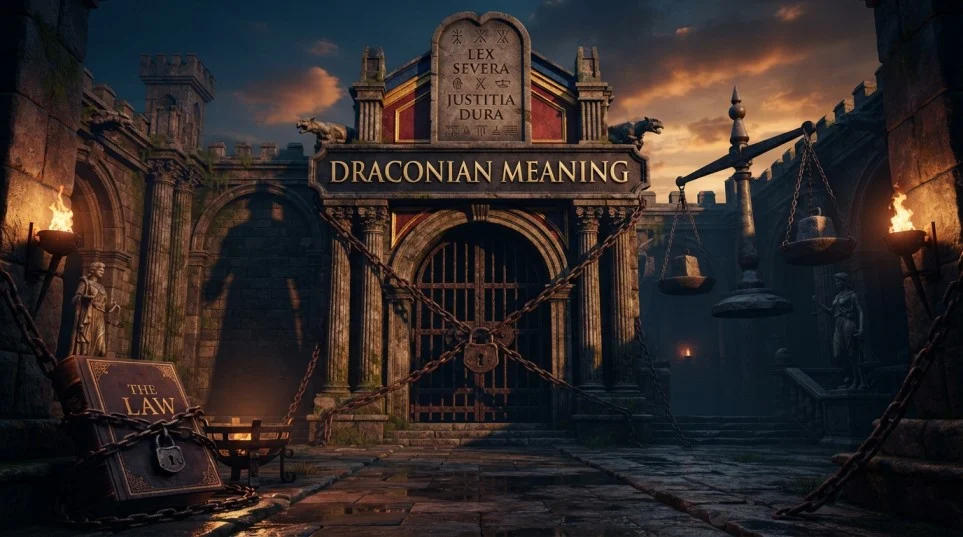
Draconian means extremely harsh, severe, or strict, especially when describing a law, punishment, rule, policy, or government measure. If someone calls a law “draconian,” they usually mean the law imposes unusually severe restrictions or penalties.
For example, “The government introduced draconian laws to punish tax evasion” means the new laws are considered extremely harsh in the penalties or restrictions they impose.
The word has a fascinating connection to ancient Athens and a lawgiver named Draco. That history explains why draconian came to represent excessive severity. Today, the word appears in discussions about laws, workplace rules, immigration policies, censorship, penalties, security measures, and many other situations where strictness goes far beyond what people consider reasonable.
Draconian Meaning in Simple English
In simple English, draconian means extremely strict or harsh.
It is stronger than simply saying something is “strict.”
| Word | General meaning | Strength |
|---|---|---|
| Strict | Firm rules with little flexibility | Moderate |
| Severe | Very serious or harsh | Strong |
| Harsh | Unkind, difficult, or severe | Strong |
| Stringent | Very strict requirements | Strong |
| Draconian | Extremely harsh, often excessively so | Very strong |
The important idea is extreme severity.
A school rule saying students must arrive before 8:00 a.m. may be strict. A rule that suspends a student for being one minute late every day could be described as draconian if the punishment seems wildly disproportionate to the offense.
So, the word often carries a sense of excessive strictness, not merely firmness.
What Does Draconian Mean?
Draconian is an adjective used for something considered exceptionally severe or unforgiving.
It commonly describes:
- Laws
- Rules
- Punishments
- Regulations
- Policies
- Restrictions
- Government measures
- Penalties
- Security measures
- Workplace policies
Examples
The company introduced draconian rules after several employees violated safety procedures.
Critics described the new law as draconian because it imposed extremely heavy penalties.
The school adopted draconian measures to stop cheating during examinations.
In each example, draconian suggests that the response is far more severe than ordinary strictness.
Draconian Definition
A straightforward dictionary-style definition is:
Draconian: extremely harsh, severe, or strict, especially in relation to laws, rules, punishments, or measures.
The word is generally used when talking about systems of control or consequences.
You would normally not describe a delicious meal as draconian or call a beautiful sunset draconian. The word belongs mainly to situations involving authority, rules, restrictions, discipline, or punishment.
Where Does the Word Draconian Come From?
The origin of draconian goes back to Draco, an ancient Athenian lawgiver who lived in the 7th century BCE.
Draco is traditionally associated with one of Athens’ earliest written legal codes. Later accounts portrayed these laws as exceptionally severe. The reputation became so closely connected with Draco that his name eventually became the foundation of the English adjective draconian.
The connection is also interesting because Draco’s name is related to the Greek Drakōn, meaning dragon. However, the modern meaning of draconian comes from the historical reputation associated with Draco’s laws, not from the modern idea of a mythical dragon.
Why Did Draco Become Associated With Harsh Laws?
Ancient legal systems could impose severe punishments, and Draco’s code became particularly famous for its severity in later historical tradition.
The idea became so powerful that “Draconian” eventually came to mean extremely harsh or severe.
This gives the word a useful historical lesson: sometimes a person’s name becomes a common word when a particular characteristic becomes strongly associated with that person.
Other English words have developed in similar ways, but draconian is especially recognizable because its historical association with harsh law remains visible in its modern meaning.
What Are Draconian Laws?
Draconian laws are laws considered extremely harsh, severe, or excessively punitive.
The phrase is usually used when penalties or restrictions appear unusually severe compared with the offense or situation involved.
For example:
The proposed legislation was criticized as draconian because even minor violations could result in enormous fines.
Here, draconian does more than mean “strict.” It suggests that the punishment or restriction is exceptionally severe.
Draconian Laws Examples
Consider these hypothetical examples:
- A minor traffic violation results in an unusually long prison sentence.
- A small administrative mistake carries an enormous financial penalty.
- A workplace violation leads automatically to permanent dismissal.
- A minor breach of a regulation results in severe legal consequences.
In each case, someone might describe the response as draconian if they believe the punishment is excessively harsh.
The term itself expresses a judgment about severity, so it is often useful to identify who is describing a measure as draconian and why.
Draconian Measures Meaning
Draconian measures are extremely strict actions taken to control, prevent, restrict, or punish something.
This phrase frequently appears in journalism, politics, business writing, and formal discussions.
For example:
The company took draconian measures to prevent confidential information from leaving the organization.
This could mean the company introduced severe restrictions, strict monitoring, or unusually harsh penalties.
Another example:
The authorities introduced draconian measures during the crisis.
The exact meaning depends on the context. The measures could involve restrictions, penalties, enforcement policies, or other forms of control.
Draconian Punishment Meaning
A draconian punishment is an exceptionally harsh penalty.
The phrase often suggests that the punishment is disproportionately severe.
For example:
A lifetime ban for a minor first-time violation would seem draconian to many people.
Notice the distinction between strict and draconian.
A strict punishment follows a firm rule.
A draconian punishment goes much further and is perceived as extraordinarily harsh.
Draconian Rules Meaning
Draconian rules are rules that are extremely strict and leave very little room for flexibility.
For example:
The dormitory introduced draconian rules that prohibited residents from having visitors at any time.
The word communicates more than inconvenience. It tells the reader that the rules feel severely restrictive.
In everyday conversation, people may use draconian when they feel rules have crossed the line from reasonable discipline into excessive control.
Draconian Policy Meaning
A draconian policy is a policy considered unusually severe or restrictive.
Example:
The new attendance policy was described as draconian because repeated minor lateness could lead to dismissal.
The term does not automatically establish that the policy is objectively unreasonable. It tells us that the policy is being characterized as extremely harsh.
That distinction matters in serious writing.
Instead of writing:
The policy was draconian.
A more precise sentence can be:
Employee groups described the policy as draconian because repeated lateness could result in dismissal.
This identifies the viewpoint and explains the specific reason for the description.
Draconian vs. Strict
These words are related, but they are not interchangeable in every situation.
Strict means a rule is firmly enforced.
Draconian means the rule, punishment, or measure is extremely harsh, often with an implication of excess.
Compare:
The university has strict examination rules.
This simply tells us that the university enforces clear standards.
Now compare:
The university has draconian examination rules.
This suggests the rules are exceptionally severe or restrictive.
A Simple Way to Remember the Difference
Strict = firm.
Draconian = extremely harsh.
That distinction makes draconian a powerful word, but it should not be used for every ordinary restriction.
Draconian Synonyms
Depending on the context, useful synonyms include:
- Harsh
- Severe
- Stringent
- Punitive
- Rigid
- Uncompromising
- Excessive
- Restrictive
- Overly strict
- Oppressive
These words are not perfect replacements in every sentence.
For example, stringent often describes demanding standards or requirements without necessarily suggesting unfairness.
Punitive emphasizes punishment.
Restrictive emphasizes limits on freedom or activity.
Draconian combines strong severity with the idea of an unusually harsh approach.
Draconian Antonyms
Possible opposites include:
- Lenient
- Flexible
- Moderate
- Permissive
- Merciful
- Tolerant
- Compassionate
- Reasonable
- Relaxed
The best antonym depends on the sentence.
For example:
The company replaced its draconian policy with a more flexible system.
Here, flexible works naturally as the contrast.
Draconian in a Sentence
Here are natural examples showing how the word works in different contexts.
Formal Example
The committee argued that the proposed penalties were excessively severe and potentially draconian.
Workplace Example
Employees considered the new attendance policy draconian because repeated minor violations could result in termination.
Education Example
The school faced criticism after introducing draconian punishments for small disciplinary offenses.
Legal Example
Lawyers argued that the proposed penalties were draconian compared with the nature of the offenses.
Government Example
The administration introduced draconian restrictions that significantly limited certain activities.
Casual Example
Those rules are a little draconian just for missing one meeting.
Creative Example
The mansion’s draconian house rules made every ordinary mistake feel like a serious offense.
Is Draconian Always Negative?
Almost always, draconian has a negative or strongly critical tone.
Calling something draconian usually communicates disapproval of its severity.
For example:
The company introduced draconian restrictions.
A reader will probably understand that the restrictions are being portrayed negatively.
There is an important nuance, though. A writer can use the word descriptively when reporting someone else’s characterization:
Opponents called the restrictions draconian.
That sentence does not necessarily mean the writer personally agrees. It reports the language used by the opponents.
This distinction is especially useful in journalism, academic writing, and formal analysis.
Is Draconian a Strong Word?
Yes.
Calling something draconian is considerably stronger than calling it strict.
Consider this progression:
firm → strict → severe → extremely harsh → draconian
This is not a fixed linguistic scale, but it helps illustrate the difference in intensity.
Because draconian is strong, using it for an ordinary rule can make writing sound exaggerated.
Weak Usage
The restaurant has draconian rules requiring customers to make reservations.
A reservation requirement is not automatically extreme.
Stronger Usage
The restaurant has draconian cancellation rules that charge customers the full price for missing a reservation by only a few minutes.
The second sentence gives the reader a concrete reason for the characterization.
How to Use Draconian Correctly
The word works best when the reader can clearly see what makes something unusually severe.
Instead of using it as decoration, connect it to a specific rule, penalty, or restriction.
Less Effective
The company introduced draconian changes.
The reader may wonder: What changes? Why are they harsh?
More Precise
The company introduced draconian changes, including immediate dismissal for minor first-time violations.
The second sentence gives the word evidence and context.
This is a useful writing principle: strong adjectives become more convincing when the surrounding facts show why they apply.
Common Contexts for the Word Draconian
You will often encounter draconian in these areas:
| Context | Common phrase |
|---|---|
| Law | draconian laws |
| Punishment | draconian punishment |
| Government | draconian measures |
| Regulation | draconian regulations |
| Business | draconian policies |
| Workplace | draconian rules |
| Education | draconian disciplinary measures |
| Security | draconian restrictions |
| Immigration | draconian immigration rules |
| Finance | draconian penalties |
The word is particularly common in formal writing because it allows a writer to communicate extreme severity in a single adjective.
Draconian vs. Stringent
These words are close, but there is a meaningful difference.
Stringent means very strict or demanding.
Draconian suggests extreme harshness, often with an additional sense that the severity may be excessive.
For example:
The laboratory has stringent safety requirements.
This sounds normal and professional.
The laboratory has draconian safety requirements.
This suggests the requirements are exceptionally restrictive or harsh.
So, stringent can be neutral, while draconian usually carries a critical tone.
Draconian vs. Oppressive
Oppressive describes something that burdens, controls, or restricts people in a harsh way.
Draconian focuses more directly on extreme severity, particularly in rules, laws, punishments, and measures.
A law can be draconian because of its severe penalties.
A system can be oppressive because it places heavy control or pressure on people.
The meanings overlap, but they emphasize different aspects.
Draconian vs. Authoritarian
These words should also be kept separate.
Authoritarian generally relates to strong centralized authority and limited freedom or participation.
Draconian describes an extremely harsh rule, law, punishment, or measure.
An authoritarian system may introduce draconian laws, but the two words do not mean exactly the same thing.
What Does Draconian Mean in Everyday Conversation?
In everyday speech, draconian can simply mean way too strict.
For example:
My boss has some draconian rules about phone use.
The speaker probably means the rules are unusually restrictive.
You might also hear:
That’s a bit draconian.
This means:
“That seems unnecessarily harsh or severe.”
The expression is often used when someone thinks a response is much stronger than the situation requires.
Common Mistakes With Draconian
1. Using It as a Synonym for Any Rule
Not every rule is draconian.
A rule can be ordinary, reasonable, strict, or stringent without being exceptionally harsh.
2. Forgetting Its Negative Tone
Because draconian usually implies excessive severity, it can sound critical.
If you simply want to describe a demanding requirement without criticism, stringent may be more appropriate.
3. Using It Without Context
A sentence such as:
The new policy is draconian.
does not tell readers what makes it severe.
Adding the actual restriction or penalty makes the writing clearer.
4. Assuming It Means “Ancient”
The word comes from ancient Greek history, but draconian does not mean ancient.
Its modern meaning concerns extreme harshness or severity.
Quick Examples: Draconian Meaning in Context
Here are some short examples to make the meaning easy to recognize:
- Draconian law: an extremely harsh law
- Draconian punishment: an exceptionally severe penalty
- Draconian rule: an excessively strict rule
- Draconian measure: an unusually harsh action
- Draconian policy: an extremely restrictive policy
- Draconian restrictions: severe limits on activity or freedom
- Draconian regulations: exceptionally strict requirements
- Draconian penalties: very severe consequences
Frequently Asked Questions
What is the simple meaning of draconian?
Draconian means extremely harsh, severe, or strict, especially when referring to laws, punishments, rules, policies, or restrictions.
Is draconian a negative word?
Yes. It usually has a negative or strongly critical tone because it suggests that something is excessively severe or restrictive.
What is an example of draconian?
A rule that gives an extremely severe punishment for a very minor violation could be described as draconian.
What are the synonyms of draconian?
Common synonyms include harsh, severe, stringent, rigid, punitive, uncompromising, restrictive, and excessive.
What is the opposite of draconian?
Depending on the context, possible opposites include lenient, flexible, moderate, permissive, tolerant, and reasonable.
Why is it called draconian?
The word comes from Draco, an ancient Athenian lawgiver associated with a famously severe legal code. His name eventually became connected with the idea of extreme legal harshness.
Is draconian the same as strict?
Not exactly. Strict means firmly enforced, while draconian suggests an extreme level of harshness, often beyond what seems reasonable.
Can draconian describe a person?
It can describe a person’s approach, behavior, or methods, but it is most naturally used for laws, rules, punishments, policies, and measures.
How do you use draconian in a sentence?
You can use it before a noun: “The company introduced draconian rules that imposed severe penalties for minor violations.”
Final Takeaway
The simplest draconian meaning is extremely harsh, severe, or strict, particularly when talking about laws, punishments, rules, policies, or restrictions.
The word is stronger than strict. It usually suggests that the level of severity is exceptional and potentially excessive. Its historical connection to Draco of Athens explains why his name became associated with harsh laws.
When you use draconian in your own writing, give readers enough context to understand the severity. A specific penalty, restriction, or consequence makes the word much more powerful than simply attaching it to a noun.