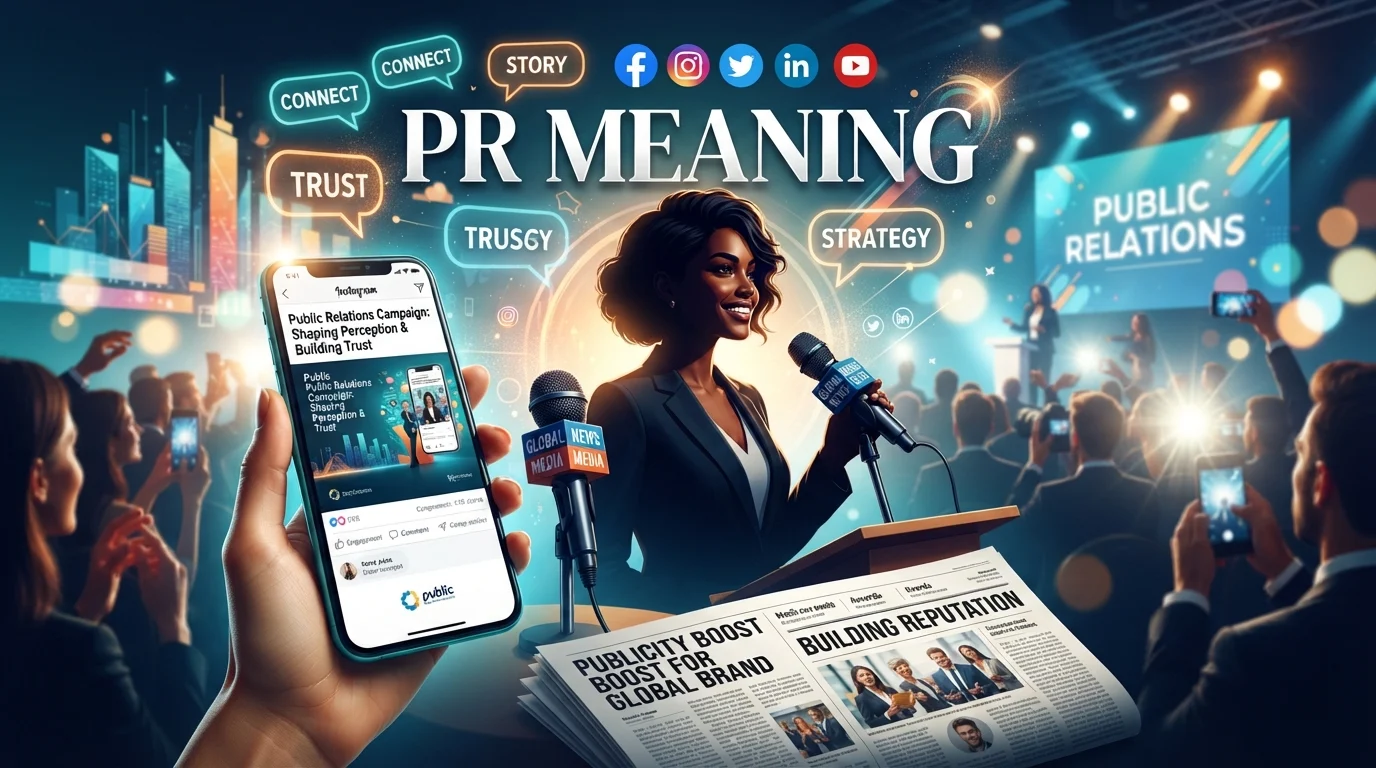
PR meaning is most commonly Public Relations. It refers to the way a person, company, organization, or public figure communicates with the public and manages how people understand and perceive them.
In simple words, PR is about building and maintaining a positive relationship between an organization and its audience. It can involve media coverage, press releases, interviews, events, public statements, social media communication, crisis responses, and community activities.
For example, if a new company launches a product and journalists write about it after receiving information from the company, that activity can be part of PR. If the same company responds publicly to a problem and explains what it is doing to fix it, that can also be public relations.
But PR is broader than simply getting publicity. At its heart, it is about communication, credibility, reputation, and relationships.
What Does PR Mean?
PR stands for Public Relations.
Public Relations is a communication discipline focused on relationships between an organization or individual and the people who matter to them.
Those people can include:
- Customers
- Employees
- Journalists
- Investors
- Business partners
- Government bodies
- Local communities
- Industry professionals
- The general public
The goal is not simply to make people notice a brand. Good PR helps an organization communicate its ideas clearly, earn attention, respond to concerns, and build a reputation over time.
Think of PR as the conversation around an organization, including the messages it intentionally shares and the way it responds when other people talk about it.
PR Full Form
The PR full form is Public Relations.
| Term | Meaning |
|---|---|
| PR | Public Relations |
| Full form | Public Relations |
| Field | Communication |
| Main focus | Public and stakeholder relationships |
| Common activities | Media relations, press releases, events, crisis communication |
| Main outcome | Awareness, credibility, and reputation |
The abbreviation PR is widely used in business, media, marketing, entertainment, politics, nonprofit organizations, and corporate communication.
What Is Public Relations in Simple Words?
Public relations can sound complicated because the field includes many different activities.
A simpler way to understand it is this:
PR is the practice of communicating with people in a way that builds understanding and manages reputation.
Imagine a small restaurant opening in a busy city.
The owner could simply post advertisements telling people to visit. That is advertising.
Instead, the restaurant might invite local food writers to experience the menu, share its founder’s story with a newspaper, organize a community event, and respond thoughtfully to customer concerns.
Those activities can fall under PR.
The difference is important because PR often depends on relationships and credibility, not only paid exposure.
What Does a PR Professional Do?
A PR professional helps an organization communicate with the audiences that matter to it.
Their daily work can vary considerably depending on the company and industry.
Common responsibilities include:
- Writing press releases
- Communicating with journalists
- Preparing media statements
- Arranging interviews
- Monitoring news coverage
- Planning public events
- Managing communication during a crisis
- Preparing executives for interviews
- Building relationships with media outlets
- Creating communication plans
- Tracking public responses
- Protecting and strengthening reputation
A PR professional may spend one morning writing a company announcement and the afternoon helping an executive prepare for a television interview.
The job is often less about “making a company look good” and more about making sure important information reaches the right people clearly and responsibly.
How Does PR Work?
PR usually works through a combination of message, audience, channel, timing, and relationship.
A simple PR process might look like this:
Situation → Message → Audience → Communication Channel → Public Response → Follow-up
For example, imagine a technology company has developed a new educational app.
1. Identify the story
The company determines what is genuinely newsworthy.
Perhaps the app helps schools provide affordable learning tools.
2. Identify the audience
The relevant audiences could include:
- Teachers
- Parents
- Schools
- Education journalists
- Students
- Technology publications
3. Develop the message
The company explains what the product does and why it matters.
4. Choose communication channels
The company might use:
- A press release
- Media interviews
- A company blog
- Social media
- Industry events
- Direct media outreach
5. Monitor the response
The PR team observes how journalists, customers, employees, and other audiences respond.
6. Continue the conversation
PR does not necessarily end when an announcement is published. Follow-up communication can answer questions, correct misunderstandings, and provide additional information.
This is one reason PR is better understood as a relationship-building process rather than a single promotional event.
What Is PR in Business?
In business, PR helps organizations communicate with customers, employees, investors, journalists, partners, and the broader public.
A company may use PR when it:
- Launches a new product
- Opens a new location
- Announces an important partnership
- Releases research
- Expands into a new market
- Responds to criticism
- Changes leadership
- Supports a community project
- Shares important company news
For example, a clothing company might announce that it has redesigned its packaging to reduce material use.
The announcement itself is only one part of the communication. The company may also provide information to journalists, answer questions, publish supporting details, and communicate with customers.
That broader communication activity is where PR becomes valuable.
PR Meaning in Marketing
PR and marketing are closely connected, but they are not identical.
Marketing generally focuses on promoting products, services, or offers to achieve business objectives. PR focuses more broadly on relationships, reputation, communication, and public perception.
Here is a simple comparison:
| PR | Marketing |
|---|---|
| Focuses strongly on reputation and relationships | Focuses strongly on promotion and demand |
| Often works through earned media and public communication | Commonly uses paid and owned promotional channels |
| Can communicate with many stakeholder groups | Often concentrates on customers and prospects |
| Includes crisis communication | Includes campaigns, promotions, and customer acquisition |
| Builds long-term public understanding | Often targets measurable commercial actions |
The two fields can work together.
For instance, a company launching a new product might use marketing campaigns to promote the product while its PR team handles media relationships, founder interviews, launch events, and public communication.
PR Meaning in Media
In media, PR commonly refers to communication between an organization and journalists or media outlets.
This area is often called media relations.
A PR professional may contact a journalist with a story idea, provide background information, arrange an interview, or send a press release.
The important point is that media coverage is not automatically guaranteed simply because a company sends a press release.
Journalists decide what is relevant to their audiences.
That means strong PR usually starts with a story that has genuine news value, useful information, credible sources, or a compelling human angle.
What Is a Press Release?
A press release is a structured announcement distributed to communicate news about an organization.
It might announce:
- A product launch
- A new executive
- A major partnership
- Research findings
- An event
- A business milestone
- A community initiative
A basic press release often includes:
- A clear headline
- The main announcement
- Important supporting details
- Relevant quotations
- Background information
- Contact information
A press release is a PR tool, not PR itself.
That distinction matters.
Sending one document does not create a complete public relations strategy. It is simply one communication method within a larger process.
PR Meaning in Social Media
Social media has changed how organizations communicate with the public.
In the past, organizations often relied heavily on newspapers, television, radio, and formal press communication.
Today, a company can communicate directly with its audience within seconds.
PR on social media can involve:
- Responding to public questions
- Sharing company announcements
- Addressing criticism
- Highlighting community activities
- Communicating during unexpected events
- Supporting executives’ public communication
- Building relationships with online communities
Social media also creates a major difference between traditional and modern PR:
The audience can respond immediately.
A company may publish one statement, but thousands of people can comment, repost, question, criticize, or support it.
That makes clarity and consistency especially important.
What Is a PR Agency?
A PR agency is a company that provides public relations and communication services to clients.
A business may hire an agency because it needs communication support but does not have a large internal PR team.
A PR agency may provide services such as:
- Media relations
- Press release writing
- Crisis communication
- Event communication
- Brand reputation support
- Executive communication
- Publicity campaigns
- Strategic communication
Some agencies specialize in particular industries, such as technology, healthcare, fashion, entertainment, finance, or consumer products.
PR Agency vs In-House PR Team
Organizations can manage PR internally or work with an external agency.
| In-House PR | PR Agency |
|---|---|
| Works directly within the organization | Works as an external partner |
| Usually deeply familiar with internal operations | May bring experience from multiple clients |
| Closely connected to company leadership | Can provide outside perspective |
| Dedicated to one organization | May have specialized teams and industry experience |
Some organizations use both.
An internal team may handle everyday communication while an agency provides specialist support for a major launch, crisis, or public campaign.
What Are Examples of PR?
PR can appear in everyday business activities without being labeled “PR.”
Product Launch
A technology company introduces a new device and provides journalists with product information and interview opportunities.
Company Milestone
A growing business reaches an important anniversary and shares its story with local media.
Community Event
A company organizes a free educational workshop for the local community and communicates the event publicly.
Crisis Communication
A company experiences a service interruption and publishes an accurate update explaining what happened and what customers should expect next.
Executive Interview
A company’s CEO speaks with a business publication about an industry development.
Research Announcement
An organization publishes original research and makes experts available to discuss its findings.
These examples show that PR is not limited to glamorous launches or celebrity publicity.
Sometimes the most important PR work happens during ordinary moments when people simply need clear, trustworthy information.
PR and Reputation Management
Reputation is one of the central ideas behind public relations.
An organization’s reputation is shaped by many things:
- What it says
- What it does
- How employees experience it
- What customers experience
- What journalists report
- How leaders behave
- How the organization handles mistakes
- What other people say about it
PR cannot completely control reputation.
That is a useful distinction.
A company can communicate honestly and consistently, but audiences still form their own opinions based on real experiences and outside information.
Good PR therefore works best when communication matches reality.
A polished statement cannot permanently hide poor service, misleading claims, or serious organizational problems.
What Is Crisis Communication?
Crisis communication is the part of PR concerned with communicating during situations that could seriously affect an organization’s people, operations, or reputation.
Examples include:
- A product safety issue
- A major service outage
- A data incident
- A controversial decision
- A public misunderstanding
- A serious operational failure
Effective crisis communication generally requires:
- Speed
- Accuracy
- Clear responsibility
- Consistent information
- Regular updates
- Appropriate empathy
- A clear explanation of next steps
One of the biggest mistakes is filling an information gap with speculation.
When people do not have reliable information, rumors can spread quickly.
A clear and factual update can help establish what is known, what is still being investigated, and what will happen next.
Earned Media, Owned Media, and Paid Media
Understanding these three terms makes PR much easier to understand.
Earned Media
Coverage or attention that an organization does not directly purchase.
Examples include:
- A newspaper article
- A journalist’s interview
- An independent review
- Organic social discussion
Owned Media
Communication channels controlled by the organization.
Examples include:
- Company website
- Blog
- Newsletter
- Official social media account
Paid Media
Exposure that an organization pays for.
Examples include:
- Advertisements
- Sponsored placements
- Paid social campaigns
PR often has a strong connection with earned media, but modern public relations can involve owned and other communication channels as well.
PR vs Publicity
These terms are sometimes used as if they mean the same thing.
They do not.
Publicity is attention or public exposure. PR is the broader practice of managing communication and relationships.
A viral news story may generate publicity.
A long-term communication program involving media relations, stakeholder communication, executive messaging, and crisis planning is PR.
Publicity can therefore be one result or component of PR, but it does not describe the entire discipline.
PR vs Advertising
Advertising is generally paid communication.
A company purchases space, time, or placement to deliver a controlled message.
PR often works differently.
For example:
Advertising: A company pays for an online advertisement promoting its new product.
PR: A journalist independently writes about the product after receiving information and speaking with the company’s representatives.
The distinction becomes even clearer when considering credibility.
Advertising gives an organization significant control over the message.
Earned media gives the media outlet editorial control over how the story is presented.
Both can be useful, but they serve different communication purposes.
Why Is PR Important?
PR matters because organizations do not operate in isolation.
People form opinions based on experiences, conversations, news coverage, public statements, and the behavior of organizations.
Strong communication can help an organization:
- Explain complex information
- Build relationships with stakeholders
- Increase public awareness
- Establish credibility
- Respond to criticism
- Communicate during difficult situations
- Share meaningful achievements
- Strengthen long-term reputation
The deeper value of PR is not simply visibility.
It is understanding.
A company that communicates clearly gives people better information with which to understand what the organization does, why it matters, and how it responds when things go wrong.
What Skills Do PR Professionals Need?
PR combines writing, communication, research, organization, and judgment.
Important skills include:
Writing
PR professionals often write press releases, statements, speeches, pitches, briefing documents, and social media copy.
Communication
They need to explain information clearly to different audiences.
Research
Good communication starts with understanding the subject.
Media Awareness
PR professionals need to understand what makes information relevant to journalists and their audiences.
Relationship Building
PR relies heavily on professional relationships with journalists, colleagues, clients, community groups, and other stakeholders.
Crisis Thinking
Unexpected situations require calm, accurate, and carefully structured communication.
Organization
A single campaign can involve multiple people, deadlines, interviews, events, approvals, and communication channels.
Is PR the Same as Marketing?
No.
PR and marketing overlap, but their primary functions differ.
Marketing is commonly associated with promoting products or services and encouraging commercial action.
PR is more focused on public communication, relationships, reputation, and stakeholder understanding.
A practical example makes this easier.
Imagine a company launches a new smartphone.
The marketing team might create advertisements, promotional offers, product pages, and campaigns designed to encourage purchases.
The PR team might arrange interviews, provide information to technology journalists, organize a launch event, prepare executives for media questions, and handle public communication around the launch.
The teams may work closely together, but their responsibilities are not identical.
Is PR the Same as Advertising?
No.
The clearest difference is control.
In advertising, the organization pays for placement and generally has much greater control over the message.
In PR, especially earned media, another party such as a journalist or publication may decide whether to cover the story and how to frame it.
For this reason, PR often requires stronger emphasis on news value, credibility, relationships, and useful information.
Does PR Mean Public Relations Everywhere?
Not always.
PR most commonly means Public Relations, especially in business and communication contexts.
However, abbreviations can have different meanings depending on context.
For example, PR may also refer to:
- Personal Record in fitness and sports
- Puerto Rico in geographic contexts
- Press Release in some workplace communication
- Proportional Representation in political and electoral discussions
- Pull Request in software development
Context is therefore important.
If someone says, “I got a new PR at the gym,” they almost certainly mean Personal Record, not Public Relations.
If a developer says, “I opened a PR,” they are likely referring to a Pull Request.
PR Meaning in Different Contexts
| Context | PR Meaning |
|---|---|
| Business | Public Relations |
| Marketing | Public Relations |
| Media | Public Relations or Press Release, depending on context |
| Fitness | Personal Record |
| Sports | Personal Record |
| Software development | Pull Request |
| Geography | Puerto Rico |
| Elections and political systems | Proportional Representation |
This is why searching for “PR meaning” without context can produce multiple interpretations.
The surrounding sentence usually tells you which meaning applies.
How to Tell Which PR Meaning Someone Means
Look at the words around the abbreviation.
Example 1
“Our company hired a PR agency.”
Here, PR means Public Relations.
Example 2
“I hit a new PR during my workout.”
Here, PR means Personal Record.
Example 3
“The developer submitted a PR on GitHub.”
Here, PR means Pull Request.
Example 4
“The election uses PR.”
Here, PR may mean Proportional Representation.
Example 5
“She moved to PR last year.”
Here, PR may mean Puerto Rico.
The abbreviation itself does not provide enough information. Context gives the meaning.
Common PR Terms You Should Know
If you are learning about public relations, these terms appear frequently.
Media Relations
Building and maintaining professional relationships with journalists and media organizations.
Press Release
A formal announcement distributed to communicate news.
Media Pitch
A targeted communication sent to a journalist suggesting a potential story.
Spokesperson
A person authorized to speak publicly on behalf of an organization.
Crisis Communication
Communication used during a serious event or situation that requires careful public response.
Reputation Management
The broader effort to understand and influence how an organization is perceived.
Publicity
Public attention or exposure, often generated through media coverage.
Stakeholder
A person or group affected by, interested in, or connected to an organization.
Earned Media
Public exposure gained without directly purchasing the media placement.
Common Mistakes People Make About PR
Mistake 1: Thinking PR Is Just Advertising
PR and advertising can support the same business goals, but they use different communication methods.
Mistake 2: Assuming PR Means Free Promotion
PR can generate attention, but coverage is not guaranteed.
Mistake 3: Thinking PR Can Control Public Opinion
Organizations can communicate their side of a story, but people ultimately form their own views.
Mistake 4: Treating a Press Release as the Entire PR Strategy
A press release is one tool among many.
Mistake 5: Ignoring Negative Information
Avoiding difficult questions can make communication problems worse. Honest, timely information is often more useful.
A Simple Real-Life PR Example
Imagine a local bakery creates a scholarship program for culinary students.
The bakery could simply announce the program on its Instagram account.
A broader PR approach might involve:
- Writing a clear announcement.
- Sharing the story with local journalists.
- Explaining why the bakery created the program.
- Interviewing the founder and scholarship recipient.
- Sharing updates after the program begins.
- Communicating the results at the end of the year.
The story now has a human element, a community angle, and a continuing narrative.
That illustrates an important PR principle:
People often connect with stories more easily than corporate announcements.
Facts tell people what happened. A well-developed story can help them understand why it matters.
How Businesses Can Improve Their PR
Effective PR does not always require a huge budget.
Smaller organizations can start with a few practical principles.
Have Something Worth Talking About
A press release cannot manufacture genuine news value from nothing.
Look for:
- Original research
- Community impact
- Useful expertise
- New products
- Significant milestones
- Interesting people
- Relevant data
- Meaningful partnerships
Know the Audience
A story that matters to a technology journalist may not interest a local newspaper.
Match the message to the audience.
Keep Information Accurate
Small factual errors can damage credibility.
Check names, dates, figures, quotations, and claims before publishing.
Make Communication Human
People respond to people.
Founder stories, customer experiences, employee perspectives, and community impact can make corporate communication easier to understand.
Prepare Before a Crisis
The worst time to decide who will speak publicly is after a crisis has already started.
Organizations can prepare basic response plans, responsibilities, approval processes, and communication channels in advance.
Frequently Asked Questions
What does PR mean?
PR most commonly means Public Relations. It refers to communication and relationship-building between an organization or individual and the public or other important stakeholders.
What is the full form of PR?
The most common PR full form is Public Relations.
What does PR mean in business?
In business, PR usually means Public Relations. It involves communicating with customers, journalists, employees, investors, communities, and other stakeholders while managing reputation and public communication.
What does a PR person do?
A PR professional may write press releases, communicate with journalists, organize interviews and events, prepare public statements, monitor media coverage, and help manage communication during difficult situations.
Is PR the same as marketing?
No. Marketing generally focuses more directly on promoting products, services, and commercial offers. PR focuses more broadly on communication, relationships, reputation, and public understanding.
Is PR the same as advertising?
No. Advertising typically involves paid media placement controlled by the advertiser. PR can involve earned media, media relations, public statements, events, and broader stakeholder communication.
What does PR mean on social media?
On social media, PR can involve public communication, reputation management, responses to customers or criticism, announcements, community engagement, and communication during important events.
What does PR mean in fitness?
In fitness and sports, PR commonly means Personal Record, referring to someone’s best recorded performance for a particular exercise or activity.
What does PR mean in software development?
In software development, PR commonly means Pull Request, a request for proposed code changes to be reviewed and potentially merged into a project.
Can PR have different meanings?
Yes. PR meaning depends on context. Public Relations is the most common meaning in business and communication, but PR can also mean Personal Record, Pull Request, Puerto Rico, and Proportional Representation.
Final Takeaway
The most common PR meaning is Public Relations.
It is the practice of managing communication and relationships between an organization or individual and the people who matter to them. PR can include media relations, press releases, interviews, events, crisis communication, social media communication, and reputation management.
The key idea is simple: PR is not just about getting attention. It is about communicating clearly, building relationships, and earning trust over time.
And remember that context matters. In a business conversation, PR usually means Public Relations. A gym, it can mean Personal Record. In software development, it can mean Pull Request.
The surrounding words usually reveal which meaning the writer intends.