A word can look familiar and still leave you wondering what it actually means. “Masque” is one of those words. You may have seen it in literature, historical writing, theatre, or an old-fashioned description and wondered if it simply means “mask.”
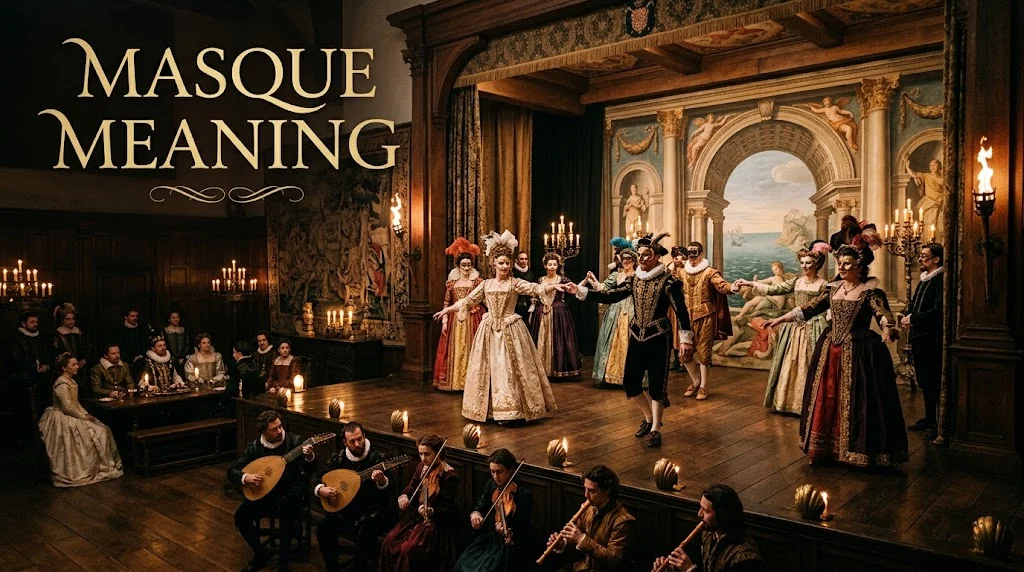
The answer is more interesting than that. Masque is a historical form of entertainment that combines poetry, music, dance, costumes, acting, and elaborate scenery. It became especially associated with the English court during the Renaissance and early modern period. The word can also be confused with “mask,” but the two terms are not always interchangeable.
In this guide, you will learn the masque meaning, its definition, historical use, pronunciation, and the difference between masque and mask. You will also see how the word appears in sentences, literature, and modern usage. This makes the explanation useful for students, writers, readers, and anyone trying to understand the term in context.
Definition & Meaning
Masque (noun) means a dramatic or theatrical entertainment involving music, dancing, poetry, costumes, and elaborate performances, especially one associated with European courts during the Renaissance and early modern period.
In simple words, a masque was a lavish performance that brought together several forms of art on one stage.
The word is strongly connected with historical English theatre. Traditional masques often featured performers wearing masks or costumes and could include symbolic characters, mythology, allegory, music, dance, and impressive stage designs.
Simple Meaning
Masque = a historical theatrical performance combining poetry, music, dance, costumes, and spectacle.
Full Form and Meaning
Masque does not have a full form. It is not an acronym made from separate words.
The term masque is a historical word related to the idea of a mask or masked performance. In English literary and theatrical contexts, it developed into the name for a particular type of elaborate entertainment.
So:
Masque → Not a full form
Masque → A theatrical or courtly entertainment involving music, dance, poetry, costumes, and spectacle
What Does Masque Mean?
The masque meaning is a form of dramatic or theatrical entertainment that traditionally combines several artistic elements, including:
- Poetry
- Music
- Dance
- Acting
- Costumes
- Scenery
- Allegory
- Mythological characters
- Spectacular stage effects
The form became particularly associated with the English court during the late 16th and early 17th centuries.
A masque could feature gods, goddesses, mythical creatures, historical figures, or symbolic characters. The performers might appear in elaborate costumes and move through carefully designed scenes accompanied by music and dance.
Unlike a conventional drama, the visual spectacle was often just as important as the spoken dialogue.
Simple Definition of Masque
A masque is a highly theatrical performance that combines poetry, music, dance, costumes, scenery, and spectacle, traditionally associated with Renaissance and Jacobean England.
Masque Meaning in Literature
In literature, masque refers to a dramatic genre rather than simply a costume or face covering.
Masques were often written as scripts containing poetry, songs, speeches, and directions for performance. Writers could use them to explore ideas such as:
- Virtue
- Power
- Beauty
- Order
- Peace
- Love
- Justice
- Royal authority
- Conflict between good and evil
Many masques used allegory, meaning characters and events could represent larger ideas.
For example, a character representing Peace might appear after characters representing War and Conflict. The performance could then symbolically show harmony overcoming disorder.
This made the masque useful for both entertainment and symbolic storytelling.
What Is a Masque in Drama?
In drama, a masque is a spectacle-driven performance that blends different forms of artistic expression.
A traditional masque might contain:
- A dramatic introduction
- Music
- Poetry or speeches
- Elaborate costumes
- Dancing
- Mythological or symbolic characters
- Decorative scenery
- A central spectacle
- A final dance or celebration
The structure was not always identical. Different writers and performers adapted the form for particular occasions.
One important feature was the interaction between performance and spectacle. The audience was not simply expected to listen to a story. They were meant to experience a carefully constructed visual and musical event.
Where Did the Masque Come From?
The masque developed from several European traditions involving masked performances, music, dancing, pageantry, and court entertainment.
In England, the form became increasingly elaborate during the reigns of Elizabeth I, James I, and Charles I.
The early English masque was influenced by continental European customs, but English writers and designers developed it into a distinctive theatrical form.
By the early 17th century, masques could involve impressive stage machinery, elaborate costumes, specially designed scenery, music, and choreographed dancing.
Royal courts provided an ideal setting for these productions because they could support the considerable expense and preparation required.
Renaissance and Jacobean Masques
The history of the English masque is closely connected with the Renaissance and Jacobean periods.
Renaissance Masque
During the English Renaissance, court entertainment became increasingly sophisticated. Masques combined literary writing with music, visual design, and performance.
They could celebrate:
- Royal marriages
- Political events
- Court celebrations
- Important visitors
- Religious or seasonal occasions
- Royal power and harmony
Jacobean Masque
The form became especially prominent under James I.
During the Jacobean period, masques grew more elaborate. Writers, composers, choreographers, actors, and stage designers could work together to create large-scale productions.
This is the period most strongly associated with Ben Jonson and Inigo Jones.
Ben Jonson and the Masque
Ben Jonson was one of the most important English writers associated with the masque.
He wrote several influential masques for the royal court. His works demonstrate how literary writing could be combined with performance, music, dance, and elaborate visual design.
Some notable examples include:
- The Masque of Blackness
- The Masque of Beauty
- The Masque of Queens
- Pleasure Reconciled to Virtue
- The Masque of Hymen
Jonson’s contribution is particularly important because he gave the masque substantial literary form.
His masques often used mythology and allegory to present ideas about virtue, order, beauty, and royal authority.
Inigo Jones and Masque Design
If Ben Jonson helped shape the literary side of the English masque, Inigo Jones played a major role in its visual development.
Jones was an architect and designer who created elaborate scenery, costumes, stage effects, and visual environments for court masques.
His work helped transform the masque into a highly sophisticated theatrical spectacle.
This partnership between Jonson’s writing and Jones’s visual design is an important part of masque history.
It also shows why calling a masque simply a “play” can be misleading. The form depended on collaboration between several artistic disciplines.
Key Characteristics of a Masque
The following features can help you identify a masque when reading a literary text.
| Characteristic | Role in a Masque |
|---|---|
| Music | Creates mood and supports the performance |
| Dance | Adds movement and spectacle |
| Poetry | Provides speeches, songs, and literary expression |
| Costumes | Helps create characters and visual symbolism |
| Scenery | Builds an impressive theatrical world |
| Allegory | Represents larger ideas through characters and events |
| Mythology | Provides gods, heroes, creatures, and symbolic stories |
| Spectacle | Creates visual excitement for the audience |
| Court setting | Many traditional English masques were performed for royal or aristocratic audiences |
These elements did not always appear in exactly the same way, but their combination is central to the traditional form.
Why Were Masques Popular?
Masques offered something that ordinary spoken drama could not easily provide.
They could combine literature, music, visual art, dance, architecture, costume, and performance in one event.
For wealthy court audiences, this created an opportunity to display:
- Wealth
- Artistic sophistication
- Social status
- Political power
- Royal celebration
- Cultural achievement
The form also allowed writers to present idealized visions of harmony and authority.
For example, a masque might begin with disorder or threatening forces and conclude with harmony, beauty, or peace. The symbolic structure could support the values the performance was designed to celebrate.
Masque vs Mask: What Is the Difference?
This is one of the most important distinctions to understand.
| Word | Meaning |
|---|---|
| Masque | A theatrical form involving music, dance, poetry, costumes, scenery, and spectacle |
| Mask | An object worn over the face, usually for disguise, protection, ritual, or performance |
The two words have historical connections, but they should not be treated as interchangeable.
Example
Masque:
The students studied a Jacobean masque by Ben Jonson.
Here, masque refers to a theatrical genre.
Mask:
The performer wore a silver mask during the ceremony.
Here, mask refers to an object covering the face.
Why Do They Sound Similar?
The similarity comes from the historical connection between masked or disguised performances and the development of the theatrical form.
Over time, masque became established as the spelling for this particular type of theatrical entertainment.
What Is a Court Masque?
A court masque was a masque performed for or within a royal or aristocratic court.
These productions could be extremely expensive. They might require:
- Professional designers
- Musicians
- Dancers
- Poets
- Actors
- Costume makers
- Stage technicians
- Architects or set designers
The scale of these performances reflected the resources of the people who commissioned them.
Court masques could also serve a ceremonial purpose. A royal marriage or major celebration could provide an occasion for a new production.
What Is a Masque in Simple English?
If you need a short explanation, you can remember it this way:
A masque is an elaborate old-style theatrical performance that combines music, poetry, dancing, costumes, scenery, and acting.
Think of it as a theatrical event where storytelling and spectacle work together.
It is especially associated with Renaissance and Jacobean England.
Examples of Masques
Several works are particularly useful when studying the genre.
The Masque of Blackness
Written by Ben Jonson and first performed in 1605, The Masque of Blackness is one of the best-known English masques.
The work combines poetry, mythology, music, costumes, and visual spectacle.
It was performed at the court of James I.
The work is also studied today in discussions of race, representation, colonial ideas, and early modern performance, making it more complex than a simple example of court entertainment.
The Masque of Queens
Jonson’s The Masque of Queens was performed in 1609.
It contrasts figures associated with disorder and evil against a vision of virtue and royal order.
The work demonstrates the importance of allegory and spectacle within the English masque tradition.
The Masque of Beauty
The Masque of Beauty followed The Masque of Blackness and continued its thematic and theatrical development.
It demonstrates how recurring characters, symbolism, costumes, and stage spectacle could be developed across related court performances.
Masque Examples in Everyday Explanation
You probably will not use masque in ordinary conversation very often. It is mainly a literary, historical, and theatrical term.
Here are some natural examples:
- The professor explained the masque as a form of Renaissance court entertainment.
- Ben Jonson wrote several famous English masques.
- The masque included music, poetry, elaborate costumes, and dancing.
- The students analyzed the symbolism in the Jacobean masque.
- The performance was designed as a spectacular court masque.
- The masque used mythological figures to represent abstract ideas.
How to Pronounce Masque
Masque is generally pronounced like “mask.”
Pronunciation: /mæsk/
The final -que does not create a separate sound.
So:
masque = mask
The meaning depends on the context.
Masque in a Sentence
Here are a few examples showing how the word works naturally:
Ben Jonson became famous for writing elaborate court masques.
The masque combined poetry, music, dance, and theatrical spectacle.
The class discussed the political symbolism of the Jacobean masque.
The masque was performed before members of the royal court.
In literature, a masque is different from an ordinary stage play.
Why the Masque Matters in Literature
The masque is important because it demonstrates how early theatre could bring several artistic disciplines together.
Modern readers sometimes approach literature as something meant mainly to be read. A masque reminds us that many dramatic texts were created for performance.
The words on the page were only one part of the experience.
Imagine reading a description of a palace appearing on stage. On paper, it might occupy only a few lines. In an actual performance, that scene could involve painted scenery, lighting, music, movement, costumes, and mechanical stage effects.
That difference matters.
A masque was designed to be seen and heard, not simply read.
Masque vs Traditional Play
A traditional play and a masque can overlap, but they generally emphasize different things.
| Feature | Masque | Traditional Play |
|---|---|---|
| Poetry | Often important | Often important |
| Dialogue | May be limited or highly stylized | Usually central |
| Music | Major component | May be present |
| Dance | Major component | Usually less central |
| Costumes | Often elaborate | Important but variable |
| Scenery | Often spectacular | Varies |
| Allegory | Common | Possible |
| Mythology | Frequently used | Sometimes used |
| Spectacle | Central | Depends on the play |
| Court celebration | Strong historical association | Not necessary |
The boundaries were not absolute. Some dramatic works can contain elements associated with the masque.
Common Misunderstandings About Masque
A Masque Is Not Simply a Mask
The spelling makes this mistake easy.
A mask is normally an object worn on the face.
A masque is a theatrical genre.
A Masque Is Not Just a Dance
Dance was important, but a masque could include poetry, music, acting, costumes, scenery, mythology, and allegory.
A Masque Is Not Only About Disguises
The early association with masks and masked performers contributed to the history of the form, but the mature English masque became a much broader theatrical spectacle.
A Masque Is Not the Same as Modern Musical Theatre
Both can combine music, performance, and storytelling, but they belong to very different historical and theatrical traditions.
Frequently Asked Questions
What is the meaning of masque?
A masque is an elaborate theatrical performance that combines elements such as poetry, music, dance, costumes, scenery, acting, and spectacle. It is especially associated with Renaissance and Jacobean England.
What is a masque in literature?
In literature, a masque is a dramatic genre that combines literary writing with music, dance, visual spectacle, costumes, and symbolic or allegorical elements.
What is the difference between masque and mask?
A masque is a type of theatrical entertainment. A mask is an object worn over the face. Although the words are historically connected, they have different meanings.
Who wrote famous masques?
Ben Jonson is one of the most famous English writers of masques. His works include The Masque of Blackness, The Masque of Queens, and The Masque of Beauty.
What is a court masque?
A court masque was a theatrical performance associated with a royal or aristocratic court. It often involved elaborate costumes, music, dancing, poetry, scenery, and stage effects.
When were masques popular?
Masques became particularly prominent in England during the late 16th and early 17th centuries, with the form reaching a high point during the Jacobean period.
How do you pronounce masque?
Masque is pronounced like “mask,” with the final letters -que not pronounced separately.
What are the main features of a masque?
Common features include music, dance, poetry, costumes, scenery, allegory, mythology, acting, and theatrical spectacle.
Is a masque a type of play?
A masque is a form of dramatic entertainment, but it differs from a conventional play because it places much greater emphasis on music, dance, visual spectacle, ceremony, and symbolic performance.
Final Takeaway
The simplest way to remember the masque meaning is this: a masque is an elaborate theatrical performance that brings together poetry, music, dance, costumes, scenery, and spectacle.
The form became particularly important in Renaissance and Jacobean England, where it was often performed at royal courts. Writers such as Ben Jonson helped establish its literary importance, while designers such as Inigo Jones helped make its visual presentation increasingly spectacular.
And remember the key spelling distinction: masque is the theatrical form; mask is the face covering. That one difference can prevent a lot of confusion when reading English literature.
1 thought on “Masque Meaning | Definition, Full Form, Uses & What It Really Means in 2026”