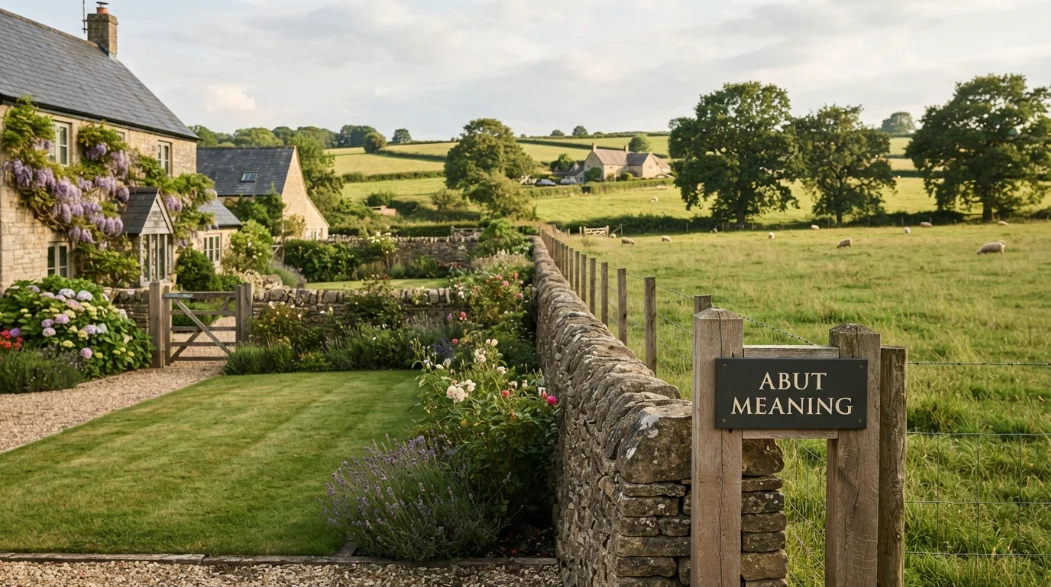
You may have seen the word “abut” in a property description, map, or writing and wondered what it actually means. The abut meaning is simple once you picture two things meeting at an edge or boundary. Unlike everyday words such as “touch” or “border,” it often appears in legal, architectural, geographic, and descriptive contexts. Knowing this distinction can make your English more precise and help you understand documents without guessing.
In this guide, we will explain the abut meaning in English, along with its pronunciation, grammar, common uses, synonyms, and examples. You will also see how the word works in sentences and how its meaning shifts slightly with context. By the end, you’ll know when and how to use “abut” naturally.
What Does Abut Mean?
Abut means to be directly next to something or to touch it at a boundary or edge.
It usually describes two things that meet along an edge or boundary rather than simply being somewhere nearby.
Simple definition
Abut: to touch or directly border something.
Example
The backyard abuts a wooded area.
This means the backyard directly meets the wooded area.
The important idea is direct contact at a boundary. If two houses are several streets apart, they do not abut each other. If their properties share a boundary, you can say they abut.
Abut Meaning in Simple English
If you want the easiest way to remember the word, think:
Abut = directly touch or share a boundary.
Here are a few simple examples:
- The garden abuts the road.
- Our property abuts a small lake.
- The restaurant abuts the hotel.
- The two fields abut each other.
- The house abuts an empty lot.
In each sentence, the things mentioned are directly beside one another.
Is Abut a Verb?
Yes. Abut is a verb.
It describes the relationship between two things that meet or share a boundary.
| Form | Example |
|---|---|
| Base form | The garden abuts the road. |
| Present participle | The garden is abutting the road. |
| Past tense | The property abutted the river. |
| Third-person singular | The field abuts the highway. |
The word is generally used to describe location or physical boundaries, especially in formal writing.
How to Use Abut in a Sentence
The most common structure is:
Subject + abut + object
For example:
The property abuts the river.
You can also use abut with against in some constructions:
The wall abuts against the neighboring building.
However, abut itself already carries the idea of directly meeting something, so simple constructions such as “the property abuts the road” are often enough.
More sentence examples
1. Property
Our backyard abuts a public park.
The backyard directly meets the park.
2. Buildings
The office building abuts a residential complex.
The two properties directly meet.
3. Roads
The farm abuts the main highway.
The farm’s property reaches the highway boundary.
4. Natural areas
The village abuts a dense forest.
The village directly borders the forest.
5. Two pieces of land
The two plots of land abut each other.
The plots share a boundary.
Abut Examples in Everyday Contexts
Although abut is perfectly correct in everyday English, it appears especially often in writing about property and geography.
Real estate
The property abuts a quiet residential street.
This tells a potential buyer that the property directly borders the street.
Architecture
The new extension abuts the existing structure.
The extension directly meets the existing building.
Geography
The northern boundary of the town abuts the river.
The town’s boundary directly reaches the river.
Urban planning
The residential district abuts an industrial area.
The two areas share a boundary.
Legal or property descriptions
The parcel abuts the eastern boundary of the neighboring property.
This type of precise wording is common when describing land boundaries.
Abut Synonyms
Several words can communicate a similar idea, but they are not always interchangeable.
| Word | Basic meaning | Main difference |
|---|---|---|
| Abut | Directly touch or share a boundary | Often formal and used for physical boundaries |
| Adjoin | Be next to or connected to something | Common for neighboring spaces or properties |
| Border | Form or lie along the edge of something | Often emphasizes the boundary |
| Touch | Come into physical contact | Much broader and more everyday |
| Neighbor | Be situated nearby | Does not always mean direct contact |
| Meet | Come together at a point or boundary | Very general |
| Adjacent | Located next to something | Usually an adjective rather than a verb |
Another word for abut
Depending on the sentence, alternatives include:
- adjoin
- border
- touch
- meet
- be next to
- be adjacent to
- share a boundary with
- lie alongside
For example:
The garden abuts the house.
Could become:
The garden adjoins the house.
Or, in simpler everyday English:
The garden is next to the house.
The meaning is similar, but the tone changes.
Abut vs. Adjoin
Abut and adjoin are close in meaning, and both can describe things that are directly next to one another.
The two properties abut each other.
The two properties adjoin each other.
The distinction is subtle. Abut strongly emphasizes the point or line where two things meet. Adjoin can focus more generally on being next to or connected with something.
For property and boundary descriptions, abut can sound particularly precise.
Abut vs. Border
These words overlap, but their sentence structures differ.
Abut means to directly meet or touch something:
The property abuts the river.
Border can mean to form the boundary of something or to lie along its edge:
The property borders the river.
You can also say:
The country borders France.
But abut would normally sound unnatural in that context because the word is more strongly associated with things physically meeting at an edge.
Abut vs. Adjacent
Adjacent is an adjective, while abut is a verb.
Compare:
The two buildings abut each other.
The two buildings are adjacent to each other.
Both indicate that the buildings are directly next to one another.
The grammar is different:
- abut = verb
- adjacent = adjective
- adjoin = verb
- border = verb or noun
This distinction matters when choosing the right word for a sentence.
Is Abut a Formal Word?
Yes, abut tends to sound more formal than next to or beside.
You are more likely to encounter it in:
- property descriptions
- legal documents
- geography
- architecture
- urban planning
- academic writing
- technical descriptions
For casual conversation, most people would simply say:
“Our house is next to the park.”
Instead of:
“Our house abuts the park.”
The second sentence is correct, but it has a more formal tone.
Abut Pronunciation
Abut is commonly pronounced:
uh-BUT
The stress falls on the second syllable.
Its pronunciation can be represented approximately as:
/əˈbʌt/
The final t is clearly pronounced, and the second syllable receives the emphasis.
Abut Word Forms
Understanding the different forms of abut can make the word easier to recognize when reading.
Abut
The basic form:
The property will abut the new road.
Abuts
Used with a singular third-person subject:
The garden abuts the neighbor’s property.
Abutted
The past-tense form:
The old building abutted the city wall.
Abutting
The present participle:
The house is located on an abutting parcel.
The double t in abutted and abutting is important in standard spelling.
What Does Abutting Mean?
Abutting means directly touching, meeting, or sharing a boundary with something.
For example:
The restaurant has an entrance from the abutting street.
Here, abutting describes the street as directly next to the restaurant or property.
You may see this form frequently in property listings, planning documents, and descriptions of land.
What Does Abutted Mean?
Abutted is the past tense of abut.
For example:
The old garden abutted the village road.
This means the garden directly met or bordered the village road in the past.
Abutment Meaning
Abutment is related to abut, but it is a noun.
An abutment can refer to a structure or point that supports something, particularly in engineering and construction. For example, bridge abutments support the ends of a bridge.
So these words should not be treated as exact equivalents:
- abut = directly meet or touch
- abutting = directly touching or bordering
- abutted = directly met or bordered
- abutment = a supporting structure or point of contact
Common Mistakes With Abut
Mistake 1: Using it for anything nearby
Abut does not simply mean “near.”
Incorrect idea:
My house abuts the supermarket, even though there are three streets between them.
If there is a significant distance between the places, abut is not appropriate.
Better:
My house is near the supermarket.
Mistake 2: Forgetting the boundary idea
The word usually suggests direct contact or a shared edge.
The garden abuts the sidewalk.
This gives a clear sense that the two meet at a boundary.
Mistake 3: Using it when “border” is more natural
Some situations are better expressed with border.
For example:
Canada borders the United States.
This is much more natural than saying:
Canada abuts the United States.
Abut is generally more useful for describing specific physical areas, parcels, buildings, or edges.
Quick Comparison: Abut, Adjoin, Border, and Next To
| Expression | Meaning | Tone |
|---|---|---|
| Abut | Directly meet at an edge or boundary | Formal |
| Adjoin | Be directly next to or connected | Formal |
| Border | Lie along or form an edge | Neutral/Formal |
| Next to | Be beside something | Everyday |
| Beside | Be at the side of something | Everyday |
If you are writing a property description, abut may be a useful choice.
If you are talking casually, next to is usually simpler.
Simple Synonyms for Abut
If you need a less formal alternative, try:
- next to
- beside
- touch
- meet
- border
- adjoin
- be adjacent to
- share a boundary with
- lie alongside
Example transformation
Formal:
The property abuts a wooded area.
Simple:
The property is next to a wooded area.
More descriptive:
The property shares a boundary with a wooded area.
All three communicate a similar basic idea, but their style differs.
Why the Word Abut Is Useful
One reason abut remains useful is precision.
Saying two places are near each other does not tell the reader exactly how close they are. Saying they abut tells the reader that they directly meet or share a boundary.
Compare:
The school is near the park.
This could mean the school is a few minutes away.
The school abuts the park.
This tells you that the school directly borders the park.
That small difference can matter in property descriptions, maps, planning documents, and geographical writing.
Frequently Asked Questions
What does abut mean in simple English?
Abut means to directly touch, meet, or share a boundary with something.
What is an example of abut?
The backyard abuts the park.
This means the backyard directly meets or borders the park.
Is abut a verb?
Yes. Abut is a verb that describes two things directly meeting or sharing a boundary.
What is another word for abut?
Depending on the context, alternatives include adjoin, border, touch, meet, be next to, and be adjacent to.
What is the difference between abut and adjoin?
Both can mean being directly next to something. Abut often emphasizes the point or boundary where two things meet, while adjoin generally means being next to or connected with something.
Is abut a formal word?
Yes. Abut is relatively formal and is particularly common in property, geographical, architectural, legal, and planning contexts.
What does abutting mean?
Abutting means directly touching, meeting, or sharing a boundary with something.
What is the past tense of abut?
The past tense is abutted.
Example:
The property abutted the river.
Does abut mean close to?
Not exactly. Abut means to directly meet or share a boundary. Something can be close without actually abutting it.
Can abut be used for people?
Usually, abut is used for physical places, objects, properties, structures, and boundaries. It is not normally used to describe people being next to one another.
Final Takeaway
The word abut has a simple core idea: to directly touch, meet, or share a boundary with something.
It is especially useful when describing properties, buildings, roads, land, geographical areas, and physical boundaries. The word is more formal than “next to” or “beside,” but it can communicate the relationship between two places with greater precision.
The easiest way to remember it is:
Abut = directly meet at an edge or boundary.
Once you understand that central idea, words such as abutting, abutted, adjoin, adjacent, and border become much easier to distinguish.
Read More Related Articles:
- Kismet Meaning | The Hidden Story of Fate, Destiny, and the …
- Orgo Meaning | What This Popular Term Really Means, Where …
- Enigma Meaning | What This Mysterious Word Really Means …
