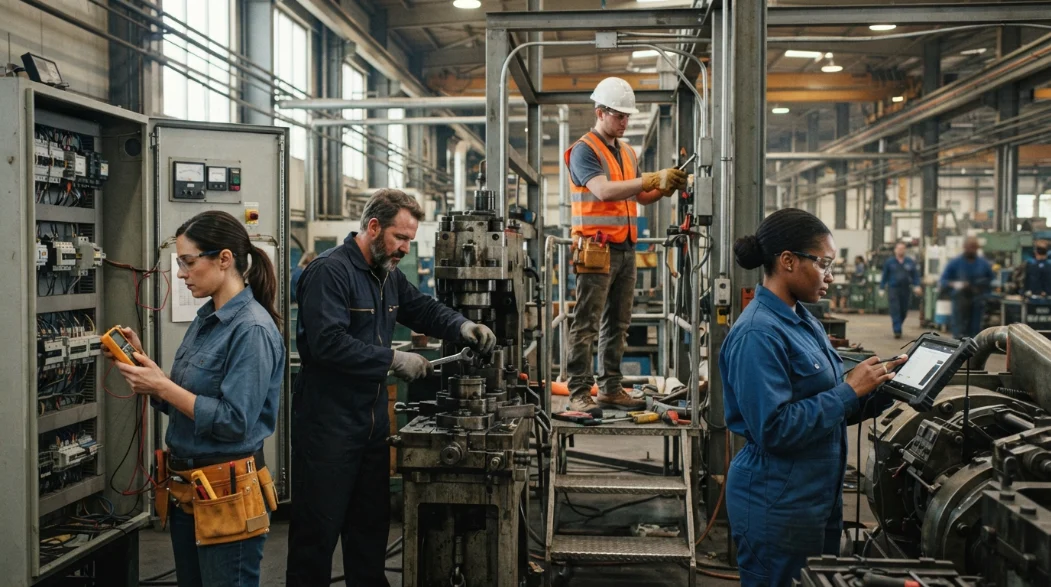
The blue collar meaning is simple: a blue-collar worker is someone who typically does manual, physical, technical, or skilled trade work. Blue-collar jobs can be found in construction, manufacturing, transportation, maintenance, repair, utilities, and many other industries.
The term does not mean that a person is uneducated or has a low-status job. A skilled electrician, mechanic, welder, plumber, or technician can require years of training and practical experience. Many blue-collar occupations demand technical knowledge, problem-solving, safety awareness, and specialized skills.
What Does Blue Collar Mean?
Blue collar describes work and workers traditionally associated with manual or hands-on labor.
A blue-collar worker might build a house, repair machinery, install electrical systems, operate industrial equipment, maintain roads, repair vehicles, or work on a production line.
The word “blue” comes from the traditional work clothing associated with many manual laborers. Dark or blue-colored work clothes were practical because they could hide dirt and wear better than lighter clothing.
Today, the term is broader than its original clothing connection. It generally refers to occupations involving hands-on, physical, technical, industrial, or trade-related work.
Simple Definition
Blue collar means a type of work traditionally involving manual labor, skilled trades, technical tasks, or hands-on physical work.
For example:
- A plumber installing pipes is a blue-collar worker.
- An electrician wiring a building is a blue-collar worker.
- A mechanic repairing an engine is a blue-collar worker.
- A construction worker building a structure is a blue-collar worker.
- A factory technician maintaining equipment can be a blue-collar worker.
What Is a Blue-Collar Worker?
A blue-collar worker is a person employed in a job that generally involves hands-on, physical, mechanical, technical, or trade-related tasks.
The exact boundaries are not always fixed. Some jobs can fall into different categories depending on the industry and the specific duties involved.
For example, a technician who spends most of the day repairing industrial machinery may be considered blue collar. A technician who mainly performs office-based technical analysis may be classified differently.
This shows why the term is best understood as a broad occupational category, not a strict legal classification.
Examples of Blue-Collar Jobs
Blue-collar work exists across many industries.
| Job | Typical Work |
|---|---|
| Electrician | Installs and repairs electrical systems |
| Plumber | Installs and repairs pipes and water systems |
| Welder | Joins metal components using specialized equipment |
| Carpenter | Builds and repairs wooden structures |
| Mechanic | Repairs and maintains vehicles or machinery |
| Construction worker | Performs hands-on building and site work |
| HVAC technician | Installs and services heating and cooling systems |
| Factory worker | Produces, assembles, or handles manufactured goods |
| Machine operator | Operates industrial machinery |
| Heavy equipment operator | Operates cranes, excavators, loaders, and similar equipment |
| Auto technician | Diagnoses and repairs vehicles |
| Maintenance worker | Maintains buildings, machines, and equipment |
| Roofer | Installs and repairs roofs |
| Painter | Applies paint and protective coatings |
| Landscaper | Maintains and develops outdoor spaces |
| Truck driver | Transports goods and materials |
| Railway worker | Performs operational or maintenance duties |
| Utility worker | Maintains infrastructure such as power or water systems |
Some of these positions require formal education, apprenticeships, licenses, certifications, or extensive on-the-job training.
Skilled Blue-Collar Jobs
Not every blue-collar job is unskilled labor.
In fact, many trades require considerable technical expertise.
Consider an electrician. The job involves much more than simply connecting wires. An electrician may need to understand electrical codes, circuits, safety procedures, equipment specifications, and troubleshooting techniques.
The same applies to mechanics, welders, plumbers, HVAC technicians, machinists, and industrial maintenance workers.
Examples of Skilled Trades
- Electrician
- Plumber
- Welder
- Carpenter
- Machinist
- HVAC technician
- Automotive technician
- Industrial maintenance technician
- Heavy equipment technician
- Construction tradesperson
These careers can require apprenticeships, vocational education, certifications, licensing, and years of practical experience.
Blue-Collar vs. White-Collar
The most common comparison is blue collar vs. white collar.
A white-collar job traditionally refers to professional, administrative, managerial, or office-based work. A blue-collar job traditionally involves hands-on, manual, technical, industrial, or trade work.
| Blue Collar | White Collar |
|---|---|
| Often hands-on work | Often office or knowledge-based work |
| Frequently involves physical tasks | Frequently involves administrative or analytical tasks |
| Common in trades and industry | Common in business and professional services |
| Examples include electricians and mechanics | Examples include accountants and managers |
| May require vocational training or apprenticeships | Often requires a college degree, though not always |
| Can involve tools, machinery, or equipment | Often involves computers, documents, meetings, or analysis |
These categories are useful for understanding broad occupational patterns, but modern jobs do not always fit neatly into one box.
For example, a highly trained industrial technician may spend part of the day using computers and analyzing technical data while also performing physical repairs.
Why Is It Called “Blue Collar”?
The term is connected to the clothing historically worn by many manual workers.
Workers in industrial and trade occupations often wore durable work clothes, including blue shirts or uniforms. Darker colors were practical because they could conceal dirt, grease, and stains better than white clothing.
The phrase became associated with working-class and manual occupations during the development of industrial employment.
Over time, blue collar became a general term for a category of work rather than a literal description of someone’s clothing.
Blue-Collar Meaning in the Modern Workplace
The meaning of blue collar has changed as workplaces have changed.
Modern blue-collar workers can use sophisticated tools, computer systems, diagnostic equipment, robotics, digital controls, and specialized software.
A modern manufacturing technician, for example, might operate computerized machinery and interpret digital production data while also performing hands-on maintenance.
This means the old idea of blue-collar work as simply “physical labor” is incomplete.
Today, many blue-collar occupations combine:
- Physical skills
- Technical knowledge
- Digital tools
- Problem-solving
- Equipment operation
- Safety procedures
- Industry-specific training
- Practical decision-making
The line between physical and knowledge-based work has become increasingly blurred.
Are Blue-Collar Jobs Considered Low-Skill Jobs?
No.
Calling a job blue collar does not automatically mean the job is low skill.
Some blue-collar positions require relatively little formal training, while others require extensive technical education and experience.
For example, an experienced industrial electrician may need a detailed understanding of electrical systems, safety standards, equipment, and troubleshooting. A master plumber can also develop highly specialized knowledge through years of training and practical work.
A better distinction is between occupational category and skill level.
Blue collar describes the general nature of the work. It does not, by itself, tell you how difficult, valuable, or specialized that work is.
Blue-Collar Work vs. Manual Labor
The terms blue collar and manual labor are closely related, but they are not identical.
Manual labor focuses on work that involves physical activity or the use of one’s hands and body.
Blue-collar work is a broader occupational category that can include physical labor, skilled trades, equipment operation, technical maintenance, transportation, and industrial work.
For example, a highly trained machine technician may be classified as blue collar even though the job involves substantial technical knowledge alongside physical tasks.
Blue-Collar Jobs in Different Industries
Blue-collar workers are found across a wide range of industries.
Construction
Construction includes occupations such as:
- Carpenters
- Electricians
- Plumbers
- Roofers
- Bricklayers
- Equipment operators
- Welders
These workers help build and maintain homes, commercial buildings, roads, bridges, and infrastructure.
Manufacturing
Manufacturing jobs can involve:
- Machine operation
- Assembly
- Welding
- Quality control
- Equipment maintenance
- Production processes
Modern factories may combine human workers with highly automated machinery and robotics.
Transportation
Transportation is another major area of blue-collar employment.
Examples include:
- Truck drivers
- Delivery workers
- Railway workers
- Vehicle mechanics
- Heavy equipment operators
- Port workers
Maintenance and Repair
Maintenance workers help keep buildings, machines, vehicles, and infrastructure functioning properly.
Examples include:
- Maintenance technicians
- Mechanics
- HVAC technicians
- Industrial repair workers
- Building maintenance workers
Blue-Collar Jobs and Education
A common misconception is that blue-collar workers do not need education.
Many occupations require substantial training, but that training may happen through vocational schools, apprenticeships, technical programs, certifications, or workplace training instead of a traditional four-year university route.
For example, someone pursuing a skilled trade might learn through a combination of:
- Classroom instruction
- Practical training
- Supervised work
- Certification or licensing
- Continued professional development
This creates a different educational pathway rather than an absence of education.
Blue-Collar and White-Collar Are Not Opposites in Every Situation
The terms are often presented as two completely separate categories, but real workplaces are more complicated.
Imagine a large manufacturing company.
A mechanic may repair machinery on the factory floor. An engineer may design the machinery. A supervisor may coordinate the workers. An accountant may manage financial records.
All of these people contribute to the same operation, but their jobs involve different types of work.
A modern economy depends on many occupational roles working together.
Other “Collar” Terms
Blue collar and white collar are not the only occupational labels.
You may also encounter:
Pink Collar
Pink-collar work traditionally refers to occupations historically associated with service and care work, such as certain administrative, hospitality, education, and caregiving roles.
The term has a historical gender dimension and is less precise as a description of modern employment.
Gray Collar
Gray-collar is sometimes used for jobs that combine elements of blue-collar and white-collar work.
Technical and specialized positions can sometimes be described this way, especially when workers combine practical skills with substantial technical or administrative responsibilities.
Gold Collar
Gold-collar has been used to describe highly skilled or specialized professionals whose expertise commands significant economic value.
These labels are informal categories, and their meanings can vary by source and context.
Is a Truck Driver a Blue-Collar Worker?
Generally, yes.
Truck driving is commonly associated with blue-collar work because it involves operating a vehicle as part of a hands-on transportation occupation.
However, modern truck driving can also involve sophisticated technology, route-management systems, electronic records, safety systems, and logistics software.
This is another example of how today’s blue-collar work can combine physical and technical skills.
Is a Mechanic a Blue-Collar Worker?
Yes, mechanics are commonly considered blue-collar workers.
Their work involves diagnosing, maintaining, and repairing vehicles or machinery. Modern mechanics often use computerized diagnostic systems alongside traditional tools.
The occupation illustrates why blue-collar work should not be reduced to simple physical labor. A mechanic needs practical ability, technical knowledge, diagnostic reasoning, and familiarity with increasingly complex equipment.
Is an Electrician a Blue-Collar Worker?
Yes. Electricians are generally considered skilled blue-collar workers.
Their responsibilities can include installing electrical systems, maintaining equipment, identifying faults, reading technical information, and following safety requirements.
Electrical work can require formal training, practical experience, certification, and licensing depending on the location and type of work.
Blue-Collar Work and Society
Blue-collar occupations play an important role in keeping communities and economies functioning.
Buildings need to be constructed and maintained. Vehicles need repairs. Electricity and water infrastructure needs maintenance. Goods need to be manufactured and transported.
These jobs often provide the practical work that allows other economic activities to happen.
For example, an office building may contain accountants, lawyers, designers, and managers, but it also depends on electricians, maintenance workers, cleaners, technicians, security workers, and other operational staff.
The distinction between job categories should therefore not be confused with a measure of a person’s worth.
Common Misconceptions About Blue-Collar Workers
“Blue collar means uneducated.”
Not necessarily. Many blue-collar careers require extensive technical training.
“Blue-collar jobs are always low paying.”
Pay varies significantly by occupation, location, experience, industry, overtime, certifications, and demand for specific skills.
“Blue-collar workers only do physical labor.”
Many modern blue-collar occupations involve computers, diagnostics, technical systems, machinery, and specialized knowledge.
“Blue collar means working in a factory.”
Factories are one part of blue-collar employment. Construction, transportation, utilities, maintenance, repair, and skilled trades are also common examples.
“Blue collar is a formal legal classification.”
Usually, it is an informal occupational term rather than a universal legal category. Specific definitions can vary by organization, industry, or context.
Blue-Collar Meaning in a Sentence
Here are some natural examples:
- My brother works as a mechanic, so he has a blue-collar job.
- The company is hiring blue-collar workers for its manufacturing facility.
- Many blue-collar workers develop specialized technical skills through apprenticeships.
- The article discusses the changing role of blue-collar workers in modern manufacturing.
- Electricians and plumbers are common examples of skilled blue-collar workers.
Blue Collar Meaning:
If you only need the short definition:
Blue collar refers to workers and jobs traditionally associated with manual, physical, technical, industrial, or skilled trade work.
Common examples include electricians, plumbers, mechanics, construction workers, welders, machine operators, factory workers, truck drivers, and maintenance technicians.
The term describes the nature of an occupation. It does not automatically indicate a person’s education, intelligence, income, or social value.
Frequently Asked Questions
What does blue collar mean?
Blue collar refers to jobs traditionally involving manual, physical, technical, industrial, or skilled trade work. Examples include electricians, mechanics, plumbers, construction workers, and welders.
Why are they called blue-collar workers?
The term is associated with the blue or dark work clothing historically worn by many manual workers. These colors were practical for jobs involving dirt, grease, and physical wear.
What are examples of blue-collar jobs?
Common examples include electricians, plumbers, mechanics, welders, carpenters, construction workers, machine operators, factory workers, HVAC technicians, truck drivers, and maintenance workers.
Is a blue-collar job a skilled job?
It can be. Many blue-collar occupations are skilled trades that require technical training, apprenticeships, certifications, licenses, and practical experience.
What is the difference between blue collar and white collar?
Blue-collar work is traditionally associated with manual, technical, industrial, and hands-on occupations. White-collar work is traditionally associated with professional, administrative, managerial, and office-based occupations.
Are blue-collar workers uneducated?
No. Blue-collar workers can have vocational education, apprenticeships, certifications, college degrees, or extensive professional training. The term describes an occupation, not a person’s education.
Is a mechanic a blue-collar worker?
Yes. Mechanics are generally considered blue-collar workers because their jobs involve hands-on maintenance, diagnosis, and repair of vehicles or machinery.
Is an electrician a blue-collar worker?
Yes. Electricians are generally considered skilled blue-collar workers. Their work involves installing, maintaining, and repairing electrical systems.
Can blue-collar jobs pay well?
Yes. Earnings vary widely across occupations and locations. Specialized skills, experience, licensing, industry, demand, and overtime can all affect compensation.
Final Takeaway
The blue collar meaning goes beyond the simple idea of someone doing physical labor. It describes a broad group of occupations involving hands-on work, skilled trades, technical tasks, industrial processes, transportation, maintenance, and practical problem-solving.
A blue-collar worker might operate heavy machinery, repair an engine, install electrical wiring, build a structure, maintain industrial equipment, or transport goods. Many of these careers require significant training and specialized expertise.
Most importantly, blue collar is an occupational description, not a measure of someone’s education, intelligence, income, or worth. As technology changes the workplace, many blue-collar jobs are becoming increasingly technical while still relying on practical, hands-on skills.
Read More Related Articles:
- Parents Meaning | Understanding the Love, Sacrifice, and …
- Limerence Meaning | What It Is, How It Feels, and Why It Can …
- Parasocial Meaning | What One-Sided Connections Really …
