
A stipend is a fixed amount of money given to support someone during an internship, education, research project, or training program. Unlike a regular salary, a stipend is often intended to help cover living or study expenses rather than pay someone for every hour of work. However, its exact purpose depends on the arrangement.
For example, imagine a university student working at a marketing agency for three months. The agency pays the student $400 each month to help cover transportation, meals, and other daily expenses. That payment is a stipend. Similarly, a graduate student may receive monthly financial support while conducting research at a university.
Understanding the stipend meaning can help you read internship advertisements, compare training opportunities, and understand financial support offered by schools or employers. The important thing is to check what the payment covers, how often it is paid, and what conditions come with it.
What Is a Stipend?
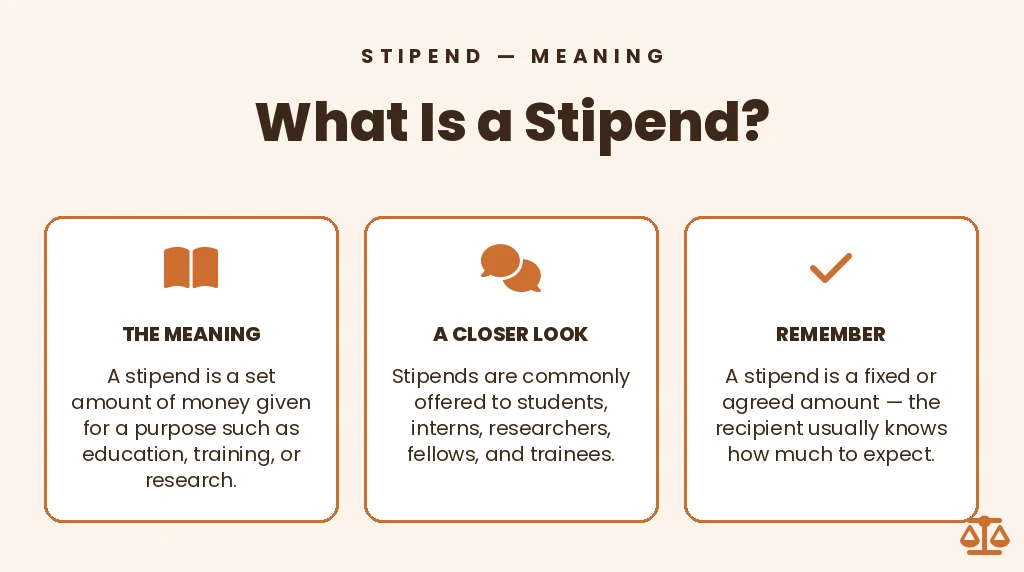
A stipend is a set amount of money provided to a person for a particular purpose, such as supporting education, training, research, or an internship.
Stipends are commonly offered to students, interns, researchers, fellows, and trainees. They may be paid weekly, monthly, per academic term, or according to another agreed schedule.
The payment is often designed to make participation in a program more affordable. For example, an unpaid internship might be difficult for a student who needs to pay for transportation and meals. A stipend can reduce some of that financial pressure.
Here are the main characteristics of a stipend:
- Fixed or agreed amount: The recipient usually knows how much support to expect.
- Specific purpose: The payment is often connected to education, training, research, or living expenses.
- Defined payment schedule: It may arrive monthly, weekly, or according to program rules.
- Different conditions: Some stipends require attendance, participation, research progress, or completion of a program.
- Varied tax treatment: Tax obligations depend on local law and the nature of the payment.
A stipend is not automatically a salary, a scholarship, or a reimbursement. The written agreement and applicable rules determine how the payment should be understood.
Stipend Meaning in Simple English
In simple English, a stipend means money given regularly to help someone cover expenses while studying, training, researching, or participating in a program.
Think of it as financial support that helps a person take part in an opportunity without carrying the entire cost alone.
For example, a college student joins a company for a two-month internship. The company gives the student $250 per month. The student can use this money for transportation, lunch, internet access, or other personal expenses.
That $250 monthly payment is a stipend if the company and the program classify it as such.
The word is especially common in education, research, internships, and nonprofit or public-service programs.
Stipend Meaning in Urdu
The Urdu meaning of stipend is وظیفہ، مالی امداد، or مقررہ مالی رقم, depending on the context.
In everyday Urdu, people may use the word wazifa for financial support given to a student or trainee. However, the exact translation depends on the situation.
For example:
- Student stipend: طالب علم کو دیا جانے والا وظیفہ
- Monthly stipend: ماہانہ مالی رقم
- Internship stipend: انٹرن شپ کے دوران ملنے والی مالی رقم
- Research stipend: تحقیق کے لیے دی جانے والی مالی معاونت
Example in English: The company provides a monthly stipend to its interns.
Meaning in Urdu: کمپنی اپنے انٹرنز کو ہر ماہ ایک مقررہ مالی رقم دیتی ہے۔
Roman Urdu: Company apne interns ko har mahine aik muqarrar raqam deti hai.
Stipend Examples in Everyday Life
The easiest way to understand a stipend is to see how it works in different situations.
| Situation | Example Payment | Purpose |
|---|---|---|
| College internship | $300 per month | Help with meals and transportation |
| University research | $1,500 per month | Support a graduate researcher |
| Teacher training | $200 per month | Help a trainee during the program |
| Educational program | $500 per term | Assist with eligible study expenses |
| Volunteer placement | $250 per month | Help cover basic participation costs |
These amounts are illustrative examples, not typical market rates. Actual payments vary by country, institution, industry, and program.
Example 1: An Internship Stipend
Sara joins a small design agency for a three-month internship. The agency offers her $350 per month.
She uses the money to pay for bus fares, lunch, and mobile data. At the end of each month, she receives the agreed payment.
The $350 is her internship stipend.
The key detail is that the payment is connected to her internship arrangement. The company may have additional obligations depending on local employment law, regardless of the label it uses.
Example 2: A Student Stipend
Ahmed studies engineering at a university. He receives financial support from a program that helps eligible students continue their education.
The program provides $200 each month during the academic year. Ahmed uses the money for books, transportation, and other study-related costs.
This is an example of a student stipend.
The program may require him to maintain enrollment, meet academic conditions, or submit documents to remain eligible.
Example 3: A Research Stipend
A graduate student works on a university research project. The university provides a monthly payment to support the student’s participation and living expenses.
The payment is described as a research stipend.
However, the exact arrangement matters. Some research students receive stipends through scholarships or fellowships, while others are employed as research assistants and receive wages or salaries.
Example 4: A Training Stipend
A trainee enrolls in a professional development program that lasts six months. The organization provides a fixed amount each month to help with expenses.
This payment is a training stipend if the program defines it that way.
It can make training more accessible to people who cannot afford to participate without financial support.
Common Types of Stipends
Stipends appear in several settings. The name usually reflects the purpose of the payment.
1. Internship Stipend
An internship stipend is financial support provided to an intern during a work-placement program.
It may help cover transportation, food, accommodation, or other costs associated with attending the internship. Some internships pay a stipend without providing a conventional salary.
Before accepting an internship, check the monthly amount, payment dates, working hours, duties, and any conditions attached to the payment.
2. Student Stipend
A student stipend helps eligible students manage expenses connected to education.
It may come from a school, university, government program, charitable organization, or another funding body. Eligibility can depend on financial need, academic performance, enrollment status, or program participation.
A student stipend is not always the same as a scholarship. A scholarship may cover tuition, while a stipend may provide money for living or study expenses.
3. Research Stipend
A research stipend supports a person participating in academic or scientific research.
Graduate students and research fellows may receive this type of funding. The payment can help them afford basic expenses while completing a research project or degree.
The funding agreement should explain the payment schedule, duration, eligible expenses, and any academic or research requirements.
4. Monthly Stipend
A monthly stipend is a fixed amount paid once a month.
For example, an organization might provide $600 per month for a six-month training program. If the full amount is paid for all six months, the total would be $3,600.
A monthly schedule makes budgeting easier, but it does not guarantee that the payment will continue if the recipient leaves the program or fails to meet its conditions.
5. Training Stipend
A training stipend helps cover expenses while someone learns a skill or completes a professional program.
It may be available in vocational training, apprenticeships, public-service programs, or employer-sponsored development schemes.
The label alone does not establish the recipient’s employment status. The actual duties and applicable rules also matter.
6. Graduate Stipend
A graduate stipend is financial support provided to eligible postgraduate students, often those completing a master’s degree, doctoral degree, or research program.
Some graduate stipends are connected to teaching or research responsibilities. Others are awarded as part of a fellowship or funding package.
Students should review the full offer, including tuition coverage, fees, health insurance, expected work, and the number of months covered.
Stipend vs. Salary: What Is the Difference?
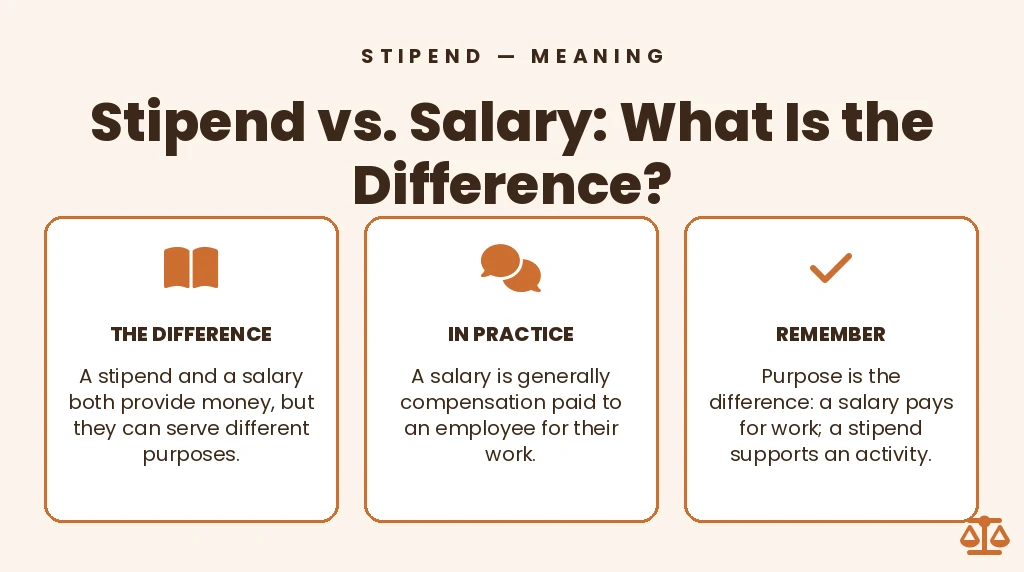
A stipend and a salary both provide money, but they can serve different purposes.
A salary is generally compensation paid to an employee for their work. A stipend is often financial support associated with a particular program, educational activity, training placement, or research arrangement.
The distinction is useful, but it is not absolute. Some organizations use the word stipend for payments connected to work, and the payment’s legal classification depends on the actual arrangement and local law.
| Feature | Stipend | Salary |
|---|---|---|
| Main purpose | Often supports participation or expenses | Generally compensates employment |
| Common recipients | Interns, students, fellows, researchers | Employees |
| Payment schedule | Monthly, weekly, or program-based | Often weekly, biweekly, or monthly |
| Amount | May be fixed by program rules | May be fixed or determined by a pay structure |
| Benefits | Depend on the program and applicable rules | May include employment benefits |
| Tax treatment | Depends on the payment and local law | Usually subject to applicable employment tax rules |
Which Payment Is Better?
Neither payment is automatically better. The right comparison depends on the money you receive, the responsibilities you accept, and the protections available to you.
Imagine two opportunities:
- Opportunity A: A six-month internship with a $500 monthly stipend.
- Opportunity B: A paid position with a $700 monthly salary.
Opportunity B offers more cash each month, but the full comparison also depends on working hours, transportation costs, training value, benefits, and the legal terms of each arrangement.
If the stipend opportunity provides valuable experience and fewer working hours, it might still suit your goals. If you need a dependable income to cover your expenses, the salary position may be more practical.
Always compare the complete terms instead of judging an opportunity by its payment label.
Stipend vs. Scholarship
A stipend and a scholarship can both help students financially, but they are not identical.
A scholarship is generally an award intended to support education. It may pay tuition directly, cover fees, or provide money for other educational costs.
A stipend is generally a payment intended to support someone during a particular activity or program. It may help cover living expenses while the recipient studies or conducts research.
Some educational packages include both.
| Feature | Stipend | Scholarship |
|---|---|---|
| Main purpose | Often supports living or participation costs | Generally supports education |
| Payment form | Often a recurring payment | May be a one-time or recurring award |
| Tuition coverage | Not necessarily included | May cover some or all tuition |
| Living expenses | May be a main purpose | May or may not be covered |
| Conditions | Depend on program rules | Depend on award requirements |
For example, a university might award a student a scholarship that covers tuition and provide a separate monthly stipend for living expenses.
The funding letter should clarify which costs are covered and if any amount must be repaid under specific circumstances.
Stipend vs. Allowance
A stipend and an allowance are related terms, but they often describe different kinds of financial support.
An allowance is commonly an amount provided for a specific expense or category, such as travel, meals, housing, or internet access. A stipend may be a broader fixed payment intended to support participation in a program or help with general expenses.
For example, an employer may provide a trainee with a monthly stipend of $400 and a separate transportation allowance of $50.
The stipend provides broader financial support, while the allowance is designated for a particular purpose.
However, organizations use these terms differently. Check the written policy to understand what each payment covers and how it is treated for tax purposes.
How Does a Stipend Work?
A stipend usually follows a defined agreement or program policy. The details can vary, but the process commonly includes the following steps.
Step 1: The Organization Sets the Amount
The university, employer, research institution, or program provider decides how much financial support is available.
The amount may depend on the budget, funding source, duration, location, and responsibilities involved.
Step 2: The Recipient Meets the Eligibility Requirements
The recipient may need to apply, provide documents, enroll in a course, accept an internship, or qualify for a research program.
Some programs also require ongoing participation or satisfactory progress.
Step 3: The Payment Terms Are Confirmed
The written offer should explain:
- The stipend amount
- Payment frequency
- Start and end dates
- Eligibility conditions
- Any required duties or activities
- Rules for missed participation or early departure
- Applicable tax or reporting information
These details help prevent misunderstandings after the program begins.
Step 4: Payments Are Made
The organization pays the stipend according to the agreed schedule. Payment may be made through a bank transfer, payroll system, student account, or another approved method.
If a payment is delayed, the recipient should check the program’s payment policy and contact the relevant administrator.
Step 5: The Recipient Follows the Program Rules
Some stipends continue only while the recipient remains enrolled, attends required sessions, or meets specified conditions.
The recipient should keep copies of the offer letter, payment records, and any important communication about the arrangement.
How Much Is a Stipend?
There is no universal stipend amount. The payment depends on the country, institution, industry, funding source, experience level, program duration, and expected responsibilities.
An internship stipend may be a few hundred dollars per month in one setting and considerably higher in another. Graduate research funding may be structured differently from short-term training support.
For a meaningful comparison, look at the following factors:
- Location: Living costs and local pay practices affect what counts as adequate support.
- Duration: A short program may offer a different payment structure from a year-long placement.
- Expenses covered: Some programs provide accommodation, meals, transport, or tuition separately.
- Workload: The hours and responsibilities may affect how attractive an offer is.
- Funding conditions: Payments may depend on attendance, academic progress, or continued participation.
- Net value: Taxes, commuting, meals, and other costs affect how much money remains available.
For example, a stipend of $400 per month may be useful if the organization also provides free accommodation and transportation. The same amount could be difficult to manage in a location where the recipient must pay for rent, travel, and meals.
To assess an offer, estimate your monthly expenses and subtract them from the money and benefits you will actually receive.
Is a Stipend Taxable?
A stipend can be taxable, but the answer depends on the country, the recipient’s circumstances, and the purpose of the payment.
Calling a payment a stipend does not automatically make it tax-free.
For example, a payment used for eligible educational expenses may receive different tax treatment from a payment connected to employment or services. Research funding, fellowship payments, and internship compensation can also follow different rules.
If you receive a stipend, check:
- The tax rules in your country or region.
- The terms of the funding or internship agreement.
- Whether the payment is connected to employment, education, research, or another activity.
- Which expenses qualify for any available tax treatment.
- Whether you must report the payment on a tax return.
If the amount is significant or the rules are unclear, consult an appropriately qualified tax professional or the relevant tax authority.
Do not assume that you owe no tax simply because the payment is described as a stipend.
Is a Stipend Considered Income?
A stipend may count as income for tax, financial aid, benefits, or other reporting purposes. The definition of income varies according to the rules being applied.
For example, a university may treat a stipend differently from wages when calculating a particular student benefit. A tax authority may apply its own classification and reporting requirements.
If you are completing a financial aid form, visa application, loan application, or tax return, follow the specific instructions provided by the relevant authority.
Keep the payment letter and supporting records so you can explain the source and purpose of the money if needed.
Advantages and Disadvantages of a Stipend
A stipend can make education, training, and professional development more accessible. However, it may not provide the same financial security or protections as regular employment.
| Advantages | Possible Disadvantages |
|---|---|
| Helps cover everyday expenses | May be too low to cover all living costs |
| Makes some internships more accessible | May not increase with workload |
| Supports education and research | May end when the program finishes |
| Provides predictable payments if terms are fixed | Benefits may be limited or unavailable |
| Can help recipients gain experience | Payment and employment status may be misunderstood |
A stipend is most useful when the payment is clearly defined, the program offers genuine value, and the recipient understands the financial commitment involved.
Before accepting an offer, consider the total cost of participating. A program can provide valuable experience while still being financially impractical for someone who needs to cover substantial living expenses.
What to Check Before Accepting a Stipend Offer
An attractive payment figure does not tell the whole story. Review the details before agreeing to a placement or program.
Confirm the Total Payment
Find out if the quoted amount is monthly, weekly, annual, or for the entire program.
For example, a $1,200 stipend might mean $1,200 per month or $1,200 for a three-month program. Those arrangements are very different.
Check the Payment Schedule
Ask when the first payment arrives and if payments are made in advance or after each period.
This matters if you need to pay transportation or accommodation costs before receiving money.
Understand Your Responsibilities
Read the duties, attendance requirements, expected hours, academic obligations, and performance conditions.
If the arrangement involves substantial work, check how local law classifies it. A company cannot necessarily avoid employment obligations simply by calling compensation a stipend.
Review Additional Benefits
Ask if the organization covers travel, meals, housing, insurance, tuition, or other expenses.
A lower stipend with substantial benefits may be more valuable than a higher payment with no additional support.
Keep Written Records
Save the offer letter, payment terms, receipts, and relevant emails. Written documentation can help resolve disputes over delayed payments, eligibility, or program conditions.
Stipend Synonyms and Related Words
The best synonym for stipend depends on the context. Some related words are close in meaning, while others describe different types of payments.
| Word | Meaning | How It Differs |
|---|---|---|
| Allowance | Money provided for a particular expense or purpose | Often tied to a specific expense category |
| Grant | Money awarded for an approved purpose | May have restrictions and reporting requirements |
| Scholarship | Financial award supporting education | May cover tuition, fees, or living expenses |
| Fellowship | A funded academic, research, or professional opportunity | May include a stipend as part of the funding |
| Salary | Regular compensation for employment | Generally paid in return for work |
| Wage | Payment for work, often calculated hourly or daily | Directly linked to work performed |
| Financial aid | Broad support that helps cover education costs | Can include grants, loans, scholarships, and other assistance |
| Subsistence allowance | Money intended to cover basic living costs | Usually emphasizes essential expenses |
Use stipend when the payment is a fixed form of financial support associated with a program, placement, or activity. Use the more specific term when the funding agreement identifies it as a salary, wage, grant, or scholarship.
How to Use Stipend in a Sentence

Here are examples showing how the word appears in everyday English.
- The company offers a monthly stipend to its interns.
- She received a stipend while completing her research project.
- The university provides a stipend to eligible graduate students.
- My training program includes a small travel allowance and a monthly stipend.
- The internship stipend helps me pay for transportation and meals.
- He accepted the fellowship because it included a stipend for living expenses.
- Students must meet the program requirements to continue receiving their stipend.
- The organization increased the stipend for participants in its training scheme.
These examples show that stipend is usually used as a noun. Common expressions include monthly stipend, student stipend, research stipend, and stipend payment.
Frequently Asked Questions
1. What does stipend mean in simple words?
A stipend is a fixed amount of money given to support someone during an internship, education, training, research, or a similar program.
2. Is a stipend the same as a salary?
No. A salary generally compensates an employee for work, while a stipend often supports participation in a program or helps cover expenses. The legal classification depends on the actual arrangement and applicable law.
3. What is a monthly stipend?
A monthly stipend is a set amount paid once a month. For example, someone receiving $300 each month for four months would receive $1,200 in total if all four payments are made.
4. What is the meaning of stipend in Urdu?
Stipend can mean وظیفہ or مقررہ مالی رقم in Urdu. It often refers to money given to a student, intern, researcher, or trainee for financial support.
5. Who can receive a stipend?
Students, interns, graduate researchers, fellows, trainees, and participants in certain educational or professional programs may receive stipends. Eligibility depends on the organization and its funding rules.
6. Is a stipend taxable?
It can be. Tax treatment depends on the country, the purpose of the payment, and the recipient’s circumstances. Check the applicable tax rules instead of assuming every stipend is tax-free.
7. What is the difference between a stipend and a scholarship?
A scholarship is generally an educational award that may cover tuition or other study costs. A stipend often provides recurring financial support for living expenses or participation in a program. One funding package can include both.
8. Does a stipend have to be paid monthly?
No. A stipend may be paid weekly, monthly, per academic term, or according to a program’s terms. The payment schedule should be stated in the written agreement.
9. Can an internship stipend be negotiated?
Sometimes. The organization may have a fixed budget, but you can politely ask if the amount is flexible or if it offers transportation, meals, housing, or other support.
10. What is another word for stipend?
Related words include allowance, grant, financial support, and subsistence payment. Salary and scholarship may be relevant in some situations, but they are not exact synonyms.
Final Thoughts
The stipend meaning is simple: it is a fixed amount of money provided to support someone during a particular activity, program, or period of study. It is common in internships, universities, research projects, and training opportunities.
The main distinction is that a stipend is often intended to provide financial support, while a salary generally compensates an employee for work. Still, the name alone does not determine the legal or tax treatment of a payment.
If you are considering a stipend, check the amount, payment schedule, responsibilities, benefits, and eligibility rules before accepting. Understanding those details helps you decide if the opportunity is financially worthwhile and suited to your needs.