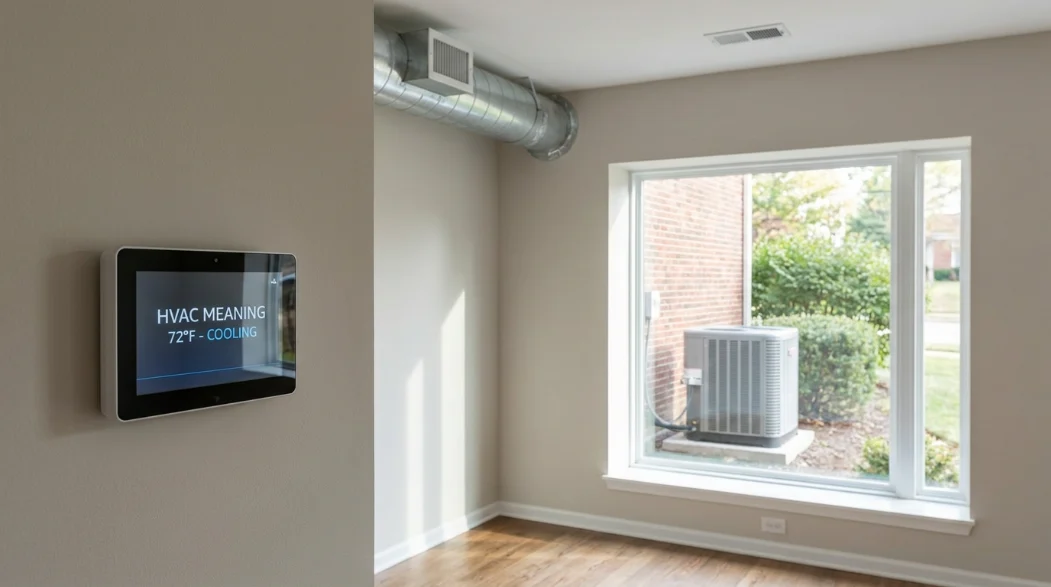
HVAC is one of those terms you may see on a building plan, service bill, job listing, or air-conditioning website without stopping to ask what it actually means. So, what is HVAC? The abbreviation stands for Heating, Ventilation, and Air Conditioning, a system designed to control indoor temperature, airflow, and overall comfort. Understanding the HVAC meaning can make technical conversations much easier, especially when you are comparing equipment, planning home improvements, or speaking with a heating and cooling professional.
But HVAC is about more than simply making a room hot or cold. Modern HVAC systems can influence indoor air quality, energy use, humidity, and everyday comfort. In this guide, you will discover what HVAC means, how each part works, common system types, and why the term matters in 2026.
What Does HVAC Stand For?
HVAC stands for Heating, Ventilation, and Air Conditioning.
Each letter describes an important part of indoor climate control:
| Letter | Meaning | Main purpose |
|---|---|---|
| H | Heating | Keeps indoor spaces warm |
| V | Ventilation | Moves and replaces indoor air |
| A | Air | Refers to air movement and conditioning |
| C | Conditioning | Helps control temperature, humidity, and comfort |
The term HVAC system is commonly used for equipment and components that work together to manage the indoor environment.
For example, a house might use a furnace for heating, an air conditioner for cooling, ducts for distributing air, and a thermostat for controlling the desired temperature. Together, these components form part of the home’s HVAC system.
What Is an HVAC System?
An HVAC system is a group of mechanical and electrical components designed to manage indoor temperature and air conditions.
A basic system may:
- Heat a building during cold weather
- Cool indoor spaces during hot weather
- Move air through rooms
- Filter particles from circulating air
- Control indoor temperature
- Help manage humidity
- Bring in or exhaust air as part of ventilation
Not every HVAC system performs all of these functions in exactly the same way.
A small apartment may have a simple split air-conditioning system with electric heating. A large commercial building can have a much more complicated setup involving rooftop units, extensive ductwork, ventilation equipment, thermostats, and automated controls.
The important point is that HVAC is a category of climate-control systems, not the name of one particular machine.
How Does HVAC Work?
Although HVAC systems vary considerably, the basic idea is straightforward.
The system responds to indoor conditions and the temperature setting selected on a thermostat or control system. It then uses heating, cooling, ventilation, or air-distribution equipment to move the indoor environment closer to the desired conditions.
Heating
A heating component raises indoor temperature when a space becomes too cold.
Common heating equipment includes:
- Furnaces
- Boilers
- Heat pumps
- Electric resistance heaters
A furnace typically heats air and sends it through ducts. A boiler heats water, which can then circulate through radiators or other heating devices.
A heat pump works differently. Instead of creating heat through combustion, it transfers heat from one location to another. Depending on the type of heat pump, it can provide both heating and cooling.
Ventilation
Ventilation is about managing the movement and replacement of air.
Indoor air can contain moisture, odors, dust, and other pollutants. Ventilation systems can help remove stale air and introduce fresh outdoor air.
Ventilation can be:
- Natural, using openings such as windows and vents
- Mechanical, using fans and dedicated ventilation equipment
- Exhaust-based, removing air from specific areas
- Balanced, bringing in outdoor air while exhausting indoor air
Ventilation is particularly important in spaces such as kitchens, bathrooms, offices, and commercial buildings.
Air Conditioning
Air conditioning removes heat from indoor air to make a space cooler.
A typical air conditioner uses a refrigeration cycle to transfer heat from inside the building to the outdoors.
It also removes some moisture from the air as part of the cooling process. This can make the indoor environment feel more comfortable, especially in humid climates.
Air Distribution
Producing conditioned air is only part of the job. That air also needs to reach the rooms where it is needed.
Ductwork, vents, registers, fans, and air handlers can all play a role in distributing air.
Poorly designed or damaged ducts can reduce system performance, create uneven temperatures, and increase energy use.
Main Components of an HVAC System
Different HVAC systems use different components, but several parts appear frequently.
| Component | What it does |
|---|---|
| Thermostat | Measures or responds to temperature and controls the system |
| Furnace | Produces heat for indoor heating |
| Air conditioner | Removes heat from indoor air |
| Heat pump | Transfers heat for heating or cooling |
| Air handler | Moves and conditions air |
| Ductwork | Carries conditioned air through a building |
| Filters | Capture particles from circulating air |
| Vents/registers | Allow air to enter or leave rooms |
| Compressor | Drives the refrigeration cycle in many cooling systems |
| Evaporator coil | Absorbs heat from indoor air during cooling |
| Condenser coil | Releases heat outside |
| Blower fan | Moves air through the system |
A technician does not necessarily work with every component listed above. The equipment depends on the particular HVAC design.
HVAC vs. AC: Are They the Same Thing?
No. HVAC and AC are not interchangeable terms.
AC means air conditioning, which primarily refers to cooling indoor spaces.
HVAC is broader. It includes heating, ventilation, and air conditioning.
For example:
- A window air conditioner is an AC appliance.
- A furnace is heating equipment.
- A complete system containing heating, cooling, and ventilation equipment can be described as an HVAC system.
Think of AC as one part of the larger HVAC category.
This distinction matters when reading equipment specifications or talking to a contractor. Someone asking for an “AC repair” may only need help with the cooling equipment, while an HVAC service can involve heating, ventilation, controls, ductwork, and cooling.
Common Types of HVAC Systems
There is no single HVAC setup that works for every building.
Split HVAC Systems
A split system separates major components between indoor and outdoor locations.
A common residential setup has an outdoor condenser unit and an indoor air handler or furnace.
These systems are widely used because the components can be arranged efficiently around the building.
Packaged HVAC Systems
A packaged system places several major components in one outdoor cabinet or unit.
These systems are often found in certain commercial applications and buildings where a centralized packaged solution makes sense.
Heat Pump Systems
Heat pumps can provide heating and cooling by transferring heat.
They are especially interesting in climates where efficient heating and cooling from one system is practical.
Common types include:
- Air-source heat pumps
- Ground-source heat pumps
Ductless Mini-Split Systems
Ductless systems use an outdoor unit connected to one or more indoor units.
They are useful in buildings that do not have existing ductwork or in rooms where extending ducts would be difficult.
Central HVAC Systems
Central systems condition air at a central location and distribute it throughout a building.
Ductwork plays an important role in many central systems.
Commercial HVAC Systems
Commercial buildings often require larger and more sophisticated systems.
An office, hospital, shopping center, school, or industrial facility may use multiple HVAC units, extensive ventilation equipment, building controls, and specialized systems.
Why Ventilation Is an Important Part of HVAC
People sometimes think HVAC is mainly about heating and cooling. Ventilation deserves equal attention.
A building can have a comfortable temperature and still have poor indoor air conditions.
Ventilation helps manage indoor air by controlling the exchange between indoor and outdoor air. Depending on the system, it can help remove excess moisture, odors, and airborne contaminants.
However, ventilation alone does not guarantee good indoor air quality.
Air filtration, humidity control, source control, proper maintenance, and building design can all matter.
This is one reason the term HVAC is more accurate than simply calling every climate-control system an “air conditioner.”
What Does an HVAC Technician Do?
An HVAC technician installs, maintains, troubleshoots, and repairs heating and cooling equipment.
Depending on their training and the job, an HVAC technician may work with:
- Furnaces
- Air conditioners
- Heat pumps
- Thermostats
- Air handlers
- Ductwork
- Refrigeration components
- Electrical controls
- Ventilation equipment
- Filters and airflow problems
For example, if one room is consistently warmer than another, the solution may not simply be replacing the air conditioner. The technician might investigate airflow, ductwork, insulation, thermostat location, equipment capacity, or other factors.
That is an important practical point: an HVAC problem is not always an equipment problem.
HVAC and Indoor Air Quality
HVAC systems can influence indoor air quality, but their effect depends heavily on system design and maintenance.
Several factors can matter:
- Air filtration
- Outdoor-air ventilation
- Humidity levels
- Duct cleanliness and condition
- Equipment maintenance
- Moisture control
- Airflow
- Indoor pollutant sources
For example, changing a filter can help maintain airflow and filtration, but it does not solve every indoor air quality issue.
Similarly, simply installing a more powerful air conditioner does not automatically make indoor air healthier.
Good HVAC performance requires the system to be appropriately designed, installed, operated, and maintained.
HVAC Maintenance: What Should You Pay Attention To?
Regular maintenance can help identify problems before they become larger and more expensive.
Useful maintenance tasks can include:
- Checking or replacing air filters
- Keeping outdoor equipment clear of debris
- Inspecting ducts where accessible
- Checking airflow
- Inspecting electrical connections
- Checking refrigerant-related components when appropriate
- Cleaning relevant coils and components
- Testing thermostats and controls
- Checking heating equipment before the heating season
The correct maintenance schedule depends on the equipment and manufacturer recommendations.
Homeowners should also avoid treating every HVAC task as a DIY project. Electrical components, refrigerant systems, combustion equipment, and other specialized parts can require qualified professional service.
Why HVAC Efficiency Matters
HVAC equipment can account for a significant portion of a building’s energy use, especially in climates with heavy heating or cooling demand.
Efficiency is not only about buying the most expensive unit.
The overall performance of an HVAC system can be influenced by:
- Equipment efficiency
- Building insulation
- Air leakage
- Duct condition
- System sizing
- Thermostat settings
- Maintenance
- Climate
- Occupancy
- Installation quality
A highly efficient air conditioner cannot compensate for every building problem.
For example, a house with poor insulation may require much more cooling than a well-insulated house, even if both use similar equipment.
This is why HVAC efficiency should be considered as part of the entire building rather than judged only by the equipment label.
HVAC Example in Everyday Life
Imagine a two-story home during a hot summer afternoon.
The thermostat detects that the indoor temperature has risen above the selected setting. The cooling system starts operating.
The air conditioner removes heat from indoor air. A blower moves the conditioned air through the ductwork and into different rooms.
At the same time, filters help capture particles from circulating air.
The thermostat continues monitoring conditions and eventually signals the system to stop cooling when the desired temperature is reached.
That simple cycle involves several components working together.
This is the practical meaning of an HVAC system: coordinated equipment and controls designed to maintain a suitable indoor environment.
HVAC Meaning in Different Contexts
You may encounter the word HVAC in several situations.
On a Property Listing
“Central HVAC” usually indicates that the property has a central heating and/or cooling system rather than relying entirely on individual portable appliances.
The exact equipment should still be verified.
In a Job Description
An HVAC job may involve installing, maintaining, or repairing heating, cooling, ventilation, and related equipment.
On an Equipment Label
HVAC may refer to the general system category rather than one specific component.
On a Repair Invoice
The term can describe the type of service being performed, such as HVAC maintenance, heating repair, or cooling-system troubleshooting.
HVAC vs. Heating, Ventilation, and Air Conditioning
The full phrase Heating, Ventilation, and Air Conditioning explains the three major areas represented by HVAC.
| Term | Focus |
|---|---|
| Heating | Raising indoor temperature |
| Ventilation | Managing indoor and outdoor air exchange |
| Air conditioning | Cooling indoor spaces and often removing moisture |
| HVAC | The broader system category combining these functions |
Not every building uses separate equipment for every function. Some modern systems combine multiple functions into one piece of equipment.
Common HVAC Terms You May See
If you’re researching HVAC equipment, these terms can appear frequently.
Thermostat: A control that monitors or responds to temperature and signals equipment to operate.
Air handler: Equipment that moves and sometimes conditions air in a building.
Ductwork: A network of passages used to distribute air.
Furnace: Heating equipment that typically heats air for distribution.
Heat pump: Equipment that transfers heat to provide heating or cooling.
Compressor: A major component in many refrigeration and air-conditioning systems.
Refrigerant: A working fluid used in refrigeration and many air-conditioning systems to transfer heat.
Filter: A component designed to capture particles from air passing through the system.
Vent: An opening or device associated with air movement into or out of a space.
Knowing these terms makes HVAC manuals, service estimates, and equipment descriptions much easier to understand.
How to Choose the Right HVAC System
Choosing an HVAC system is not simply a matter of picking the biggest or cheapest unit.
Important factors include:
- Building size: The heating and cooling load depends partly on the size and characteristics of the space.
- Local climate: Heating-dominated and cooling-dominated climates create different requirements.
- Insulation: Better insulation can reduce heating and cooling demand.
- Existing ductwork: A ducted system may make sense when suitable ducts already exist.
- Energy efficiency: More efficient equipment can reduce operating costs.
- Installation quality: Correct installation is critical to system performance.
- Maintenance requirements: Different systems have different service needs.
- Budget: Both purchase cost and long-term operating costs matter.
Professional load calculations and appropriate equipment selection are more reliable than choosing equipment based only on floor area.
What Does HVAC Mean in Simple Words?
In simple words, HVAC means the systems that help control the temperature and air inside a building.
The abbreviation stands for:
H = Heating
V = Ventilation
AC = Air Conditioning
An HVAC system can heat your home in winter, cool it in summer, move air through rooms, and support indoor comfort and air management.
So, when someone says “the HVAC system,” they are generally talking about the building’s heating, cooling, ventilation, and related control equipment.
Frequently Asked Questions
What does HVAC mean?
HVAC stands for Heating, Ventilation, and Air Conditioning. It is a broad term for systems used to heat, cool, circulate, and manage air inside buildings.
What does HVAC stand for in construction?
In construction, HVAC stands for Heating, Ventilation, and Air Conditioning. The term covers the systems and equipment designed to provide indoor temperature control, ventilation, and air distribution.
Is HVAC the same as AC?
No. AC means air conditioning, while HVAC is a broader term that includes heating, ventilation, and air conditioning.
What are the main parts of an HVAC system?
Common components include a thermostat, furnace or heat pump, air conditioner, air handler, blower, filters, ductwork, coils, compressor, and vents. The exact components vary by system.
What does an HVAC technician do?
An HVAC technician may install, inspect, maintain, troubleshoot, and repair heating, cooling, ventilation, and related equipment.
Does HVAC include ventilation?
Yes. Ventilation is one of the three components represented by the HVAC abbreviation. It involves managing the movement and exchange of indoor and outdoor air.
Is a heat pump an HVAC system?
A heat pump is HVAC equipment that can provide heating and cooling. It can form the main heating and cooling component of an HVAC system.
Why is HVAC important?
HVAC systems help maintain comfortable indoor temperatures and can support air movement, ventilation, humidity management, and indoor air conditions.
How often should an HVAC system be maintained?
Maintenance frequency depends on the equipment, manufacturer recommendations, operating conditions, and local environment. Filters may need attention more frequently than other components.
Final Takeaway
HVAC means Heating, Ventilation, and Air Conditioning. It is a general term for the systems that manage indoor heating, cooling, air movement, and related environmental conditions.
An HVAC system can be simple, such as a small ductless setup, or highly complex, such as the climate-control system in a large commercial building.
The key distinction to remember is simple: AC is mainly about cooling, while HVAC describes the wider system of heating, ventilation, and air conditioning.
Read More Related Articles:
- Nonchalant Meaning | The Cool, Unbothered Attitude Behind …
- TLDR Meaning Explained | The Internet Shortcut Behind …
- Humility Meaning | The Quiet Strength Behind Confidence …
