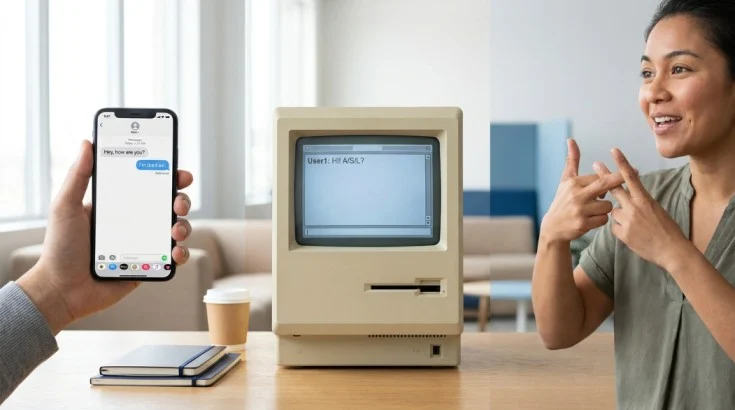
Seeing “asl” in a text can leave you wondering what the person actually meant. One minute it looks like ordinary internet slang. The next, it appears to be a question about someone’s personal information. Then you see ASL in a school course or accessibility discussion and discover that it means something completely different.
That’s because ASL has multiple established meanings. The intended meaning depends heavily on the sentence, platform, conversation, and even the position of the abbreviation.
In modern casual texting, asl often means “as hell.” It works as an intensifier in phrases such as “tired asl” or “funny asl.” In older internet chat culture, ASL or A/S/L meant “age, sex, location,” a quick way to ask a stranger for basic personal information. In another completely different context, ASL stands for American Sign Language, a complete natural language with its own grammar and structure.
So, what does ASL mean? There isn’t one answer that fits every conversation. Context is the key.
What Does ASL Mean?
ASL is an abbreviation or initialism with several common meanings. The three meanings most relevant to everyday language are:
- As hell modern informal internet slang used for emphasis.
- Age, sex, location an older online chat abbreviation used to ask personal details.
- American Sign Language a complete natural visual language used primarily within the Deaf community in the United States and parts of Canada.
Here’s the easiest way to tell them apart:
| ASL usage | Meaning | Typical context | Example |
|---|---|---|---|
| asl | As hell | Texting, comments, social media | “I’m tired asl.” |
| ASL? / A/S/L? | Age, sex, location | Chatrooms, online conversations | “Hey, ASL?” |
| ASL | American Sign Language | Education, accessibility, Deaf culture | “I’m learning ASL.” |
The spelling alone doesn’t always settle the question. Someone can write ASL, asl, or A/S/L in informal communication. The surrounding words usually provide the better clue.
For example, compare these two sentences:
“That test was hard asl.”
Here, asl means “as hell.”
Now consider:
“Hey, what’s your ASL?”
That older conversational pattern points toward “age, sex, location.”
Finally:
“She took an ASL class.”
The context clearly refers to American Sign Language.
The same three letters can therefore act like three different doors. You need the sentence around them to know which door to open.
ASL Meaning in Texting
In current casual texting, one of the most common interpretations of lowercase asl is “as hell.”
People use it to make an adjective or description stronger. It serves a similar purpose to words such as very, extremely, or really, although its tone is much more informal.
Consider these examples:
- “I’m hungry asl.”
- “That game was difficult asl.”
- “She’s funny asl.”
- “It’s cold asl today.”
- “That dog is cute asl.”
- “I’m tired asl.”
- “This place is crowded asl.”
In each example, asl intensifies the word immediately before it.
How “As Hell” Works in a Sentence
The pattern is usually simple:
adjective + asl
For example:
“That movie was scary asl.”
The speaker isn’t asking about age, sex, or location. They’re saying the movie was extremely scary.
Another example:
“I’m busy asl today.”
The intended meaning is roughly “I’m extremely busy today.”
The slang version feels stronger and more casual than simply saying “very.”
That difference matters.
If a friend texts:
“I’m hungry asl.”
the phrase sounds natural in casual digital conversation.
However, putting the same wording into a formal business email would be inappropriate. A professional message would normally use something like “very hungry” or simply avoid the unnecessary emphasis altogether.
Why People Write “asl” Instead of “as hell”
Texting favors speed, brevity, and recognizable patterns. Digital communication has created thousands of shortened expressions because people often want to communicate an idea quickly without typing every word.
In this case, three letters can replace a longer phrase.
The result is compact:
“That was funny asl.”
Instead of:
“That was funny as hell.”
The meaning remains easy to understand for people familiar with the slang.
Still, not every reader will interpret it that way. Someone familiar with older internet culture may see ASL and immediately think “age, sex, location.”
That’s where context becomes important.
What Does ASL Mean in Slang?
When asl appears as modern slang, it generally works as an intensifier.
An intensifier adds force to another word or expression. English has many of them:
- very
- really
- extremely
- incredibly
- unbelievably
In casual internet slang, asl can perform a similar job.
ASL Slang Examples
| Text | Meaning |
|---|---|
| “Funny asl” | Extremely funny |
| “Tired asl” | Extremely tired |
| “Cute asl” | Very cute |
| “Cold asl” | Extremely cold |
| “Busy asl” | Extremely busy |
| “Loud asl” | Extremely loud |
| “Hungry asl” | Extremely hungry |
| “Expensive asl” | Extremely expensive |
The phrase usually follows the word it intensifies.
For example:
“That restaurant was expensive asl.”
The speaker isn’t defining the restaurant. They’re emphasizing the degree of its expense.
ASL Slang Is Highly Informal
This distinction is worth remembering.
“As hell” is casual language. The abbreviated form asl is even more tied to online conversation.
You might see it in:
- Text messages
- TikTok comments
- Instagram comments
- Snapchat conversations
- Discord chats
- Group chats
- Memes
- Casual posts
- Gaming conversations
You generally wouldn’t use it in:
- Academic essays
- Formal reports
- Job applications
- Business proposals
- Professional emails
- Official documents
Language isn’t just about meaning. Register matters too.
A word can be grammatically understandable while still being completely wrong for the setting.
What Does ASL Mean in Chat?
The answer depends on how the abbreviation appears.
If someone writes:
“I’m tired asl.”
the meaning is probably “as hell.”
If someone sends:
“ASL?”
the traditional interpretation is “age, sex, location?”
If someone says:
“I’m taking ASL this semester.”
they’re talking about American Sign Language.
This gives you a useful three-part test:
1. Is ASL Following an Adjective?
If yes, “as hell” is often the intended meaning.
Example:
“That was weird asl.”
2. Is ASL Written as a Standalone Question?
If someone writes “ASL?”, especially while meeting an unknown person online, the historical meaning is likely “age, sex, location?”
3. Is the Conversation About Language or Signing?
If the discussion involves Deaf culture, interpreters, signing, fingerspelling, or language classes, ASL almost certainly means American Sign Language.
This simple approach solves most everyday confusion.
ASL Meaning in Messages
Text messages provide very little context sometimes. A single abbreviation can therefore be ambiguous.
Imagine receiving:
“ASL?”
If you’ve never encountered old internet slang, you might wonder whether the sender is asking about American Sign Language.
In a traditional online chat context, however, the person is likely asking:
- How old are you?
- What is your sex or gender?
- Where are you located?
Now imagine receiving:
“That was awkward asl.”
The grammatical structure changes everything.
Here, asl follows the adjective awkward. It means “awkward as hell.”
This is why reading the entire sentence is more useful than searching for a single definition.
A Quick ASL Message Decoder
| Message | Likely interpretation |
|---|---|
| “I’m tired asl.” | As hell |
| “That’s funny asl.” | As hell |
| “ASL?” | Age, sex, location |
| “What is your ASL?” | Age, sex, location |
| “I study ASL.” | American Sign Language |
| “ASL interpreter” | American Sign Language |
| “ASL grammar” | American Sign Language |
| “Learn ASL signs” | American Sign Language |
The position of ASL is often just as informative as the capitalization.
ASL Meaning on Social Media
Social media has helped create a strange overlap between old internet language and newer slang.
A person who spent years using early chatrooms might see ASL and remember the question “age, sex, location?”
A younger social media user may see:
“That outfit is cute asl.”
and immediately understand asl as “as hell.”
Both interpretations exist.
That’s why social media can produce amusing misunderstandings. Internet language doesn’t always replace old meanings completely. Sometimes it adds a new meaning on top of an older one.
ASL Meaning on TikTok
On TikTok, lowercase asl commonly appears in casual comments and captions as an intensifier.
Examples include:
“This is funny asl.”
“Bro is fast asl.”
“That transition was clean asl.”
In these examples, the abbreviation adds emphasis.
The exact tone depends on the creator and audience. Some people use it casually while others may avoid it because they don’t like slang abbreviations.
ASL Meaning on Snapchat
Snapchat conversations are highly informal, so asl may appear as slang.
For example:
“I’m tired asl.”
means the person is extremely tired.
However, a standalone:
“asl?”
can carry the older age, sex, location meaning.
That distinction becomes particularly important when talking to someone you don’t know.
ASL Meaning on Instagram
Instagram comments and direct messages can contain either modern slang or older internet shorthand.
Consider:
“That picture is cute asl.”
Here, the meaning is “cute as hell.”
But:
“Hey, ASL?”
could be asking for age, sex, and location.
The topic and sentence structure provide the clue.
ASL Meaning on Discord
Discord has many different communities, so there isn’t one universal style.
In a gaming server, someone might write:
“That boss was hard asl.”
Here, asl means “as hell.”
In an anonymous social channel, someone could instead type:
“asl?”
That may revive the older chatroom meaning.
Discord demonstrates an important point about internet slang: platform names alone don’t determine meaning. Community context does.
ASL Meaning on Facebook
Facebook conversations can contain older and newer forms of internet language because its user base spans several generations.
An older user may recognize ASL primarily as “age, sex, location.”
A younger user may recognize asl as “as hell.”
Someone discussing accessibility or language education may use ASL for American Sign Language.
Again, context wins.
What Does “ASL?” Mean?
When someone sends only:
ASL?
the traditional meaning is:
Age, sex, location?
It is essentially a compressed three-part personal question.
The three letters represent:
- A = Age
- S = Sex
- L = Location
A historical response might look like:
“22/F/Texas”
That would communicate the person’s age, sex, and general location.
The abbreviation became useful because early online conversations often involved strangers who had little or no profile information.
Today, however, the meaning is much less universal.
A person who has never used old-school chatrooms may not recognize the question immediately. Someone familiar with modern slang may interpret asl differently.
ASL Age, Sex, Location Meaning
The age, sex, location meaning belongs strongly to early internet chat culture.
Before modern social media profiles became normal, an online username could tell you almost nothing about the person behind it.
You might enter a chatroom and see usernames such as:
BlueSky92
GamerTom
StarGirl
There might be no profile photograph, biography, verified account, or visible personal information.
So someone could simply type:
“A/S/L?”
The request compressed three questions into one.
What Each Letter Means
A: Age
The person wanted to know how old you were.
S: Sex
The traditional abbreviation used the word “sex” to ask about a person’s sex. Modern discussions of identity often use more precise language depending on what information is actually relevant.
L: Location
The person wanted to know where you were from or where you were located.
The location could be broad, such as a state, city, or country.
It didn’t necessarily mean someone was asking for a street address.
Why A/S/L Became Popular
Early internet communication lacked many features people now take for granted.
Modern social profiles can display:
- A profile picture
- A display name
- A biography
- A location
- Mutual friends
- Interests
- Posts
- Videos
- Other identifying information
Early chatrooms were much more anonymous.
As a result, A/S/L became a quick conversational shortcut.
Research on early online chat found that the expression was a conventional way for participants to ask about each other’s basic characteristics. One study of teen chatroom interaction described a/s/l as a well-established chat convention.
A later summary of internet chat history also notes that A/S/L became particularly associated with chatrooms and instant messaging during the late 1990s and early 2000s.
The History of ASL as “Age, Sex, Location”
The history of A/S/L is closely tied to the development of anonymous online conversation.
In the early internet, people frequently met strangers through text-based environments. Unlike today’s social networks, these spaces often gave users very little information about each other.
A/S/L solved a practical communication problem.
Instead of asking three separate questions, users could type three letters:
A/S/L?
The response could also be compressed:
18/F/California
The exchange took only seconds.
A/S/L in Early Chatrooms
Chatrooms created a culture in which short, recognizable expressions mattered.
People were communicating quickly. Messages appeared in a shared stream. Users might enter and leave at any moment.
A long introduction wasn’t always practical.
The abbreviation became a kind of conversational shorthand.
Research from the early 2000s documented A/S/L as a conventional opening in online chat. The expression could function as an initial greeting or a way of learning basic information about another participant.
Why the Meaning Eventually Became Less Central
Online communication changed dramatically.
Social networks introduced profiles. Instant messaging became more personal. Photos became normal. Video calls became widespread. Dating apps began displaying structured profile information.
The need to type:
“A/S/L?”
became less important.
A stranger could often see at least some information before starting a conversation.
That didn’t erase the expression completely. It simply made it less central to everyday online communication.
Is ASL Still Used to Mean Age, Sex, Location?
Yes, but it is far less central to mainstream online communication than it was during the early chatroom era.
You may still encounter:
- “ASL?”
- “A/S/L?”
- “What’s your ASL?”
- “Age/sex/location?”
The expression can appear in nostalgic discussions of internet culture, anonymous chat environments, gaming spaces, or conversations influenced by older online slang.
However, modern readers shouldn’t automatically assume that every asl means “age, sex, location.”
For example:
“This is good asl.”
is almost certainly not asking for someone’s age.
It’s an intensifier.
Likewise:
“I’m learning ASL.”
is discussing American Sign Language.
The historical meaning survives, but it now shares the same abbreviation with other uses.
Is Asking for ASL Safe?
The old age, sex, location question involves personal information. That doesn’t automatically make every request dangerous, but it does mean you should think before answering.
You don’t owe a stranger personal details.
Especially online, you may not know:
- Who the person really is
- Why they want the information
- Whether their profile is genuine
- What they plan to do with the information
- Whether the location they request is more specific than necessary
A broad answer such as a country or general region reveals less than a precise location.
You Can Decline an ASL Question
If someone sends:
“ASL?”
you can simply respond:
“I don’t share personal information online.”
Or:
“What do you mean by ASL?”
You can also redirect the conversation:
“I’d rather talk about something else.”
There is no rule requiring you to answer.
A conversation starter should remain a choice, not a demand.
How to Respond to “ASL?”
Your best response depends on what the person means.
If They Mean “Age, Sex, Location”
You can answer only the information you’re comfortable sharing.
For example:
“I’m an adult and I’m from the U.S. I don’t share more personal details online.”
Or simply:
“I don’t share that information.”
If You’re Unsure
Ask:
“Do you mean age, sex, location?”
This removes ambiguity immediately.
If They Mean “As Hell”
You don’t need to respond to the abbreviation itself.
For example:
“That movie was scary asl.”
A natural response would be:
“Seriously. The ending was wild.”
If They Mean American Sign Language
You can respond based on the topic.
For example:
“I’m learning ASL.”
A natural reply could be:
“Nice. How long have you been studying it?”
What Does ASL Mean in American Sign Language?
The third major meaning is American Sign Language.
This is completely different from the slang meanings.
American Sign Language is a complete natural language. It has its own grammatical structure and linguistic rules. It isn’t simply English translated into hand movements. The National Institute on Deafness and Other Communication Disorders describes ASL as a complete natural language whose grammar differs from English.
ASL is expressed through a combination of:
- Hand movements
- Handshapes
- Palm orientation
- Location
- Movement
- Facial expressions
- Other non-manual signals
These elements work together to communicate meaning.
That makes ASL much more than a collection of gestures.
ASL Is a Real Language
One common misconception is that sign language is just a visual version of spoken English.
It isn’t.
ASL has its own:
- Grammar
- Syntax
- Vocabulary
- Word order
- Linguistic conventions
- Regional variation
- Discourse patterns
The National Institutes of Health specifically notes that ASL is separate and distinct from English and contains its own rules for word formation and word order.
This distinction matters.
Learning ASL isn’t simply learning how to “sign English words.” You’re learning another language.
American Sign Language and the Deaf Community
ASL plays a major role in the linguistic and cultural life of many Deaf people in North America.
It is used primarily by many Deaf and hard-of-hearing people in the United States and is also used by hearing people.
That means ASL is connected to more than communication alone.
It also intersects with:
- Deaf culture
- Community identity
- Education
- Family communication
- Accessibility
- Social relationships
- Interpreting
- Language development
For many people, ASL is not simply a tool for overcoming hearing differences. It is a language used naturally within a community.
Is ASL Universal?
No.
There is no single universal sign language.
This is one of the most important facts about ASL.
Different regions and countries have developed different sign languages. For example, British Sign Language (BSL) is distinct from American Sign Language. Knowing ASL does not automatically mean that a person understands BSL.
The situation resembles spoken languages.
Knowing English doesn’t automatically mean knowing Spanish. Likewise, knowing ASL doesn’t automatically mean knowing every sign language used around the world.
- ASL and British Sign Language Are Different
- ASL and BSL have different linguistic histories and structures.
- ASL has historical connections with French Sign Language alongside local sign languages that developed in North America. The exact origins are complex, and ASL developed over time rather than being created by one individual or committee.
This history is one reason ASL cannot simply be described as “English in signs.”
How Does ASL Grammar Work?
ASL grammar differs from English grammar.
That difference can surprise beginners because people sometimes expect signed communication to follow the same sentence structure as spoken English.
It doesn’t have to.
ASL can use word order, facial expressions, body movement, and spatial organization to communicate grammatical information.
Gallaudet University teaching materials, for example, describe ASL study as involving syntax, grammar, vocabulary, fingerspelling, numbers, and non-manual signals.
Facial Expressions Are Part of ASL
Facial expressions aren’t merely emotional decoration in ASL.
They can contribute to grammatical meaning.
For example, ASL questions can involve changes in:
- Eyebrow position
- Eye widening
- Head movement
- Body position
The National Institute on Deafness and Other Communication Disorders notes that ASL users can mark questions through facial and body cues, such as raised eyebrows, widened eyes, and a forward body position.
That means looking only at the hands doesn’t give you the entire message.
The face can be part of the grammar.
What Are ASL Signs?
An ASL sign is a meaningful unit used within American Sign Language.
Signs can differ according to several physical parameters.
Educational resources from Gallaudet describe five major parameters associated with ASL signs:
- Handshape
- Palm orientation
- Location
- Movement
- Facial expressions and other non-manual signals
Changing one of these elements can sometimes change the meaning.
This is similar to spoken language, where changing a sound can create a different word.
The physical form of a sign isn’t random. Small differences can carry linguistic information.
What Is the ASL Alphabet?
The ASL alphabet is commonly used for fingerspelling.
Fingerspelling represents letters through specific handshapes.
It is particularly useful for:
- Proper names
- Places
- Names of people
- Specialized terms
- Words without an established sign in a particular context
- Clarifying English spellings
Fingerspelling is therefore part of ASL but isn’t the same thing as ASL itself.
You wouldn’t normally describe the entire language as simply “the alphabet.”
Think of it this way:
The alphabet is one tool inside the language.
The National Institute on Deafness and Other Communication Disorders notes that fingerspelling is part of ASL and is often used for proper names and to indicate English words.
ASL Fingerspelling vs. ASL Grammar
These concepts are easy to confuse.
Fingerspelling focuses on representing letters.
ASL grammar governs how the language communicates complete ideas.
A person can memorize the ASL alphabet without knowing how to hold a full conversation in ASL.
It’s similar to knowing the English alphabet without knowing English grammar.
Learning a language requires much more than memorizing symbols.
Is ASL Just Hand Movements?
No.
Calling ASL “just hand movements” misses much of what makes it a language.
ASL communication can involve:
- Handshape
- Movement
- Direction
- Location
- Palm orientation
- Facial expressions
- Eye gaze
- Body posture
- Spatial relationships
- Timing
Some of these features carry grammatical meaning.
The face and body therefore aren’t merely background signals. They can form part of the linguistic structure itself.
ASL vs. English
ASL and English are separate languages.
English primarily uses an auditory-vocal channel in spoken form. ASL uses a visual-manual-spatial channel.
That difference affects grammar and structure.
For instance, English can mark a question through word order and rising intonation. ASL can use facial and body markers as part of the question structure.
The difference goes deeper than changing English words into signs.
A fluent ASL user isn’t simply performing a word-for-word translation of an English sentence.
They’re using ASL.
That distinction is essential for anyone learning the language.
ASL Has Regional Variation
Another sign that ASL functions like a natural language is variation.
People don’t necessarily sign exactly the same way in every location.
ASL has regional variations in signs, rhythm, pronunciation-like features, slang, and usage. Age, gender, and other social factors can also influence how individuals use the language.
This is similar to spoken languages.
English speakers from different regions can use different words or pronunciations while still understanding each other.
ASL can show comparable variation.
So there isn’t necessarily one single “perfect” way that every signer uses every sign.
What Does an ASL Interpreter Do?
An ASL interpreter facilitates communication between people using different languages or communication modes.
Depending on the situation, an interpreter may help Deaf and hearing people communicate in settings such as:
- Education
- Healthcare
- Legal environments
- Public services
- Workplaces
- Conferences
- Community events
Interpreting isn’t simply replacing each English word with a sign.
A skilled interpreter needs strong language knowledge, contextual awareness, and the ability to convey meaning accurately between languages.
That’s another reason why ASL should be understood as a complete language rather than a collection of gestures.
ASL Meaning From a Girl or Guy
Searches such as “ASL meaning from a girl” or “ASL meaning from a guy” can be misleading because the sender’s gender doesn’t determine the definition.
Context matters more.
If someone sends:
“ASL?”
the traditional meaning may be age, sex, location.
If someone writes:
“You’re cute asl.”
the meaning is “you’re extremely cute.”
If someone says:
“Do you know ASL?”
they may be asking whether you know American Sign Language.
The same abbreviation can therefore appear in conversations with romantic, friendly, educational, or completely unrelated contexts.
Don’t try to decode ASL based only on who sent it.
Look at the sentence.
ASL Meaning in Casual Communication
Internet language evolves quickly.
People shorten phrases, repurpose old abbreviations, create new meanings, and sometimes bring old expressions back into circulation.
ASL is a good example of that process.
Its history shows three different layers:
Older internet meaning
A/S/L = Age, Sex, Location
Modern slang meaning
asl = as hell
Language meaning
ASL = American Sign Language
These meanings don’t necessarily compete.
They occupy different conversational spaces.
The trick is recognizing which space you’re in.
ASL Acronym or Initialism?
People often call every shortened expression an acronym, but there’s a useful distinction.
An acronym is usually pronounced as a word, such as “NASA.”
An initialism is normally pronounced letter by letter, such as “FBI.”
ASL is commonly treated as an initialism because people generally say the individual letters when referring to American Sign Language or the older “age, sex, location” expression.
In everyday writing, however, people frequently use the broader word abbreviation.
So searches for ASL acronym meaning, ASL abbreviation, and ASL full form can all point toward the same basic question even though the linguistic labels aren’t identical.
ASL Full Form
There isn’t one universal ASL full form.
The correct expansion depends on context.
| Full form | Meaning |
|---|---|
| American Sign Language | A natural visual language |
| Age, Sex, Location | An older internet chat question |
| As hell | Modern informal slang |
This is why simply memorizing “ASL means ___” isn’t enough.
The better approach is to recognize the context.
ASL Meaning Depending on Context
Here’s the most practical way to understand the abbreviation:
If ASL describes something, it often means “as hell.” If someone asks “ASL?” they may mean “age, sex, location.” If the conversation concerns signing or Deaf culture, it means “American Sign Language.”
That isn’t an absolute rule, but it works well as a first filter.
Context Clue 1: Grammar
Look at what comes before ASL.
“Funny asl.”
Likely as hell.
Context Clue 2: Punctuation
“ASL?”
A standalone question suggests the older chat meaning.
Context Clue 3: Topic
“ASL class”
Likely American Sign Language.
Context Clue 4: Vocabulary
Words such as:
- interpreter
- signing
- fingerspelling
- Deaf
- grammar
- language
- signs
strongly point toward American Sign Language.
Words such as:
- tired
- funny
- cute
- weird
- hungry
- crazy
- cold
often appear before the slang use asl.
Common Mistakes About ASL Meaning
Several misunderstandings appear again and again.
Mistake 1: Assuming ASL Always Means American Sign Language
ASL has important slang and historical meanings too.
If someone writes:
“I’m hungry asl.”
they aren’t discussing sign language.
Mistake 2: Assuming ASL Always Means Age, Sex, Location
That interpretation is strongly associated with older internet chat culture.
Modern slang frequently uses asl to mean “as hell.”
Mistake 3: Thinking Capitalization Solves Everything
Capitalization helps sometimes, but it isn’t a perfect decoder.
People often type casually and inconsistently online.
Mistake 4: Treating ASL as English in Hand Gestures
American Sign Language is a complete natural language with its own grammar.
It isn’t simply signed English.
Mistake 5: Assuming Sign Language Is Universal
ASL is one sign language among many.
British Sign Language, for example, is a distinct language.
Mistake 6: Sharing Personal Information Automatically
If someone asks:
“ASL?”
you don’t have to provide your age or location.
A stranger’s question doesn’t create an obligation to answer.
ASL vs. Similar Texting Abbreviations
ASL belongs to a much larger world of online shorthand.
Here are a few common examples:
| Abbreviation | Meaning | Typical use |
|---|---|---|
| ASL | As hell / Age, sex, location / American Sign Language | Context-dependent |
| IDK | I don’t know | Uncertainty |
| TBH | To be honest | Personal opinion |
| IMO | In my opinion | Expressing a view |
| BTW | By the way | Adding information |
| BRB | Be right back | Temporary absence |
| FYI | For your information | Sharing information |
| LOL | Laughing out loud | Humor or reaction |
The important difference is that ASL has unusually different meanings across unrelated contexts.
That’s why it can cause more confusion than many common texting abbreviations.
ASL in Digital Communication
Digital communication constantly reshapes language.
People type quickly. Platforms have character limits or fast-moving conversations. Memes spread expressions across communities. Younger users adopt older terms and give them new functions.
ASL demonstrates this evolution clearly.
The old A/S/L was a question.
The newer asl can function almost like an adverbial intensifier.
Meanwhile, ASL as American Sign Language remains the name of a natural language.
One spelling can therefore represent:
- A question
- An intensifier
- A language
That isn’t a contradiction. It’s a normal feature of language.
Words and abbreviations often develop multiple meanings because speakers reuse familiar forms in new situations.
ASL Meaning in Online Conversations
When you’re reading an unfamiliar abbreviation, don’t immediately search for the first definition you see.
Instead, examine the sentence.
Suppose you encounter:
“That was crazy asl.”
The surrounding word crazy gives you a strong clue.
Now suppose you see:
“ASL?”
The punctuation and standalone structure point toward the older chat expression.
Then consider:
“ASL vocabulary is different from English vocabulary.”
The academic language makes the intended meaning obvious.
This is essentially how people understand polysemous words in ordinary language.
Context narrows meaning.
Three Realistic ASL Conversation Examples
Example 1: Modern Slang
Alex: “How was the concert?”
Jordan: “Loud asl, but it was amazing.”
Here, asl means “as hell.”
Jordan is emphasizing how loud the concert was.
Example 2: Older Internet Chat Style
Alex: “Hey, who are you?”
Jordan: “Just someone from the chat.”
Alex: “ASL?”
Here, ASL means “age, sex, location?”
Alex is asking for basic personal information.
Example 3: American Sign Language
Alex: “What language are you learning?”
Jordan: “ASL.”
Alex: “That’s cool. How long have you been studying?”
Here, ASL means American Sign Language.
The surrounding topic makes the meaning clear.
ASL Meaning in Formal Writing
The slang version of ASL should generally stay out of formal writing.
Writing:
“The results were surprising asl.”
in an academic paper would look unprofessional.
A formal alternative might be:
“The results were extremely surprising.”
However, American Sign Language is completely appropriate in formal writing when that’s what you mean.
For example:
“The university offers American Sign Language courses.”
There is nothing informal about that use.
This is an important distinction because the same abbreviation can be informal in one sentence and completely formal in another.
Why Context Matters So Much With ASL
Language rarely works like a dictionary lookup.
A dictionary can give you possible meanings. It can’t always tell you which meaning belongs in a particular conversation.
ASL is a perfect example.
Imagine seeing the three letters:
ASL
By themselves, they tell you very little.
Now add context:
“I’m taking an ASL class.”
The meaning becomes clear.
Add different context:
“I’m tired asl.”
Now the meaning changes.
Add a question mark:
“ASL?”
The traditional chat interpretation becomes much more likely.
The surrounding words act like signposts.
They guide the reader toward the correct meaning.
A Simple ASL Meaning Cheat Sheet
If you want the fastest possible explanation, remember this:
| If you see… | Think… |
|---|---|
| “tired asl” | As hell |
| “funny asl” | As hell |
| “cute asl” | As hell |
| “ASL?” | Age, sex, location |
| “What’s your ASL?” | Age, sex, location |
| “Learn ASL” | American Sign Language |
| “ASL class” | American Sign Language |
| “ASL interpreter” | American Sign Language |
| “ASL grammar” | American Sign Language |
This table captures the three meanings without requiring you to memorize a complicated rule.
Frequently Asked Questions
What does ASL mean in texting?
In modern casual texting, asl commonly means “as hell” when it follows an adjective. For example, “I’m tired asl” means “I’m extremely tired.” In other contexts, ASL can mean “age, sex, location” or “American Sign Language.”
What does ASL mean in slang?
In current internet slang, asl commonly means “as hell.” It acts as an intensifier after an adjective, as in “funny asl,” “tired asl,” or “cute asl.”
What does ASL stand for?
ASL can stand for American Sign Language, age, sex, location, or the slang expression “as hell.” The correct meaning depends on context.
What does ASL mean in chat?
In older internet chat culture, ASL? means “age, sex, location?” In modern casual chat, lowercase asl can also mean “as hell.”
What does ASL mean on TikTok?
On TikTok, asl can function as slang meaning “as hell.” For example, “That was funny asl” means “That was extremely funny.” The older “age, sex, location” meaning can also appear depending on the conversation.
What does ASL mean on Snapchat?
On Snapchat, asl can mean “as hell” when it follows an adjective. A standalone “ASL?” can refer to the older age, sex, location question.
What does ASL mean on Instagram?
On Instagram, the meaning depends on context. “Cute asl” uses asl as “as hell,” while “ASL?” may use the older “age, sex, location” meaning. Discussions about Deaf culture or signing use ASL for American Sign Language.
What does ASL mean on Discord?
ASL can have multiple meanings on Discord because different communities use different forms of internet slang. “Hard asl” generally means “hard as hell,” while “ASL?” can refer to age, sex, and location.
What does A/S/L mean?
A/S/L stands for age, sex, location. It was a common abbreviation in early online chatrooms where people used it to ask strangers for basic personal information.
Does ASL still mean age, sex, location?
Yes, the expression still exists, but it is much more strongly associated with older internet chat culture than it once was. Modern users may instead interpret lowercase asl as “as hell.”
Is ASL the same as sign language?
ASL means American Sign Language, which is one particular sign language. It isn’t a universal sign language. Other countries and regions use different sign languages.
Is ASL the same as English?
No. American Sign Language is a distinct natural language with its own grammar and structure. It isn’t simply English translated into hand movements.
Is ASL universal?
No. There is no single universal sign language. ASL and British Sign Language, for example, are separate languages.
What is the ASL alphabet?
The ASL alphabet is a system of handshapes used for fingerspelling letters. Fingerspelling is one component of ASL and is often useful for names and English words.
What is ASL grammar?
ASL grammar is the system of rules that organizes meaning in American Sign Language. It differs from English grammar and can involve hand movement, spatial relationships, facial expressions, and other non-manual signals.
What does ASL mean from a girl?
The sender’s gender doesn’t determine the meaning. If she writes “cute asl,” it likely means “cute as hell.” If she asks “ASL?” she may mean age, sex, location. She’s discussing signing, ASL may mean American Sign Language.
What does ASL mean from a guy?
The same rule applies. The meaning comes from context, not the sender’s gender. “Tired asl” usually means “tired as hell,” while “ASL?” can mean “age, sex, location?”
Is ASL slang appropriate in professional communication?
The slang meaning “as hell” is informal and usually doesn’t belong in professional writing. The abbreviation ASL meaning American Sign Language is completely appropriate when discussing the language.
How do you respond to “ASL?”
First, determine what the person means. If they mean age, sex, location, you can share only information you’re comfortable revealing or politely decline. If you’re unsure, simply ask, “Do you mean age, sex, location?”
Final ASL Meaning Explained
The meaning of ASL becomes much easier once you stop treating it as a single definition.
In modern texting and social media slang, asl often means “as hell.” It adds emphasis to a description, as in “tired asl” or “funny asl.”
In older internet chat culture, ASL or A/S/L means “age, sex, location.” It was a compact way for strangers to ask for basic personal information during online conversations.
And in discussions about language, accessibility, education, or Deaf culture, ASL means American Sign Language. Unlike the slang meanings, this refers to a complete natural language with its own grammar, vocabulary, and linguistic structure.
The easiest rule to remember is simple:
“tired asl” usually means “tired as hell.” “ASL?” can mean “age, sex, location?” “ASL class” means American Sign Language.
Three letters. Three very different meanings.
Context tells you which one is hiding in the sentence.
Read More Related Articles:
- SYBAU Meaning | What This Viral Slang Really Means and …
- Parents Meaning | Understanding the Love, Sacrifice, and …
- Fascist Meaning | What the Word Really Means, Where It …
