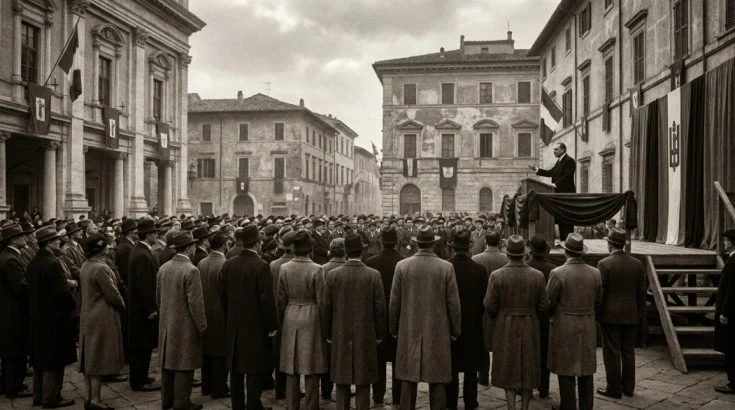
Have you ever heard someone called a “fascist” during a political argument and wondered what the word actually means? It is a word that appears often in news reports, history books, political debates, and everyday conversations. Yet, its meaning is sometimes used so loosely that it can become difficult to separate the real definition from the insult.
The fascist meaning has a specific historical and political background. A fascist is generally a person who supports or is associated with fascism, an authoritarian political ideology that places intense importance on the nation, centralized power, obedience, and the suppression of political opposition.
Understanding the word requires more than memorizing a one sentence definition. Its history, political beliefs, connection to Benito Mussolini, relationship with Nazism, and modern usage all help explain what the term really means.
Fascist Meaning in Simple Words
In simple terms, a fascist is a person who supports fascism or a political system based on fascist ideas.
Fascism is an authoritarian ideology. It typically emphasizes extreme nationalism, strong centralized leadership, obedience to the state, and the rejection of liberal democracy. Fascist movements have historically opposed political pluralism and have used propaganda, censorship, intimidation, and violence to silence opponents.
So, when someone asks, “What does fascist mean?” a simple answer is:
A fascist is someone who supports or is associated with fascism, a political ideology that favors authoritarian rule, intense nationalism, and the suppression of political opposition.
The exact meaning can depend on historical context. A historian discussing Mussolini’s Italy is using the term in a specific political and historical sense. Someone casually calling another person a “fascist” may simply be accusing them of being extremely controlling or intolerant.
Those uses should not automatically be treated as identical.
What Is Fascism?
To understand the fascist definition, it helps to understand fascism first.
Fascism is a political ideology and movement that developed in Europe in the early twentieth century. The most historically important early example was Italian Fascism under Benito Mussolini, who came to power in Italy in 1922.
Fascist movements generally rejected liberal democracy, political pluralism, and many forms of individualism. They promoted a powerful state, national unity, discipline, hierarchy, and loyalty to the nation and its leader.
Fascist movements have not all been identical. Different countries and movements developed their own ideas and practices. However, several recurring characteristics are commonly associated with fascism.
These include:
- Extreme or aggressive nationalism
- Authoritarian leadership
- Rejection of liberal democracy
- Suppression of political opposition
- Glorification of strength and political violence
- Strong state control
- Mass propaganda
- Political mobilization and organized movements
- Emphasis on national unity and obedience
- Hostility toward groups portrayed as enemies of the nation
This is why simply saying that fascism means “being strict” does not accurately capture the political meaning of the word.
What Does a Fascist Believe?
There is no single checklist that every fascist throughout history has followed. Fascist beliefs have varied between movements. Still, certain ideas commonly appear in fascist politics.
Strong Central Leadership
Fascist movements often place enormous importance on a powerful leader. The leader may be presented as the person capable of restoring national strength, unity, or greatness.
Loyalty to the leader can become closely connected with loyalty to the nation itself.
Extreme Nationalism
Nationalism is another important part of fascist ideology. Fascist movements often portray the nation as something that must be protected, strengthened, and placed above competing interests.
This can become an exclusionary form of nationalism in which certain groups are portrayed as threats to national identity.
Rejection of Political Opposition
Fascist systems historically have not accepted open political competition in the way pluralistic democracies do.
Opposition parties, independent organizations, journalists, activists, and other critics may be restricted, censored, imprisoned, or violently attacked.
Emphasis on Obedience and Discipline
Fascist ideology often values obedience, hierarchy, discipline, and collective action. Individual interests may be presented as less important than the interests of the nation or state.
Use of Propaganda
Propaganda has historically played an important role in fascist movements.
Rather than simply presenting information, propaganda can be used to create a particular image of the nation, leader, enemies, and political reality. Repetition, emotional appeals, symbolism, mass rallies, and carefully controlled messaging can all become tools of political persuasion.
Characteristics of Fascism
When studying the characteristics of fascism, it is useful to look at the broader pattern rather than one isolated feature.
A political movement is not automatically fascist simply because it is authoritarian, nationalist, militaristic, or conservative. These characteristics can appear in other political systems as well.
Fascism is better understood through the combination of several features.
Authoritarianism
Fascist governments concentrate political power and limit meaningful opposition. Political institutions become subordinate to the ruling movement or leader.
Ultranationalism
Fascism usually promotes an intense vision of national identity. The nation is often presented as something that must be purified, strengthened, or restored to greatness.
Political Repression
Fascist regimes have historically used censorship, surveillance, imprisonment, intimidation, and violence against political opponents and other targeted groups.
Militarism
Military strength and ideas associated with discipline, sacrifice, and national struggle can play a major role in fascist politics.
Mass Mobilization
Fascism does not always rely only on passive obedience. Fascist movements have historically organized large numbers of people through rallies, youth organizations, political groups, uniforms, symbols, and other forms of mass participation.
Propaganda
The government or movement may attempt to control public narratives and create a powerful emotional connection between citizens, the nation, and the political leadership.
Fascist Meaning in Politics
In political discussions, fascist meaning is more specific than simply describing someone as “mean” or “controlling.”
Calling a political movement fascist generally suggests that it has characteristics associated with fascism, such as authoritarian leadership, extreme nationalism, rejection of democratic pluralism, suppression of opposition, and political violence.
However, the word is frequently used as a political insult.
For example, someone might call a strict boss a “fascist” because the boss demands obedience. That does not necessarily mean the boss literally supports fascism.
This distinction matters because political terms lose some of their usefulness when they are used for every person or policy someone strongly dislikes.
Fascist vs. Authoritarian
The terms fascist and authoritarian are related, but they are not perfect synonyms.
Authoritarianism is a broader concept. An authoritarian government generally concentrates political power and restricts political freedoms and opposition.
Fascism is a particular political ideology and movement with additional characteristics, including intense nationalism, mass political mobilization, a powerful leader, and a vision of national renewal or transformation.
In other words:
Authoritarianism is a broad category of political rule, while fascism is a specific political ideology associated with a particular combination of ideas and practices.
Not every authoritarian government is fascist.
Fascism vs. Dictatorship
A dictatorship describes a system in which political power is concentrated in the hands of one person or a small group, often without genuine democratic accountability.
Fascist regimes can be dictatorships, but the concepts are not interchangeable.
A dictator does not necessarily follow fascist ideology. A dictatorship may be based on military rule, personal power, a monarchy, a revolutionary ideology, or another political system.
Fascism describes the ideological character of a movement or regime, while dictatorship primarily describes the concentration of political power.
Fascism vs. Nazism
Fascism and Nazism are closely connected historically, but they are not exactly the same thing.
Italian Fascism under Mussolini was one of the earliest major fascist movements. German National Socialism, led by Adolf Hitler, developed within the broader fascist era but had its own distinctive ideology.
Nazism placed an especially central role on racial ideology, antisemitism, and the idea of racial hierarchy. The Nazi regime’s persecution and mass murder of Jews and many other groups became central features of its rule.
Therefore, it is more accurate to say that Nazism is a distinct movement with important fascist characteristics, rather than simply treating the two words as completely interchangeable.
Benito Mussolini and Italian Fascism
The history of fascism is strongly connected with Benito Mussolini.
Mussolini founded the Italian Fasces of Combat in 1919. His movement grew during a period of severe political and social instability following the First World War.
In 1922, Mussolini became prime minister after the March on Rome. Over the following years, he transformed Italy into an increasingly authoritarian state and established a dictatorship.
The Italian Fascist regime promoted nationalism, political obedience, state power, propaganda, and the image of Mussolini as a strong national leader.
Mussolini’s rule became one of the most important historical examples used when studying fascism.
History of Fascism
The rise of fascism cannot be separated from the political and economic turmoil of Europe after the First World War.
Italy experienced serious social conflict, economic difficulties, political instability, and fears of revolutionary movements. Fascist groups presented themselves as a force capable of restoring order and national strength.
The Italian example influenced political movements elsewhere.
In Germany, Adolf Hitler and the Nazi Party developed their own form of authoritarian ultranationalism and racial politics. The Nazis eventually established a dictatorship and pursued expansionist policies that contributed directly to the Second World War.
Fascist and fascist-like movements also appeared in other European countries during the interwar period.
The history is important because it shows that fascism was not simply a personality type. It was connected to organized political movements, institutions, propaganda, violence, and the transformation of governments.
Fascist Meaning Today
Today, the word fascist is used in two different ways.
The first is historical and political. Historians may use it to describe people, movements, or regimes that genuinely belong to the fascist tradition.
The second is informal. People sometimes use “fascist” to describe someone they consider extremely controlling, oppressive, intolerant, or authoritarian.
For example, a person might jokingly say:
“My teacher is a fascist about deadlines.”
In that sentence, the speaker probably does not mean that the teacher supports Italian Fascism or Nazi ideology. They are using the word metaphorically to describe someone perceived as excessively strict.
Understanding the context is therefore essential.
Why Is Someone Called a Fascist?
Someone may be called a fascist because they openly support fascist ideology or belong to a fascist political organization.
The term can also be used more loosely when someone believes another person is behaving in an authoritarian or oppressive way.
However, calling someone a fascist is a serious political claim when the word is used literally. It should ideally be supported by evidence about their political beliefs, actions, or affiliations rather than simply their personality.
Being strict, conservative, patriotic, confident, or politically unpopular does not automatically make someone a fascist.
Is Fascist Always a Political Word?
Not always.
The word has a political origin and its literal meaning remains political. But everyday speakers sometimes use it to describe controlling behavior.
Consider these examples:
Political use:
“The movement adopted fascist ideas and rejected democratic opposition.”
Historical use:
“Mussolini established a fascist dictatorship in Italy.”
Informal use:
“My roommate is a fascist about keeping the kitchen clean.”
The third example uses the word figuratively. It should not be confused with the historical definition.
Fascist as an Insult
“Fascist” can function as an insult because fascism is strongly associated with dictatorship, repression, political violence, and the destruction of democratic freedoms.
People sometimes use the word when they feel that someone is exercising excessive control.
But overusing the term can make political discussion less precise. If a person simply disagrees with a policy, calling the person a fascist does not explain the disagreement.
It is more useful to describe the specific behavior.
For example, saying that a government is “restricting opposition parties” communicates more information than simply calling it “fascist.”
Common Misunderstandings About Fascism
Several misconceptions make the word harder to understand.
Fascism Does Not Simply Mean Strictness
A strict teacher, demanding parent, or controlling manager is not automatically a fascist.
The political meaning is much more specific.
Fascism Is Not Just Another Word for Dictatorship
Dictatorships can exist under different ideologies. Fascism is one particular political tradition.
Nationalism Alone Does Not Equal Fascism
Nationalism exists in many political traditions. Fascism is associated with a particularly intense and often exclusionary form of nationalism combined with other political characteristics.
Fascism and Nazism Are Related but Distinct
Nazism developed within the wider political environment of fascist movements but had distinctive racial and antisemitic doctrines.
The Modern Insult Is Not Always the Historical Definition
Someone using “fascist” casually may not be making a literal historical or political claim.
Examples of Fascist Behavior
When discussing examples of fascist behavior, context matters.
Historically associated behaviors can include:
- Suppressing political opposition
- Eliminating meaningful political competition
- Using propaganda to promote the ruling movement
- Glorifying political violence
- Creating a cult of leadership
- Attacking independent media
- Promoting extreme national unity
- Targeting groups portrayed as enemies of the nation
- Using intimidation against political opponents
- Concentrating power in the state and ruling movement
One behavior alone does not necessarily prove that a person or government is fascist. Political systems should be evaluated as a whole.
Frequently Asked Questions
What is the simplest meaning of fascist?
A fascist is a person who supports or is associated with fascism, an authoritarian political ideology characterized by intense nationalism, centralized leadership, suppression of opposition, and other related features.
What does fascist mean in politics?
In politics, fascist generally refers to someone or something associated with fascism, a political tradition that rejects liberal democratic pluralism and emphasizes authoritarian leadership, nationalism, state power, and political mobilization.
What is the difference between fascism and fascist?
Fascism refers to the ideology, political movement, or system. A fascist is a person associated with or supporting that ideology or movement.
Is fascism the same as dictatorship?
No. Fascism and dictatorship are related but different concepts. Fascism is an ideology and political tradition, while dictatorship describes a form of political rule in which power is highly concentrated.
Is every authoritarian person a fascist?
No. Authoritarianism is a broader concept. A person can support authoritarian rule without supporting fascism.
Who was the first major fascist leader?
Benito Mussolini is generally regarded as the founding leader of Italian Fascism and one of the earliest major fascist leaders.
What are the main characteristics of fascism?
Commonly identified characteristics include extreme nationalism, authoritarian leadership, suppression of opposition, propaganda, political violence, mass mobilization, hierarchy, and strong state power.
Why do people call others fascist?
The word can be used literally to describe support for fascism, but it is also frequently used as an insult for someone perceived as extremely controlling, oppressive, or authoritarian.
Is Nazism the same as fascism?
They are closely related but not identical. Nazism was a distinct German movement with fascist characteristics and a particularly central focus on racial hierarchy and antisemitism.
Can fascist be used outside politics?
In casual speech, yes. People sometimes use the word figuratively to describe extremely controlling behavior. However, this informal use is different from the historical and political meaning.
Final Thoughts on Fascist Meaning
The fascist meaning becomes much clearer when the word is placed in its historical and political context. A fascist is not simply someone who is strict, aggressive, or difficult. In its literal political sense, the term refers to someone associated with fascism, an authoritarian political tradition marked by intense nationalism, powerful centralized leadership, suppression of opposition, propaganda, and other related characteristics.
The word also has a long history, particularly through Mussolini’s Italy and the wider political movements that developed in Europe during the twentieth century.
At the same time, modern conversations often use “fascist” more casually. Recognizing the difference between the historical definition and the everyday insult helps you understand the word more accurately and use it more responsibly.
Discover More Post:

1 thought on “Fascist Meaning | What the Word Really Means, Where It Came From, and Why It Still Matters in 2026”