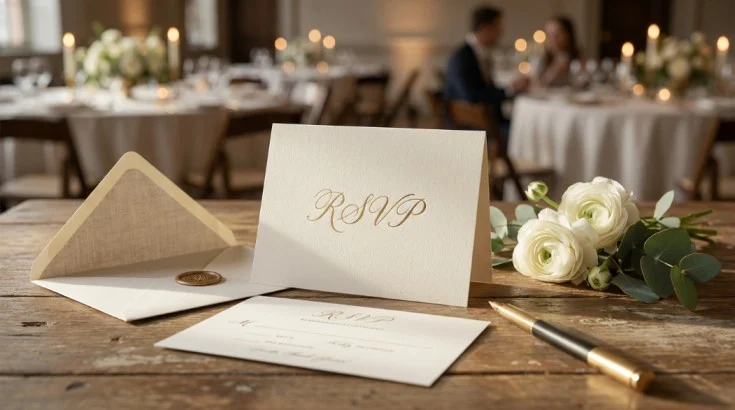
Seeing “RSVP” at the bottom of an invitation can raise a surprisingly simple question: What exactly am I supposed to do? You might spot it on a wedding invitation, birthday card, dinner invitation, business event, ceremony, or online event page. In every case, the basic request is the same: the host wants a response.
The RSVP meaning comes from the French phrase “répondez s’il vous plaît,” which translates to “please respond.” It doesn’t mean that you have to accept the invitation. Instead, it asks you to tell the host whether you’ll attend.
That small abbreviation carries an important practical purpose. Your response helps the host organize the guest list, estimate the headcount, arrange seating, plan catering, and prepare the event properly. Once you understand the RSVP full form, the rest becomes much easier.
This guide explains what RSVP means, what RSVP stands for, how to respond, what RSVP by dates mean, what “regrets only” means, and which RSVP etiquette rules actually matter. You’ll also find realistic RSVP examples for weddings, parties, business events, dinners, and digital invitations.
What Does RSVP Mean?
RSVP means “please respond.” It comes from the French expression “répondez s’il vous plaît,” which asks an invited person to reply to an invitation.
When you see RSVP on an invitation, the host is usually asking you to confirm one of two things:
- Yes, I’ll attend.
- No, I can’t attend.
The important point is that RSVP doesn’t mean “yes.” It means “please tell me your answer.”
For example, imagine receiving this invitation:
You are warmly invited to Sarah’s wedding.
Saturday, October 17
Please RSVP by September 15.
The host isn’t assuming you’ll attend. They want you to make your decision and communicate it before the stated deadline.
Your response might simply say:
“Thank you for the invitation. I’m happy to confirm that I’ll attend.”
Or:
“Thank you for inviting me. Unfortunately, I won’t be able to attend.”
Both responses fulfill the RSVP request.
RSVP Meaning in Simple Words
If you need the shortest possible explanation:
RSVP means “please reply.” When an invitation asks you to RSVP, the host wants you to confirm whether you will attend.
That’s the heart of the RSVP definition.
The details can vary from event to event, but the basic purpose remains the same: the host needs your answer.
What Does RSVP Stand For?
The RSVP full form is:
Répondez s’il vous plaît
This is a French phrase that means “please respond” or “please reply.”
The abbreviation comes directly from the first letters of the French words:
| Letter | French | Basic English meaning |
|---|---|---|
| R | Répondez | Respond |
| S | S’il | If it |
| V | Vous | You |
| P | Plaît | Pleases |
The complete expression is commonly understood as a polite request for a response.
What Does “Répondez S’il Vous Plaît” Mean?
The phrase répondez s’il vous plaît is a polite French request. In an invitation context, its natural English equivalent is “please respond.”
The word répondez comes from the French verb répondre, meaning “to respond” or “to answer.” The form répondez is used when addressing someone formally or addressing multiple people.
The phrase s’il vous plaît is the familiar French expression for “please.”
So when English-speaking invitations use RSVP, they retain the French abbreviation while treating it as a normal part of English invitation language.
You don’t need to know French to understand or use RSVP. In modern English, the abbreviation has become familiar enough that most people recognize it immediately.
What Is the RSVP Abbreviation Meaning?
The RSVP abbreviation meaning is essentially a request for an invitation response.
It doesn’t describe the event itself. It describes the action expected from the invitee.
Think of it this way:
Invitation → RSVP request → Guest response → Confirmed attendance
The host sends an invitation. The invitation asks for an RSVP. The guest responds. The host then knows who plans to attend.
This distinction matters because people sometimes interpret RSVP as if it means acceptance.
It doesn’t.
An RSVP can produce several outcomes:
| RSVP response | What it tells the host |
|---|---|
| Accept | You plan to attend |
| Decline | You won’t attend |
| No response | The host doesn’t have a confirmed answer |
| Regrets only response | You respond only if you cannot attend |
That’s why RSVP is better understood as a response request rather than an acceptance itself.
What Does RSVP Mean on an Invitation?
The RSVP meaning on an invitation is straightforward: the host wants you to reply about your attendance.
You might see RSVP written in several ways:
- RSVP by May 10
- Please RSVP
- RSVP required
- Kindly RSVP
- RSVP requested
- Please confirm your attendance
- Respond by June 1
- Regrets only
These phrases can look slightly different, but they all communicate information about the response process.
For example:
RSVP by August 5
This means the host wants your answer by August 5.
Another invitation might say:
Please confirm attendance by August 5.
That’s essentially the same request in plain English.
A digital invitation could instead display:
Will you attend? Yes / No
Clicking one of those options performs the same basic function as an RSVP.
Why Do Invitations Ask for RSVPs?
Events require planning.
A wedding venue needs to know how many chairs to arrange. A caterer needs an approximate number of meals. A dinner host needs to know how much food to prepare. A conference organizer may need to estimate attendance for badges, seating, refreshments, or room capacity.
Your RSVP gives the host a useful number.
Without responses, planning becomes guesswork.
That’s why a tiny abbreviation can have a surprisingly large effect on event organization.
What Does RSVP Mean on a Wedding Invitation?
The RSVP meaning on a wedding invitation is usually a request to confirm whether you or the invited guests will attend the wedding.
Wedding invitations often require more information than a casual party invitation.
A wedding RSVP may ask you to provide:
- Your name
- Attendance confirmation
- Number of guests
- Meal selection
- Dietary restrictions
- Sometimes additional event selections
For example:
Please RSVP by September 1
☐ Joyfully accepts
☐ Regretfully declines
A modern wedding might use an online RSVP form instead.
Why Wedding RSVPs Matter So Much
Wedding planning often depends on relatively precise guest numbers.
The final guest count can influence:
- Catering quantities
- Seating arrangements
- Table assignments
- Venue setup
- Printed materials
- Transportation
- Wedding favors
- Meal selections
- Event staffing
A guest who doesn’t respond may create uncertainty for the couple.
For that reason, wedding RSVP etiquette places particular emphasis on replying before the deadline.
If the invitation names two people, don’t automatically assume you can bring a third person. The guest list usually reflects deliberate planning.
Does RSVP Mean Yes or No?
No.
RSVP means that you should respond.
Your answer can be yes or no.
Consider this simple distinction:
RSVP = “Tell me your answer.”
Accept = “Yes, I’ll attend.”
Decline = “No, I won’t attend.”
This distinction clears up one of the most common misunderstandings about RSVP.
If someone says, “I need to RSVP to the wedding,” that doesn’t tell you whether they’re attending. They still need to choose between accepting and declining.
Can You RSVP No?
Absolutely.
Declining an invitation is still a valid RSVP.
In fact, a clear “no” is often more helpful than silence because the host can remove your place from the expected headcount.
A polite decline might read:
“Thank you for the invitation. Unfortunately, I won’t be able to attend, but I hope you have a wonderful celebration.”
You don’t need to invent an elaborate explanation.
A brief, sincere response works perfectly well.
How to RSVP to an Invitation
Learning how to RSVP is easier than it sounds.
Start by reading the entire invitation carefully. Look for the response method and deadline before making your reply.
Check Who Was Invited
First, identify the people covered by the invitation.
An invitation might address:
“Mr. and Mrs. Anderson”
Or:
“Emily Anderson and guest”
Or:
“The Anderson Family”
Those wordings don’t necessarily mean the same thing.
If you’re unsure whether another person can attend, ask the host before adding them.
Find the RSVP Deadline
Look for wording such as:
- RSVP by July 20
- Reply by July 20
- Please respond before July 20
- Kindly confirm by July 20
This date tells you when the host needs your answer.
Decide Whether You’ll Attend
Give the host a clear answer.
Don’t write something vague like:
“I might be able to make it.”
If the invitation requires a final response, the host needs a definite answer.
Use the Requested Response Method
The invitation may ask you to:
- Mail an RSVP card
- Reply by email
- Call a phone number
- Complete an online RSVP form
- Click an RSVP link
- Respond by text message
Use the method provided whenever possible.
Include Requested Information
- If the host asks for a meal choice, give one.
- If the form asks for the number of attendees, enter the correct number.
- If the invitation requests dietary information, provide it clearly.
A complete RSVP saves the host from having to contact you again.
How to Respond to an RSVP
People often search for how to respond to an RSVP, but technically you’re responding to the invitation’s RSVP request.
Your response doesn’t need to be complicated.
A useful RSVP response usually includes:
- Your name
- Your decision
- Any requested details
- A polite closing
For example:
“Thank you for inviting me. I’m pleased to confirm that I’ll attend.”
That’s enough for a simple formal event.
For a digital form, you may only need to select Yes or No and submit your information.
What Makes a Good RSVP Response?
A good response is:
- Clear
- Timely
- Accurate
- Polite
- Complete
The host shouldn’t have to decode your message.
- If you’re attending, say so.
- If you can’t attend, say that clearly.
- If you’re bringing an approved guest, include them when requested.
RSVP Response Examples
Different situations call for slightly different wording. A wedding invitation may deserve a warmer response than a casual birthday party.
Here are practical RSVP response examples you can adapt.
Formal RSVP Acceptance
Thank you for the kind invitation. I’m pleased to confirm my attendance and look forward to joining you.
Simple RSVP Acceptance
Thank you for inviting me. I’d be happy to attend.
Casual RSVP Acceptance
Thanks for the invite! I’d love to come.
Formal RSVP Decline
Thank you for the invitation. Unfortunately, I won’t be able to attend. I appreciate you thinking of me.
Warm RSVP Decline
Thank you so much for inviting me. I’m sorry I can’t make it, but I hope you have a wonderful celebration.
Wedding RSVP Acceptance
We’re delighted to accept your invitation and look forward to celebrating with you.
Wedding RSVP Decline
Thank you for including us. We’re sorry we won’t be able to attend, but we’ll be thinking of you on your special day.
Business Event RSVP
Thank you for the invitation. I’m pleased to confirm my attendance at the event.
Dinner Invitation RSVP
Thank you for inviting me. I’d be happy to join you for dinner.
The best response usually sounds natural rather than overly formal.
What Does “RSVP By” Mean?
“RSVP by” means you should submit your response no later than the stated date.
For example:
RSVP by September 10
The host wants your answer by September 10.
This is called the RSVP deadline, response deadline, or response date.
It isn’t necessarily the date the host begins planning. They may need your answer earlier than the event itself so they can finalize arrangements.
Why Is There an RSVP Deadline?
Event planning involves multiple moving parts.
A host may need to provide a final guest count to a caterer. A venue may require an estimated attendance number. Seating arrangements may need to be prepared. Printed materials may need to be ordered.
The RSVP date creates a practical cutoff.
Think of it as the point where the host stops guessing and starts finalizing.
What If You Need More Time?
If you’re genuinely uncertain, don’t simply disappear.
Contact the host and explain that you need a little more time.
For example:
“I’m sorry, but I’m still working out my schedule. Would it be okay if I confirm by Friday?”
That gives the host information instead of leaving them waiting.
What Does “RSVP Required” Mean?
RSVP required means the host expects you to respond.
It generally means you shouldn’t assume that your attendance is automatically recorded.
If you see:
RSVP required by October 5
you should provide an answer before that date.
The phrase is especially common for:
- Business conferences
- Formal dinners
- Weddings
- Fundraisers
- Private parties
- Ceremonies
- Networking events
- Limited-capacity events
A required RSVP helps the organizer build a more accurate attendance list.
What Does “RSVP Requested” Mean?
RSVP requested also means that the host would like a response.
The wording may sound softer than “RSVP required,” but the practical expectation is usually similar: respond so the host knows whether you’re coming.
If you’re unsure, treat the request seriously.
A quick response takes very little effort and gives the host useful information.
What Does “Regrets Only” Mean?
“Regrets only” means you should respond only if you cannot attend.
This differs from a standard RSVP.
With a traditional RSVP request:
Please RSVP by May 1.
You generally respond yes or no.
With:
Regrets only.
You usually respond only when you cannot attend.
The underlying assumption is that guests who don’t send regrets plan to attend.
Regrets Only vs. Standard RSVP
| Invitation wording | Expected response |
|---|---|
| RSVP | Yes or no |
| Please RSVP | Yes or no |
| RSVP required | Yes or no |
| Confirm attendance | Usually yes or no |
| Regrets only | Reply if you cannot attend |
If the wording isn’t clear, follow any additional instructions on the invitation.
What Does the “M” Mean on an RSVP Card?
Traditional RSVP cards sometimes include a line such as:
M________________
The M traditionally serves as the beginning of a courtesy title, such as:
- Mr.
- Mrs.
- Ms.
- Miss
The guest completes the line with the appropriate title and name.
Modern RSVP cards often use more straightforward wording because titles and naming conventions vary.
For example, a contemporary card might simply say:
Name: __________________
That format is easier for guests and avoids confusion about the traditional M line.
Why Does the M Appear?
The tradition comes from formal printed invitation etiquette.
The line was designed for the invitee to write a courtesy title followed by their name.
So if you encounter an M on a formal RSVP card, it isn’t a mysterious RSVP code. It’s simply part of the traditional name format.
Can You RSVP for Someone Else?
Sometimes you can, but it depends on the invitation and situation.
If you’re responding for a household, couple, or family that the invitation clearly includes, one person may submit the response for everyone.
For example, a family invitation might request:
“Please confirm the number of guests attending.”
One family member can provide the complete answer.
However, you shouldn’t use an RSVP to add people who weren’t invited.
If your friend receives:
“John Smith”
that doesn’t automatically mean John can bring a guest.
If the invitation says:
“John Smith and Guest”
then a plus-one is clearly included.
When the wording isn’t clear, ask the host.
Can You RSVP for a Plus-One?
Yes, if the invitation allows a plus-one.
Suppose the invitation says:
“Alex Johnson and Guest”
You can normally include the additional guest when completing the RSVP.
But if the invitation names only you, don’t automatically add someone else.
This matters particularly at weddings and formal dinners because every additional guest can affect:
- Seating
- Catering
- Venue capacity
- Meal counts
- Event materials
- Overall cost
A simple question to the host can prevent an awkward situation:
“I wanted to check whether the invitation includes a guest before I RSVP.”
That’s much better than arriving with an unexpected plus-one.
What Happens If You Miss the RSVP Deadline?
Missing the deadline doesn’t necessarily mean you’re banned from the event.
However, you should respond as soon as possible.
The host may already have finalized:
- Catering numbers
- Seating arrangements
- Guest lists
- Name badges
- Transportation
- Venue arrangements
Send your response rather than waiting longer.
You can briefly acknowledge the delay:
“I’m sorry I missed the RSVP deadline. I’d still love to attend if there’s room. Please let me know.”
This approach gives the host a chance to check.
Don’t assume that silence means your place is reserved.
Can You Change Your RSVP?
Yes. Plans can change.
The important thing is to tell the host promptly.
Suppose you originally accepted an invitation but later discover that you can’t attend. Contact the host instead of simply failing to show up.
A simple message works:
“I’m sorry, but my plans have changed and I won’t be able to attend. I wanted to let you know as soon as possible.”
The same principle applies in reverse.
If you originally declined but later discover that you can attend, ask the host first:
“My plans have changed, and I may now be able to attend. If there’s still room, I’d be happy to join you.”
The host may have already finalized the guest count.
Is “Please RSVP” Correct?
Yes, “please RSVP” is common and natural in modern English.
Strictly speaking, RSVP already comes from a French phrase containing a polite “please” idea. So phrases such as “please RSVP” can be viewed as somewhat redundant.
However, English speakers commonly use RSVP as an ordinary English verb.
You may see:
- Please RSVP by Friday.
- Kindly RSVP.
- Please RSVP using the link below.
- Please RSVP no later than June 10.
These expressions are widely understood.
There is no practical reason to avoid “please RSVP” in an ordinary invitation.
RSVP as a Noun and a Verb
One interesting part of the RSVP definition is that English uses RSVP as both a noun and a verb.
RSVP as a Verb
“Please RSVP by Friday.”
Here, RSVP means respond to the invitation.
Another example:
“Did you RSVP to the wedding?”
Again, RSVP functions as a verb.
RSVP as a Noun
“We received 75 RSVPs.”
Here, RSVPs means responses to the invitation.
The distinction is easy:
Verb:
Please RSVP.
Noun:
We received 75 RSVPs.
This flexible usage has helped RSVP become a normal part of English event language.
RSVP, R.S.V.P., and RSVPed: What Is the Difference?
You may encounter several written forms.
RSVP
This is the clean, modern form most commonly seen today.
Please RSVP by Friday.
R.S.V.P.
This version uses periods between the letters.
Please R.S.V.P. by Friday.
It’s understandable, but the unpunctuated RSVP form is common in contemporary writing.
RSVPed
This form describes a past action.
“She RSVPed to the invitation yesterday.”
You may also see RSVP’d in informal writing.
RSVPing
This form describes the action in progress.
“I’m RSVPing now.”
Because RSVP originated as an abbreviation, its verb forms can look unusual. English nevertheless treats it much like other borrowed expressions that have become established in everyday usage.
What Does RSVP Mean in Text?
The RSVP meaning in text is the same basic concept as on a printed invitation: respond or confirm whether you will attend.
Someone might text:
“Can you RSVP by Thursday?”
They are asking you to confirm your attendance.
A friend might also say:
“Did you RSVP?”
That means:
“Did you respond to the invitation?”
Text messages have made RSVP communication more casual, but the purpose hasn’t changed.
RSVP Text Message Examples
Accepting:
Thanks for inviting me! I’ll be there.
Declining:
Thanks for the invite. I won’t be able to make it, unfortunately.
Asking for clarification:
Thanks! Does the invitation include a plus-one?
Responding late:
Sorry for the late reply. If there’s still room, I’d love to attend.
The wording can be relaxed when the event is casual.
What Does RSVP Mean in Email?
An RSVP email response is simply an email confirming whether you’ll attend.
For a formal event, keep your message clear and courteous.
RSVP Email Accepting an Invitation
Dear Maria,
Thank you for the invitation. I’m pleased to confirm my attendance at the event. I look forward to joining you.
Best,
Daniel
RSVP Email Declining an Invitation
Dear Maria,
Thank you for inviting me. Unfortunately, I won’t be able to attend, but I appreciate the invitation and hope the event goes wonderfully.
Best,
Daniel
The exact wording depends on your relationship with the host.
A business event usually calls for more formality than a friend’s birthday party.
What Is an Online RSVP?
An online RSVP is a digital method for confirming attendance.
Instead of mailing a physical card or calling the host, you might receive an:
- RSVP link
- RSVP form
- Event webpage
- Email confirmation button
- Digital invitation
The process is usually simple.
You open the provided RSVP page. Then you enter your information and select your response.
For example:
Will you attend?
○ Yes
○ No
The form may then ask:
Number of guests: 2
Or:
Meal preference:
○ Chicken
○ Vegetarian
Once you submit the form, the organizer receives your response.
Why Online RSVPs Are Useful
Digital responses can make event planning easier because organizers can collect information in one place.
An online RSVP system may help track:
- Names
- Attendance
- Guest counts
- Meal choices
- Dietary requirements
- Contact details
- Response status
It also eliminates the need to interpret handwritten cards.
What Is an RSVP Form?
An RSVP form is a form designed to collect event responses.
A simple form might ask:
| Question | Example answer |
|---|---|
| Name | Emily Johnson |
| Will you attend? | Yes |
| Number of guests | 2 |
| Meal choice | Vegetarian |
| Dietary needs | None |
A larger event may ask for additional information.
The form should only request information that the organizer genuinely needs.
For guests, the important thing is to answer each required field accurately.
What Is an RSVP Link?
An RSVP link takes an invitee directly to the place where they can submit their response.
For example, an invitation may say:
Please RSVP online by September 15.
The next line might provide an RSVP link.
The link replaces the traditional reply card.
The concept remains identical:
Invitation → Response page → Attendance confirmation
Digital technology changes the method, not the meaning.
What Is RSVP Confirmation?
An RSVP confirmation is evidence that your response has been successfully recorded.
For example, after completing an online form, you might receive:
“Your RSVP has been received.”
An email confirmation may also arrive.
This tells you that the organizer’s system received your response.
However, a confirmation of your RSVP isn’t always the same as a separate admission ticket. If the event requires a ticket or registration confirmation, follow the organizer’s instructions.
What Does RSVP Status Mean?
RSVP status describes the current response associated with an invitee.
Common statuses include:
| RSVP status | Meaning |
|---|---|
| Attending | Guest confirmed they will attend |
| Declined | Guest said they won’t attend |
| Pending | No final response has been recorded |
| Awaiting response | Organizer still needs an answer |
| Maybe | Guest hasn’t given a definite commitment |
For formal event planning, organizers usually prefer confirmed yes or no responses rather than uncertain answers.
A clear RSVP status makes the guest list much easier to manage.
Why Does RSVP Matter for Event Planning?
At first glance, an RSVP may seem like a tiny administrative detail.
It isn’t.
For many events, the guest count influences nearly every logistical decision.
Imagine a dinner for 40 people. The host receives only 15 responses. They can’t confidently determine how much food to prepare.
Now imagine a wedding with 200 invited guests.
A difference of 20 or 30 people can affect the entire setup.
RSVP Helps With Headcount
Headcount means the number of people expected to attend.
A reliable headcount helps an event organizer estimate demand.
RSVP Helps With Catering
Caterers need approximate numbers.
Some events also require specific meal selections.
RSVP Helps With Seating
Formal dinners and weddings may use assigned seating.
The final RSVP list helps the host create those arrangements.
RSVP Helps With Guest Lists
The host can separate:
- Confirmed guests
- Declined guests
- Guests who haven’t responded
That makes follow-up much easier.
RSVP Helps With Venue Planning
Some venues have capacity limits.
An accurate response list can help organizers stay within those limits.
The abbreviation may be small, but its role in event planning is practical and significant.
RSVP Etiquette for Guests
Good RSVP etiquette isn’t about following dozens of rigid rules.
It’s mostly about being considerate.
Respond Before the Deadline
This is the most important rule.
If the invitation asks for a response by Friday, don’t wait until the event is almost here.
Give a Clear Answer
Avoid vague responses when the host needs a definite number.
“Maybe” doesn’t help much with catering or seating.
Respect the Guest List
Don’t assume you can bring another person.
If you want to bring a guest, ask first when the invitation doesn’t clearly include one.
Provide Accurate Details
If the host asks for a meal choice, give the correct information.
If you’re bringing someone who is included on the invitation, provide their details when requested.
Tell the Host About Changes
If you accept and later can’t attend, let the host know.
If you decline and later become available, ask before assuming you can join.
Don’t Make the Host Chase You
A missing RSVP creates extra work.
One short message can prevent several follow-up calls or texts.
RSVP Etiquette for Weddings
Weddings deserve special attention because guest numbers can influence significant arrangements.
If you’re invited to a wedding:
- Check exactly who is invited.
- Respond by the stated deadline.
- Choose your meal carefully if required.
- Don’t add an uninvited guest.
- Tell the couple if your plans change.
- Don’t treat an RSVP as optional when a response is requested.
- Contact the couple or designated organizer if you’re uncertain about the invitation.
A wedding RSVP isn’t just a formality.
It helps the couple turn a guest list into an actual event plan.
RSVP Etiquette for Business Events
Business invitations often use RSVP systems for conferences, dinners, networking events, seminars, and corporate functions.
Professional RSVP etiquette generally calls for a concise response.
For example:
Thank you for the invitation. I’m pleased to confirm my attendance.
If you can’t attend:
Thank you for the invitation. Unfortunately, I won’t be able to attend.
Don’t write a long explanation unless one is necessary.
Professional communication benefits from clarity.
RSVP Etiquette for Casual Parties
A birthday party or informal dinner doesn’t require stiff language.
A simple response is enough:
“Thanks! I’ll be there.”
Or:
“Thanks for inviting me. I can’t make it this time.”
The goal isn’t to sound ceremonial.
The goal is to make your attendance clear.
Common RSVP Mistakes to Avoid
A few mistakes appear repeatedly.
Thinking RSVP Means “Yes”
It doesn’t.
RSVP means respond.
Ignoring the Invitation
Silence doesn’t give the host a reliable answer.
Missing the Deadline Without Explaining
If you forget, respond as soon as you remember.
Assuming a Plus-One
A guest should only be added when the invitation allows one or the host approves it.
Bringing an Unlisted Guest
This can create seating and catering problems.
Giving the Wrong Meal Choice
If your meal selection matters, double-check it before submitting your RSVP.
Changing Plans Without Telling the Host
A confirmed guest who doesn’t show can leave the host with an inaccurate headcount.
Treating “Regrets Only” Like a Standard RSVP
Read the wording carefully.
“Regrets only” means you normally reply only if you’re declining.
RSVP vs. Invitation: What’s the Difference?
These two terms describe different parts of the process.
An invitation asks you to attend an event.
An RSVP asks you to respond to that invitation.
Think of the relationship like this:
Invitation = “Please join us.”
RSVP = “Please tell us if you’re coming.”
The invitation provides event information.
The RSVP provides attendance information.
Together, they create a simple communication loop between the host and guest.
RSVP vs. Confirmation: What’s the Difference?
An RSVP is your response.
A confirmation is the resulting acknowledgment or status.
For example:
You submit an RSVP saying Yes.
The event system sends:
Attendance confirmed.
Your RSVP is the action. The confirmation tells you that the response has been recorded.
These terms can overlap in casual conversation, but they describe slightly different steps.
RSVP vs. Regrets Only
The distinction is worth remembering.
Standard RSVP:
“Please RSVP by June 1.”
You should generally say yes or no.
Regrets only:
“Regrets only.”
You normally respond only if you’re unable to attend.
If you don’t understand which system an invitation uses, check the exact wording rather than guessing.
How Hosts Can Make RSVP Instructions Clear
Good RSVP instructions make life easier for everyone.
A host should clearly state:
- The response deadline
- The preferred response method
- Who is invited
- Whether guests are allowed
- Meal choices, if relevant
- Any additional information required
Compare these two examples.
Unclear
Please let us know.
Clear
Please RSVP by September 10 using the online form. The invitation is for two guests.
The second version leaves much less room for confusion.
Clear instructions produce cleaner responses.
How to Write an RSVP Request
If you’re creating an invitation, the RSVP request should match the event.
Formal
Kindly RSVP by September 15.
Friendly
Please let us know if you can make it by September 15.
Digital
Please RSVP using the link below by September 15.
Simple
RSVP by September 15.
Regrets Only
Regrets only by September 15.
The wording can change, but the important information should remain obvious.
RSVP Examples for Different Events
The same abbreviation appears across many types of invitations.
Birthday Party
Please RSVP by Saturday so we know how many pizzas to order.
Here, the RSVP helps the host estimate food and guests.
Wedding
Please RSVP by September 1 and select your preferred meal.
Here, the response supports catering and seating arrangements.
Business Dinner
Kindly RSVP by November 5.
The organizer may need a final attendance count for the venue.
Conference
RSVP required for in-person attendance.
The organizer may have limited capacity.
Baby Shower
Please RSVP by August 12.
The host needs to know who will attend.
Graduation Party
Please RSVP by May 20 so we can plan seating.
Again, the response provides a useful headcount.
What Should You Include in an RSVP?
A standard RSVP response doesn’t need to be lengthy.
Depending on the event, include:
- Your name
- Attendance decision
- Number of guests
- Guest names when requested
- Meal selection
- Dietary information
- Any other requested details
For example:
Name: Emma Carter
Attendance: Yes
Guests: 1
Meal: Vegetarian
An online RSVP form may collect this information automatically.
For an email or text response, you may need to provide it yourself.
How Quickly Should You RSVP?
The best answer is simple:
As soon as you know your plans, preferably before the stated deadline.
You don’t need to RSVP immediately after receiving an invitation if you genuinely need time to check your schedule.
But once you know, respond.
Waiting until the last possible moment creates unnecessary uncertainty.
A quick RSVP is especially considerate when the host is organizing a meal, reserved seating, transportation, or a limited-capacity venue.
What If You’re Unsure About Attending?
Sometimes life doesn’t provide a clean yes or no.
You may be waiting for:
- Work confirmation
- Travel details
- Family arrangements
- Another commitment
- Health or scheduling information
If the deadline approaches and you’re still uncertain, communicate with the host.
You could say:
“I’d really like to come, but I’m still waiting to confirm my schedule. Could I give you a definite answer by Monday?”
That gives the host something useful instead of leaving the RSVP unanswered.
However, don’t use “maybe” simply because you don’t want to make a decision.
An RSVP works best when it gives the host a reliable answer.
What If You Can’t Attend After RSVPing Yes?
Contact the host quickly.
A last-minute cancellation can happen for many legitimate reasons.
The etiquette issue isn’t that plans changed. The problem comes from failing to communicate the change.
A short message is enough:
“I’m really sorry, but something unexpected came up and I can no longer attend. I wanted to let you know as soon as possible.”
For a major event such as a wedding, contacting the appropriate person quickly is especially important.
The host can then adjust the seating or guest count if possible.
What If You Declined but Later Can Attend?
Don’t simply show up.
Ask first.
The host may have already finalized arrangements.
You can write:
“My plans have changed and I’m now available. If there’s still space, I’d love to attend.”
This gives the host control over the final guest count.
If there’s room, great.
If there isn’t, respect the answer.
Does RSVP Apply Only to Formal Events?
No.
You can use RSVP for many kinds of events.
Common examples include:
- Weddings
- Birthday parties
- Dinner parties
- Conferences
- Meetings
- Ceremonies
- Fundraisers
- Graduations
- Baby showers
- Networking events
- Corporate dinners
- Community gatherings
The level of formality changes, but the fundamental meaning stays the same.
Why Do People Still Use the French RSVP Abbreviation?
This is one of the more interesting aspects of the term.
English has adopted thousands of words and expressions from other languages. RSVP is unusual because English retained a French phrase in abbreviated form.
Over time, RSVP became recognizable as its own English-language event term.
Most people don’t mentally translate the French phrase every time they see RSVP. They simply understand it as a request to reply to an invitation.
That’s why an invitation can say:
RSVP by Friday
without explaining the French origin.
The abbreviation has become part of familiar English usage.
RSVP Meaning in English
The RSVP meaning in English is:
Please respond or please reply to an invitation.
Although the expression comes from French, RSVP functions naturally in English.
English speakers use it in sentences such as:
“Please RSVP by Friday.”
“Have you RSVPed yet?”
“We received 120 RSVPs.”
That shows how the abbreviation has moved beyond its original language and become part of ordinary English vocabulary.
What Is the Difference Between RSVP and Reply?
In everyday use, they often point to the same action.
Reply is the ordinary English word.
RSVP specifically carries the context of responding to an invitation or event request.
For example:
“Please reply by Friday.”
is a general request.
Meanwhile:
“Please RSVP by Friday.”
strongly suggests an invitation or event.
RSVP therefore adds a specific social and event-planning context.
Why a “No” RSVP Still Helps the Host
A declined invitation might feel less useful than an acceptance.
Actually, it provides valuable information.
Suppose 100 people receive an invitation.
If 60 say yes and 20 say no, the host knows that 20 people won’t attend. The remaining 20 haven’t answered yet.
That’s much more useful than simply knowing that 60 people accepted.
A decline is still a response.
For event organizers, certainty is valuable.
Why Hosts Sometimes Follow Up on Missing RSVPs
If guests don’t respond, hosts may send reminders.
This isn’t necessarily pushy.
The organizer may genuinely need a final number.
For example, a venue might require the guest count several days before an event.
A polite reminder could say:
“Just checking in to see if you’ll be able to join us. We’re finalizing the guest count.”
The purpose is practical.
The host isn’t asking for an essay. They need a simple attendance decision.
RSVP Etiquette: A Quick Guest Checklist
Before submitting your response, check these points:
- Did you read the full invitation?
- Do you know who is invited?
- Did you check the RSVP deadline?
- Did you decide whether you’re attending?
- Did you use the requested response method?
- Did you include all requested information?
- Did you avoid adding an unapproved guest?
- Did you provide accurate meal information?
- Did you tell the host if your plans changed?
If you can answer yes to these questions, you’ve probably handled the RSVP correctly.
RSVP Meaning: Quick Reference Table
| Question | Answer |
|---|---|
| What does RSVP mean? | Please respond |
| What does RSVP stand for? | Répondez s’il vous plaît |
| What language is RSVP from? | French |
| What does RSVP mean on an invitation? | The host wants a response about attendance |
| Does RSVP mean yes? | No |
| Can you RSVP no? | Yes |
| What does RSVP by Friday mean? | Respond no later than Friday |
| What does RSVP required mean? | A response is expected |
| What does regrets only mean? | Respond only if you can’t attend |
| What does an RSVP card do? | Collects the guest’s response |
| What is an RSVP form? | A digital or printed form for event responses |
| What is an RSVP link? | A link used to submit an event response |
| Can RSVP be a verb? | Yes |
| Can RSVP be a noun? | Yes |
Common Questions About RSVP Meaning
What does RSVP stand for?
RSVP stands for “répondez s’il vous plaît,” a French phrase meaning “please respond.”
What does RSVP mean on an invitation?
It means the host wants you to reply and confirm whether you’ll attend.
Does RSVP mean yes?
No. RSVP means respond. You can accept or decline the invitation.
Do you RSVP if you can’t attend?
Yes, unless the invitation specifically says “regrets only.” A clear decline helps the host finalize the guest list.
What does RSVP by date mean?
An RSVP by date is the deadline for sending your response.
What does RSVP required mean?
It means the host or organizer expects you to provide an attendance response.
What does RSVP requested mean?
It means the host is asking guests to respond about attendance.
What does “regrets only” mean?
It means you generally respond only if you cannot attend.
What does the M mean on an RSVP card?
The traditional M begins a courtesy-title line where guests can write titles such as Mr., Mrs., Ms., or Miss.
How do you RSVP to an invitation?
Follow the invitation’s instructions. You may need to return a card, send an email, reply by text, make a phone call, or complete an online RSVP form.
Can you RSVP by text?
Yes, if the host provides text messaging as an RSVP method or has clearly invited you to respond that way.
Can you change an RSVP?
Yes. If your plans change, tell the host as soon as possible.
What should you do if you miss the RSVP deadline?
Respond immediately and ask whether attendance is still possible. Don’t assume your place is guaranteed.
Can you RSVP for a guest?
You can include a guest when the invitation allows one. Don’t add an uninvited person without asking the host.
Is RSVP used as a verb?
Yes. For example:
“Please RSVP by Friday.”
It can also function as a noun:
“We received 50 RSVPs.”
Is “please RSVP” correct?
Yes. Although RSVP already comes from a French phrase expressing a polite request, “please RSVP” is common and natural in modern English.
What is RSVP in simple English?
RSVP means “please reply.” On an invitation, it asks you to tell the host whether you plan to attend.
Final Takeaway:
The RSVP meaning is simple once you break it down. RSVP stands for “répondez s’il vous plaît,” a French phrase that means “please respond.” On an invitation, it asks you to tell the host whether you’ll attend an event.
The most important thing to remember is that RSVP doesn’t mean yes. It means give the host an answer. You can accept the invitation or politely decline it.
When you see an RSVP request, check the response deadline and follow the instructions provided. If the invitation includes an RSVP card, form, email address, phone number, or online RSVP link, use that method. Give accurate information about attendance, guests, and meal choices when requested.
A timely response does more than follow invitation etiquette. It helps the host manage the guest list, headcount, catering, seating arrangements, and overall event planning. In other words, those four letters may look small on an invitation, but your response can make a real difference.
Read More Related Articles:
- SYBAU Meaning | What This Viral Slang Really Means and …
- Parents Meaning | Understanding the Love, Sacrifice, and …
- Fascist Meaning | What the Word Really Means, Where It …
