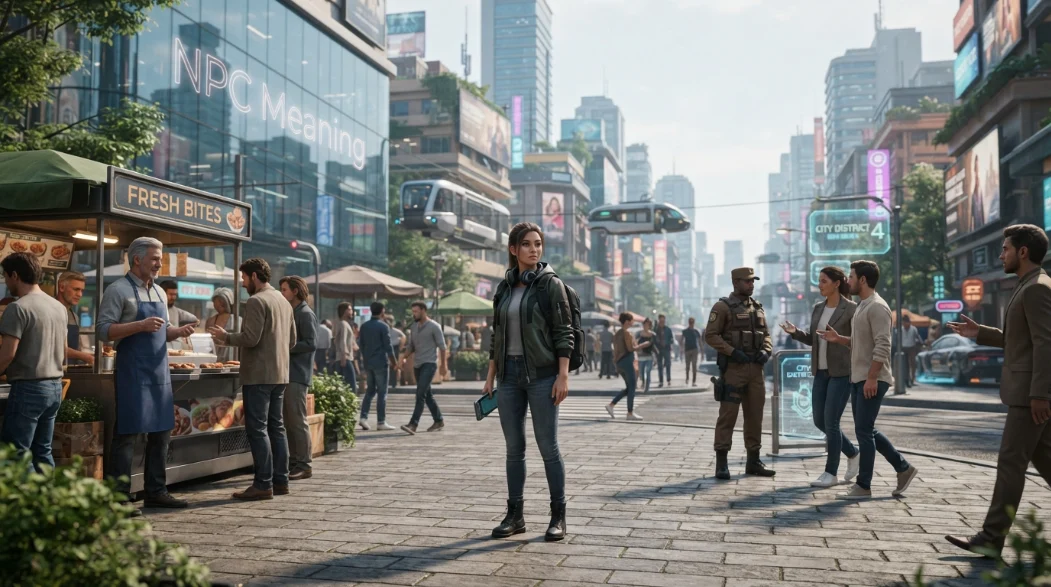
NPC stands for Non-Player Character. In video games, an NPC is a character controlled by the game rather than by a human player. NPCs can give quests, sell items, provide information, become companions, create obstacles, or simply make a game world feel alive.
The term has also moved beyond gaming. Online, calling someone an “NPC” can describe a person who seems to repeat the same opinions, phrases, or behaviors without thinking independently. On TikTok and other social platforms, the word has also developed into a meme and livestream trend.
So, NPC meaning depends on context. In a game, it is usually a neutral technical term. In everyday internet slang, it can be humorous, critical, or insulting.
What Does NPC Stand For?
NPC means Non-Player Character.
The word comes from video game terminology. A player character is controlled directly by a person playing the game. An NPC is controlled by the game’s software, usually through programmed behavior, dialogue, rules, or artificial intelligence.
For example, imagine an RPG where your character walks into a village. You might meet:
- A shopkeeper who sells weapons
- A farmer who gives you information
- A guard who blocks an entrance
- A companion who joins your party
- A villager who comments on events
- A quest giver who sends you on a mission
These characters are NPCs because the player does not directly control them.
The important point is that NPC does not simply mean “unimportant character.” An NPC can be one of the most important characters in a game. The defining feature is that the character is not directly controlled by the player.
NPC Meaning in Gaming
In gaming, an NPC is a computer-controlled character that interacts with the player or the game world.
NPCs have existed across many types of games, from role-playing games and adventure titles to strategy games, simulation games, and open-world games.
A simple NPC might follow a fixed routine. For example, a shopkeeper could open the store in the morning, talk to the player, and close the shop at night.
More advanced NPCs can respond to changing situations. They may detect the player’s actions, move around a game world, fight enemies, cooperate with other characters, or react differently depending on what the player has done.
Common Types of NPCs
| NPC type | Typical role | Example |
|---|---|---|
| Quest giver | Gives the player a task | A villager asking you to find an object |
| Merchant | Buys and sells items | A shopkeeper selling weapons |
| Companion | Helps the player | A character joining your adventure |
| Guard | Protects an area | A guard controlling access to a city |
| Villager | Adds life to the world | A character walking around town |
| Enemy | Creates opposition | A computer-controlled opponent |
| Guide | Provides information | A character explaining game mechanics |
Not every game uses the term in exactly the same way, but the basic idea remains the same: the character is not directly controlled by the player.
NPC vs Player Character
The easiest way to understand an NPC is to compare it with a player character.
A player character is controlled directly by a human player. An NPC is controlled by the game.
Consider an open-world game. You control your own character while exploring a city. The pedestrians walking down the street, the restaurant worker serving customers, and the police officer responding to events can all be NPCs.
| Feature | Player Character | NPC |
|---|---|---|
| Controlled by | Human player | Game/software |
| Direct player input | Yes | Usually no |
| Role | Main playable character | Supporting, opposing, or world-building role |
| Behavior | Directed by player | Programmed or AI-driven |
| Interaction | Player controls actions | Game determines responses |
This distinction is more useful than thinking of NPCs simply as background characters.
Why Are NPCs Important in Video Games?
NPCs help turn a collection of game mechanics into a believable world.
Without NPCs, a large fantasy city might feel like an empty collection of buildings. Add merchants, guards, travelers, children, workers, quest givers, and other characters, and suddenly the location feels populated.
NPCs can serve several purposes.
They Move the Story Forward
A character might reveal information about the plot or give the player the next objective.
For example:
“The old bridge has been destroyed. Find another route through the forest.”
That simple interaction can direct the player’s next action.
They Create a Sense of Life
NPCs can make environments feel active.
A character sweeping a shop, talking to another villager, walking home, or reacting to an event gives the world a sense of routine.
They Teach Players
Some NPCs act as guides. They can explain controls, introduce new mechanics, or demonstrate how a particular system works.
They Provide Gameplay Services
Merchants, blacksmiths, healers, trainers, and other service characters give players useful resources.
They Create Conflict
NPCs can also become opponents. Guards may chase the player, enemies may attack, or rival characters may interfere with a mission.
What Does NPC Mean in Slang?
The meaning of NPC changes when the word is used to describe a person.
In internet slang, calling someone an NPC generally suggests that the person appears to behave like a programmed character. The comparison may imply that they repeat common opinions, follow trends automatically, or do not appear to think independently.
For example:
“Everyone at the meeting repeated the same talking points. It felt like an NPC conversation.”
Here, NPC is not referring to a literal video game character. It is a metaphor for behavior that seems predictable or scripted.
Another example:
“He just repeats whatever he sees online. People are calling him an NPC.”
This usage is usually figurative.
The tone matters. Friends might use NPC jokingly, while someone using it during an argument may intend it as an insult.
What Does NPC Mean When Someone Calls You One?
If someone calls you an NPC, they are usually comparing your behavior to a non-player character in a video game.
They may mean that you seem:
- Predictable
- Repetitive
- Unoriginal
- Heavily influenced by trends
- Scripted in your responses
- Unwilling to question popular ideas
- Focused on routine behavior
It does not automatically mean any of these things are actually true.
The word is often used casually online, so its meaning can range from harmless teasing to genuine criticism.
For example, a friend might say:
“Bro, you say the same thing every morning. You’re such an NPC.”
That can simply be a joke about someone’s routine.
In a serious discussion, however, calling another person an NPC can be dismissive because it reduces a real person to a stereotype.
NPC Meaning on TikTok and Social Media
The term NPC became especially visible on social media because creators began using the idea of an NPC as entertainment.
One notable example is the NPC livestream trend, where creators repeat specific phrases, gestures, or reactions in response to virtual gifts or viewer interactions.
The behavior resembles the repetitive responses associated with game characters.
This gave NPC a meaning beyond ordinary gaming terminology. On social media, it can now refer to:
- A repetitive online persona
- Someone acting in a scripted way
- A meme about predictable behavior
- A livestream performance style
- Someone who appears to copy trends
Context is essential because a post about a video game and a TikTok joke can use the same three letters while meaning very different things.
What Is NPC Behavior?
NPC behavior is an informal phrase used to describe actions that appear highly predictable or repetitive.
For example, imagine someone always responds to a particular situation with exactly the same phrase. Another person might jokingly describe that as “NPC behavior.”
The phrase can also describe repetitive routines:
“I walked into the kitchen, opened the fridge, stared inside, and walked away. Peak NPC behavior.”
This example is humorous because many people recognize the habit.
The phrase can also become more serious when used to criticize someone’s independent thinking. That is where the slang can become offensive or unfair.
A useful distinction is:
Repetitive behavior is real. Calling someone an NPC is an interpretation of that behavior.
The label does not prove that a person lacks independent thought.
NPC Meme Meaning
The NPC meme plays with the idea that people sometimes behave like characters following a script.
A typical meme might show someone repeating a familiar phrase or performing the same action again and again, followed by a caption describing the person as an NPC.
The humor comes from comparing ordinary human habits with programmed game behavior.
NPC memes can be about almost anything:
- Repeating the same morning routine
- Using the same internet phrase
- Following a popular trend
- Ordering the same food
- Giving predictable answers
- Walking around without paying attention
- Reacting to situations in an expected way
The joke works because everyone has routines. The exaggeration makes an ordinary behavior look like game programming.
NPC Meaning in Text and Chat
When someone types NPC in a text, DM, comment, or chat, you need to look at the surrounding conversation.
Here are some common interpretations:
| Context | Likely meaning |
|---|---|
| “This RPG has great NPCs” | Non-player characters |
| “Talk to the NPC to start the quest” | Game character |
| “Bro is acting like an NPC” | Predictable or scripted behavior |
| “NPC behavior 😂” | Joke about repetitive behavior |
| “He’s an NPC” | Slang describing someone as unoriginal or predictable |
| “NPC livestream” | Social media performance trend |
The same abbreviation can therefore have a neutral gaming meaning or a mocking slang meaning.
NPC Examples in Everyday Language
Here are some natural examples showing how the term works.
Gaming Examples
“The NPC gave me a new quest.”
“Talk to the merchant NPC before leaving town.”
“The guards are NPCs controlled by the game’s AI.”
Casual Slang Examples
“You have the same breakfast every day. Total NPC behavior.”
“He walked into the room, said the same line, and left like an NPC.”
Social Media Examples
“That NPC livestream trend became huge online.”
“The video is making fun of people who act like NPCs.”
Notice the difference. The gaming examples use NPC as a technical term. The slang examples use it as a comparison.
Is NPC an Insult?
It can be.
The word itself is not inherently offensive. In gaming, NPC is a normal technical term.
When used toward a person, however, it can be insulting because it may suggest that the person has no original thoughts or simply follows other people.
For example:
Playful:
“You order the exact same pizza every Friday. NPC behavior.”
Insulting:
“You’re an NPC who can’t think for yourself.”
The first is clearly framed as a joke about a routine. The second attacks the person’s intelligence or independence.
So, the safest way to understand the slang is to consider who said it, why they said it, and what was happening in the conversation.
NPC vs AI Characters
NPCs and AI are related, but they are not identical concepts.
An NPC is a type of character in a game. AI is a set of technologies or techniques that can be used to control or influence that character’s behavior.
Some NPCs use sophisticated AI systems. Others rely on simple scripted instructions.
For example, an NPC might be programmed to:
- Walk to a specific location.
- Say a particular line.
- Wait for a few seconds.
- Return to its original position.
That character is still an NPC even though its behavior may be completely scripted.
Modern games can make NPC behavior much more dynamic, but the basic definition remains the same.
NPC vs Background Character
People sometimes use “NPC” and “background character” as if they mean exactly the same thing. They do not.
A background character may exist mainly to populate a scene.
An NPC can have a much more active role.
For example, a merchant who controls an important part of the game’s economy is an NPC. A quest giver who starts a major storyline is also an NPC.
So an NPC can be:
- Important or unimportant
- Interactive or minimally interactive
- Central to a quest or simply part of the environment
- Highly complex or extremely simple
The key distinction is control, not importance.
Where Did the Term NPC Come From?
The term became established through tabletop role-playing and video game culture.
In tabletop role-playing games, a non-player character is generally a character controlled by the game master rather than by one of the players.
Video games adopted the concept and adapted it to computer-controlled characters.
As gaming became a major part of popular culture, NPC entered everyday internet vocabulary. Social media later gave the term another layer through memes, jokes, and livestream trends.
This is a good example of how gaming terminology can move into ordinary online language.
Why Do People Use “NPC” as a Metaphor?
The metaphor works because game NPCs are often associated with predictable responses and programmed routines.
A player can walk up to a shopkeeper and hear the same greeting repeatedly. A guard may follow a defined patrol route. A villager may perform the same daily routine.
People sometimes notice similar patterns in real life.
Someone who always says the same thing, follows every trend, or performs the same routine can therefore be jokingly compared to an NPC.
The interesting part is that the slang does not describe a person’s actual programming. It describes how their behavior appears from the outside.
That distinction is important because human behavior is much more complicated than a game script.
Quick Guide to NPC Meanings
| Phrase | Meaning |
|---|---|
| NPC | Non-Player Character |
| NPC in gaming | A character controlled by the game |
| NPC character | Usually a computer-controlled game character |
| NPC slang | A person perceived as predictable or unoriginal |
| NPC behavior | Repetitive or scripted-looking behavior |
| NPC meme | Internet humor based on the NPC comparison |
| NPC on TikTok | Often connected with NPC-style performances or slang |
| NPC livestream | A performance involving repetitive reactions or phrases |
| NPC personality | Informal description of someone acting predictable |
| Calling someone an NPC | Comparing their behavior to a programmed game character |
Common Mistakes About NPC Meaning
NPC Does Not Mean “Bad Character”
An NPC can be helpful, dangerous, funny, important, or central to the story.
NPC Does Not Always Mean AI
Some NPC behavior is based on simple scripts rather than sophisticated artificial intelligence.
NPC Does Not Always Mean an Insult
In gaming, it is a completely ordinary term. In slang, the tone determines the meaning.
NPC Does Not Mean a Character Has No Personality
Many games give NPCs detailed personalities, histories, motivations, and dialogue.
NPC Does Not Literally Describe a Person
When someone calls another person an NPC, it is usually a metaphor or insult, not a factual description.
How to Use NPC Correctly
Use NPC as a technical gaming term when talking about characters controlled by the game.
For slang, make sure the context makes your meaning clear.
Natural gaming use:
“The NPC at the village entrance gave me a quest.”
Natural casual use:
“I keep doing the same thing every day. I feel like an NPC.”
Meme-style use:
“NPC behavior detected.”
Avoid using the term as a serious judgment of someone’s intelligence or ability to think independently. It is usually more useful as humor or casual internet language.
Related Terms You May See
Understanding NPC becomes easier when you know a few related gaming terms.
Player Character
The character directly controlled by the player.
Protagonist
The main character in a story. A protagonist can be a player character, but the terms are not interchangeable.
AI
Technology used to create or control certain behaviors in games and other applications.
Game Master
In tabletop role-playing games, the person who controls the world, story events, and non-player characters.
RPG
A role-playing game, a genre where players typically control characters and make decisions within a larger game world.
Background Character
A character whose main purpose is to populate or support a setting.
These terms overlap in some situations, but each has its own meaning.
Frequently Asked Questions
What does NPC mean?
NPC means Non-Player Character. In video games, it refers to a character controlled by the game rather than directly by a human player.
What does NPC mean in slang?
In slang, NPC usually describes someone who appears predictable, repetitive, or lacking independent thought. It is often used jokingly online, but it can also be insulting.
What does NPC mean on TikTok?
On TikTok, NPC can refer to the broader internet slang meaning or to the NPC livestream trend, where creators perform repetitive reactions and phrases in response to viewer interactions.
Is NPC an insult?
NPC can be an insult when it is used to suggest that someone cannot think independently. In gaming, however, NPC is simply a neutral term for a non-player character.
What does NPC stand for in gaming?
In gaming, NPC stands for Non-Player Character. These characters are controlled by the game rather than directly by the player.
What is an NPC character?
An NPC is a character in a game that the player does not directly control. NPCs can include merchants, guards, quest givers, companions, villagers, and many other roles.
What does NPC behavior mean?
NPC behavior is informal slang for behavior that seems repetitive, predictable, or scripted. It comes from the way game characters often follow programmed routines.
Is an NPC controlled by AI?
Not necessarily. Some NPCs use advanced AI systems, while others follow simple scripts or predefined rules. An NPC is defined by being non-player-controlled, not by the specific technology controlling it.
Why do people call someone an NPC?
People use the term as a metaphor when someone’s behavior seems repetitive, predictable, trend-driven, or scripted. It can be a joke, but it can also be used negatively.
What is the difference between an NPC and a player character?
A player character is directly controlled by a human player. An NPC is controlled by the game or another non-player system.
Conclusion
The meaning of NPC depends on where you see it. In gaming, NPC stands for Non-Player Character, referring to characters controlled by the game rather than directly by a player. They can guide the story, offer quests, sell items, provide information, or make a virtual world feel more alive.
Online, NPC has taken on a different meaning. Calling someone an NPC usually suggests that their behavior seems repetitive, predictable, or scripted. It can be a harmless joke, a meme, or an insult depending on the context.
Understanding the difference between these uses makes the term much easier to recognize. When you see NPC in a game, think non-player character. When you see it in social media slang, look at the context to understand what the speaker really means.
Read More Related Articles:
- Serendipity Meaning | The Beautiful Art of Finding What You …
- Limerence Meaning | What It Is, How It Feels, and Why It Can …
- Lobotomy Meaning | What It Was, Why It Changed Medicine …
