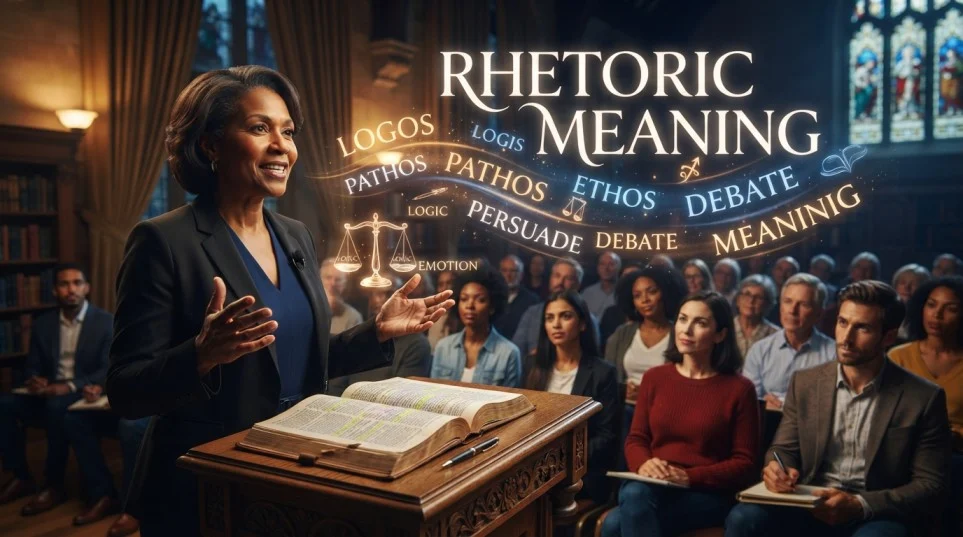
Rhetoric means the art of using language in a deliberate and effective way to influence, inform, engage, or persuade an audience. It is used in speeches, essays, advertisements, debates, literature, politics, classrooms, and everyday conversations.
When someone carefully chooses words to make an idea more convincing, memorable, emotional, or powerful, they are using rhetoric.
For example, saying “We need to protect our future” creates a different effect from simply saying “We need to make a change.” Both statements communicate an idea, but the first uses emotional language to make the message feel more urgent and personal.
Rhetoric is not automatically dishonest or manipulative. It can be used to make a strong argument, explain an important idea, inspire people, or make writing more memorable. The key is understanding how language is being used and what effect it is intended to create.
What Does Rhetoric Mean?
The simple meaning of rhetoric is the skillful use of language to communicate an idea effectively, especially when trying to persuade an audience.
The word can describe both a communication technique and a broader way of speaking or writing.
For example:
“Her speech used powerful rhetoric to encourage people to support the project.”
Here, rhetoric refers to the carefully chosen language and persuasive techniques used in the speech.
In another context, someone might say:
“The politician’s rhetoric focused heavily on national unity.”
In this case, rhetoric refers to the particular language, themes, and style used in political communication.
So, rhetoric is not simply about using complicated words. Clear, simple language can be highly rhetorical if it is carefully designed to affect an audience.
Rhetoric in Simple Words
Think of rhetoric as choosing your words with a purpose.
If you tell a friend:
“You should probably study tonight.”
That is advice.
If you say:
“Imagine walking into the exam tomorrow knowing you gave yourself the best chance to succeed.”
The second version uses rhetoric. It creates an image and appeals to the listener’s emotions and motivation.
The basic idea is:
Words + purpose + audience + effect = rhetoric
Where Did the Word Rhetoric Come From?
Rhetoric has a long history.
The concept became especially important in ancient Greece, where public speaking was central to civic life. Speakers needed to present arguments clearly and persuade audiences in courts, political settings, and public gatherings.
Greek thinkers developed systematic ideas about how persuasion works. One of the most influential figures was Aristotle, who described rhetoric as the ability to identify the available means of persuasion in a particular situation.
Classical rhetoric later influenced Roman education and public speaking. Thinkers such as Cicero and Quintilian expanded ideas about effective speech, argument, style, and the responsibilities of a speaker.
Today, rhetoric exists far beyond formal speeches. It appears in social media posts, marketing, news commentary, classroom discussions, novels, films, campaign messages, business presentations, and ordinary conversations.
The technology changed. The basic communication challenge did not:
How do you make another person understand, remember, care about, or accept an idea?
Rhetoric Examples in Everyday Life
You probably encounter rhetoric more often than you realize.
Consider these examples.
Example 1: Advertising
“Give your family the protection they deserve.”
This does more than describe a product. It connects the product with family, responsibility, and safety.
Example 2: A Teacher
“Every mistake you make today is one step closer to understanding the problem.”
The teacher is reframing failure as progress. The language is designed to change how students think about mistakes.
Example 3: A Friend
“You’ve worked on this for three months. Are you really going to quit now?”
This is a rhetorical question. The speaker does not necessarily expect an answer. The question is meant to encourage persistence.
Example 4: A Speech
“We can complain about the problem, or we can become part of the solution.”
The sentence creates a contrast between two choices. That contrast makes the message more memorable and persuasive.
Example 5: Social Media
“If we want a better future, we have to start building it today.”
The statement uses an emotional idea about the future to motivate action.
These examples show something important: rhetoric is about effect, not fancy vocabulary.
What Is Rhetorical Language?
Rhetorical language is language intentionally shaped to create a particular response from an audience.
It may make people:
- Think about an issue differently
- Feel an emotion
- Remember a message
- Agree with an argument
- Question an assumption
- Take action
- Pay closer attention
- Connect personally with an idea
Rhetorical language can be emotional, logical, humorous, dramatic, poetic, direct, or subtle.
For instance:
Plain statement:
“The city needs more trees.”
More rhetorical statement:
“A city without trees is a city that has forgotten how to breathe.”
The second sentence uses metaphor and emotional imagery. It gives the audience something to picture.
The Three Classical Appeals of Rhetoric
One of the most useful ways to understand rhetoric is through three classical persuasive appeals:
- Ethos
- Pathos
- Logos
These ideas are associated with Aristotle’s discussion of persuasion.
Ethos: Appeal to Credibility
Ethos concerns the speaker’s credibility, character, authority, or trustworthiness.
A doctor explaining a medical topic may establish ethos by discussing their professional experience.
For example:
“After working with patients for more than two decades, I have seen how important early treatment can be.”
The speaker is presenting information while also establishing credibility.
Ethos does not simply mean having a title. A writer can establish credibility by:
- Using reliable evidence
- Acknowledging limitations
- Showing knowledge of the subject
- Avoiding exaggerated claims
- Representing opposing views fairly
Pathos: Appeal to Emotion
Pathos appeals to emotions.
It can involve feelings such as:
- Hope
- Fear
- Joy
- Sympathy
- Anger
- Pride
- Love
- Sadness
For example:
“No child should have to wonder if there will be enough food at home tonight.”
The sentence is designed to create an emotional response.
Pathos is not automatically manipulation. Emotional communication is a normal part of human language. The ethical question depends on how honestly and responsibly the emotion is being used.
Logos: Appeal to Logic
Logos uses reasoning, evidence, facts, examples, and logical relationships.
For example:
“The program reduced processing time by 30 percent during its first year, according to the reported results.”
The emphasis here is evidence and reasoning.
Strong arguments often combine all three:
Ethos builds trust. Pathos creates emotional connection. Logos supports the reasoning.
Why Ethos, Pathos, and Logos Matter
Imagine a charity asking people to support a clean-water project.
- A message based mainly on logos might explain the number of people affected and the projected impact of the project.
- A message using pathos might describe what daily life is like for a family without reliable clean water.
- A message using ethos might introduce the organization’s experience and explain how the project is managed.
- A well-constructed message can use all three without becoming repetitive.
- This is one reason rhetoric is more sophisticated than simply saying something persuasive.
Common Rhetorical Devices
Rhetorical devices are specific techniques writers and speakers use to strengthen communication.
Here are some of the most common ones.
Rhetorical Question
A rhetorical question is asked to make a point rather than to receive a literal answer.
“Who doesn’t want a second chance?”
The speaker is not conducting a survey. The question encourages the audience to think about the idea.
Repetition
Repeating a word or phrase can make a message memorable.
“We need courage. We need patience. We need action.”
The repeated structure creates rhythm and emphasis.
Metaphor
A metaphor describes one thing through another concept.
“Fear is a locked door.”
The sentence does not literally mean fear is a physical door. It creates an image that helps explain how fear can prevent someone from moving forward.
Simile
A simile compares two things using words such as like or as.
“Her words spread through the room like a spark.”
Contrast
Contrast places opposing ideas close together.
“We can build bridges, or we can build walls.”
The opposition makes the choices easier to notice.
Parallelism
Parallelism uses similar grammatical structures.
“We came to learn, we came to grow, and we came to lead.”
The repeated structure creates rhythm and makes the statement easier to remember.
Anaphora
Anaphora is repetition at the beginning of successive phrases or sentences.
“We will listen. We will learn. We will improve.”
The repeated opening gives the passage momentum.
Hyperbole
Hyperbole is deliberate exaggeration for emphasis.
“I’ve told you a million times.”
The speaker obviously does not mean exactly one million times. The exaggeration emphasizes frustration.
Analogy
An analogy explains one idea by comparing it with another familiar idea.
“Learning a language is like building a new road in your mind. The more you travel it, the easier the journey becomes.”
The comparison helps make an abstract process easier to understand.
Rhetoric vs Persuasion
Rhetoric and persuasion are closely related, but they are not identical.
Persuasion is the broader goal or process of influencing someone’s beliefs, attitudes, or actions.
Rhetoric is the strategic use of communication to achieve effects such as persuasion, understanding, emphasis, engagement, or memorability.
A useful way to think about it is:
| Concept | Basic Meaning |
|---|---|
| Rhetoric | Deliberate use of language and communication techniques |
| Persuasion | Attempt to influence someone’s thinking or behavior |
| Argument | A structured claim supported by reasons or evidence |
| Communication | The broader process of sharing information or meaning |
A persuasive message can rely heavily on rhetoric, but rhetoric can also be used when the main goal is not persuasion.
For example, a teacher may use rhetorical techniques to make a complicated concept memorable without trying to convince students to adopt a particular opinion.
Rhetoric vs Propaganda
These terms are sometimes treated as synonyms, but they carry different meanings.
Rhetoric refers broadly to the strategic use of communication.
Propaganda generally refers to communication designed to promote a particular political, ideological, or other cause, often through selective presentation or emotionally charged messaging.
Rhetoric can be used in propaganda, but not every rhetorical message is propaganda.
For example, a student using repetition and analogy in an essay is using rhetoric. That does not make the essay propaganda.
The distinction becomes important when analyzing persuasive communication critically.
Instead of asking only:
“Is this rhetoric?”
Ask:
- What is the speaker trying to achieve?
- Who is the intended audience?
- What evidence is provided?
- What information is missing?
- Which emotions are being activated?
- Are opposing perspectives addressed?
- Are the claims supported?
These questions reveal much more than simply labeling a message.
Rhetoric in Writing
Rhetoric plays a major role in effective writing.
An essay is not simply a collection of sentences. A writer makes choices about:
- Audience
- Tone
- Structure
- Evidence
- Word choice
- Examples
- Emotional emphasis
- Order of ideas
- Counterarguments
- Conclusion
All of these choices can affect how readers receive the message.
Rhetoric in an Essay
Suppose a writer wants to argue that students should read more books.
A weak argument might say:
“Students should read more because reading is good.”
A stronger rhetorical approach could say:
“A few quiet pages each night can give students something a crowded digital day often takes away: uninterrupted attention.”
The second statement creates contrast, imagery, and emotional appeal while introducing the argument.
The writer can then support the idea with evidence.
This combination is powerful:
Rhetorical language attracts attention. Evidence supports the claim.
Rhetoric in Literature
Authors use rhetoric to shape how readers experience characters, scenes, and ideas.
A novelist might use repetition to show obsession.
A poet might use metaphor to express grief.
A playwright might use rhetorical questions to reveal conflict.
A narrator might use contrast to show the difference between appearance and reality.
For example:
“The house was full of people, yet somehow it felt empty.”
The contrast between full and empty creates a deeper emotional meaning.
Literary rhetoric often works indirectly. The reader may feel the effect before consciously identifying the technique.
Rhetoric in Politics
Political communication frequently uses rhetoric because political speakers need to communicate complicated ideas to large audiences.
Political rhetoric may include:
- Repetition
- Slogans
- Emotional appeals
- Historical references
- Contrasts
- Promises
- Metaphors
- Calls to action
- Appeals to shared identity
- Rhetorical questions
For example:
“What kind of country do we want to leave for the next generation?”
The speaker is using a rhetorical question to move the audience toward thinking about the future.
When analyzing political rhetoric, it helps to separate language from evidence.
A powerful speech can sound convincing because of its delivery and wording. That does not automatically prove the claims being made.
A careful reader should examine both:
How is the message presented?
and
What evidence supports the message?
Rhetoric in Advertising
Advertising is another place where rhetoric appears constantly.
Consider the difference between:
“This phone has a larger battery.”
and:
“Stay connected from morning until night.”
The first statement emphasizes a product feature.
The second emphasizes the experience the feature is supposed to provide.
Advertising rhetoric often connects products with broader ideas such as:
- Freedom
- Confidence
- Success
- Comfort
- Beauty
- Security
- Belonging
- Adventure
This is why understanding rhetoric can also improve media literacy.
Instead of simply asking “What is this advertisement selling?”, ask:
“What feeling or identity is this advertisement selling alongside the product?”
That question often reveals the deeper persuasive strategy.
Rhetoric in Everyday Conversation
Rhetoric does not require a stage, microphone, or formal speech.
You may use it when you say:
“Do you really think that’s a good idea?”
Or:
“Think about where you’ll be one year from now.”
Or:
“We’ve come this far. Why stop now?”
These statements use questions, future imagery, and repetition of progress to influence the conversation.
Even a parent encouraging a child to clean their room might say:
“How much easier would tomorrow morning be if everything were already ready?”
The speaker is framing the action around a future benefit.
That is rhetoric in ordinary life.
What Makes Rhetoric Effective?
Good rhetoric usually starts with understanding the audience.
The same message can produce completely different reactions in different groups.
Imagine a writer explaining climate science to:
- A group of scientists
- High school students
- Business owners
- General readers
The underlying facts may remain similar, but the language, examples, level of detail, and structure can change.
Effective rhetoric considers:
Audience
Who is listening or reading?
Purpose
What should the audience understand, feel, question, or do?
Context
Where and when is the message being delivered?
Language
Which words will communicate the idea clearly?
Evidence
What information supports the argument?
Tone
Should the message feel serious, hopeful, urgent, humorous, calm, or reflective?
This is why rhetoric is partly about reading the room.
How to Identify Rhetoric in a Text
You do not need to be a literary scholar to analyze rhetoric.
Use this simple process.
Step 1: Find the Main Message
Ask:
What is the writer or speaker trying to communicate?
Step 2: Identify the Audience
Ask:
Who is this message intended for?
Step 3: Look at Word Choice
Notice words that create strong emotional or mental associations.
Step 4: Look for Patterns
Watch for:
- Repetition
- Questions
- Contrasts
- Metaphors
- Analogies
- Parallel structures
- Strong emotional language
Step 5: Examine Evidence
Ask:
Are the important claims supported by facts, examples, reasoning, or credible sources?
Step 6: Consider the Intended Effect
Ask:
What does the writer want me to think or feel after reading this?
This final question is especially useful because rhetoric is fundamentally connected to audience response.
Rhetoric and Tone Are Not the Same Thing
Rhetoric and tone can overlap, but they describe different things.
Tone is the attitude or emotional quality conveyed by a speaker or writer.
Rhetoric concerns the strategies and choices used to communicate an idea and affect an audience.
For example, a writer can use rhetorical questions in a humorous tone.
Another writer can use the same rhetorical device in a serious tone.
So:
Rhetorical device = technique
Tone = attitude or emotional character
Understanding this distinction can make literary and writing analysis much clearer.
Positive and Negative Uses of Rhetoric
Rhetoric itself is neither automatically good nor bad.
Its value depends heavily on how it is used.
Responsible rhetoric can:
- Explain complicated ideas
- Encourage constructive action
- Make information memorable
- Give people a voice
- Build emotional connection
- Strengthen an argument
- Help audiences understand different perspectives
Poor or deceptive rhetoric can:
- Hide weak reasoning
- Exploit emotions
- Distort information
- Create false impressions
- Distract from missing evidence
- Make unsupported claims sound authoritative
This is why strong rhetorical analysis should examine both style and substance.
A beautiful sentence is still not evidence.
An emotional story is still not proof of a general claim.
A confident speaker can still be mistaken.
Rhetoric affects how a message feels, but critical thinking helps determine how much trust the message deserves.
How to Use Rhetoric in Your Own Writing
You do not need to make your writing complicated to make it more rhetorical.
Start with your purpose.
Ask yourself:
“What do I want my reader to understand or remember?”
Then make deliberate choices.
Use a Strong Opening
Start with a statement, image, question, or observation that gives readers a reason to continue.
Use Specific Examples
Abstract arguments become stronger when readers can picture a real situation.
Use Contrast
Putting two opposing ideas together can sharpen your point.
Use Repetition Carefully
Repeat an important phrase when it adds rhythm or emphasis. Avoid repeating the same idea without adding anything new.
Mix Logic and Emotion
Facts help readers understand an argument. Human examples help them connect with it.
Respect the Reader
Strong rhetoric does not require exaggeration. Clear reasoning combined with purposeful language can be more effective than dramatic wording.
A Simple Rhetorical Example
Here is a basic transformation.
Plain Version
“People should spend less time on their phones.”
Rhetorical Version
“If every quiet moment is filled with a screen, when do we give our minds a chance to be still?”
The second version uses a rhetorical question and creates a contrast between constant stimulation and mental quiet.
It does not simply state the argument. It invites the reader to experience the problem mentally.
That is one of the central strengths of rhetoric.
Rhetoric in a Sentence
Here are several examples showing how the word rhetoric is naturally used.
- The speaker used powerful rhetoric to motivate the audience.
- The essay examines the rhetoric surrounding social change.
- His political rhetoric focused on economic security.
- The advertisement relies on emotional rhetoric rather than detailed evidence.
- She studied classical rhetoric to improve her public speaking.
- The author’s rhetoric makes the central argument easier to remember.
- The debate showed how rhetoric can shape public opinion.
- The teacher explained how rhetorical devices strengthen an argument.
Rhetoric vs Rhetorical
These words are related but are used differently.
Rhetoric is generally a noun.
“The speech contained powerful rhetoric.”
Rhetorical is an adjective.
“The speaker used a rhetorical question.”
Another example:
“Political rhetoric can influence public discussion.”
“The politician used rhetorical techniques during the speech.”
A useful shortcut is:
Rhetoric = the broader practice or language
Rhetorical = describing something related to rhetoric
What Does Rhetorical Mean?
Rhetorical means related to rhetoric or designed to have a particular effect on an audience through language.
The most familiar example is a rhetorical question.
A rhetorical question is not normally asked because the speaker genuinely needs an answer.
For example:
“Isn’t everyone looking for a better life?”
The expected response is implied. The question is being used to emphasize an idea.
However, not every question in a persuasive conversation is rhetorical. Context matters.
The Difference Between a Rhetorical Question and a Normal Question
Consider:
“What time does the meeting start?”
This is a genuine question. The speaker wants information.
Now consider:
“How could anyone ignore a problem like this?”
The speaker is probably not asking the audience to provide a factual answer. The question expresses a judgment and encourages reflection.
That is a rhetorical question.
Common Mistakes When Using Rhetoric
Rhetorical writing can become weak when every sentence tries too hard to sound dramatic.
Avoid:
Too Many Rhetorical Questions
One strong question can be effective. Ten questions in a row can feel artificial.
Empty Emotional Language
Words such as “amazing,” “shocking,” or “unbelievable” have limited value if the writing gives readers no reason to believe them.
Overcomplicated Vocabulary
Rhetoric does not mean using the biggest words available.
Simple language can carry enormous rhetorical power.
Repeating the Same Point
Repetition works when it creates emphasis. Repeating an idea without developing it makes writing feel padded.
Ignoring Evidence
Persuasive language cannot replace evidence when a factual claim requires proof.
The strongest writing often combines clarity, evidence, and carefully chosen language.
Why Understanding Rhetoric Matters
Learning about rhetoric gives you two valuable skills.
First, it can make you a better communicator.
You become more aware of:
- Word choice
- Audience
- Structure
- Tone
- Persuasive techniques
- Emotional appeals
- Evidence
Second, it can make you a better reader.
You become more capable of noticing when a message is trying to influence you.
That matters in a world filled with:
- Advertisements
- Political speeches
- Social media
- Headlines
- Influencer content
- Brand campaigns
- Opinion articles
- Public debates
Understanding rhetoric does not mean distrusting every persuasive message.
It means knowing how to examine the message instead of simply reacting to it.
A Quick Formula for Understanding Rhetoric
When you encounter a persuasive message, remember:
Who is speaking?
Who is the audience?
- What is the purpose?
- What techniques are being used?
- What emotions are being activated?
- What evidence is provided?
- What information might be missing?
- What response does the speaker want?
These questions turn passive reading into active analysis.
Frequently Asked Questions
What is the simple meaning of rhetoric?
Rhetoric is the deliberate use of language to communicate an idea effectively and often to influence or persuade an audience.
What is an example of rhetoric?
“Are we really willing to give up on our future?” is an example of rhetoric because the rhetorical question is designed to make an audience reflect on an issue rather than simply provide information.
Is rhetoric the same as persuasion?
No. Persuasion is the process of influencing someone’s beliefs, attitudes, or actions. Rhetoric is the strategic use of communication and language that can be used for persuasion and other purposes.
Is rhetoric always manipulative?
No. Rhetoric can be used responsibly to explain ideas, strengthen arguments, inspire people, or make communication clearer. It can also be used deceptively, so the evidence and context behind a message matter.
What are the three types of rhetoric?
The three classical persuasive appeals are ethos, pathos, and logos. Ethos relates to credibility, pathos to emotion, and logos to reasoning and evidence.
What is a rhetorical question?
A rhetorical question is a question asked mainly to make a point, emphasize an idea, or encourage reflection rather than to obtain a literal answer.
What is rhetoric in writing?
Rhetoric in writing involves making deliberate choices about language, structure, evidence, examples, tone, and rhetorical devices to create a particular effect on readers.
What is the difference between rhetoric and rhetorical?
Rhetoric is a noun referring to the practice or use of persuasive and effective language. Rhetorical is an adjective describing something connected with rhetoric, such as a rhetorical question or rhetorical strategy.
Is rhetoric only used in politics?
No. Rhetoric appears in politics, but it is also common in literature, advertising, education, journalism, business communication, social media, speeches, and ordinary conversation.
Why is rhetoric important?
Rhetoric helps people communicate ideas more effectively and helps readers recognize how language is being used to influence their attention, emotions, beliefs, and decisions.
Conclusion
Understanding rhetoric meaning becomes much easier when you stop thinking of it as complicated or fancy language. At its core, rhetoric is about using words deliberately to make an idea clearer, stronger, more memorable, or more persuasive. You can find it in speeches, essays, literature, advertisements, politics, classrooms, and everyday conversations.
From ethos, pathos, and logos to rhetorical questions, repetition, metaphors, contrast, and analogy, these techniques shape how people understand and respond to a message. Learning to recognize them can improve your own writing while also helping you think more critically about the messages you encounter every day.
The next time a speech, advertisement, or article strongly affects your thoughts or emotions, pause and ask: What words are creating this effect, and why were they chosen? That simple question is the beginning of understanding rhetoric.