Rapport means a friendly, comfortable connection between people based on mutual understanding, trust, and respect. When two people have rapport, they usually find it easier to communicate, understand each other, and feel at ease in one another’s company. For example, a teacher who listens patiently to students and makes them feel comfortable may develop strong rapport with them.
The interesting thing about rapport is that it does not require people to share the same personality, interests, or opinions. Two people can have very different backgrounds and still connect through respectful communication and genuine interest. You might experience rapport with a new colleague, a helpful doctor, a close friend, or even someone you have just met. Understanding the rapport meaning helps you recognize why some conversations feel natural while others feel uncomfortable. It also shows how small actions, such as listening carefully, remembering details, and responding thoughtfully, can turn an ordinary interaction into a meaningful connection.
What Does Rapport Mean in Simple English?

In simple English, rapport means getting along well with someone and feeling that you understand each other.
It describes a positive connection that makes communication feel natural rather than forced. People who have good rapport often feel comfortable expressing their thoughts, asking questions, and sharing ideas.
Simple definition: Rapport is a friendly relationship in which people feel understood, respected, and comfortable communicating with each other.
Consider two situations.
In the first, you meet someone who interrupts you, looks distracted, and seems uninterested in your answers. The conversation feels awkward.
In the second, the person listens, responds thoughtfully, and asks questions about what you say. You feel more comfortable talking to them.
The second interaction shows how rapport can develop. It is not necessarily about becoming friends. It is about creating a positive connection that supports understanding.
Rapport Definition, Pronunciation, and Part of Speech
Here are the essential details about the word.
| Word Detail | Explanation |
|---|---|
| Word | Rapport |
| Part of speech | Noun |
| Pronunciation | ra-POHR, approximately /ræˈpɔːr/ |
| Simple definition | A friendly connection based on understanding and mutual trust |
| Plural form | Rapports, although the singular is more common |
| Common expressions | Build rapport, establish rapport, develop rapport |
| Word origin | From French rapport, associated with bringing or relating things together |
The word is pronounced with the stress on the second syllable. The final letters are not pronounced like the ending of the English word report. In common English pronunciation, rapport sounds roughly like “ra-POHR.”
Rapport is a noun, so it commonly appears after verbs such as build, establish, develop, and maintain.
For example:
- The manager built rapport with the new employees.
- Good communication helped establish rapport between the two teams.
- She has excellent rapport with her students.
These expressions describe the development or presence of a positive connection between people.
Examples of Rapport in Everyday Life

Rapport becomes easier to understand when you see how it works in real situations. It can develop in personal conversations, classrooms, workplaces, and even brief interactions with strangers.
1. Rapport Between Friends
Two friends may have different hobbies but still understand and support each other. They listen without making every conversation a competition and feel comfortable discussing their problems.
Example: “Maya and Sara developed a strong rapport because they always listened to each other without judgment.”
2. Rapport Between a Teacher and a Student
A student may hesitate to ask questions in a classroom where mistakes are treated harshly. A supportive teacher can create an environment where the student feels safe enough to participate.
Example: “The teacher’s patience helped her build rapport with students who were afraid of making mistakes.”
3. Rapport in the Workplace
Colleagues work together more comfortably when they communicate respectfully, share information, and understand each other’s responsibilities.
Example: “The new team leader established rapport with the staff by listening to their concerns before introducing changes.”
4. Rapport Between a Business and a Customer
A customer is more likely to feel comfortable asking questions when a representative listens carefully and provides honest answers instead of pushing for a quick sale.
Example: “The salesperson built rapport with the customer by understanding her needs and explaining the available options clearly.”
5. Rapport Between a Doctor and a Patient
A patient may find it easier to discuss concerns when a healthcare professional listens attentively, explains information clearly, and treats the patient with respect.
Example: “The doctor’s calm communication helped establish rapport with the nervous patient.”
6. Rapport With Someone You Have Just Met
You do not need years of friendship to establish rapport. A friendly greeting, a thoughtful question, and genuine attention can create an initial connection.
Example: “We established rapport during the first conversation because we both felt comfortable sharing our ideas.”
These examples demonstrate an important point: rapport can exist in both personal and professional settings. Its depth may vary, but the foundation remains mutual understanding and comfortable communication.
What Does Building Rapport Mean?
Building rapport means developing a positive connection with another person through your words, actions, and attitude.
It usually happens gradually. One friendly conversation may create an initial connection, but consistent behavior helps strengthen it over time.
Imagine that you have joined a new workplace. During your first week, you introduce yourself to colleagues, ask about their responsibilities, listen when they explain their work, and follow through on your commitments.
These actions show that you respect their time and value their contributions. As people become more comfortable communicating with you, rapport can grow.
Building rapport does not mean agreeing with everything someone says. You can disagree respectfully and still maintain a positive connection.
Building Rapport vs. Having Rapport
These expressions are related, but they describe slightly different things.
| Expression | Meaning | Example |
|---|---|---|
| Building rapport | Developing a connection | She is building rapport with her new team. |
| Having rapport | Already sharing a positive connection | He has good rapport with his colleagues. |
| Establishing rapport | Creating an initial connection | The interviewer established rapport with the candidate. |
| Maintaining rapport | Keeping communication positive | Regular check-ins helped maintain rapport. |
The distinction is useful in professional writing, interviews, presentations, and everyday conversations.
How to Build Rapport With Someone Naturally
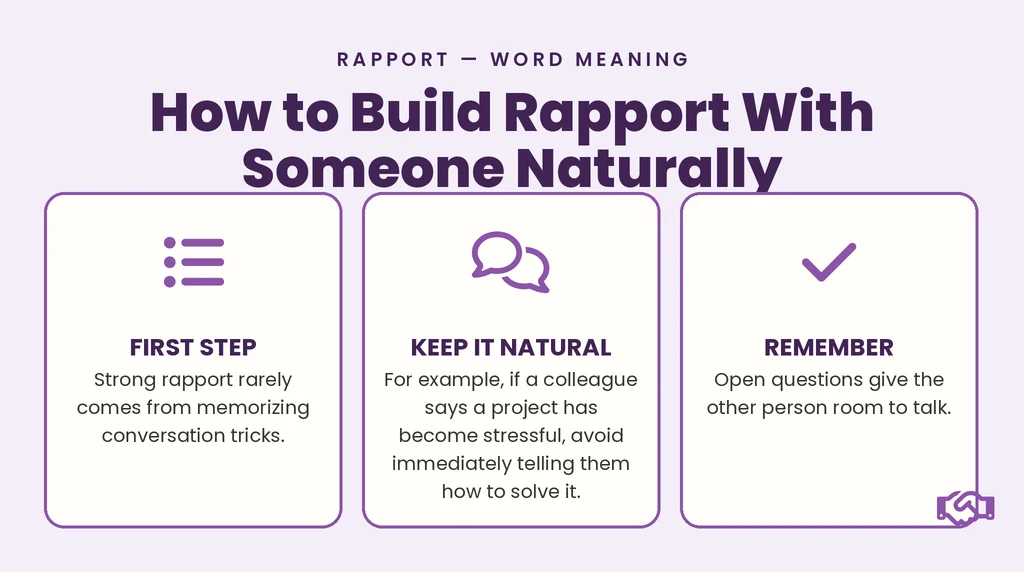
Strong rapport rarely comes from memorizing conversation tricks. It develops when people feel that their words matter and their boundaries are respected.
Here are practical ways to create that connection.
1. Listen to Understand, Not Just to Reply
Active listening means paying attention to what someone is saying instead of preparing your next response while they speak.
Allow the person to finish, ask relevant questions, and acknowledge their main point.
For example, if a colleague says a project has become stressful, avoid immediately telling them how to solve it. You could ask, “Which part has been the most difficult so far?”
That question gives them room to explain the situation and helps you understand what they actually need.
2. Show Genuine Interest
People can often recognize when a conversation feels like an obligation. Asking thoughtful questions about someone’s interests, responsibilities, or experiences can make the interaction more meaningful.
If a friend mentions learning photography, you might ask what kind of pictures they enjoy taking.
The goal is not to ask endless questions. It is to show that you paid attention and want to understand the person better.
3. Use Respectful Body Language
Communication involves more than words. Facial expressions, posture, eye contact, and tone of voice can influence how a conversation feels.
A relaxed posture, an attentive expression, and comfortable eye contact may help another person feel acknowledged.
However, body language varies across cultures and individuals. Some people avoid direct eye contact for personal, cultural, or other reasons. Respectful communication does not require everyone to behave in exactly the same way.
4. Find Common Ground Without Pretending
Shared interests can provide an easy starting point for a conversation. You might discover that you enjoy the same books, follow similar sports, or have faced comparable challenges.
Still, genuine rapport does not depend on having everything in common.
If you disagree about a topic, you can remain curious about the other person’s perspective instead of pretending to agree.
5. Remember Important Details
Remembering a detail someone shared can show that you were paying attention.
For instance, if a colleague mentioned an upcoming presentation, asking how it went the following week can help strengthen your professional connection.
This does not mean you must remember every detail about everyone. Small, sincere gestures are more valuable than forced attempts to impress people.
6. Be Consistent and Keep Your Promises
A friendly conversation may create an initial connection, but reliable behavior helps sustain it.
If you promise to send a document, send it when you said you would. If you cannot meet a commitment, communicate the change honestly.
Consistency helps people understand what they can expect from you. Over time, this can support both rapport and trust.
7. Respect Boundaries and Different Opinions
Trying too hard to create a connection can have the opposite effect. Personal questions, unwanted jokes, excessive familiarity, or pressure to share private information may make someone uncomfortable.
Give people space to decide how much they want to share. A positive connection should feel voluntary, not forced.
A useful principle: Focus on helping the other person feel heard rather than trying to make them like you.
Why Is Rapport Important in Communication?
Rapport helps people exchange information more comfortably. When a conversation feels respectful, people may be more willing to ask questions, explain problems, share feedback, and clarify misunderstandings.
Its value depends on the situation, but several benefits are especially common.
- Clearer communication: People may feel more comfortable explaining what they mean.
- Better collaboration: Colleagues can discuss responsibilities and problems more openly.
- Stronger relationships: Mutual understanding can help maintain personal and professional connections.
- More productive conversations: A comfortable atmosphere can make discussions easier to manage.
- Improved customer interactions: Customers may feel more comfortable explaining their needs and concerns.
- Greater willingness to participate: Students and team members may feel more confident contributing ideas.
Rapport does not guarantee agreement or eliminate conflict. Two people can have a positive connection and still disagree about important decisions.
Its real value is that it can make those disagreements easier to discuss respectfully.
Rapport in Psychology and Human Behavior
In psychology and interpersonal communication, rapport generally refers to a positive interpersonal connection marked by mutual attention, responsiveness, and a sense of understanding.
You may notice it when two people are engaged in a conversation and respond naturally to one another. They take turns speaking, recognize each other’s emotions, and adjust their communication to the situation.
For example, a counselor who listens without rushing to judgment may help a client feel more comfortable discussing difficult experiences. That connection can support communication, although rapport alone does not replace professional training, appropriate boundaries, or effective treatment.
Rapport is also relevant to interviews, education, teamwork, and customer service because each setting involves people exchanging information and responding to one another.
It is important to distinguish rapport from simple friendliness. Someone may smile and speak politely without developing a deeper sense of mutual understanding. Conversely, two people with different communication styles may develop good rapport through patience and respect.
Rapport Synonyms and Antonyms
Understanding similar and opposite words helps you use rapport more accurately.
Common Synonyms of Rapport
| Synonym | Meaning | Best Use |
|---|---|---|
| Connection | A sense of being linked to someone | General conversations |
| Understanding | Recognizing another person’s perspective | Discussions and relationships |
| Harmony | A peaceful or cooperative relationship | Groups and teams |
| Compatibility | The ability to work or interact well together | Personal and professional settings |
| Affinity | A natural liking or attraction | Shared interests or preferences |
| Relationship | A connection between people | Broad personal or professional contexts |
| Mutual trust | Confidence in each other’s honesty or reliability | Long-term interactions |
These words are related, but they are not always interchangeable. Relationship is broader than rapport, while affinity often emphasizes a natural liking or shared attraction.
Common Antonyms of Rapport
- Discord
- Hostility
- Tension
- Antagonism
- Misunderstanding
- Friction
- Disconnection
For example, ongoing tension between coworkers may make communication difficult and prevent them from developing rapport.
However, a temporary disagreement does not automatically mean rapport has disappeared. People can experience conflict and still maintain mutual respect.
Rapport vs. Relationship vs. Trust
These three terms are closely connected, but each emphasizes a different aspect of human interaction.
| Term | Main Meaning | Example |
|---|---|---|
| Rapport | A comfortable connection and mutual understanding | Two colleagues communicate easily. |
| Relationship | The broader connection between people | Two colleagues work together regularly. |
| Trust | Confidence in someone’s honesty, intentions, or reliability | One colleague knows the other will handle confidential information responsibly. |
A relationship can exist without strong rapport. For example, two coworkers may communicate only when necessary because their jobs require it.
Rapport can also begin before deep trust develops. Two people might enjoy their first conversation and feel comfortable around each other, but they still need time to learn if they can rely on one another.
Trust often grows through repeated experiences, especially when people act consistently and handle responsibilities honestly.
The three concepts can reinforce one another, but they are not identical.
How to Use Rapport in a Sentence
The word is commonly used in professional communication, personal relationships, education, and customer service.
Here are natural examples showing how it works in different contexts.
Formal Examples
- The manager developed rapport with employees by encouraging open communication.
- The interviewer established rapport before asking detailed questions.
- Effective collaboration depends partly on rapport between team members.
- The teacher maintained good rapport with students throughout the academic year.
Casual Examples
- “I have good rapport with my new roommate.”
- “They built rapport pretty quickly.”
- “She has a natural rapport with children.”
- “It took us a few conversations to develop rapport.”
Common Phrases With Rapport
- Build rapport: Develop a positive connection.
- Establish rapport: Create an initial connection.
- Develop rapport: Strengthen a connection over time.
- Maintain rapport: Keep an existing connection positive.
- Good rapport: A comfortable, friendly connection.
- Rapport between people: The quality of their interpersonal connection.
A useful writing tip is to choose the verb that best describes the situation. Use establish for an initial connection, build or develop for a growing connection, and maintain for one that already exists.
Common Mistakes to Avoid When Building Rapport
The desire to connect with someone can lead to habits that make communication less natural.
Confusing Rapport With Agreement
You do not need to agree with someone’s beliefs or decisions to establish rapport. Respectful disagreement can demonstrate that you value honest communication.
Trying Too Hard to Impress
Exaggerating your achievements, pretending to share interests, or constantly steering conversations toward yourself can weaken a genuine connection.
Asking Too Many Personal Questions
Curiosity is helpful when it respects the other person’s comfort. Let the conversation develop naturally instead of expecting immediate openness.
Assuming Rapport Means Friendship
You can have good rapport with a customer, teacher, colleague, or service professional without having a close personal relationship.
Expecting an Instant Connection
Some conversations feel comfortable immediately, while others require time. Different personalities, communication styles, and circumstances influence how quickly rapport develops.
The most useful approach is to remain attentive, respectful, and consistent without demanding a particular outcome.
Frequently Asked Questions
1. What does rapport mean in simple words?
Rapport means having a friendly connection with someone in which both people feel understood and comfortable communicating.
2. What is an example of rapport?
A teacher who listens to students, answers their questions patiently, and makes them feel comfortable participating demonstrates rapport.
3. What does building rapport mean?
Building rapport means developing a positive connection through active listening, respectful communication, shared understanding, and consistent behavior.
4. Is rapport a noun or a verb?
Rapport is a noun. You can build rapport, establish rapport, or maintain rapport, but rapport itself is not a verb.
5. How do you pronounce rapport?
Rapport is commonly pronounced ra-POHR, with the stress on the second syllable. The final letters are not pronounced like the ending of report.
6. What is another word for rapport?
Depending on the context, similar words include connection, understanding, harmony, affinity, and mutual trust. Each has a slightly different meaning.
7. What does good rapport mean at work?
Good rapport at work means colleagues can communicate comfortably, understand one another’s perspectives, and interact with mutual respect. It can support teamwork and productive discussions.
8. Is rapport the same as trust?
No. Rapport describes a comfortable interpersonal connection, while trust means having confidence in someone’s honesty, intentions, or reliability. The two can develop together, but they are different concepts.
9. Can you have rapport with someone you disagree with?
Yes. Rapport does not require identical opinions. People can disagree while listening carefully, respecting boundaries, and communicating without hostility.
10. How long does it take to build rapport?
There is no fixed timeline. Some people establish an initial connection in one conversation, while stronger rapport may require repeated interactions and consistent behavior.
Conclusion
The meaning of rapport goes beyond simply getting along with another person. It describes a positive connection built through mutual understanding, attentive communication, and respect. Rapport can make conversations more comfortable, strengthen teamwork, and help people express their thoughts more openly.
You do not need a perfect personality or shared interests to build it. Listening carefully, showing genuine interest, respecting boundaries, and keeping your commitments are practical ways to develop a stronger connection. The most meaningful rapport develops when both people feel comfortable being themselves. Instead of trying to impress everyone you meet, focus on communicating honestly and treating others with consideration. A small change in how you listen and respond can make everyday interactions more positive and productive.