Gamelan is a traditional Indonesian musical ensemble made up mainly of gongs, metallophones, drums, and other percussion instruments. The word can refer to both the collection of instruments and the musical tradition performed with them. Its distinctive sound comes from several instruments playing connected rhythmic and melodic patterns at the same time.
Gamelan has deep cultural roots in Indonesia, particularly in Java and Bali. It is performed at ceremonies, festivals, traditional theatre, and concerts. More than a style of music, it represents a shared cultural practice passed from one generation to the next. UNESCO added Indonesian gamelan to its Representative List of the Intangible Cultural Heritage of Humanity in 2021. (UNESCO)
What Does Gamelan Mean?
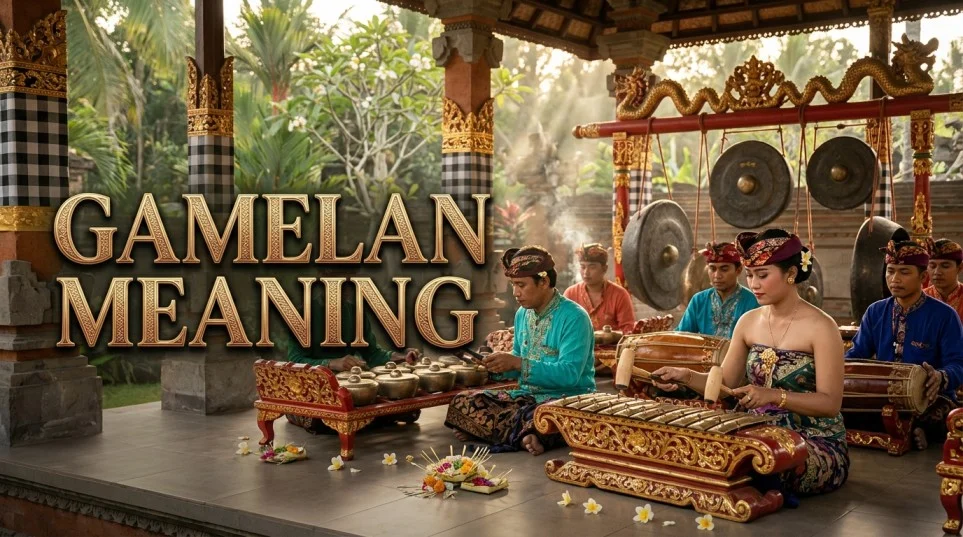
The word gamelan refers to a traditional Indonesian orchestra or ensemble whose music relies heavily on tuned percussion instruments. Unlike a Western orchestra, which often features violins, brass, and woodwinds, a gamelan ensemble usually centers on metal instruments that produce ringing, resonant sounds.
These instruments work together to create a complete musical arrangement. One instrument may carry the main melody, another may develop it with faster notes, and large gongs may mark important moments in the composition.
For example, imagine hearing a series of bright metallic notes followed by a deep gong, with drums maintaining the rhythm underneath. When these sounds combine in a carefully organized pattern, they can create the characteristic sound of gamelan music.
The term does not describe just one instrument. It refers to an ensemble and a musical tradition that can vary across Indonesian regions.
How Do You Pronounce Gamelan?
Gamelan is commonly pronounced GAM-uh-lan.
The word has three syllables:
- Gam: Sounds like the beginning of “game,” with a short vowel.
- Uh: A brief, unstressed middle sound.
- Lan: Sounds like “lan” in “land,” without the final d.
Cambridge Dictionary gives the pronunciation as /ˈɡæm.ə.læn/. You can hear the pronunciation through its gamelan dictionary entry.
The word is a noun. It can appear in phrases such as “a gamelan ensemble,” “gamelan music,” and “a traditional gamelan performance.”
Where Did Gamelan Originate?
Gamelan originated in Indonesia, where different communities developed their own musical traditions over many centuries. Java and Bali are particularly well known for their distinctive gamelan ensembles, although the tradition extends to other parts of the country.
Historical evidence shows that Indonesian musical traditions have a long history. UNESCO notes that representations of gamelan-related practices appear in the reliefs of Borobudur, an eighth-century Buddhist temple in Java.
Over time, gamelan became closely connected with local customs, ceremonies, royal courts, dance, and theatre. Different communities developed their own instruments, tuning systems, rhythms, and performance styles.
Javanese Gamelan
Javanese gamelan is often associated with flowing melodies, balanced rhythms, and a measured musical atmosphere. Some performances develop gradually, allowing listeners to hear how the different instrumental layers fit together.
Traditional Javanese gamelan is used in cultural events, court traditions, ceremonies, and theatrical performances.
Balinese Gamelan
Balinese gamelan is often known for its energetic rhythms, rapid interlocking patterns, and dramatic changes in intensity. Some ensembles create the impression of one continuous musical movement through tightly coordinated playing.
Balinese gamelan frequently accompanies traditional dance, religious ceremonies, and community celebrations.
These descriptions are broad rather than absolute. Both traditions contain a variety of styles, and individual ensembles can sound quite different.
What Instruments Are Used in Gamelan?
A gamelan ensemble can contain several types of instruments. The exact combination depends on the regional tradition, the musical purpose, and the particular ensemble.
| Instrument | What it does |
|---|---|
| Gongs | Mark important points in the musical structure and create deep, resonant tones |
| Metallophones | Produce tuned notes that carry melodies or elaborate musical patterns |
| Gong-chimes | Play sequences of notes using several small, tuned gongs |
| Drums | Guide tempo, signal changes, and coordinate performers |
| Cymbals | Add accents and rhythmic energy in some ensembles |
| Bamboo flutes | Provide flowing melodic lines and softer musical textures |
| String instruments | Add melodic expression and variation in certain traditions |
The instruments are not simply played at random. Each has a role in the musical structure, and performers must understand how their parts connect with the rest of the ensemble.
Why Are Metallophones Important?
Metallophones are instruments with tuned metal bars or plates that performers strike with mallets. Their bright, sustained tones are a defining feature of many gamelan ensembles.
Some metallophones play a basic melody, while others add more elaborate patterns around it. This creates several layers of sound without requiring every instrument to play exactly the same notes at the same speed.
The result is a musical texture that feels rich and interconnected.
What Role Do Gongs Play?
Gongs provide more than dramatic sound effects. In many gamelan compositions, they help organize the music.
A large gong may sound at the end of a musical cycle, helping performers recognize the structure of the piece. Smaller gongs may mark additional divisions or contribute melodic patterns.
This means a gong can function as both a musical instrument and a guide to the composition’s structure.
What Does Gamelan Music Sound Like?
Gamelan music often features bright metallic tones, deep gong sounds, repeating rhythmic cycles, and overlapping melodic patterns. Depending on the ensemble, the result can feel calm and meditative, lively and energetic, or dramatic and ceremonial.
One distinctive feature is the way instruments divide musical work among themselves.
Instead of one musician performing every note of a melody, several performers may contribute different parts of the same musical idea. Some play the main melodic outline, while others add faster notes or rhythmic details.
This approach creates a sound that is greater than the contribution of any single instrument.
Understanding Interlocking Rhythms
Interlocking rhythms occur when different instrumental parts fit together like pieces of a puzzle.
Imagine two musicians playing alternating notes. The first plays one part, and the second fills the spaces between those notes. Together, they produce a continuous pattern that neither musician creates alone.
Some gamelan traditions use this technique extensively. It requires careful listening, coordination, and a strong sense of timing.
For beginners, this is one of the most interesting things to notice when listening to gamelan. The music may sound complex at first, but its parts often follow organized patterns.
Why Does Gamelan Music Repeat?
Repetition helps give gamelan compositions their structure. Musical patterns may return in cycles, with gongs marking important points along the way.
However, repetition does not mean that the music remains completely unchanged. Instruments can introduce variations, increase rhythmic activity, or alter the intensity as the composition develops.
Listening for recurring gong sounds can help a new listener recognize these cycles.
What Is the Cultural Significance of Gamelan?
Gamelan is an important part of Indonesian cultural heritage. Its role extends beyond entertainment because it is connected with community life, artistic expression, traditional knowledge, and ceremonial practices.
UNESCO recognizes gamelan as intangible cultural heritage, highlighting the knowledge and skills involved in its performance, construction, tuning, and transmission.
Several aspects make this tradition especially significant.
Community participation: Gamelan brings musicians together to create a shared performance. Each person contributes to a larger musical result.
Cultural continuity: Skills and musical knowledge are passed between generations through teaching, practice, and participation in cultural events.
Ceremonial use: In many communities, gamelan accompanies religious rituals, celebrations, and traditional theatre.
Traditional craftsmanship: Making and tuning the instruments requires specialized knowledge. The instruments must work together as a coherent ensemble.
Creative expression: Performers use established musical traditions while developing interpretations and performances suited to different occasions.
Gamelan therefore represents both a musical art form and a living cultural practice.
Is Gamelan an Instrument or an Orchestra?
Gamelan is an ensemble, not a single musical instrument.
The distinction is important because people sometimes encounter the word while searching for a particular gong or metal instrument. Although gongs and metallophones are central to many gamelan ensembles, neither instrument alone represents the entire tradition.
Think of the difference between a drum and a drum band. A drum is one instrument, while a drum band is a group of performers and instruments working together. Gamelan operates on a similar principle, although its musical organization and cultural background are distinct.
The word can refer to the group of instruments, the ensemble that performs them, or the broader musical tradition associated with them.
How Is Gamelan Different From a Western Orchestra?
Both gamelan and Western orchestras bring multiple instruments together to create organized music. Their main differences lie in instrumentation, tuning, musical organization, and performance traditions.
| Feature | Gamelan | Typical Western orchestra |
|---|---|---|
| Main instruments | Gongs and tuned percussion, often with additional instruments | Strings, woodwinds, brass, and percussion |
| Musical texture | Often built from interlocking patterns and layered melodies | Often uses written parts arranged around orchestral sections |
| Tuning | Ensembles commonly use their own tuning systems | Instruments generally follow standardized pitch references |
| Cultural roots | Indonesian musical traditions | Various Western classical traditions |
| Performance settings | Ceremonies, dance, theatre, festivals, and concerts | Concert halls, theatres, and other performance spaces |
These are general distinctions, not strict rules. Western orchestras use percussion and layered rhythms, while gamelan ensembles can include flutes, strings, and vocals. Both traditions are diverse and continue to evolve.
One especially interesting difference is that many gamelan instruments are tuned to their particular ensemble. Instruments from separate sets may not blend in exactly the same way, even when they appear similar.
What Are the Main Types of Gamelan?
There is no single gamelan arrangement used throughout Indonesia. Different regional traditions have developed their own instrument combinations, musical structures, and performance styles.
Some widely recognized examples include:
- Gamelan Jawa: The Javanese tradition, often associated with Central Java and Yogyakarta, features several types of tuned percussion, gongs, drums, and sometimes flutes, strings, and vocals.
- Gamelan Bali: Balinese ensembles are known for a wide range of styles, including performances with fast, interlocking rhythms and strong dynamic contrasts.
- Gamelan Sunda: Associated with Sundanese communities in West Java, this tradition may feature instruments such as the metallophone, gongs, drums, and the bamboo flute known as the suling.
The differences between these traditions show why gamelan should not be treated as one fixed orchestra with one universal sound. Its variety is part of its cultural richness.
Is Gamelan Recognized by UNESCO?
Yes. Indonesian gamelan was inscribed on UNESCO’s Representative List of the Intangible Cultural Heritage of Humanity in 2021.
The recognition acknowledges the tradition’s cultural value, including its musical knowledge, craftsmanship, performance practices, and role in Indonesian community life.
This recognition does not mean that gamelan is a museum piece or a tradition that belongs only to the past. It continues to be performed, taught, and developed by musicians across generations.
You can verify the designation through UNESCO’s official gamelan listing.
How Can Beginners Start Listening to Gamelan?
You do not need formal musical training to appreciate gamelan. Listening with a little attention to the instruments and their roles can make the experience more rewarding.
Try these simple steps:
- Listen for the gong. Notice when the deepest gong sounds and how it relates to the musical pattern.
- Follow the repeating melody. Identify a phrase that returns throughout the performance.
- Notice the faster patterns. Listen for instruments that play more notes between the main melodic notes.
- Compare regional styles. Listen to one Javanese performance and one Balinese performance to hear differences in rhythm, energy, and musical texture.
- Watch the performers. A live performance can reveal how musicians coordinate with one another and respond to changes in the music.
For a first listening session, choose a recording of a traditional ensemble rather than relying only on a short clip of an isolated gong. Hearing the instruments together makes it easier to understand what gamelan actually is.
Frequently Asked Questions
1. What is the simple meaning of gamelan?
Gamelan is a traditional Indonesian musical ensemble made up mainly of gongs, metallophones, drums, and other instruments. The word can also refer to the musical tradition associated with the ensemble.
2. Is gamelan Indonesian or Balinese?
Gamelan is Indonesian. Bali has a famous and distinctive gamelan tradition, but gamelan is also strongly associated with Java and other regions of Indonesia.
3. What does gamelan music sound like?
It often features ringing metal tones, deep gongs, repeating musical cycles, and interlocking rhythms. The sound can be gentle, energetic, or dramatic depending on the ensemble and composition.
4. What is the main instrument in gamelan?
There is no single main instrument for every ensemble. Gongs and metallophones are central to many gamelan traditions, while drums often help coordinate rhythm and signal changes.
5. Is gamelan a type of percussion music?
Yes, percussion is central to most gamelan ensembles. However, some also include flutes, string instruments, and vocals, so the music is not limited to percussion alone.
6. What is the difference between Javanese and Balinese gamelan?
Javanese gamelan is often associated with flowing melodies and measured musical development. Balinese gamelan is frequently recognized for its energetic rhythms and rapid interlocking patterns. Both traditions contain considerable stylistic variety.
7. Why is gamelan important in Indonesia?
Gamelan supports cultural expression, community participation, traditional ceremonies, theatre, and the transmission of musical knowledge. It is an important part of Indonesia’s living cultural heritage.
8. When did UNESCO recognize gamelan?
UNESCO added Indonesian gamelan to its Representative List of the Intangible Cultural Heritage of Humanity in 2021.
9. Can beginners learn to play gamelan?
Yes. Beginners can learn through community groups, cultural workshops, music programs, and guided practice. Learning often involves listening closely, following rhythmic patterns, and coordinating with other performers.
10. What is the origin of the word gamelan?
The English word gamelan comes from Javanese. It entered English usage in the early nineteenth century. The term is now widely used to describe the Indonesian ensemble and its musical tradition.
Conclusion
Gamelan meaning goes beyond a simple musical definition. It describes a traditional Indonesian ensemble built around gongs, metallophones, drums, and carefully coordinated musical patterns. Its sound reflects centuries of artistic development, regional diversity, and shared cultural knowledge.
From the flowing melodies of Javanese ensembles to the energetic rhythms of Balinese performances, gamelan offers many ways to experience Indonesian music. Its recognition by UNESCO in 2021 also highlights its continuing cultural importance. Understanding gamelan begins with recognizing that its instruments, performers, and traditions work together to create something no single instrument can achieve alone.