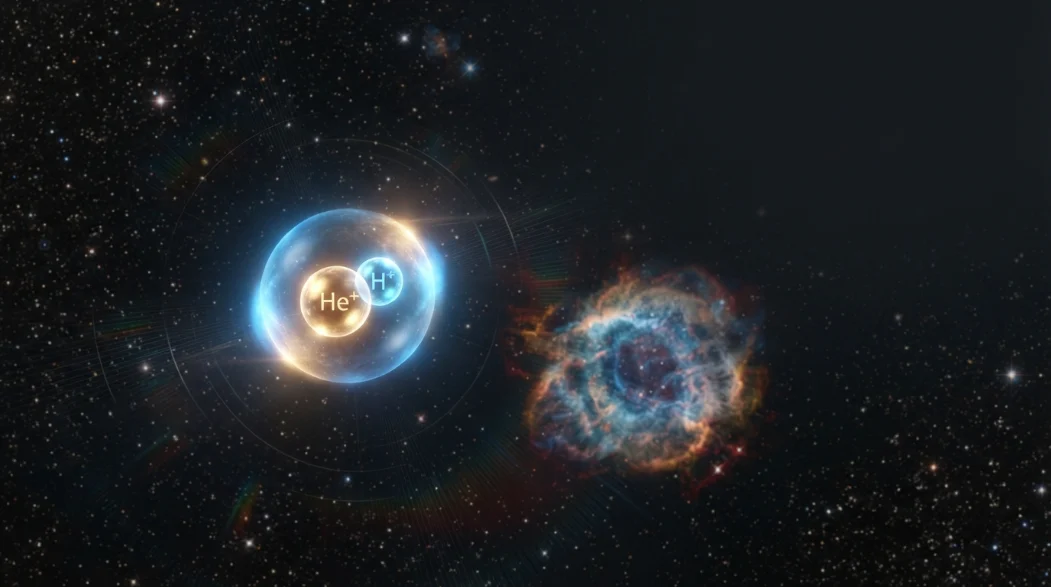
If you searched for helonium meaning, you may have expected to find the name of a chemical element. Helonium is something more unusual. In chemistry, helonium refers to the helium hydride ion, written as HeH⁺, a positively charged molecular ion made from helium and hydrogen.
The word can be confusing because it sounds similar to names found on the periodic table. However, helonium is not an element and does not have its own atomic number. It is the name used for a specific chemical species that has attracted attention in chemistry, molecular physics, and astronomy.
What makes helonium especially interesting is its connection to the early universe. Scientists have studied HeH⁺ for almost a century, and in 2019 researchers finally detected it in space in the planetary nebula NGC 7027.
What Does Helonium Mean?
Helonium means the helium hydride ion, HeH⁺.
In simple terms, it is a positively charged molecular ion containing one helium atom and one hydrogen nucleus. The plus sign in HeH⁺ indicates that the species has an overall positive charge.
Here is the basic identity:
| Property | Helonium |
|---|---|
| Scientific identity | Helium hydride ion |
| Chemical formula | HeH⁺ |
| Type | Molecular cation |
| Elements involved | Helium and hydrogen |
| Overall charge | +1 |
| Chemical element? | No |
| Common scientific context | Chemistry, molecular physics, astrophysics |
The term helium hydride ion is often clearer than helonium because it immediately tells you what the species contains.
A useful way to remember it is:
Helonium = HeH⁺ = helium hydride ion
The term is also associated with the systematic name hydridohelium(1+).
What Is Helonium in Chemistry?
Helonium is a molecular ion, meaning it contains more than one atom and carries an electrical charge.
The formula HeH⁺ contains three important pieces of information:
- He represents helium.
- H represents hydrogen.
- ⁺ shows that the species has a positive charge.
The ion can also be described as protonated helium, because the hydrogen component can be viewed as a proton interacting with a helium atom.
This is unusual because helium is a noble gas. Its electrons are held tightly, making ordinary chemical bonding difficult. HeH⁺ demonstrates that under suitable conditions, helium can participate in a chemical species despite its famously low reactivity.
That unusual behavior is one reason the ion has been important in molecular chemistry and astrophysics.
Is Helonium a Chemical Element?
No. Helonium is not a chemical element.
This is one of the most important points to understand when looking up the helonium meaning.
Helium is an element. Its chemical symbol is He, and its atomic number is 2.
Helonium is different. It is HeH⁺, a molecular ion containing helium and hydrogen.
| Term | What it is | Formula |
|---|---|---|
| Helium | Chemical element | He |
| Hydrogen | Chemical element | H |
| Helonium | Helium hydride ion | HeH⁺ |
| Helium hydride ion | Molecular ion | HeH⁺ |
So, there is no “Helonium” entry on the periodic table.
If you see a website describing helonium as a new element, that description does not match the established chemical meaning of the term.
What Is the Formula for Helonium?
The chemical formula for helonium is:
HeH⁺
The formula is short, but it tells us quite a lot.
The He represents helium, while H represents hydrogen. The superscript + tells us that the entire molecular ion has one positive charge.
This makes HeH⁺ a cation, which is simply a positively charged ion.
The term can therefore be broken down conceptually as:
Helium + hydrogen + positive charge = HeH⁺
For scientific writing, using the formula is often preferable to relying only on the word helonium because the formula makes the identity of the species immediately clear.
Why Is Helonium Unusual?
Helonium is interesting partly because of the element involved.
Helium is a noble gas with a full outer electron shell. It is famous for being chemically unreactive compared with many other elements.
Yet helium can form HeH⁺ under particular conditions.
The ion is also extremely reactive. It does not behave like a stable everyday substance that can simply be collected in a bottle. Its chemistry is most useful when researchers study it under controlled laboratory or astrophysical conditions.
This unusual combination makes HeH⁺ valuable for studying fundamental questions about molecular bonding and chemical reactions.
How Was Helonium First Discovered?
The history of helonium goes back to 1925, when researchers T. R. Hogness and E. G. Lunn reported evidence for the helium hydride ion in laboratory experiments. The later Nature literature identifies this work as the first laboratory discovery of the ion.
That early discovery was important, but scientists faced another challenge.
They wanted to know if HeH⁺ could exist naturally in space.
The answer was theoretically plausible. Models of the early universe suggested that helium and hydrogen could interact as the universe cooled, producing HeH⁺ during the early stages of cosmic chemistry.
For decades, however, astronomers could not unambiguously detect the ion in space.
Helonium and the Early Universe
This is where helonium becomes much more than an obscure chemistry term.
After the Big Bang, the universe was extremely hot and dominated by simple elements and ions. As it expanded and cooled, atoms and molecules gradually began to form.
Scientific models indicate that HeH⁺ played an important role during this early period of molecular chemistry. Nature describes HeH⁺ as the first molecular bond formed by neutral helium in the young universe, during an era when temperatures had fallen below roughly 4,000 kelvin.
The ion was also involved in chemical pathways that eventually contributed to the formation of molecular hydrogen.
That matters because molecular hydrogen became an important part of the chemistry and cooling of early cosmic gas.
So, when scientists discuss helonium in an astronomy context, they are often talking about the early chemistry of the universe, not simply a strange chemical name.
When Was Helonium Detected in Space?
Scientists confirmed the presence of HeH⁺ in space in 2019.
Researchers using the SOFIA airborne observatory detected the helium hydride ion in the planetary nebula NGC 7027. Their results were published in Nature on April 17, 2019.
The observation was significant because scientists had known about HeH⁺ from laboratory experiments for decades, but had struggled to find an unmistakable astronomical signal.
The detection provided direct evidence that the ion can exist in an astrophysical environment.
Researchers observed its rotational transition at a wavelength of approximately 149.1 micrometres using the GREAT instrument aboard SOFIA.
Where Does Helonium Occur?
Helonium can be studied in both laboratory and astrophysical settings.
In space, the 2019 detection came from NGC 7027, a young planetary nebula. The environment there contains conditions that allow HeH⁺ to form.
The early universe is another important setting in theoretical and observational studies of the ion.
Researchers are interested in places where hydrogen and helium exist under energetic conditions that allow the relevant reactions to occur.
This is why helonium can appear in subjects such as:
- Astrochemistry
- Molecular physics
- Spectroscopy
- Interstellar chemistry
- Early-universe chemistry
- Planetary nebulae
Why Does Helonium Matter?
Helonium matters because it connects very small-scale chemistry with the history of the universe.
- At the molecular level, HeH⁺ provides scientists with a simple system for studying chemical bonding and molecular ions.
- At the astronomical level, it provides information about the chemical conditions inside hot, ionized environments.
- At the cosmological level, its formation helps researchers understand the earliest stages of molecular chemistry.
The 2019 astronomical detection was especially useful because it gave scientists observational evidence for a species that had long been predicted and studied theoretically.
In other words, helonium is a small molecule with a surprisingly large scientific story.
What Does the Name Helonium Mean?
The word helonium is formed from helium and the chemical ending -onium.
The English Wiktionary entry traces the term to helium plus -onium and lists helonium as a synonym for helium hydride in inorganic chemistry.
The naming can make the word look like an element name. That is probably one reason people searching for its meaning can become confused.
The important distinction is that the name identifies a chemical species, not a new element.
It is similar to the way scientific terminology can give ions distinctive names even though those ions are made from familiar elements.
Helonium vs. Helium
These two words should not be treated as synonyms.
Helium is an element.
Helonium refers to the helium hydride ion, HeH⁺.
Here is the difference:
| Helium | Helonium |
|---|---|
| Chemical element | Molecular ion |
| Symbol: He | Formula: HeH⁺ |
| Atomic number: 2 | No separate atomic number |
| Noble gas | Positively charged species |
| One type of atom | Helium and hydrogen |
| Found on the periodic table | Not a separate periodic-table element |
This distinction is particularly useful for students because the names look closely related.
Helonium vs. Helionium
Another possible source of confusion is helionium.
The spelling is very similar, but the terms should not automatically be treated as the same thing.
Helonium is used for the helium hydride ion, HeH⁺.
If you encounter helionium in a source, check the context carefully because it can refer to a different scientific concept.
For chemistry and astrophysics discussions involving HeH⁺, helonium is the relevant term.
Is Helonium a Slang Word?
There is no strong basis for treating helonium as mainstream English slang.
Its established scientific meaning is connected to the helium hydride ion, HeH⁺.
You may find websites or social posts assigning unusual informal meanings to obscure words. A web appearance alone does not establish a recognized dictionary definition.
If someone uses the word in a chemistry, astronomy, physics, or space-related discussion, the scientific meaning is the sensible interpretation.
If it appears in an unrelated conversation, context should be checked before assigning a meaning.
How Is Helonium Used in a Sentence?
Here are some natural examples:
- Scientists detected helonium in the planetary nebula NGC 7027.
- Helonium is another name for the helium hydride ion, HeH⁺.
- The chemistry of helonium helps researchers study the early universe.
- Helonium should not be confused with helium, which is a chemical element.
- The formula for helonium is HeH⁺.
- The detection of HeH⁺ provided important evidence for models of cosmic chemistry.
These examples show that helonium is mainly a scientific term, not an everyday conversational word.
How to Understand Helonium in Simple English
If you are not studying chemistry, you do not need to memorize complicated terminology.
Think of it this way:
Helium is an element.
Hydrogen is another element.
When a helium atom and hydrogen interact in the right ionized conditions, they can form HeH⁺, the helium hydride ion.
Helonium is another name for that ion.
That is the core of the helonium meaning.
The interesting part comes from where the ion appears. Scientists think HeH⁺ was important during the earliest stages of molecular chemistry in the universe, and they later confirmed its presence in space.
Is Helonium the Same as Helium Hydride?
In the context of HeH⁺, yes.
Helonium is used as another name for the helium hydride ion. The formula HeH⁺ gives the precise chemical identity.
The word “helium hydride” can sometimes be used more broadly in discussions of helium-hydrogen chemistry, so the formula is useful when precision matters.
For the specific molecular ion discussed in astronomy and early-universe chemistry, the relationship is:
Helonium = helium hydride ion = HeH⁺
Does Helonium Have Practical Everyday Uses?
Not in the way materials such as helium gas, oxygen, or water do.
HeH⁺ is extremely reactive and is mainly important as an object of scientific study. Researchers investigate it to understand molecular structure, ion chemistry, spectroscopy, and astrophysical environments.
Its value is therefore primarily scientific rather than commercial.
Studying an unusual ion such as HeH⁺ can help scientists test theoretical models and understand chemical processes under conditions that cannot be reproduced in ordinary everyday environments.
Why Was the 2019 Discovery Important?
The 2019 detection solved a long-standing observational problem.
Scientists had known about HeH⁺ from laboratory research since 1925, and theoretical models suggested that it should exist in certain astrophysical environments. Yet direct astronomical detection remained elusive for decades.
The observation toward NGC 7027 changed that.
Researchers were able to identify the ion’s characteristic spectral signal using the GREAT instrument aboard SOFIA. The finding supported the idea that HeH⁺ can survive in suitable astronomical environments and helped refine models of the chemistry taking place there.
This is a useful example of how scientific knowledge develops:
prediction → laboratory evidence → theoretical models → astronomical observation
Each stage adds a different kind of evidence.
Common Misunderstandings About Helonium
Helonium is not a new element
There is no separate chemical element called helonium.
Helonium is not another name for helium gas
Helium is He. Helonium in this context is HeH⁺.
Helonium is not ordinary neutral helium hydride
The term generally refers to the positively charged helium hydride ion.
Helonium is not primarily an internet slang term
Its established scientific meaning is associated with HeH⁺.
The name does not mean a new type of helium
It describes a molecular ion involving helium and hydrogen.
These distinctions make it much easier to understand scientific references to the word.
Quick Facts About Helonium
- Meaning: Helium hydride ion
- Formula: HeH⁺
- Charge: +1
- Type: Molecular cation
- Elements involved: Helium and hydrogen
- Chemical element: No
- Laboratory discovery: 1925
- Astronomical detection: 2019
- Detected in: Planetary nebula NGC 7027
- Scientific fields: Chemistry, molecular physics, spectroscopy, and astrophysics
- Importance: Early-universe and astrophysical chemistry
The 2019 detection was reported in Nature by an international research team and independently described by the SOFIA Science Center.
Frequently Asked Questions
What does helonium mean?
Helonium refers to the helium hydride ion, HeH⁺, a positively charged molecular ion containing helium and hydrogen.
Is helonium an element?
No. Helonium is not a chemical element and does not have its own atomic number. It refers to the molecular ion HeH⁺.
What is the formula for helonium?
The formula is HeH⁺. The plus sign indicates an overall positive charge.
Is helonium the same as helium?
No. Helium is the chemical element He. Helonium refers to the helium hydride ion, HeH⁺.
Is helonium the same as helium hydride?
In the context of HeH⁺, yes. Helonium is another name for the helium hydride ion.
Why is helonium important?
Helonium is important because HeH⁺ is linked to early-universe chemistry and provides scientists with a useful example of unusual molecular ion chemistry.
When was helonium discovered?
HeH⁺ was first identified through laboratory experiments in 1925. Its presence in space was later confirmed in 2019.
Where was helonium detected in space?
Astronomers detected HeH⁺ in the planetary nebula NGC 7027 using the GREAT instrument aboard the SOFIA airborne observatory.
Is helonium a common English word?
No. It is a specialized scientific term and is far less common in everyday English than words such as helium or hydrogen.
What is the simplest way to remember helonium?
Remember this equation:
Helonium = helium hydride ion = HeH⁺
That single connection captures the essential helonium meaning.
Final Takeaway
The simplest definition of helonium is the helium hydride ion, HeH⁺. It is a positively charged molecular ion made from helium and hydrogen, not a separate chemical element.
Its importance goes far beyond its unusual name. HeH⁺ was identified in laboratory experiments in 1925 and later detected in space in 2019, giving scientists direct evidence of a molecular ion that has a significant role in models of early cosmic chemistry.
So, if you encounter the word helonium meaning in a chemistry or astronomy context, the clearest interpretation is simple: helonium is another name for HeH⁺, the helium hydride ion.
Read More Related Articles:
- 111 Meaning | The Hidden Message Behind This Powerful …
- Kismet Meaning | The Hidden Story of Fate, Destiny, and the …
- What This Ancient Word Really Means in Yoga, Sanskrit, and …
