
Some goals take longer than expected. You study for an exam and still get a disappointing grade. You work on a project that seems to go nowhere. You try to learn a new skill, but progress feels painfully slow. These moments test more than your ability. They test your willingness to continue.
Perseverance means continuing to work toward a goal despite difficulties, failures, delays, or setbacks. It is the ability to keep making an effort when success does not come easily. A persevering person does not need to feel motivated every day. They learn to take the next useful step, even when the process becomes frustrating.
Perseverance is not about ignoring failure or pushing yourself until you are exhausted. It means staying committed to what matters, learning from mistakes, and changing your approach when necessary. From students preparing for exams to athletes recovering after defeat, perseverance helps people turn consistent effort into meaningful progress.
What Does Perseverance Mean?
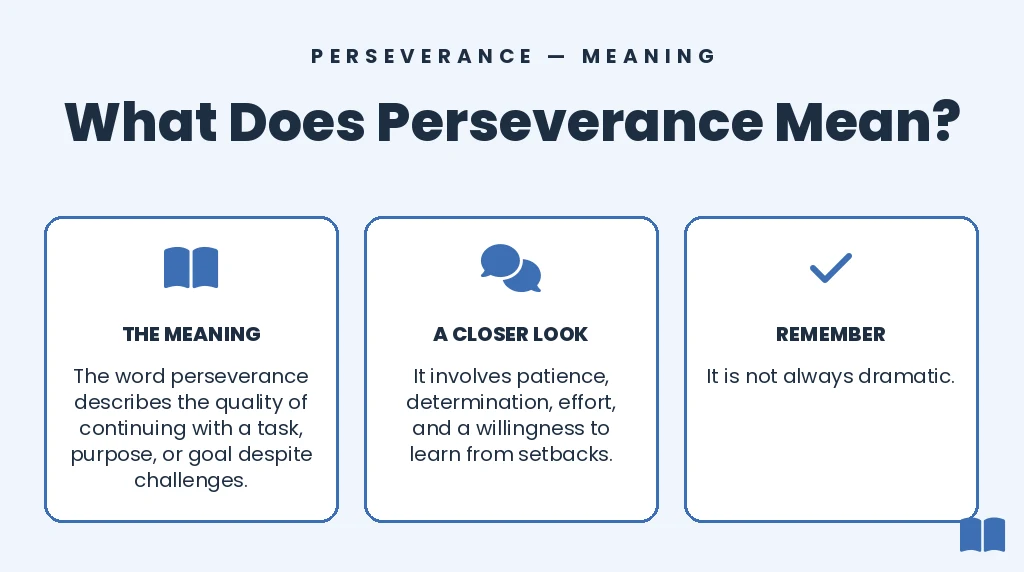
The word perseverance describes the quality of continuing with a task, purpose, or goal despite challenges. It involves patience, determination, effort, and a willingness to learn from setbacks.
In simple words, perseverance means not giving up just because something is difficult.
Imagine two students preparing for the same difficult examination. Both receive low marks on their first practice test. One decides that the subject is too hard and stops studying. The other reviews the mistakes, asks questions, and changes their study routine.
The second student demonstrates perseverance. They have not guaranteed a perfect result, but they are giving themselves a better opportunity to improve.
Perseverance can appear in small, ordinary actions. Finishing a difficult assignment, practising a musical instrument, rebuilding a business after a disappointing month, or working through a challenging conversation can all require it.
It is not always dramatic. Often, perseverance is simply the decision to try again with a little more understanding than before.
Perseverance Definition in Simple Words
Perseverance is the continued effort to achieve something valuable despite obstacles or disappointment.
Here is a quick breakdown of its meaning:
| Aspect | Explanation |
|---|---|
| Simple definition | Continuing despite difficulties |
| Main quality | Steady effort |
| Common challenge | Failure, frustration, or slow progress |
| Helpful response | Learn, adjust, and keep working |
| Main purpose | Make progress toward a meaningful goal |
| Everyday example | Practising a skill after making repeated mistakes |
The important point is that perseverance involves more than repeating an action. It also includes learning what works, recognizing what does not, and deciding how to move forward.
For example, repeatedly using the same ineffective study method may not improve your grades. Reviewing your mistakes and trying a better method is a more useful form of perseverance.
Real-Life Examples of Perseverance
Perseverance becomes easier to understand when you see how it works in ordinary situations. It does not require extraordinary talent or a dramatic success story.
1. Perseverance in Education
A student struggles to understand algebra. Instead of assuming they are naturally bad at mathematics, they practise a few problems daily, review incorrect answers, and ask their teacher for help.
Their progress may be slow, but each practice session builds understanding.
Why it shows perseverance: The student continues learning despite frustration and uses mistakes to improve.
2. Perseverance at Work
An employee receives feedback that a presentation lacks clarity. They reorganize the information, practise explaining their ideas, and ask a colleague for another review.
Rather than treating criticism as proof of failure, they use it to strengthen their work.
Why it shows perseverance: They remain committed to improvement after receiving disappointing feedback.
3. Perseverance in Sports
A runner finishes a race slower than expected. They review their training routine, work on their stamina, and gradually increase their practice.
They understand that improvement takes time and that every training session will not produce an obvious result.
Why it shows perseverance: They maintain consistent effort while adjusting their training to meet their needs.
4. Perseverance in Personal Growth
Someone wants to become more confident when speaking in public. At first, they feel nervous during conversations and presentations. They begin by speaking in small groups, preparing notes, and practising regularly.
Their confidence develops through experience rather than appearing overnight.
Why it shows perseverance: They continue facing a manageable challenge instead of waiting for fear to disappear completely.
5. Perseverance During Difficult Times
A person experiences a major change in life and struggles to establish a new routine. They focus on manageable tasks, seek support from trusted people, and give themselves time to adjust.
In this situation, perseverance may look like taking one small step each day.
Why it shows perseverance: They keep moving toward stability without demanding immediate recovery from themselves.
These examples share one important feature: perseverance does not mean feeling strong all the time. It means finding a reasonable way to continue when circumstances become difficult.
Perseverance in a Sentence

The word perseverance is a noun. It describes a quality rather than a single action.
Here are examples of how to use perseverance naturally in writing and conversation.
| Context | Example Sentence |
|---|---|
| Education | Her perseverance helped her understand a subject she once found impossible. |
| Career | His perseverance allowed him to improve his skills after several setbacks. |
| Sports | The athlete showed perseverance throughout a demanding season. |
| Personal growth | Learning to manage his fear required patience and perseverance. |
| Everyday life | It takes perseverance to build a useful habit and maintain it. |
| Formal writing | The project demonstrated the importance of perseverance in achieving long-term goals. |
| Casual conversation | I admire your perseverance because you kept trying when things got difficult. |
| Storytelling | Through perseverance, the young musician slowly found her confidence. |
A Short Example Paragraph
Maya wanted to learn how to play the piano, but her first lessons were frustrating. She struggled to coordinate both hands and often made mistakes. Instead of quitting, she practised for fifteen minutes each evening and focused on one difficult passage at a time. After several weeks, she could play a complete song. Her perseverance helped her develop a skill that once seemed beyond her ability.
Notice that the example does not present success as instant or effortless. It shows how manageable practice, patience, and continued effort can work together.
Perseverance Synonyms and Related Words
Several words are similar to perseverance, but each emphasizes a slightly different quality. Choosing the right word makes your writing more precise.
| Synonym | Meaning | Example |
|---|---|---|
| Persistence | Continuing an effort despite difficulty | Her persistence helped her finish the assignment. |
| Determination | A firm decision to achieve something | His determination kept him focused on his goal. |
| Tenacity | Holding firmly to a purpose | The team’s tenacity helped them recover from a difficult start. |
| Resilience | Adapting or recovering after setbacks | Her resilience helped her rebuild after disappointment. |
| Grit | Sustained effort and commitment toward long-term goals | He showed grit while training for the competition. |
| Endurance | The ability to withstand prolonged difficulty | The hike required physical endurance. |
| Dedication | Strong commitment to a task or purpose | Her dedication to learning was clear. |
| Patience | Remaining calm while progress takes time | Patience helped him master the technique. |
| Resolve | Firmness of purpose | She approached the challenge with resolve. |
| Discipline | Following through on useful actions consistently | Daily practice required discipline. |
These words overlap, but they are not interchangeable in every sentence. Perseverance emphasizes continuing despite difficulty, while resilience places greater emphasis on adapting or recovering after adversity.
Perseverance Antonyms
Antonyms are words with opposite or contrasting meanings. Understanding them helps clarify what perseverance involves.
| Antonym or Contrast | Meaning | Example |
|---|---|---|
| Giving up | Stopping an effort before reaching the goal | He gave up after his first setback. |
| Quitting | Leaving a task or commitment | She considered quitting when the work became difficult. |
| Surrender | Abandoning resistance or a goal | They surrendered their plans after repeated obstacles. |
| Inconsistency | Failing to maintain a steady pattern of effort | Inconsistent practice slowed his progress. |
| Indecision | Difficulty choosing a course of action | Indecision prevented her from taking the next step. |
| Passivity | Not taking meaningful action | Passivity kept the problem unresolved. |
Not every antonym describes a permanent personality trait. Someone may stop one project, change direction, or take a break without being an unpersevering person. Circumstances matter.
Perseverance vs. Persistence vs. Resilience
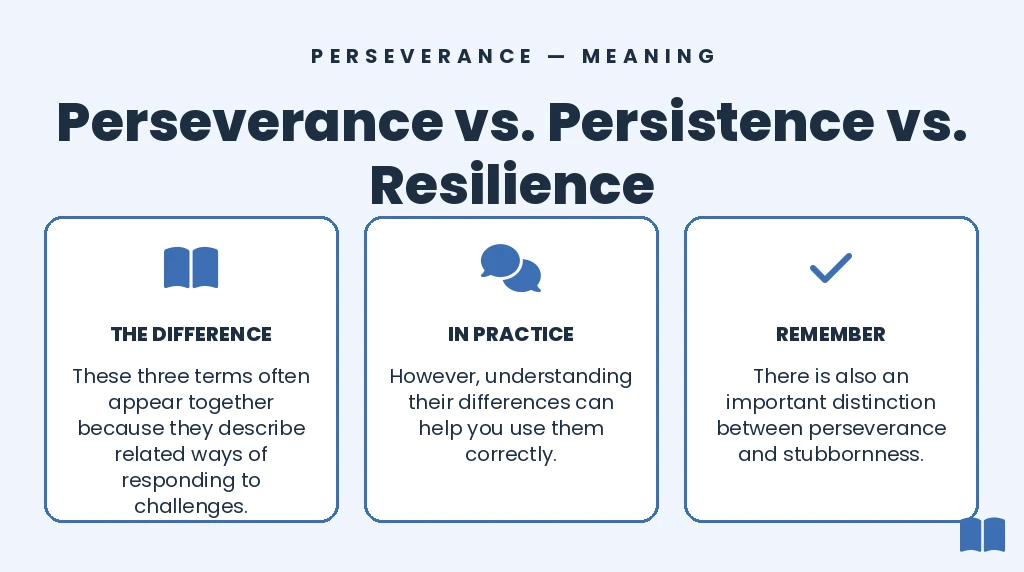
These three terms often appear together because they describe related ways of responding to challenges. However, understanding their differences can help you use them correctly.
| Quality | Main Focus | Practical Example |
|---|---|---|
| Perseverance | Continuing toward a goal despite difficulties | A student keeps studying after disappointing results. |
| Persistence | Repeatedly pursuing an action or outcome | A job seeker continues applying and improving applications. |
| Resilience | Adapting and recovering after setbacks | A worker rebuilds confidence after losing a job. |
Consider someone who is trying to find a new job.
- Perseverance: They keep working toward employment despite rejection.
- Persistence: They continue submitting applications and contacting employers.
- Resilience: They recover emotionally from rejection, learn from the experience, and adapt their approach.
One person can demonstrate all three qualities at the same time.
There is also an important distinction between perseverance and stubbornness. Perseverance involves commitment to a meaningful goal, while stubbornness may involve refusing to reconsider an approach even when evidence shows it is not working.
A persevering person can change their strategy without abandoning their purpose.
Why Is Perseverance Important in Life?
Perseverance matters because worthwhile goals often involve uncertainty, mistakes, and periods when progress is difficult to notice. Continued effort can help people build skills, learn from experience, and respond more constructively to challenges.
It Helps You Learn From Failure
Failure provides information about what needs improvement. A disappointing result can reveal a gap in knowledge, an unrealistic plan, or a method that needs changing.
Perseverance makes it more likely that you will examine that information instead of treating one setback as a final judgment of your ability.
It Builds Useful Habits
Many skills improve through repeated practice. Reading, writing, communication, and physical training all benefit from consistent effort.
Perseverance helps you continue practising after the initial excitement fades.
It Strengthens Problem-Solving
Difficult tasks rarely have one obvious solution. When the first attempt fails, you may need to break the problem into smaller parts, ask for advice, or test another approach.
This process develops practical judgment as well as determination.
It Supports Long-Term Goals
Large goals often require months or years of effort. Perseverance helps you focus on the next achievable step instead of becoming discouraged by the distance between your current position and your desired result.
It Can Strengthen Self-Trust
When you repeatedly follow through on realistic commitments, you gain evidence that you can depend on your own actions. This does not mean every attempt will succeed. It means you learn to respond to setbacks with greater confidence and flexibility.
An important limitation: Perseverance cannot guarantee success. Health, resources, opportunity, timing, and circumstances also affect outcomes. Sometimes the wisest decision is to change a goal, pause, or seek help.
How to Develop Perseverance in Everyday Life
Perseverance is not an ability reserved for naturally determined people. You can strengthen it by making your goals manageable and learning how to respond when things become difficult.
1. Choose a Clear, Meaningful Goal
Vague goals make progress difficult to measure. Instead of saying, “I want to improve my writing,” decide to write one short paragraph each day or revise one section of an article.
A clear goal gives your effort direction.
2. Break Difficult Tasks Into Smaller Steps
A large task can feel overwhelming when you look at it as one enormous responsibility.
For example, preparing for an examination may involve reviewing one topic, solving practice questions, checking mistakes, and revisiting difficult concepts. Smaller steps make it easier to begin and identify progress.
3. Focus on Consistency Rather Than Perfection
Missing a day or making a mistake does not erase your progress. What matters is how you respond.
If you miss a planned study session, return to your routine the next day rather than deciding that the entire plan has failed.
4. Treat Mistakes as Information
After an unsuccessful attempt, ask yourself three questions:
- What went wrong?
- What can I learn from it?
- What should I try differently next time?
These questions turn frustration into a practical plan.
5. Make Progress Visible
Keep a simple record of completed tasks, practice sessions, or skills you have improved. Visible evidence can help you recognize progress that feels too small to notice from day to day.
For example, a language learner could record new vocabulary each week rather than judging progress by how fluent they feel every morning.
6. Build a Routine That Fits Your Life
A routine should be challenging enough to encourage growth but realistic enough to maintain.
Someone with a demanding schedule may benefit more from fifteen focused minutes each day than from an ambitious two-hour plan they cannot sustain.
7. Ask for Help When Necessary
Perseverance does not require solving every problem alone. A teacher, colleague, mentor, friend, or qualified professional may offer useful guidance.
Seeking help can be an act of determination because it allows you to address an obstacle more effectively.
8. Know When to Change Your Approach
If repeated effort produces no improvement, examine the method rather than simply increasing the effort.
A student might need a different study technique. A job seeker might need feedback on their applications. A person pursuing an unrealistic goal might need to revise their expectations.
The goal is not to keep doing the same thing forever. The goal is to keep making thoughtful progress toward something worthwhile.
Perseverance Meaning for Students
For students, perseverance means continuing to learn when a lesson is confusing, an assignment is challenging, or a result is disappointing.
It helps students understand that ability can develop through practice, feedback, and effective learning strategies. However, perseverance should not be confused with studying endlessly without rest or support.
A practical example is a student who repeatedly struggles with fractions. Instead of memorizing answers, they review the basic concepts, practise a few questions, check their errors, and ask for clarification.
Students can practise perseverance by:
- Completing difficult assignments one section at a time.
- Reviewing incorrect answers instead of ignoring them.
- Asking questions when a topic remains unclear.
- Following a realistic study schedule.
- Taking breaks to protect concentration.
- Recognizing improvement, not just final grades.
Parents and teachers can encourage perseverance by praising specific actions, such as careful practice, thoughtful revision, and willingness to ask questions. This is more useful than telling a child that they must succeed at everything.
Perseverance Meaning in Life and Personal Growth
In everyday life, perseverance can mean continuing to build a healthy routine, learning to communicate more clearly, improving a professional skill, or adjusting to a major change.
Personal growth is rarely a straight line. You may make progress for several weeks, encounter a setback, and need to reconsider your approach.
For example, someone trying to become more organized might start by planning every hour of the day. If that routine becomes stressful, they could switch to identifying three priorities each morning. Changing the method does not mean abandoning the goal.
The same principle applies to relationships and emotional growth. Improving communication may require repeated conversations, reflection, and support. Perseverance helps you stay engaged in that process, while good judgment helps you recognize boundaries and situations that are not healthy.
A useful question to ask yourself is: Am I continuing because this goal matters, or am I continuing only because I do not want to admit that my approach needs to change?
That question helps separate meaningful perseverance from unproductive persistence.
Perseverance Quotes and Their Meaning
Short statements about perseverance can serve as reminders when motivation becomes difficult to maintain. Rather than treating a quote as a promise of success, use it as a starting point for action.
Here are some original lines you can use for reflection or writing:
- “Small steps still move you forward.” Progress does not need to be dramatic to matter.
- “A setback can change your route without ending your journey.” One failed attempt does not have to determine the outcome.
- “Consistency gives effort a chance to grow.” Repeated practice creates opportunities for improvement.
- “Perseverance is trying again with new understanding.” Learning from mistakes makes the next attempt more useful.
- “You can rest without abandoning your goal.” Recovery and determination can work together.
The common idea behind these lines is that perseverance is not blind optimism. It is a practical response to difficulty, supported by learning, flexibility, and realistic expectations.
Is Perseverance Always a Good Thing?
Perseverance is valuable, but continuing is not automatically the right decision in every situation.
Imagine an entrepreneur who has spent years developing a product that customers do not need. Continuing without reviewing the evidence may waste money and time. Examining customer feedback and changing the product could be a better expression of perseverance.
Similarly, pushing through exhaustion can reduce concentration and harm well-being. Asking for help, taking a break, or deciding that a goal no longer fits your priorities can be sensible choices.
Before continuing, consider:
- Purpose: Is the goal still meaningful?
- Evidence: Am I learning anything from my efforts?
- Method: Is there a better way to proceed?
- Resources: Do I have the time, support, and energy required?
- Cost: Is continuing creating harm that outweighs the likely benefit?
Perseverance works best when commitment is balanced with reflection. You can remain dedicated to your values while changing the path you take to honor them.
Frequently Asked Questions
1. What is the simple meaning of perseverance?
Perseverance means continuing to work toward a goal despite difficulties, setbacks, or slow progress. It involves steady effort and a willingness to learn from mistakes.
2. What is an example of perseverance?
A student who keeps practising mathematics, reviews incorrect answers, and asks for help after receiving a low grade demonstrates perseverance.
3. What is another word for perseverance?
Common synonyms include persistence, determination, tenacity, grit, and resolve. The best choice depends on the context and the specific quality you want to emphasize.
4. What is the opposite of perseverance?
Giving up, quitting, and abandoning an effort are common contrasts. However, changing an unsuitable goal or taking a necessary break does not automatically indicate a lack of perseverance.
5. What does perseverance mean in life?
It means continuing to make thoughtful efforts toward meaningful goals despite obstacles. In everyday life, this may involve learning a skill, developing a habit, or adjusting to a difficult change.
6. What is the difference between perseverance and persistence?
Perseverance emphasizes sustained effort despite challenges. Persistence emphasizes continuing or repeating an effort. Their meanings overlap, and they can often be used in similar contexts.
7. What is the difference between perseverance and resilience?
Perseverance focuses on continuing toward a goal despite difficulty. Resilience focuses on adapting or recovering after adversity. A person can demonstrate both qualities during the same challenge.
8. Why is perseverance important for students?
It encourages students to practise, learn from mistakes, seek help, and keep improving when a subject is difficult. It supports learning without guaranteeing a particular grade or result.
9. How can I develop perseverance?
Set realistic goals, divide tasks into smaller steps, establish a routine, review mistakes, track progress, and seek help when needed. Adjust your approach when repeated effort is not working.
10. Is perseverance the same as never giving up?
No. Perseverance means remaining committed to a meaningful purpose while responding intelligently to challenges. Sometimes changing your strategy, resting, or leaving an unsuitable goal is the wiser decision.
Final Thoughts
Perseverance is the ability to keep working toward something meaningful when the process becomes difficult. It is built through ordinary decisions: practising after a mistake, learning from criticism, returning to a task, and asking for help when necessary.
You do not need to feel confident every day to demonstrate perseverance. You need a realistic goal, a willingness to learn, and the judgment to recognize when your approach should change.
The next time a challenge feels overwhelming, do not focus only on how far you still have to go. Identify one useful step you can take now. Sometimes that small action is how meaningful progress begins.
Read More Related Articles:
Proscribed Meaning |What This Powerful Word Really Means …
What Does PRN Stand For? Full Form, Definition & Uses 2026
What Does Luffy Really Mean? Origin, Symbolism & Hidden …