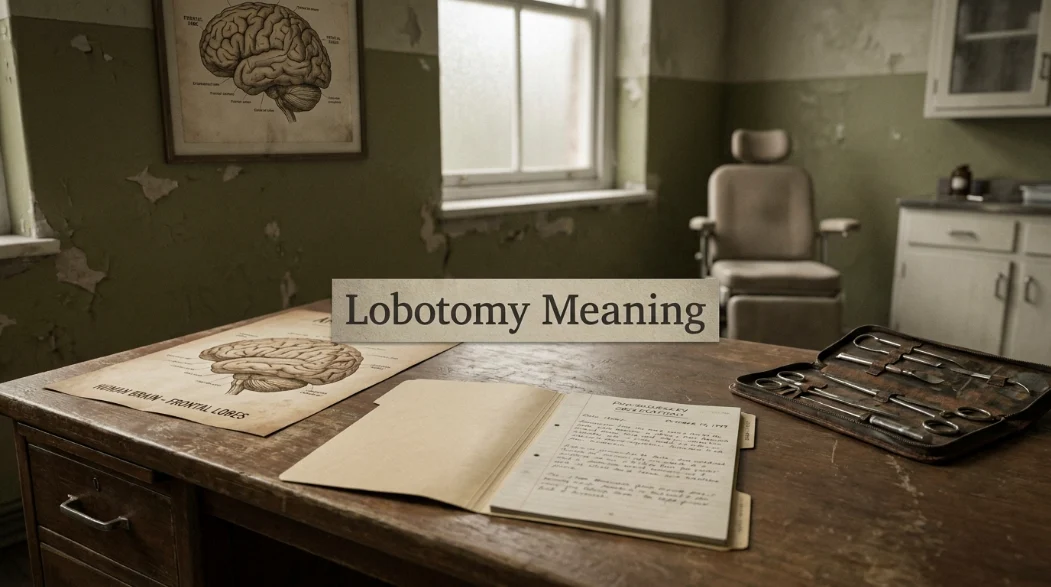
If you are searching for lobotomy meaning, a lobotomy was a historical form of psychosurgery that involved deliberately disrupting connections in the brain, particularly connections involving the frontal lobes. It was developed in the early 20th century and was once promoted as a treatment for severe psychiatric disorders.
The procedure became controversial because some patients experienced profound and permanent changes in personality, behavior, emotions, cognition, and independence. As psychiatric medicines and safer treatments became available, the use of lobotomy declined dramatically.
Today, lobotomy is mainly discussed in the history of medicine, psychiatry, and neuroscience. It is not considered a standard treatment for mental illness.
What Does Lobotomy Mean?
The simplest lobotomy definition is:
A lobotomy was a surgical procedure that intentionally disrupted pathways connecting the brain’s frontal regions with other parts of the brain.
The word is closely associated with psychosurgery, a broader term for surgical interventions intended to influence behavior or psychiatric symptoms.
The best-known form was the prefrontal lobotomy, which targeted connections involving the prefrontal areas of the brain.
Unlike modern brain surgery, the goal was not to remove a tumor or repair a physical injury. The objective was to alter brain circuits thought to contribute to severe psychiatric symptoms.
Lobotomy in Simple Words
Think of the brain as a highly connected communication network.
Doctors performing a lobotomy attempted to interrupt some of those connections. The hope was that disrupting certain pathways would reduce severe symptoms such as extreme agitation, distress, or disruptive behavior.
The problem was that the brain’s functions are interconnected. Interrupting pathways could also affect personality, motivation, judgment, emotional responses, and everyday functioning.
That helps explain why the history of lobotomy is so complicated.
What Was a Lobotomy Used For?
Lobotomies were primarily associated with severe psychiatric conditions, particularly during a period when doctors had relatively few effective treatments for people with serious mental illness.
They were used in attempts to manage conditions and symptoms including:
- Severe schizophrenia
- Major psychiatric disturbances
- Extreme agitation
- Severe mood-related symptoms
- Obsessive or distressing behaviors
- Psychiatric symptoms that were difficult to manage in institutions
However, historical use varied considerably by country, institution, doctor, and period.
It is also important not to interpret historical use as proof that the procedure was medically sound by today’s standards. Medicine in the first half of the 20th century had a very different understanding of brain function, psychiatric illness, informed consent, and treatment safety.
How Did a Lobotomy Work?
A traditional prefrontal lobotomy attempted to disrupt pathways between the frontal areas of the brain and deeper brain structures.
The frontal regions are involved in many complex functions, including:
- Planning
- Decision-making
- Emotional regulation
- Social behavior
- Motivation
- Impulse control
- Aspects of personality
Because these functions depend on interconnected brain networks, disrupting those networks could produce changes far beyond the symptoms doctors hoped to treat.
The Evolution of the Procedure
Lobotomy was not one single technique.
Different approaches were developed over time. Early procedures involved opening the skull and surgically cutting brain tissue or connections.
Later, the transorbital lobotomy became associated with Walter Freeman. This approach entered the brain through the area near the eye socket and became known for being faster than earlier surgical methods.
The development of different techniques contributed to the procedure’s rapid spread, but speed and accessibility also raised serious questions about patient selection, safety, and the quality of long-term evaluation.
Who Invented the Lobotomy?
The history of lobotomy is generally associated with Portuguese neurologist António Egas Moniz, who developed the procedure known as prefrontal leucotomy in the 1930s.
Moniz’s work was later recognized with the Nobel Prize in Physiology or Medicine in 1949.
The procedure was subsequently promoted and modified in the United States by physicians including Walter Freeman and neurosurgeon James W. Watts.
This history is important because it shows how medical ideas can change dramatically. A treatment can receive substantial professional attention at one point in history and later become regarded as unsafe or inappropriate.
Lobotomy vs. Psychosurgery
These terms are related but are not identical.
| Term | Meaning |
|---|---|
| Lobotomy | A historical procedure that disrupted specific brain connections, especially involving frontal regions |
| Psychosurgery | A broader category of surgical procedures intended to influence psychiatric symptoms |
| Prefrontal lobotomy | A type of lobotomy targeting connections involving the prefrontal brain |
| Transorbital lobotomy | A technique associated with entering the brain through the region near the eye socket |
| Leucotomy | A term historically used for procedures that severed white-matter pathways |
So, lobotomy is a type of psychosurgery, but psychosurgery is a broader category.
What Did a Lobotomy Do to the Brain?
A lobotomy was intended to alter communication between brain regions.
The frontal lobes do not operate in isolation. They interact with networks involved in emotion, motivation, memory, attention, and behavior.
Disrupting these connections could therefore change a person’s behavior in significant ways.
Some patients were reported to become less agitated or easier to manage. But other patients experienced serious difficulties, including:
- Reduced initiative
- Changes in personality
- Emotional flattening
- Difficulty making decisions
- Reduced independence
- Cognitive problems
- Seizures and other neurological complications
- In severe cases, profound disability or death
The outcomes were not uniform. Some people appeared to improve in particular symptoms, while others experienced devastating consequences.
That variation is one reason historical claims about lobotomy need to be interpreted carefully.
Lobotomy Effects and Side Effects
The effects of lobotomy depended on the technique, the area affected, the patient’s condition, and other factors.
One major historical problem was that improvement was sometimes judged by how manageable a patient became rather than by a comprehensive assessment of their quality of life, cognitive abilities, autonomy, and long-term functioning.
This distinction matters.
A person becoming quieter does not automatically mean their underlying condition has been successfully treated.
For example, imagine a severely distressed patient who becomes noticeably less agitated after a brain procedure but also loses initiative, emotional range, or the ability to live independently.
From one perspective, a particular behavior has changed. From another, the patient has suffered a serious loss of functioning.
Modern medical ethics place much greater emphasis on informed consent, patient autonomy, measurable outcomes, risk assessment, and long-term follow-up.
Why Was Lobotomy So Controversial?
The controversy surrounding lobotomy involves more than the fact that it was brain surgery.
Several issues contributed to its eventual rejection.
Limited Understanding of the Brain
Scientists had far less knowledge about complex brain networks than researchers have today.
The idea that disrupting particular connections could relieve psychiatric symptoms was attractive, but the consequences were difficult to predict.
Serious and Permanent Risks
Brain tissue does not simply grow back after being intentionally damaged.
If a procedure permanently disrupts neural pathways, resulting changes can also be permanent.
Consent and Patient Autonomy
Historical standards for informed consent were very different from modern expectations.
Some patients were vulnerable because of severe mental illness, institutionalization, or limited ability to advocate for themselves.
This created difficult ethical questions about who could authorize irreversible procedures and how risks were communicated.
Institutional Pressure
In some settings, psychiatric hospitals were overcrowded and had limited treatment options.
A procedure that appeared to make severely disturbed patients calmer or easier to manage could therefore be viewed favorably by institutions, even when the patient’s broader quality of life was not adequately considered.
The Arrival of New Treatments
The development and widespread adoption of psychiatric medications, particularly chlorpromazine in the 1950s, changed psychiatric treatment considerably.
As medication and other approaches became available, enthusiasm for lobotomy declined.
Why Did Lobotomy Stop?
Lobotomy gradually fell out of favor because of several factors rather than one single event.
The growing recognition of serious complications played a major role. So did improved psychiatric treatments, advances in neuroscience, changing medical ethics, and increasing criticism of the procedure.
By the later 20th century, lobotomy had become a powerful example of the risks associated with irreversible medical interventions based on incomplete understanding.
Today, the term is generally used when discussing medical history, psychiatric history, neuroscience, and ethics.
Is Lobotomy Still Performed Today?
Traditional lobotomy is not a standard modern treatment for psychiatric disorders.
Modern medicine does include carefully controlled forms of psychosurgery, but these are fundamentally different from the widespread historical use of lobotomy.
Some highly specialized procedures can target specific brain circuits for severe, treatment-resistant neurological or psychiatric conditions. These procedures involve much more precise technology, strict patient selection, extensive evaluation, and ethical safeguards.
It would therefore be misleading to treat modern neurosurgical interventions as simply the same thing as historical lobotomy.
Lobotomy and the History of Psychiatry
The story of lobotomy reveals an important lesson about medical progress.
Doctors in earlier generations were not necessarily acting with the same knowledge available today. They were working with the scientific models, technologies, and treatment options of their time.
At the same time, understanding historical context should not mean ignoring harm.
Lobotomy remains important because it demonstrates why medicine needs:
- Strong clinical evidence
- Long-term outcome measurement
- Ethical oversight
- Informed consent
- Independent review
- Careful evaluation of risks and benefits
- Respect for patient autonomy
The history also illustrates a broader principle: a treatment can appear promising before its long-term consequences are fully understood.
Lobotomy Meaning in Psychology
In psychology and popular discussions, lobotomy meaning can sometimes be used metaphorically.
Someone might say a person “looks like they had a lobotomy” to describe someone who appears unusually emotionless, passive, confused, or disconnected.
That is a figurative use, not the medical definition.
It is also worth being careful with such comparisons because lobotomy was a real and irreversible medical procedure that affected real patients.
For educational or professional writing, using the historical and medical meaning is usually clearer.
Lobotomy vs. Modern Mental Health Treatment
It is useful to understand how dramatically psychiatric care has changed.
| Historical approach | Modern approach |
|---|---|
| Limited understanding of brain networks | Advanced neuroscience and brain imaging |
| Often irreversible intervention | Greater emphasis on reversible and evidence-based options |
| Limited long-term outcome data | Structured clinical research and follow-up |
| Very different consent standards | Stronger informed-consent requirements |
| Few effective psychiatric medicines | Multiple medication classes and psychological treatments |
| Broad disruption of brain pathways | Greater focus on precise, targeted interventions |
Modern mental health care can include psychotherapy, medication, community support, rehabilitation, behavioral interventions, and specialized treatments depending on the condition.
No single treatment works for everyone, but contemporary practice places much greater emphasis on evidence, safety, patient preferences, and functional outcomes.
Famous Figures Connected to Lobotomy
António Egas Moniz
António Egas Moniz was a Portuguese neurologist who developed prefrontal leucotomy, the procedure that became associated with the history of lobotomy.
His work received the Nobel Prize in Physiology or Medicine in 1949.
Walter Freeman
Walter Freeman was an American physician who became one of the most prominent advocates of lobotomy in the United States.
He helped popularize the transorbital lobotomy, a faster technique that became particularly controversial because of its broad use.
James W. Watts
James W. Watts was a neurosurgeon who collaborated with Freeman on early American lobotomy work.
Their partnership helped move the procedure from an experimental concept into wider clinical practice.
Common Misconceptions About Lobotomy
“A lobotomy removes part of the brain.”
Not necessarily.
The procedure primarily involved disrupting connections involving brain regions rather than simply removing an entire brain lobe.
“Everyone who had a lobotomy became emotionless.”
No.
Outcomes varied significantly. Some patients experienced changes in emotion, personality, motivation, or cognition, but there was no single universal result.
“Lobotomy was considered a successful treatment forever.”
No.
Its popularity declined as evidence of serious consequences accumulated and alternative treatments became available.
“Lobotomy and all modern psychosurgery are the same.”
They are not.
Modern neurosurgical approaches can be considerably more targeted and are used under very different scientific and ethical standards.
Why Is Lobotomy Still Remembered Today?
Lobotomy remains culturally recognizable because it sits at the intersection of medicine, neuroscience, ethics, and human suffering.
It represents a period when physicians were willing to make profound changes to the brain in the hope of treating otherwise difficult psychiatric conditions.
Its history also raises uncomfortable but valuable questions:
- How much risk should a medical treatment involve?
- What counts as meaningful improvement?
- Who gets to decide when a patient cannot decide for themselves?
- How should doctors evaluate irreversible procedures?
- What happens when scientific confidence moves faster than evidence?
These questions remain relevant far beyond lobotomy.
Frequently Asked Questions
What is the meaning of lobotomy?
A lobotomy was a historical psychosurgical procedure that intentionally disrupted connections involving the frontal regions of the brain. It was once used in attempts to treat severe psychiatric conditions.
What was a lobotomy used for?
Lobotomies were used primarily for severe psychiatric disorders and symptoms that doctors found difficult to manage with the treatments available at the time.
Who invented the lobotomy?
The procedure is generally associated with Portuguese neurologist António Egas Moniz, who developed prefrontal leucotomy in the 1930s.
What did a lobotomy do to a person?
Results varied. Some patients showed reductions in certain troubling behaviors, while others experienced major changes in personality, motivation, emotional functioning, cognition, independence, or neurological health.
Is a lobotomy still used today?
Traditional lobotomy is not a standard modern psychiatric treatment. Some specialized forms of psychosurgery exist for carefully selected cases, but they are very different from historical lobotomy.
Why did doctors perform lobotomies?
Doctors performed them because severe mental illness often had few effective treatments at the time. Early reports suggested that disrupting certain brain pathways could reduce severe psychiatric symptoms.
What is a prefrontal lobotomy?
A prefrontal lobotomy was a form of psychosurgery that disrupted connections involving the prefrontal regions of the brain. It became the best-known form of historical lobotomy.
Was lobotomy considered successful?
It was considered promising by some physicians during part of its history, but its serious risks, inconsistent outcomes, ethical concerns, and the emergence of better treatments eventually led to its decline.
What is psychosurgery?
Psychosurgery refers broadly to surgical procedures designed to influence brain circuits associated with psychiatric or behavioral symptoms. Lobotomy was one historical form of psychosurgery.
Final Thoughts
The lobotomy meaning is straightforward, but its history is anything but simple. It was a form of psychosurgery designed to disrupt brain connections in an attempt to reduce severe psychiatric symptoms.
For a time, some doctors viewed it as a promising solution when few effective treatments existed. Its serious and sometimes permanent consequences, along with advances in psychiatric medicine and changing ethical standards, eventually brought its widespread use to an end.
Today, lobotomy is best understood as a significant chapter in the history of medicine. It reminds us that medical progress requires more than promising ideas. Good treatment also requires evidence, careful risk assessment, ethical safeguards, informed consent, and respect for the person receiving care.
Discover More Post:
- FAFO Meaning | What This Bold Internet Slang Really Means …
- TLDR Meaning Explained | The Internet Shortcut Behind …
- What Does Zionist Really Mean? History, Beliefs & the Story …

2 thoughts on “Lobotomy Meaning | What It Was, Why It Changed Medicine, and the Dark History Behind It in 2026”