Imagine reading the sentence, “I need to read the book I read yesterday.” The word read appears twice, but its pronunciation changes because one use refers to the present and the other to the past. English has many spelling patterns that can surprise even confident readers.
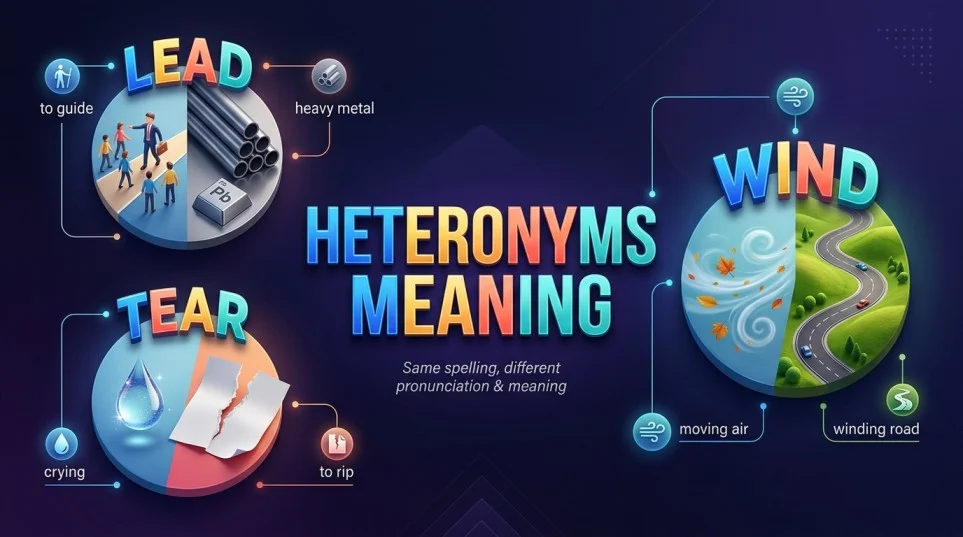
Heteronyms are words spelled the same but pronounced differently and carrying different meanings. For example, lead can rhyme with “seed” when it means to guide, or with “red” when it refers to the metal. The spelling stays the same, but the sound and meaning change.
Understanding heteronyms makes reading, writing, and pronunciation easier. It also helps explain why context matters so much in English. This guide covers common heteronyms, their meanings, example sentences, and the differences between heteronyms, homographs, homophones, and homonyms.
What Are Heteronyms?
A heteronym is a word that shares its spelling with another word but has a different pronunciation and meaning.
The word comes from Greek roots associated with “different” and “name.” In English, heteronyms are often discussed as a special type of homograph because they share the same written form but sound different when spoken.
Consider the word wind:
- Wind pronounced like wined: to twist or turn something.
- Wind pronounced like inned: moving air.
The second pronunciation guide above is approximate. More precisely, the first rhymes with find, while the second rhymes with pinned.
Now compare these sentences:
- Please wind the clock before going to bed.
- The wind blew leaves across the garden.
The surrounding words reveal which meaning is intended. You do not need a different spelling to understand the difference.
What Makes a Word a Heteronym?
A word generally qualifies as a heteronym when these three features are present:
- Same spelling: The written form is identical.
- Different pronunciation: The word is spoken differently in its separate uses.
- Different meaning: Each pronunciation represents a distinct meaning.
For example, tear can refer to a drop from your eye or the act of ripping something. One rhymes with deer, and the other rhymes with air.
This is what makes heteronyms interesting: the reader must use pronunciation, meaning, and context together to understand the word.
30+ Heteronyms Examples With Meanings and Pronunciations
The following list includes common English heteronyms, with simple pronunciation guides and examples. Pronunciation guides use familiar English words to approximate the sounds.
1. Common Heteronyms You May Already Know
| Heteronym | Pronunciation and Meaning 1 | Pronunciation and Meaning 2 |
|---|---|---|
| Lead | leed: to guide or direct | led: a soft, heavy metal |
| Tear | teer: a drop from the eye | tair: to rip or pull apart |
| Wind | rhymes with pinned: moving air | rhymes with find: to twist or turn |
| Bow | rhymes with go: a ribbon knot or weapon | rhymes with cow: to bend forward |
| Bass | rhymes with base: a low musical range or sound | rhymes with mass: a type of fish |
| Dove | duhv: a bird | dohv: past tense of dive in some varieties of English |
| Close | klohz: to shut | klohs: near in distance or relationship |
| Live | liv: to be alive or reside | lyve: happening now |
| Does | duhz: performs an action | dohz: female deer |
| Desert | DEZ-ert: a dry region | dih-ZERT: to abandon someone or something |
| Polish | PAH-lish: related to Poland | PAH-lish or PAW-lish, depending on accent, with the first syllable stressed: to make something shine |
| Object | OB-jekt: a thing | ub-JEKT: to express disagreement |
| Present | PREZ-unt: a gift or something existing now | pri-ZENT: to give, show, or introduce |
| Record | REK-erd: a documented account | ri-KORD: to capture information |
| Content | KON-tent: material or information | kun-TENT: satisfied |
| Conduct | KON-dukt: behavior | kun-DUKT: to lead or carry out |
| Permit | PER-mit: an official document | per-MIT: to allow |
| Produce | PRO-doos: fruits and vegetables as a category | pruh-DOOS: to create or make |
| Refuse | REF-yoos: rubbish or waste | ri-FYOOZ: to decline |
| Minute | MIN-it: a unit of time | my-NOOT: extremely small |
| Invalid | IN-vuh-lid: a person who is ill or disabled, in older or specific usage | in-VAL-id: not valid |
| Entrance | EN-truns: a way in | en-TRANCE: to fill someone with delight or fascination |
| Row | roh: a line of things | rou: an argument |
| Sewer | SOO-er: an underground drainage channel | SOH-er: a person who sews |
| Wound | woond: an injury | wownd: past tense of wind, meaning to twist |
| Minute | MIN-it: sixty seconds | my-NOOT: tiny |
| Alternate | awl-TUR-nut: a substitute | AWL-ter-nayt: to take turns or switch |
| Attribute | AT-ri-byoot: a quality or characteristic | uh-TRIB-yoot: to credit something to a cause |
| Conflict | KON-flikt: a disagreement | kun-FLIKT: to be incompatible |
| Convict | KON-vikt: a person found guilty of a crime | kun-VIKT: to find someone guilty |
| Invalid | IN-vuh-lid: a person who is unwell, in specific or older usage | in-VAL-id: not legally or factually valid |
Some words in this list have pronunciation differences that depend on regional accent or usage. In particular, dove as the past tense of dive is common in American English, while dived is also widely used. The pronunciation of Polish and polish changes mainly through stress and vowel quality, not spelling.
A few entries appear twice because they are useful examples of different pronunciation patterns. For a concise study list, keep one entry for each word.
2. Heteronyms in Everyday Sentences
Seeing both meanings in context is often more useful than memorizing a definition alone.
| Word | Sentence 1 | Sentence 2 |
|---|---|---|
| Lead | The captain will lead the team. | The old pipe contained lead. |
| Tear | A tear rolled down her cheek. | Be careful not to tear the page. |
| Wind | The wind rattled the windows. | Please wind the toy before using it. |
| Bow | She tied a bow around the gift. | The actor took a bow after the show. |
| Close | Please close the door. | Their houses are close to each other. |
| Desert | The camel crossed the desert. | Never desert a friend in trouble. |
| Object | The shiny object fell off the shelf. | I object to the proposed changes. |
| Present | He gave me a birthday present. | The speaker will present the award. |
| Record | She kept a written record of expenses. | They will record the interview. |
| Refuse | Please place the refuse in the bin. | I must refuse the invitation. |
| Wound | The nurse cleaned the wound. | He wound the string around the box. |
| Row | We sat in the front row. | The neighbors had a loud row. |
A useful learning trick: Read each pair aloud. If you only read silently, you may notice the difference in meaning without noticing the change in pronunciation.
Heteronyms With Different Word Stress
Some heteronyms differ because the stress moves from one syllable to another. This pattern appears frequently in English nouns and verbs.
In the table below, capital letters show the stressed syllable.
| Word | Noun or Adjective | Verb |
|---|---|---|
| Present | PREZ-ent: a gift | pri-ZENT: to give or show |
| Record | REK-erd: stored information | ri-KORD: to capture information |
| Object | OB-jekt: a thing | ub-JEKT: to oppose |
| Conduct | KON-dukt: behavior | kun-DUKT: to lead or carry out |
| Permit | PER-mit: official authorization | per-MIT: to allow |
| Produce | PRO-doos: fruits and vegetables | pruh-DOOS: to make or create |
| Refuse | REF-yoos: waste or rubbish | ri-FYOOZ: to decline |
| Conflict | KON-flikt: a disagreement | kun-FLIKT: to clash or be incompatible |
| Convict | KON-vikt: a person found guilty | kun-VIKT: to find guilty |
| Increase | IN-kreess: a rise or growth | in-KREESS: to grow or make greater |
| Decrease | DEE-kreess: a reduction | dih-KREESS: to become or make smaller |
| Progress | PRAH-gress: advancement | pruh-GRESS: to move forward |
Stress patterns can vary by accent, and some speakers use more than one pronunciation. Dictionaries with audio are helpful if you need a precise regional pronunciation.
Why Does Word Stress Matter?
In English, changing the stressed syllable can signal a grammatical difference. The noun record and the verb record have the same spelling, but their stress patterns help listeners identify the intended use.
This is especially useful for English learners. If a sentence begins with “Please record,” the verb stress is expected. In “Check the record,” the noun stress is expected.
What Is the Difference Between Heteronyms and Homographs?
Heteronyms and homographs are closely related, but the terms do not mean exactly the same thing.
Homographs are words spelled the same but with different meanings. They may be pronounced the same or differently. Heteronyms are homographs whose pronunciations differ.
For example, lead is a heteronym because its two meanings have different pronunciations. Some homographs, however, share the same pronunciation and therefore are not heteronyms.
| Feature | Heteronyms | Homographs |
|---|---|---|
| Same spelling | Yes | Yes |
| Different meanings | Yes | Usually discussed as different lexical meanings |
| Different pronunciation required | Yes | No |
| Example | Lead: guide / metal | Bat: flying mammal / sports equipment |
A simple way to remember the relationship is: all heteronyms are homographs, but not all homographs are heteronyms.
Heteronyms vs. Homophones vs. Homonyms
These three terms are often confused because they describe different relationships between spelling, sound, and meaning.
| Term | What It Means | Example |
|---|---|---|
| Heteronyms | Same spelling, different pronunciation and meaning | Tear: eye drop / rip |
| Homophones | Same pronunciation, different meanings; spelling may differ | Flour / flower |
| Homographs | Same spelling, different meanings; pronunciation may or may not differ | Lead: guide / metal |
| Homonyms | A broader or sometimes narrower label for words sharing spelling or pronunciation but differing in meaning | Bat: animal / sports equipment |
Terminology around homonyms varies between dictionaries and textbooks. Some sources use it broadly for words that share spelling or pronunciation, while others reserve it for words that share both spelling and pronunciation but have different meanings.
The most reliable approach is to check the feature being discussed: spelling, pronunciation, or both.
Quick Memory Guide
- Heteronyms: Same spelling, different sounds.
- Homophones: Same sounds.
- Homographs: Same spelling.
- Homonyms: A term whose scope varies by source.
These categories help explain why English can be confusing even when a word is spelled correctly.
How to Identify Heteronyms in a Sentence
You can usually identify a heteronym by combining context clues with pronunciation.
Step 1: Look at the Meaning
Ask what the sentence is describing. Is wind referring to moving air or the act of twisting something?
Step 2: Identify the Word’s Role
Notice how the word functions in the sentence. A noun and a verb may have different stress patterns, as in record and record.
Step 3: Read the Whole Sentence
Surrounding words often reveal the intended meaning.
Compare:
- The company will record the meeting.
- The record contains the meeting notes.
The first sentence uses a verb. The second uses a noun.
Step 4: Check a Dictionary When Needed
If you are unsure of the pronunciation, consult a reliable dictionary with audio recordings. This is particularly useful for regional differences and less familiar words.
Step 5: Create Your Own Example
Write one sentence for each meaning. This forces you to connect the spelling, pronunciation, and definition.
For example:
- The children played outside in the wind.
- Please wind the clock.
Practicing with pairs is more effective than memorizing a long list without context.
Why Are Heteronyms Important in English?
Heteronyms demonstrate that spelling alone does not always determine pronunciation. Readers and speakers use context, grammar, stress, and familiarity to work out the intended meaning.
They are useful to understand for several reasons:
- Reading comprehension: Recognizing the correct meaning prevents confusion.
- Speaking clearly: Pronouncing a word correctly can make your message easier to understand.
- Vocabulary development: Learning two meanings at once expands your knowledge of English.
- Writing: Using the correct form and context makes sentences more precise.
- Language learning: Heteronyms show how English pronunciation can change even when spelling stays the same.
They can also create wordplay. A writer might use a heteronym to make a line of poetry or dialogue more interesting, but the surrounding context must make the intended meaning clear.
Common Mistakes When Learning Heteronyms
Mistake 1: Assuming every word with multiple meanings is a heteronym.
A word only qualifies as a heteronym when the pronunciations differ as well as the meanings.
Mistake 2: Confusing homophones with heteronyms.
Homophones sound alike. Heteronyms are spelled alike but sound different.
Mistake 3: Ignoring stress.
Words such as present, record, and permit may change their stress depending on how they are used.
Mistake 4: Assuming pronunciation is identical across all English accents.
Some words have regional variations. A pronunciation guide should be treated as an aid, not a substitute for listening to the relevant accent.
Mistake 5: Memorizing definitions without sentences.
A sentence shows how grammar and meaning work together. Learn both meanings in context to remember them more easily.
Frequently Asked Questions
What is a heteronym in simple terms?
A heteronym is a word that is spelled the same as another word but pronounced differently and has a different meaning. “Lead” is a common example.
How is a heteronym different from a homonym?
A homonym is a broader category. Homonyms can be spelled the same or sound the same. Heteronyms specifically require the same spelling but different pronunciation and meaning.
Can a heteronym have more than two pronunciations?
Yes, though it is rare. Some words have multiple pronunciations across different dialects or contexts. But most heteronyms have two clear forms.
Are heteronyms common in English?
They are more common than most people think. Dozens of everyday words function as heteronyms. Many native speakers use them without noticing the pattern.
How do I know which pronunciation to use?
Context is your main guide. The surrounding words tell you whether the heteronym is a noun, a verb, or a different part of speech. Stress patterns help too.
Do other languages have heteronyms?
Yes. Heteronyms exist in many languages, including French, Spanish, and Chinese. The specific rules vary by language.
What is the difference between a heteronym and a homograph?
All heteronyms are homographs, but not all homographs are heteronyms. Homographs share spelling. Heteronyms share spelling and differ in pronunciation and meaning.
Why do heteronyms exist?
They often arise from historical language changes. Words that once sounded different evolved to share spelling. Or words from different origins merged in form. English is especially prone to this because of its mixed roots.
Final Thoughts
Heteronyms are a fascinating quirk of English. They reward careful reading and listening. They also remind us that spelling and sound are not always reliable partners.
For learners, the key is not memorization. It is pattern recognition. Notice the noun-verb stress shift. Listen for vowel changes. Use context to guide your pronunciation.
For writers, heteronyms are a reminder to write clearly. A sentence that could be misread is a sentence that needs revision.
For anyone curious about language, heteronyms offer a window into how English evolved. They show that words are not fixed things. They shift, split, and sometimes collide in surprising ways.