
The word soliciting can sound formal, suspicious, or even intimidating, especially when it appears on a sign outside a building or in a legal document. Yet the basic idea is simple: soliciting means asking for, seeking, or trying to obtain something from another person. What that request involves depends on the situation.
For example, a charity worker soliciting donations is asking people to support a cause. A salesperson soliciting customers is trying to attract business. In a legal context, soliciting can describe encouraging or requesting someone to take a particular action, sometimes an unlawful one. Understanding the setting is the key to interpreting the word correctly.
What Does Soliciting Mean?
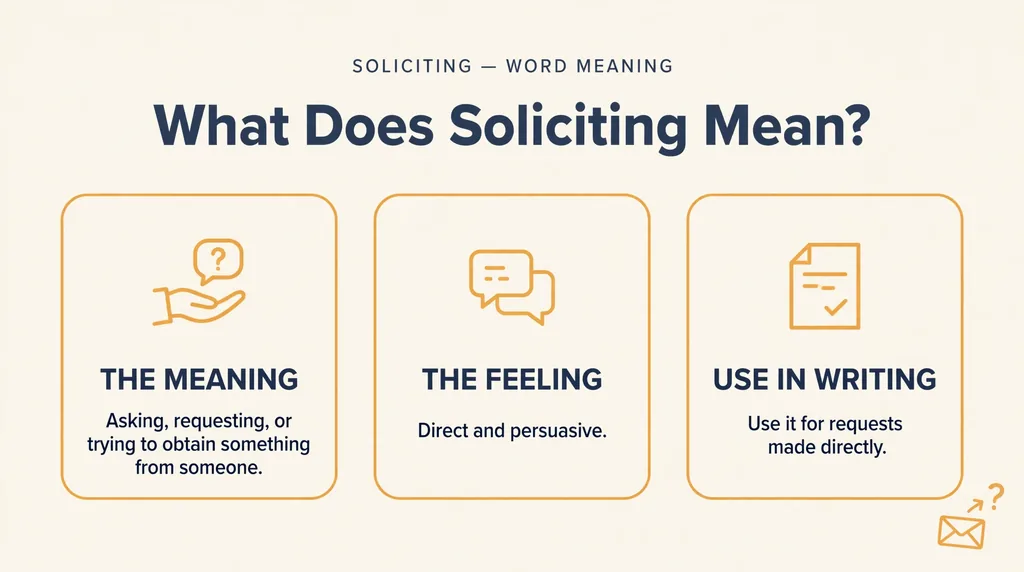
Soliciting means asking, requesting, seeking, or attempting to obtain something from another person, often through direct communication or persuasion.
It is the present participle of the verb solicit. People use it when someone actively approaches another person to request money, business, help, support, services, or action.
The word does not automatically imply wrongdoing. A request may be completely ordinary, professionally appropriate, or legally restricted, depending on what is being requested and how the interaction takes place.
Here are some simple examples:
- A nonprofit organization is soliciting donations for a local shelter.
- A freelancer is soliciting new clients through professional networking.
- A student is soliciting support for a school project.
- A person is soliciting someone to participate in an illegal activity.
In each example, someone is trying to obtain something. The purpose and circumstances determine the precise meaning.
Soliciting Definition and Part of Speech

The word soliciting comes from the verb solicit, which means to ask for, seek, or try to persuade someone to do something.
| Word | Meaning | Example |
|---|---|---|
| Solicit | To request or seek something | We solicit feedback from customers. |
| Soliciting | The act of requesting or seeking | She is soliciting donations. |
| Solicitation | A request, appeal, or act of seeking something | The organization sent a solicitation for funds. |
| Solicitor | A person who solicits; in some countries, also a specific type of lawyer | The solicitor approached local businesses. |
Grammar tip: Soliciting often appears in continuous verb forms, such as “They are soliciting customers.” It can also function as a noun-like form when describing the activity itself, as in “Soliciting donations requires careful planning.”
The word solicitor has different meanings across English-speaking countries. In British legal usage, it commonly refers to a qualified legal professional, so the surrounding context matters.
What Does Soliciting Mean in Different Contexts?

Soliciting has several related meanings. Looking at the situation helps you understand what the speaker intends.
1. Soliciting in Everyday Life
In ordinary conversation, soliciting means approaching someone to ask for something or encourage them to take action.
For example, a community volunteer might solicit help cleaning a public park. A student might solicit advice from an experienced teacher. Neither activity is inherently inappropriate.
Example: “The neighborhood group is soliciting volunteers for its weekend cleanup.”
This means the group is asking people to volunteer their time.
2. Soliciting Business
Soliciting business means actively trying to attract customers, clients, contracts, or commercial opportunities.
Businesses and independent professionals may solicit through emails, phone calls, networking events, advertisements, or personal visits.
Example: “The graphic designer spent the afternoon soliciting new clients.”
The designer was reaching out to potential customers in an effort to secure work.
Business solicitation can be legitimate, but organizations may need to follow rules about marketing, privacy, consent, and unsolicited communications.
3. Soliciting Donations
Soliciting donations means asking individuals or organizations to contribute money, goods, or other resources to support a cause.
Charities, schools, community groups, and disaster-relief organizations commonly engage in fundraising solicitation.
Example: “The charity is soliciting donations to provide meals for families affected by flooding.”
Here, the word describes an appeal for financial or material support, not an accusation of misconduct.
4. Soliciting Services
Soliciting services means asking for or attempting to obtain a particular service. The meaning depends on the service being discussed.
For instance, a homeowner might solicit cleaning services from local providers. In other situations, the expression can refer to requests or offers involving regulated or prohibited services.
Example: “The company is soliciting proposals from IT service providers.”
The company is inviting providers to submit offers for potential work.
5. Soliciting in a Legal Context
In law, solicitation can refer to requesting, encouraging, or attempting to persuade another person to perform a particular act. In some circumstances, especially when the intended act is criminal, solicitation can itself constitute an offense.
The exact definition varies by jurisdiction and offense. Legal systems may consider the nature of the request, the intended conduct, the person’s intent, and other statutory requirements.
Example: A person repeatedly encourages another individual to commit a crime. Depending on the applicable law and facts, that conduct could raise a question of criminal solicitation.
A request is not automatically criminal simply because someone dislikes it or finds it inappropriate. The relevant law and circumstances determine the legal position.
6. Soliciting in a Sexual Context
In sexual or law-enforcement contexts, soliciting may refer to requesting or offering sexual services, including prostitution-related activity.
However, the term can have specific legal meanings, and the rules differ between locations. A reference to soliciting in a police report, news story, or legal document should be interpreted in its full context rather than assumed to describe every situation involving an offer or request.
What Does “No Soliciting” Mean?
A “No Soliciting” sign usually means that visitors should not approach occupants or businesses to make unsolicited sales pitches, request donations, distribute promotional material, or seek support, depending on the property’s rules.
You might see these signs on residential doors, apartment entrances, offices, or commercial buildings.
For example, imagine that a salesperson knocks on a homeowner’s door to sell internet service. The homeowner has a “No Soliciting” sign displayed. The sign communicates that the homeowner does not want unsolicited sales approaches.
The exact scope of a sign can vary. Some signs specifically prohibit salespeople, while others also address fundraising, canvassing, or other requests.
| Sign or phrase | Usual meaning |
|---|---|
| No Soliciting | Do not make unsolicited approaches or requests covered by the sign. |
| No Sales Solicitation | Do not approach people to sell products or services. |
| No Soliciting or Canvassing | Do not make covered sales, fundraising, or outreach approaches. |
| Soliciting Donations | Asking people to contribute money or goods. |
| Soliciting Business | Seeking customers, clients, or commercial opportunities. |
Practical tip: If you see a “No Soliciting” sign, respect the property’s stated rules. If you are unsure whether your activity is permitted, ask the property manager or consult the relevant local rules.
What Does It Mean When Someone Is Soliciting?
When someone is described as soliciting, they are actively trying to obtain something from another person. To understand what they mean, identify three things: the request, the intended recipient, and the purpose.
Consider these examples:
- “He is soliciting donations.” He is asking people to contribute money or goods.
- “She is soliciting customers.” She is trying to attract people who may buy her products or services.
- “They are soliciting feedback.” They are asking people to share their opinions.
- “The suspect was accused of soliciting a crime.” The allegation concerns encouraging or requesting criminal conduct; the precise legal meaning depends on the applicable law.
Notice how the same word can describe a helpful community effort, an ordinary business activity, or an alleged offense.
The word alone does not tell you whether the behavior is legal, welcome, or appropriate. The details of the request provide that information.
Is Soliciting Illegal?
Soliciting is not inherently illegal. Asking for donations, seeking clients, requesting feedback, and inviting people to support a project are common activities.
Legality depends on what is being requested, the manner of the request, the location, and any applicable rules or laws.
| Situation | General explanation |
|---|---|
| Asking for charitable donations | Often permitted, subject to applicable fundraising rules. |
| Contacting potential business clients | Generally permitted when relevant marketing and communication rules are followed. |
| Selling products door to door | May be subject to local permits, restrictions, or property rules. |
| Sending unsolicited commercial messages | May be restricted by privacy, marketing, or anti-spam laws. |
| Soliciting someone to commit a crime | May constitute a criminal offense under applicable law. |
| Soliciting prostitution-related services | Legal treatment varies significantly by jurisdiction and circumstances. |
These are general explanations, not legal conclusions about a particular case.
If a specific incident involves an accusation, a police report, or a legal notice, consult the relevant local law or a qualified lawyer. The everyday meaning of a word is not a substitute for the legal definition used in a particular jurisdiction.
Soliciting Synonyms and Related Words
Several words are similar to soliciting, but they are not interchangeable in every situation.
| Word | Meaning | Example |
|---|---|---|
| Requesting | Asking for something | She is requesting additional information. |
| Seeking | Trying to find or obtain something | They are seeking new investors. |
| Asking | Making a request | He is asking for help. |
| Appealing | Making a request, often for support | The group is appealing for donations. |
| Persuading | Trying to convince someone | She is persuading customers to try the service. |
| Canvassing | Approaching people to gather support, opinions, or business | Volunteers are canvassing the neighborhood. |
| Pitching | Presenting an idea, product, or service | He is pitching his proposal to a client. |
| Recruiting | Seeking people to join a group or activity | The club is recruiting new members. |
The best synonym depends on the purpose. Requesting is neutral, persuading emphasizes influence, and canvassing often suggests organized outreach.
Soliciting vs. Solicitation: What Is the Difference?
Soliciting and solicitation come from the same verb, but they serve different grammatical roles.
Soliciting usually describes the action currently taking place or the activity of making requests.
Solicitation generally refers to the act, process, or instance of making a request.
Compare these sentences:
- “The organization is soliciting donations.” This describes what the organization is doing.
- “The organization launched a donation solicitation.” This refers to the fundraising request or campaign.
- “The business prohibits unauthorized solicitation.” This describes a policy restricting certain requests or approaches.
In everyday English, the distinction is mainly grammatical. In legal documents, solicitation may have a specific statutory meaning, so the relevant law should guide its interpretation.
How to Use Soliciting in a Sentence
Here are practical examples showing how the word works in different situations.
- Business: “The agency is soliciting proposals from qualified contractors.”
- Fundraising: “The school is soliciting donations for its library.”
- Community: “Volunteers are soliciting support for the neighborhood project.”
- Research: “The researcher is soliciting feedback from participants.”
- Marketing: “The company stopped soliciting customers by unsolicited phone calls.”
- Property rules: “The building manager asked visitors to stop soliciting residents.”
- Legal reporting: “The case involved an allegation of criminal solicitation.”
Common Mistakes to Avoid
- Assuming soliciting is always illegal: Many ordinary requests and business activities involve solicitation.
- Assuming it always means selling: Soliciting can involve donations, help, information, services, or action.
- Confusing soliciting with solicitation: One commonly describes an action; the other refers to the act or request.
- Ignoring context: A “No Soliciting” sign and a criminal charge use the same word in very different circumstances.
- Treating an allegation as a proven offense: Legal reports may describe accusations that have not been established in court.
Frequently Asked Questions
1. What is the simple meaning of soliciting?
Soliciting means asking, requesting, or trying to obtain something from someone. It can involve money, business, support, services, or action.
2. What does soliciting mean in simple terms?
It means actively asking someone for something or trying to convince them to provide it. For example, a charity soliciting donations is asking people to contribute to its cause.
3. What does soliciting someone mean?
It means approaching or contacting someone to make a request, seek an opportunity, or encourage a particular action. The exact meaning depends on the situation.
4. What does no soliciting mean?
A “No Soliciting” sign generally tells visitors not to make unsolicited sales pitches or other requests covered by the property’s rules.
5. What does soliciting business mean?
It means trying to attract customers, clients, contracts, or commercial opportunities through outreach, networking, sales calls, or other business-development activities.
6. What is the difference between solicit and solicitation?
Solicit is a verb meaning to ask for or seek something. Solicitation is the noun describing the act, process, or instance of making that request.
7. Is soliciting the same as begging?
No. Begging usually means asking people for money, food, or other assistance, often because of need. Soliciting is broader and can include business development, fundraising, and requests for many other things.
8. Is soliciting illegal?
Not necessarily. Many forms of soliciting are lawful. Certain activities may be prohibited or regulated by local laws, property rules, or specific criminal statutes.
9. What does soliciting mean in a legal document?
It depends on the document and the applicable law. It may describe requesting or encouraging a particular act, including conduct that could be criminal. The exact legal definition should be checked in context.
10. What is another word for soliciting?
Depending on the context, alternatives include requesting, seeking, asking, appealing, canvassing, and pitching. Each word carries a slightly different meaning.
Final Thoughts
Soliciting simply means asking for, seeking, or attempting to obtain something from another person. It can describe a charity collecting donations, a professional looking for clients, a company inviting proposals, or a request discussed in a legal setting.
The most important distinction is context. The word itself does not automatically imply criminal behavior or inappropriate conduct. Look at what is being requested, why the request is being made, and the circumstances surrounding it. That approach makes the meaning of soliciting much easier to understand in everyday conversations, business communications, signs, and legal documents.