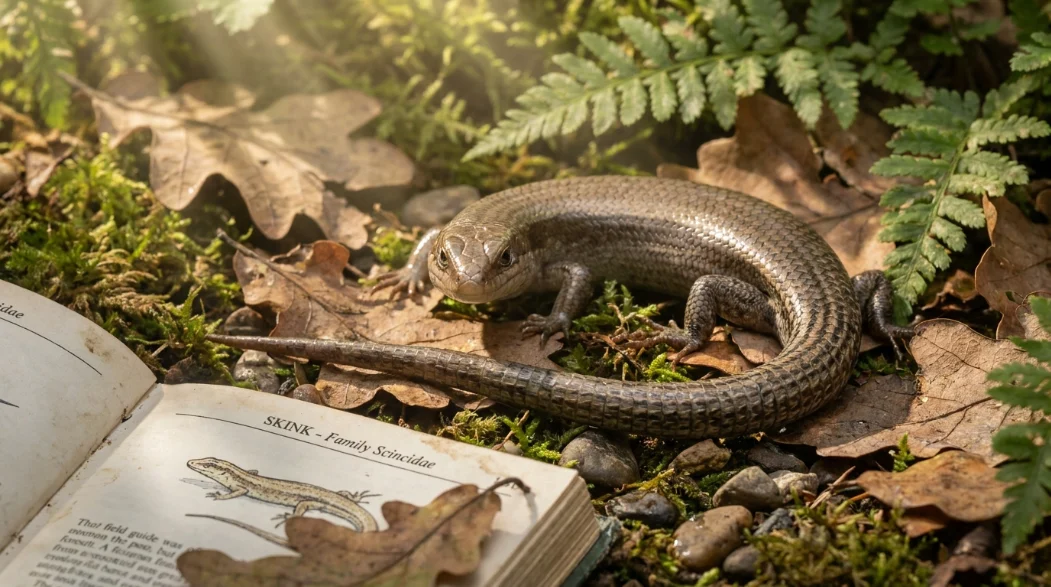
If you searched for skink meaning, the simple answer is this: a skink is a type of lizard belonging to the family Scincidae. Skinks are reptiles recognized by their smooth, shiny scales, long bodies, and relatively short legs. They can be found in many parts of the world, from forests and grasslands to deserts and gardens.
The word can sound unfamiliar because skinks are less commonly discussed than animals such as geckos, iguanas, or snakes. Yet they are a large and diverse group of lizards with hundreds of species.
In this guide, you will learn what a skink is, what the word means, how skinks look and behave, where they live, what they eat, and how they differ from other lizards.
Skink Meaning at a Glance
Skink means a type of lizard or reptile in the family Scincidae.
Here is the basic meaning:
| Term | Meaning |
|---|---|
| Skink | A type of lizard in the family Scincidae |
| Animal type | Reptile |
| Scientific family | Scincidae |
| Body shape | Usually elongated |
| Scales | Smooth and often shiny |
| Legs | Usually short, with some species having reduced limbs |
| Habitat | Forests, grasslands, deserts, wetlands, gardens, and other environments |
| Diet | Often insects and other small animals, with some species also eating plant matter |
So, if someone says, “I saw a skink in the garden,” they are talking about a particular kind of lizard.
What Is a Skink?
A skink is a reptile from the Scincidae family. Skinks are lizards, but they have a distinctive appearance that makes many species easy to recognize.
Most have smooth, overlapping scales that can give their bodies a polished or glossy appearance. Their bodies are often long and their legs comparatively short.
Some skinks look like ordinary small lizards at first glance. Others have much more distinctive features, such as bright blue tongues, colorful bodies, or unusual patterns.
One interesting feature is their tail. Many skink species can lose part of their tail as a defense against predators. The detached tail may move for a short time, distracting the predator while the skink escapes.
What Does a Skink Look Like?
There is no single appearance shared by every skink because the family contains many different species.
Common characteristics include:
- An elongated body
- Smooth, shiny scales
- A long tail
- Four relatively short legs in many species
- Small, overlapping scales
- A pointed or rounded head
- Clawed toes
- Colors ranging from brown and gray to green, red, orange, or blue
Some species are especially colorful.
The blue-tongued skink, for example, is famous for its broad blue tongue. It can display this tongue when threatened, making the animal appear more intimidating to a potential predator.
Other species are much less noticeable and blend into soil, leaves, rocks, or vegetation.
Is a Skink a Lizard?
Yes. A skink is a lizard.
The easiest way to understand the relationship is:
Reptile → Lizard → Skink
All skinks are lizards, but not all lizards are skinks.
A gecko, anole, iguana, and skink are all lizards, but they belong to different groups. Skinks are specifically associated with the family Scincidae.
This distinction matters because people sometimes use “lizard” and “skink” as if they mean exactly the same thing. They do not.
“Lizard” is a broad category, while “skink” identifies a particular family of lizards.
Why Are Skinks Called Skinks?
The word skink is an old animal name that has been used for this group of lizards for centuries.
In modern English, the word primarily refers to members of the skink family, Scincidae.
You may also encounter species names containing the word “skink,” such as:
- Blue-tongued skink
- Five-lined skink
- Fire skink
- Broad-headed skink
- Sand skink
- Garden skink
The exact appearance and behavior can vary significantly from one species to another.
Where Do Skinks Live?
Skinks have adapted to a wide range of environments.
Depending on the species, they can live in:
- Tropical forests
- Woodlands
- Grasslands
- Deserts
- Rocky areas
- Coastal environments
- Wetlands
- Gardens
- Areas around human homes
Different species have different habitat preferences.
A desert skink, for example, is adapted to dry conditions, while tropical skinks may live in warm, humid environments.
Some species spend considerable time under rocks, fallen leaves, logs, or soil. These hiding places provide protection from predators and can also help the animals regulate their body temperature.
What Do Skinks Eat?
Many skinks are opportunistic feeders. Their diet depends on the species, age, habitat, and food available.
Common foods include:
- Insects
- Spiders
- Beetles
- Crickets
- Larvae
- Small invertebrates
- Snails
- Fruits
- Vegetation
- Small vertebrates in some larger species
Young skinks often eat plenty of small insects because animal protein is important during growth.
Larger species may have a broader diet.
This flexibility helps skinks survive in different environments where food availability changes throughout the year.
Are Skinks Dangerous?
Most skinks are not dangerous to humans.
They generally prefer to escape rather than confront people. If a skink feels threatened, it may run into vegetation, hide under an object, or use defensive behavior designed to discourage a predator.
Like many wild animals, a skink can bite if handled or seriously threatened. However, simply seeing one in a garden or outdoors is usually not a reason for alarm.
The safest approach is simple: observe it without trying to catch or handle it.
Are Skinks Poisonous or Venomous?
The answer needs some care because people often use “poisonous” and “venomous” interchangeably.
A venomous animal actively delivers venom through a bite, sting, or another specialized mechanism. A poisonous animal is harmful when its toxins are eaten, touched, or otherwise absorbed.
Most skinks encountered by people are not considered dangerous venomous reptiles.
There are, however, unusual cases within the broader skink family that have attracted scientific interest because certain species can produce toxic substances associated with their saliva. This does not mean ordinary skinks are a major threat to people.
For everyday purposes, encountering a skink should generally be treated as a normal wildlife encounter rather than a dangerous one.
What Do Skinks Do When They Feel Threatened?
A skink’s first response is often to escape and hide.
Depending on the species, defensive behavior can include:
- Running quickly toward cover
- Hiding under rocks, leaves, or logs
- Freezing to avoid detection
- Displaying the mouth or tongue
- Dropping part of the tail
Tail loss is particularly interesting.
A predator may focus on the moving tail while the skink gets away. The lost portion can later regenerate to some extent, although the replacement tail may not look exactly like the original.
This is an example of how animal behavior and physical adaptations work together for survival.
Common Types of Skinks
The word “skink” covers a huge range of species, so these animals can look very different.
Blue-Tongued Skink
Blue-tongued skinks are among the best-known skinks. Their large blue tongues are an impressive defensive display.
They are relatively robust compared with many small garden lizards and are native to Australia and nearby regions.
Five-Lined Skink
The five-lined skink is known for the stripes that can be particularly noticeable in younger individuals.
Juveniles can have vivid blue tails, while their coloration may become less striking as they mature.
Fire Skink
Fire skinks are colorful lizards associated with tropical regions of Africa. Their reddish or orange coloration makes them visually distinctive.
Sand Skinks
Some skinks have adaptations that help them move through loose sand. Their body shape and limb structure can make them look quite different from the typical lizard people imagine.
These examples show why the word “skink” should not be associated with one exact appearance.
Skink vs. Lizard: What’s the Difference?
The main difference is category.
A lizard is a broad group of reptiles. A skink is one particular family of lizards.
| Feature | Skink | Lizard in general |
|---|---|---|
| Classification | Family Scincidae | Broad group of reptiles |
| Body shape | Often long and streamlined | Highly variable |
| Scales | Often smooth and shiny | Can be smooth, rough, granular, or keeled |
| Legs | Often relatively short | Can range from well-developed to greatly reduced |
| Tail | Often long | Shape and size vary greatly |
| Examples | Blue-tongued skink, five-lined skink | Gecko, iguana, anole, monitor lizard, skink |
Think of it this way: “lizard” is the larger label, while “skink” is a more specific label.
Skink vs. Gecko
Skinks and geckos are both lizards, but they have noticeable differences.
Geckos are often famous for their large eyes, specialized toe pads, and ability to climb smooth surfaces in many species.
Skinks usually have a more streamlined body with smooth, overlapping scales.
Their behavior also differs among species. Some geckos are strongly associated with nighttime activity, while skinks include both daytime and nighttime species.
There is no single rule that describes every member of either group, but their physical features can usually help you tell them apart.
Are Skinks Good to Have in a Garden?
In many situations, seeing a skink in a garden can be a positive sign.
Many skinks eat insects and other small invertebrates. They are therefore part of the natural food web and can contribute to controlling populations of small creatures.
A garden that provides:
- Natural hiding places
- Leaf litter
- Rocks
- Logs
- Native vegetation
- Access to suitable food
may be attractive to local reptiles.
Instead of viewing every small reptile as a pest, it can be useful to recognize that these animals have a role in the local ecosystem.
Why Do People Confuse Skinks With Snakes?
Some skinks have unusually long bodies and small or reduced legs. From a quick glance, they can look surprisingly snake-like.
This is especially true for species adapted to moving through sand, soil, or dense vegetation.
But skinks are lizards, not snakes.
Many retain obvious lizard characteristics such as four legs, claws, external ear openings, and eyelids, although these features vary among species.
Some skinks have evolved body shapes that reduce their limbs, showing how different reptile species can adapt to particular environments.
How to Use “Skink” in a Sentence
Here are a few natural examples:
Simple:
“I saw a small skink near the garden wall.”
Descriptive:
“The brown skink disappeared beneath the fallen leaves.”
Educational:
“A skink is a type of lizard belonging to the family Scincidae.”
Nature writing:
“The skink slipped between the rocks before I could get a closer look.”
Conversational:
“Is that a skink or another kind of lizard?”
These examples show that “skink” is normally used as a noun when referring to the animal.
Interesting Facts About Skinks
Skinks are more diverse than their simple appearance might suggest.
Here are some useful facts:
- Skinks belong to the family Scincidae.
- They are lizards, not snakes.
- Many species have smooth, glossy-looking scales.
- Skinks occur across a wide range of habitats.
- Some species can detach their tails as a defense.
- Certain skinks have striking colors and patterns.
- The blue-tongued skink is known for its vivid blue tongue.
- Many skinks eat insects and other small invertebrates.
- Some species have reduced limbs or unusual body shapes.
- Their behavior varies considerably between species.
What Does “Skink” Mean in Simple English?
In very simple English:
A skink is a kind of lizard.
It usually has a long body, smooth scales, short legs, and a long tail. Skinks live in many different parts of the world and eat a variety of foods, especially insects and other small creatures.
So if a child asks, “What is a skink?”, a simple answer is:
“A skink is a type of lizard.”
That explanation is accurate and easy to understand.
Is “Skink” a Specific Animal or a General Word?
It is a general name for a group of related lizards, rather than the name of only one species.
This is similar to how “frog” can refer to many species rather than one individual animal.
When someone says “skink,” you need additional context to know the exact species.
For example, a blue-tongued skink and a five-lined skink are both skinks, but they have different appearances, habitats, and behaviors.
Frequently Asked Questions
What does skink mean?
Skink means a type of lizard belonging to the family Scincidae. Skinks are reptiles commonly recognized by their elongated bodies, smooth scales, and relatively short legs.
Is a skink a lizard?
Yes. A skink is a lizard. The word “lizard” describes a broad group, while “skink” refers specifically to members of the family Scincidae.
Are skinks dangerous to humans?
Most skinks are harmless to humans and normally avoid people. They may bite if captured or threatened, so wild skinks are best left alone.
Can skinks bite?
Yes, skinks can bite, but they generally do so as a defensive response. Most wild skinks would rather escape and hide than attack a person.
Are skinks poisonous?
Most skinks are not considered poisonous animals that pose a normal threat to people. Some unusual species have been studied for toxic compounds, so it is best not to handle unfamiliar wildlife.
What do skinks eat?
Many skinks eat insects and other small invertebrates. Depending on the species, their diet can also include fruit, vegetation, snails, and other small animals.
Where do skinks live?
Skinks live in many environments, including forests, grasslands, deserts, rocky areas, and gardens. Their habitat depends on the particular species.
Why do skinks lose their tails?
Some skinks can detach part of their tails when attacked by a predator. The moving tail may distract the predator and give the skink an opportunity to escape.
What is the difference between a skink and a gecko?
Both are lizards, but they belong to different groups. Skinks commonly have elongated bodies and smooth scales, while many geckos have large eyes and specialized toe structures for climbing.
Internal Linking Suggestions
If your website contains related animal, vocabulary, or definition content, these internal links would fit naturally:
- What Is a Lizard?
Link from the section explaining that skinks are lizards. - Reptile Meaning
Link from the definition and classification section. - Gecko Meaning
Link from the skink vs. gecko comparison. - Animal Names and Their Meanings
Link from the simple-English explanation. - What Does Scales Mean?
Link from the sections discussing a skink’s physical appearance.
Use descriptive anchor text instead of repeatedly linking with the exact phrase “skink meaning.”
Final Thoughts
The simplest skink meaning is a type of lizard from the family Scincidae. Although skinks may look like ordinary small lizards at first, the group includes an impressive range of species with different colors, body shapes, habitats, and behaviors.
Some live in deserts, others in forests or gardens. Some have striking blue tongues, while others rely on camouflage. Several species can also use tail loss as a defense against predators.
The next time you see a small, smooth-scaled reptile disappearing beneath leaves or a rock, it may be more than just “a lizard.” It could be a skink, a diverse and fascinating member of the reptile world.
Discover More Post:
- FAFO Meaning | What This Bold Internet Slang Really Means …
- TLDR Meaning Explained | The Internet Shortcut Behind …
- What Does Zionist Really Mean? History, Beliefs & the Story …
