A name can carry centuries of history, and Luxor is a perfect example. Located along the Nile River in southern Egypt, Luxor is famous for its enormous temples, royal tombs, and remarkable connection to ancient Egyptian civilization. But the story behind its name is just as fascinating as the monuments themselves.
The word Luxor comes from the Arabic al-Uqṣur, meaning “the palaces.” The name reflects the impressive ancient structures that stood in the area and inspired later visitors. Before it became known as Luxor, the city was called Waset by the ancient Egyptians and Thebes by the Greeks. These names reveal how different civilizations understood and remembered the same historic place. <Cite refs={[“turn394458search0″,”turn394458search5”]}/>
What Does Luxor Mean?

Luxor means “the palaces” or, in some explanations, “the castles.” Its modern name comes from the Arabic al-Uqṣur, associated with the plural of qaṣr, meaning a palace or castle. <Cite refs={[“turn394458search5″,”turn394458search12”]}/>
The name is closely connected to the impressive ruins that make Luxor one of Egypt’s most important historical destinations. Its ancient temples, monumental columns, statues, and ceremonial structures could appear palace-like to people encountering them centuries after their construction.
Here is a quick breakdown:
| Detail | Explanation |
|---|---|
| Word | Luxor |
| Literal meaning | The palaces |
| Language of origin | Arabic |
| Arabic form | Al-Uqṣur |
| Ancient Egyptian name | Waset |
| Greek name | Thebes |
| Location | Southern Egypt, along the Nile River |
The important distinction is that Luxor is the city’s modern name, not its original ancient Egyptian name. The word describes the place through a later linguistic and historical perspective.
Where Does the Name Luxor Come From?
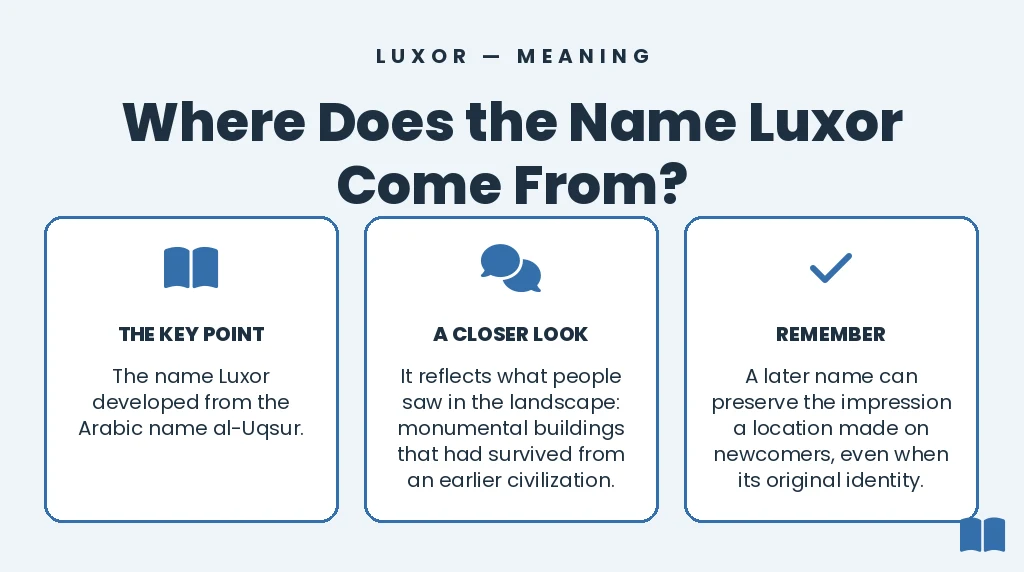
The name Luxor developed from the Arabic name al-Uqṣur. The Egyptian Ministry of Tourism and Antiquities explains that Arabs used this name after the Arab conquest of Egypt in the seventh century, when the area’s ancient temples impressed them so deeply that they were associated with palaces. <Cite refs={[“turn394458search0″,”turn394458search6”]}/>
This origin gives the name a practical historical meaning rather than a purely symbolic one. It reflects what people saw in the landscape: monumental buildings that had survived from an earlier civilization.
The Arabic word qaṣr can mean a palace or castle, while quṣūr is its plural form. The English spelling Luxor developed through the transmission of the Arabic place name into other languages. <Cite refs={[“turn394458search5″,”turn394458search12”]}/>
The name also illustrates an interesting pattern in history. Places often receive new names when languages, rulers, and cultures change. A later name can preserve the impression a location made on newcomers, even when its original identity is much older.
What Was Luxor Called in Ancient Egypt?
Luxor was known as Waset in ancient Egyptian times. It later became widely known by the Greek name Thebes, which is the name commonly used in historical accounts of ancient Egypt. <Cite refs={[“turn394458search0″,”turn394458search14”]}/>
Each name belongs to a different historical context.
Waset: The Ancient Egyptian Name
Waset was the ancient Egyptian name associated with the city. It became an important center of political power and religious life, particularly during periods when Thebes served as Egypt’s capital.
The city was closely associated with the worship of Amun-Ra, one of the most important deities in ancient Egyptian religion. Its temples and religious institutions helped make it a major center of worship and royal authority. <Cite refs={[“turn394458search0″,”turn394458search17”]}/>
Thebes: The Greek Name
Thebes is the Greek name for the ancient Egyptian city. Greek writers used it when describing the region’s monumental architecture, religious traditions, and political importance.
The name appears frequently in accounts of ancient Egyptian history. It is especially relevant when reading about the Middle Kingdom and New Kingdom periods, when Thebes played a major role in Egyptian government and culture. <Cite refs={[“turn394458search18″,”turn394458search17”]}/>
Luxor: The Modern Name
Luxor is the name used for the modern city. It connects today’s destination with the archaeological remains of ancient Thebes and the temples that helped define the region.
The three names are not simply interchangeable historical labels. Each reflects a different language and period, making them useful clues for understanding how the city evolved.
Why Is Luxor Known as the City of Palaces?
Luxor is often associated with the phrase “city of palaces” because of the meaning of its Arabic-derived name and the impressive ancient structures found there.
The area’s temples were religious and ceremonial complexes, not simply royal residences. Their enormous gateways, carved reliefs, statues, courtyards, and towering columns reflected the power of rulers and the importance of religious life.
The name Luxor captures the visual impact of these structures, but it should not be taken as a literal description of every ancient building.
Three features help explain the association:
- Monumental architecture: Large stone structures and decorated entrances made the temples visually impressive.
- Royal connections: Pharaohs commissioned and expanded major religious monuments as expressions of kingship and devotion.
- Historical survival: Many structures remained visible long after the civilization that built them had changed.
The result is a name that preserves a later visitor’s impression of an extraordinary ancient landscape.
The Historical Importance of Luxor
Understanding Luxor’s meaning becomes more interesting when you understand the city’s role in ancient Egypt.
The region was not simply a collection of impressive buildings. It was an important center of government, religious activity, royal ceremonies, and monumental construction.
During the New Kingdom, approximately 1550 to 1070 BCE, Thebes was a major center of Egyptian power. Its influence extended through royal projects, religious institutions, and the burial traditions of rulers and elites. <Cite refs={[“turn394458search17″,”turn394458search18”]}/>
The ancient city developed on both sides of the Nile, with major temples on the eastern bank and important royal burial grounds on the western bank.
This geographical arrangement helps explain why the wider Luxor area contains such a remarkable range of archaeological sites.
Famous Historical Sites Connected to Luxor
<text weight=”medium”>The landmarks below help explain the history behind the name.</text>
<row align=start gap={3}> <AsyncImage query=”Luxor Temple Egypt monumental columns and statues photorealistic” aspectRatio=”3:4″ width=”112px”/> <box flex=”1″ gap={1}> **Luxor Temple**
This temple was a major religious complex associated with Amun and royal ceremonies. Its architecture includes monumental entrances, statues, courtyards, and columns. It is one of the most recognizable landmarks associated with the city.</box> </row>
<row align=start gap={3}> <AsyncImage query=”Karnak Temple Egypt Great Hypostyle Hall massive ancient columns” aspectRatio=”3:4″ width=”112px”/> <box flex=”1″ gap={1}> **Karnak Temple Complex**
Karnak developed over many centuries through the work of different rulers. Its vast religious structures demonstrate the importance of Thebes as a center of worship, especially for Amun-Ra.</box> </row>
<row align=start gap={3}> <AsyncImage query=”Valley of the Kings Luxor Egypt desert royal tomb entrance” aspectRatio=”3:4″ width=”112px”/> <box flex=”1″ gap={1}> **Valley of the Kings**
Located on Luxor's western bank, this burial area contains royal tombs associated with pharaohs of the New Kingdom. It shows another side of the region's history: beliefs about death, the afterlife, and royal burial.</box> </row>
Together, these places reveal why Luxor has such strong historical associations. The city name refers to palaces, but the heritage behind it includes religious architecture, royal burial grounds, and centuries of cultural development.
Luxor Meaning in Arabic and English
The Arabic origin is the clearest way to explain the word’s literal meaning.
| Language or context | Name or expression | Meaning |
|---|---|---|
| English | Luxor | Name of a historic Egyptian city |
| Arabic | Al-Uqṣur | The palaces |
| Arabic singular | Qaṣr | A palace or castle |
| Ancient Egyptian | Waset | Ancient name associated with the city |
| Greek | Thebes | Historical Greek name for the city |
The modern English spelling represents a place name borrowed through Arabic. Its meaning is therefore different from the way ordinary English words are usually formed.
For example, if someone asks, “What does Luxor mean in English?”, the most direct answer is “the palaces.” If the question is about history, the answer should also explain the city’s earlier identity as Waset and Thebes.
Is Luxor a Name or a Place?
Luxor is primarily known as a geographical place name. It refers to the Egyptian city and its surrounding historic landscape.
Someone may also use Luxor as a business name, brand name, or personal name. Those uses do not necessarily establish a separate traditional meaning.
For example:
- A travel company might use Luxor to suggest Egyptian history or cultural heritage.
- A hotel might use Luxor to evoke grandeur and ancient architecture.
- A parent might choose Luxor as an uncommon personal name because of its historical associations.
In these examples, the intended symbolism depends on the person or organization choosing the name. It is more accurate to distinguish such personal interpretations from the documented Arabic origin.
Does Luxor Have a Symbolic Meaning?
Luxor does not have one universally established symbolic meaning beyond its historical and geographical associations. However, its connection with ancient Egyptian civilization can inspire several interpretations.
History and legacy: The city represents the survival of a civilization through monuments, inscriptions, and archaeological discoveries.
Grandeur and power: Its monumental temples and royal tombs can evoke authority, ambition, and architectural achievement.
Spiritual heritage: Its religious complexes reflect the role of worship, ritual, and the divine in ancient Egyptian society.
Cultural continuity: The names Waset, Thebes, and Luxor show how a place can retain its importance while its language and political surroundings change.
These are interpretations inspired by the city’s history, not dictionary definitions of the word Luxor. This distinction matters when explaining the name accurately.
Luxor vs. Thebes vs. Waset
The names can be confusing because they refer to the same historic urban center in different periods and languages.
| Name | Historical context | What to remember |
|---|---|---|
| Waset | Ancient Egyptian | The city’s ancient Egyptian name |
| Thebes | Greek | The name widely used in historical accounts |
| Luxor | Modern Arabic-derived name | The name of the present-day Egyptian city |
The ancient remains of Thebes lie within the modern city of Luxor and its surrounding archaeological landscape. The wider area includes temples, tombs, and other monuments that reveal the city’s long history. <Cite refs={[“turn394458search0″,”turn394458search18”]}/>
A useful way to remember the difference is to think of these names as historical layers. Waset reflects ancient Egyptian identity, Thebes reflects Greek usage, and Luxor reflects the later Arabic-derived name.
How to Use the Word Luxor in a Sentence

Because Luxor is a proper noun, it normally begins with a capital letter.
Here are some natural examples:
- “Luxor is famous for its ancient Egyptian temples.”
- “The meaning of Luxor is connected to the Arabic word for palaces.”
- “Waset was the ancient Egyptian name associated with Luxor.”
- “Thebes is the historical Greek name for the ancient city.”
- “The temples of Luxor offer insight into ancient Egyptian religious life.”
- “The name Luxor reflects the impression made by the region’s monumental ruins.”
These examples show how to use the word when discussing its meaning, geography, and historical background.
Frequently Asked Questions
1. What does Luxor mean in English?
Luxor means “the palaces,” from the Arabic-derived name al-Uqṣur. The name is associated with the ancient temples and monumental ruins in the area. <Cite refs={[“turn394458search0″,”turn394458search5”]}/>
2. What is the origin of the name Luxor?
The name comes from Arabic al-Uqṣur, related to qaṣr, meaning a palace or castle. The name became associated with the area after the Arab conquest of Egypt in the seventh century. <Cite refs={[“turn394458search0″,”turn394458search12”]}/>
3. What was Luxor called in ancient Egypt?
It was known as Waset in ancient Egyptian times. The name Thebes was later used by the Greeks and became widely established in historical writing. <Cite refs={[“turn394458search0″,”turn394458search18”]}/>
4. Why is Luxor called the City of Palaces?
The name derives from an Arabic expression meaning “the palaces.” The impressive ancient temples and monumental structures in the area help explain the association.
5. Does Luxor mean palace or palaces?
The commonly given meaning is “the palaces.” It comes from the Arabic-derived plural form al-Uqṣur, related to the singular qaṣr, meaning a palace or castle. <Cite refs={[“turn394458search5″,”turn394458search12”]}/>
6. Is Luxor an Arabic word?
Luxor is an English spelling of a place name derived from Arabic al-Uqṣur. Its modern form reflects the history of the name as it passed between languages.
7. Is Luxor a person’s name?
Luxor is best known as the name of the Egyptian city. It can also be adopted as a personal or brand name, but such uses do not automatically give it a separate established personal-name meaning.
8. What is the difference between Luxor and Thebes?
Luxor is the modern city name, while Thebes is the Greek name for the ancient city. Waset is the ancient Egyptian name associated with it.
9. Why is Luxor historically important?
Luxor contains major remains of ancient Thebes, an important center of Egyptian political and religious life. Its temples and royal burial sites preserve evidence of ancient architecture, beliefs, and kingship. <Cite refs={[“turn394458search0″,”turn394458search17”]}/>
10. Is Luxor’s meaning symbolic or literal?
Its documented meaning is “the palaces.” Ideas such as grandeur, history, and spiritual heritage are symbolic interpretations inspired by the city’s monuments, rather than literal dictionary meanings.
Final Thoughts
The meaning of Luxor is rooted in the Arabic expression al-Uqṣur, commonly translated as “the palaces.” But the name becomes more meaningful when you understand the history behind it.
Before the modern name took hold, the city was known as Waset to the ancient Egyptians and Thebes to the Greeks. Its monumental temples, royal tombs, and religious heritage helped make it one of the most important archaeological regions in Egypt.
Luxor is therefore more than a name on a map. It preserves a record of how different civilizations encountered, described, and remembered an extraordinary historic place.