Have you ever opened a message that says “What’s good, gng?” and wondered what the last three letters mean? You’re not alone. Internet slang changes quickly, and short expressions can leave you guessing when you encounter them for the first time. Fortunately, the GNG meaning in text is usually “gang,” an informal way to address a friend, a group of friends, or people who share a close connection.
You might see GNG in text messages, TikTok comments, Snapchat conversations, Instagram captions, and gaming chats. Someone might use it to greet a friend, show appreciation for their circle, or make a casual message sound more familiar. However, context still matters. In some messages, GNG may be a personal abbreviation or a shortened spelling of another word. Understanding the sentence around it helps you interpret the intended meaning without guessing.
What Does GNG Mean in Text?
The most common slang meaning of GNG is “gang.” In casual online communication, people often use it to refer to their friends, close social circle, or familiar group. It can also work as a friendly way to address one person.
For example, someone might text:
“You coming tonight, gng?”
The sender probably means, “Are you coming tonight, bro?” or “Are you coming tonight, my friend?” They aren’t necessarily talking about a formal group or a criminal organization. They’re using a casual expression to make the message feel familiar.
GNG is an example of informal text message shorthand. People frequently remove vowels from words when typing quickly or adopting a style popular in online communities. The result is a short spelling that saves a little space and gives the message a distinct internet-culture feel.
The exact meaning can still depend on the conversation. A message such as “Love my gng” strongly suggests friends or a social circle. A sentence such as “I’m gng home” may indicate that the writer is shortening “going,” although that spelling is less standard and needs context.
GNG Meaning at a Glance
| Detail | Explanation |
|---|---|
| Main slang meaning | Gang |
| Meaning in everyday texting | Friend, friends, or one’s social circle |
| Typical tone | Casual, friendly, playful, or familiar |
| Common settings | Text messages, social media comments, group chats, gaming chats |
| Formality | Informal |
| Is it always an acronym? | No. In its common slang use, it’s a shortened spelling of “gang.” |
| Can the meaning change? | Yes. The surrounding sentence and community can affect interpretation. |
| Does it automatically imply crime? | No. In casual slang, it often refers simply to friends. |
The most useful thing to remember is that GNG usually communicates familiarity rather than a special hidden message. If someone calls you GNG, they’re often addressing you in the same general spirit as “bro,” “fam,” or “my people.”
What Does GNG Stand for in Texting?
When people ask what GNG stands for, they’re often looking for a full form made from three words. In common texting slang, however, GNG usually represents “gang” with the vowels removed.
This distinction matters because an abbreviation and an acronym aren’t exactly the same thing.
- Abbreviation: A shortened form of a word or phrase.
- Acronym: A term formed from the initial letters of several words and commonly pronounced as a word.
- Initialism: A term formed from initial letters that people pronounce individually.
For example, “ASAP” is an acronym commonly used for “as soon as possible,” while “BRB” is an initialism for “be right back.” GNG, when used to mean gang, is better understood as a shortened spelling than as a traditional acronym.
People may create their own full forms for GNG in a private chat, gaming community, or social group. Those interpretations can make sense within that circle, but they shouldn’t automatically be treated as universal slang definitions.
Why Do People Write GNG Instead of Gang?
Online language often favors speed, personality, and recognizable patterns. Removing vowels creates compact spellings such as “srsly” for “seriously” or “tmrw” for “tomorrow.” GNG fits this broader habit of shortening familiar words.
There are several reasons someone might choose GNG:
- Typing style: Short forms can make messages feel quick and casual.
- Social familiarity: The term can signal that the sender considers the recipient a friend or part of their circle.
- Internet culture: Distinctive spellings help users match the language of a particular online community.
- Visual brevity: Three letters are easy to fit into a short comment or caption.
- Personal preference: Some users simply like the appearance of GNG more than the full word.
Not everyone uses the spelling in the same way. One person might type “gang,” another might write “gng,” and someone else might prefer “bro.” These choices often reflect individual style rather than meaningful differences in the relationship.
GNG Slang Meaning: How People Use It in Everyday Conversations
Understanding the definition is only the first step. To recognize GNG naturally, it helps to see how people use it in different situations.
The same term can function as a greeting, a direct form of address, a reference to a group, or an expression of solidarity. The surrounding words usually reveal which role it plays.
GNG as a Friendly Greeting
A common use of GNG is to greet someone or start a conversation. Instead of writing a formal greeting, a person may use the term to create a relaxed atmosphere.
Examples:
- “Yo gng, what are you doing?”
- “What’s good, gng?”
- “Morning, gng!”
- “You outside today, gng?”
- “How you been, gng?”
In these messages, GNG functions much like “bro” or “dude.” The sender is opening a conversation with someone they feel comfortable addressing informally.
Imagine a friend sending “What’s good, gng?” after school. You wouldn’t normally interpret the message as a serious question about a criminal gang. The likely intention is simply to say hello and see what’s happening.
GNG as a Term for Close Friends
People also use GNG when talking about their friends collectively. In this case, it can refer to a group rather than one specific person.
Examples:
- “Hanging with the gng tonight.”
- “My gng always shows up.”
- “Shoutout to the gng.”
- “Miss my gng from college.”
- “Best memories with the gng.”
These examples show how the term can express belonging. It may refer to a small group of friends, teammates, classmates, or people who regularly spend time together.
However, GNG doesn’t establish how close the relationships really are. Someone might use it for lifelong friends, while another person might use it for a casual online group. The word alone doesn’t prove the depth of the connection.
GNG as a Way to Show Support
In some conversations, GNG adds warmth or solidarity to a message. The sender may use it while encouraging someone, celebrating an achievement, or showing appreciation.
For example:
“You got this, gng. Don’t give up now.”
The message means that the sender is encouraging a friend. GNG makes the advice feel more personal and relaxed.
Other examples include:
- “Proud of you, gng.”
- “We got this, gng.”
- “Keep going, gng!”
- “That’s my gng!”
- “Always got your back, gng.”
These messages communicate support through their full wording. GNG adds a familiar tone, but it isn’t the sole reason the messages sound encouraging.
GNG in Jokes and Playful Messages
Friends often use slang while teasing each other or reacting to something funny. GNG can fit naturally into that style.
Consider these examples:
- “Bro really forgot his own birthday, gng 😭”
- “You did all that for one cookie, gng?”
- “Nah, you’re actually wild, gng.”
- “Gng, what was that performance?”
- “You can’t be serious, gng 😂”
Here, the term adds emphasis and familiarity. The emojis and surrounding words help convey humor, disbelief, or playful criticism.
Still, context matters. A joke between close friends might sound rude when directed at a stranger. GNG doesn’t automatically make every sentence friendly.
GNG in Group Chats
Group chats are a natural setting for language that refers to a shared circle of friends. Someone may use GNG to address everyone or to describe the group itself.
For example:
Alex: “Gng, who’s coming to the game?”
Jordan: “I’m in.”
Sam: “Same here. What time?”
Alex: “Let’s meet at 6.”
In this conversation, GNG works as a casual collective address. Alex is speaking to the group rather than singling out one person.
It can also appear in a message about the group:
“The gng finally got together after months.”
In that sentence, GNG refers to the people who met up.
A useful distinction is that GNG can address one person or refer to several people. You need the sentence to determine which meaning fits.
GNG Meaning on Social Media
Social media gives slang a place to travel between friend groups, gaming communities, creators, and everyday users. GNG fits naturally into short captions, comments, and messages because it takes little space and communicates familiarity.
However, there isn’t one universal rule for how everyone uses the term. A person’s age, online community, and usual texting habits can influence whether they write GNG, gang, bro, or another expression.
GNG Meaning on TikTok
On TikTok, GNG may appear in video comments, captions, replies, and conversations between creators and their followers. Users can employ it to address friends, refer to a group, or give a comment a playful, informal tone.
For example, imagine a creator posting a video about finally passing a difficult exam. A commenter might write:
“We made it, gng 😭”
The commenter is using GNG as a friendly address to the people sharing the moment. The wording creates a sense of community, even if the people watching the video don’t personally know one another.
Here are other examples of how the term might appear on TikTok:
- “The gng is back together.”
- “Good morning, gng.”
- “Gng, this trend is getting out of hand.”
- “Who remembers this era, gng?”
- “My gng never disappoints.”
The first example refers to a group of people. The second addresses an audience casually. The third adds a familiar tone to a reaction, while the fourth invites people to share a memory.
GNG can also appear in comments on gaming clips, comedy videos, school-related content, and posts about friendship. Its role depends on the words around it rather than on the platform alone.
Does GNG have a special TikTok-only meaning? Not usually. The common slang interpretation remains “gang.” TikTok provides a setting where users may encounter the expression, but it doesn’t automatically give the term a separate definition.
It’s also important not to assume that every commenter using GNG belongs to Gen Z. Internet slang crosses age groups, and users often pick up expressions from friends, creators, and online communities.
GNG Meaning on Snapchat
Snapchat combines direct messages, photo and video sharing, Stories, and group conversations. GNG can appear in any of these settings when users communicate informally.
Suppose someone replies to your Story with:
“Looking good, gng 🔥”
They’re likely offering a compliment while addressing you in a friendly way. The exact tone depends on your relationship and the rest of the conversation, but the term itself doesn’t establish romantic interest.
You might also see messages such as:
- “Where the gng at?”
- “You coming with the gng?”
- “Miss y’all, gng.”
- “Gng, check your snaps.”
- “We outside tonight, gng.”
These examples refer to friends, plans, or a familiar group. In a group conversation, the term may address everyone. In a private message, it may refer to one person.
Don’t Confuse GNG With GN
A common source of confusion is the difference between GNG and GN.
| Abbreviation | Common meaning | Example |
|---|---|---|
| GNG | Gang; friend or friend group | “What’s up, gng?” |
| GN | Good night | “GN, talk tomorrow.” |
| GM | Good morning | “GM everyone!” |
| GNS | Can have context-specific meanings; not a universal substitute for GNG | Check the full message |
| GTG | Got to go | “GTG, my ride is here.” |
GN is a widely recognized abbreviation for “good night.” GNG, by contrast, usually means “gang” when it appears as casual slang.
The distinction becomes clear when you read the complete sentence. “GN, gng” could mean “Good night, gang,” with each abbreviation doing a different job. The first marks the farewell, while the second addresses the friend or group.
GNG Meaning on Instagram
Instagram users may write GNG in captions, comments, Story replies, and direct messages. Its meaning generally follows the same pattern found elsewhere in casual internet slang.
A person posting a group photo might caption it:
“Nothing but love for the gng ❤️”
The term refers to the people in the photo or the poster’s close circle. The heart emoji reinforces affection, but the phrase itself doesn’t require a romantic interpretation.
Other plausible examples include:
- “Weekend with the gng.”
- “My gng understood the assignment.”
- “Gng, rate this fit.”
- “Tag your gng.”
- “Core memories with my gng.”
These phrases serve different purposes. One describes a social outing, another praises friends, and another invites followers to join a conversation.
On Instagram, GNG may also appear under Reels about friendship, celebrations, fashion, or everyday humor. Users sometimes adopt a slang term because they recognize it from other posts. That doesn’t mean everyone interprets it identically.
If you encounter GNG in an unfamiliar comment, check the content being discussed. A comment beneath a group photo will probably refer to friends. A comment in a gaming discussion may refer to teammates or an online crew.
GNG Meaning in Discord and Gaming Chats
Gaming communities often develop their own informal vocabulary. Players use short messages to coordinate matches, react to wins, invite teammates, or joke with familiar players.
GNG can refer to a player’s friends, teammates, or regular gaming group.
For example:
Player 1: “Gng, one more match?”
Player 2: “I’m down.”
Player 3: “Give me five minutes.”
Here, the speaker addresses the group and asks whether everyone wants to play again.
Other examples include:
- “The gng carried that round.”
- “Waiting for the gng to join.”
- “GGs, gng.”
- “Gng, queue up.”
- “We need the whole gng online tonight.”
In these examples, the term creates a casual sense of group identity. It doesn’t replace the actual gaming instructions. Players still rely on words such as “queue,” “match,” and “join” to explain what they want to do.
The same usage can appear in Discord servers dedicated to games, hobbies, music, or shared interests. A group of online friends may use GNG even if they’ve never met in person.
However, don’t assume GNG is the official name of a gaming team or clan. It may simply be a casual reference to the people playing together.
GNG Meaning in Other Online Communities
The term can also appear in smaller communities, including school group chats, sports teams, fandoms, and hobby forums.
For example, students might use it when arranging a group project:
“The gng is meeting at the library at 4.”
A sports team member might write:
“Practice was solid today, gng.”
An online fandom might use the word to address fellow fans:
“Y’all already know, gng.”
These uses share a common feature: the term establishes familiarity. It helps the message sound like it comes from a member of the group rather than from a formal announcement.
Still, GNG isn’t required for a group to feel connected. Some communities prefer “team,” “crew,” “fam,” or the name of their group. The best interpretation comes from observing how the people in that community actually communicate.
What Does GNG Mean From a Guy or a Girl?
People often search for the meaning of slang based on who sent the message. They may wonder if a guy calling them GNG is flirting or if a girl using it signals a close friendship.
The simplest answer is that the word usually has the same basic meaning regardless of the sender’s gender. It commonly refers to a friend or group of friends. The relationship and surrounding conversation provide more useful clues about the sender’s intentions.
What Does GNG Mean When a Guy Says It?
If a guy texts you GNG, he may be addressing you casually, showing familiarity, or using the slang he normally uses with friends.
For example:
“You coming to the party, gng?”
The most straightforward interpretation is that he wants to know if you’re attending the party. GNG gives the message a relaxed tone.
Consider a few other examples:
| Message | Likely interpretation |
|---|---|
| “What’s good, gng?” | A casual greeting |
| “You got this, gng.” | Encouragement |
| “Good game, gng.” | Friendly recognition after a game |
| “Where the gng at?” | Asking about the group |
| “Appreciate you, gng.” | Showing gratitude in an informal way |
None of these messages automatically signals attraction. A person may use the term with close friends, acquaintances, classmates, teammates, or someone they have just met online.
If you’re trying to understand whether he is flirting, look at the broader pattern of communication. Does he express personal interest? Does he make plans with you? Does he communicate in a way that goes beyond ordinary friendship?
Even those details need to be interpreted carefully. One slang word cannot reliably reveal someone’s romantic intentions.
What Does GNG Mean When a Girl Says It?
When a girl calls someone GNG, she may be using the term as a friendly address, a playful expression, or a reference to a group.
For instance:
“Gng, you need to see this video.”
The message is simply directing the recipient’s attention to something. The term adds familiarity but doesn’t change the main request.
Other examples include:
- “My gng always makes me laugh.”
- “You coming with us, gng?”
- “Love you, gng.”
- “Gng, that was hilarious.”
- “That’s my gng for real.”
The meaning depends on the relationship. Two close friends might use GNG constantly, while someone else might use it only in group chats.
It’s also possible for people to adopt slang from their social circles without attaching a deep meaning to it. They may use GNG because their friends use it or because it fits their usual texting style.
The practical rule: Interpret the complete message rather than assigning romantic or emotional meaning to GNG alone.
Does GNG Mean Someone Considers You a Close Friend?
Not necessarily. It can indicate familiarity, but it isn’t a reliable measure of friendship.
Someone might call a longtime friend GNG because they’ve known each other for years. Another person might use the same term with a casual gaming teammate or a stranger in a comment section.
Look at behavior rather than relying on one expression. Consistent support, trust, shared experiences, and respectful communication tell you more about a relationship than a slang label.
GNG can be part of a friendly relationship, but the word itself doesn’t define that relationship.
Other Possible Meanings of GNG
Although “gang” is the main interpretation in casual texting, not every instance of GNG has to mean the same thing.
Abbreviations are especially sensitive to context because three letters can represent different words, phrases, usernames, or private references. The key is to distinguish established everyday usage from a meaning that only makes sense in a particular conversation.
Can GNG Mean Going?
In some messages, a person may use GNG as a shortened spelling of “going.” This is a less standard interpretation than the common slang use meaning “gang,” so the sentence matters.
For example:
“I’m gng home now.”
The writer may intend to say, “I’m going home now.” The grammar makes that interpretation plausible because “going” fits naturally after “I’m.”
Compare these examples:
- “I’m gng to the store.” The intended word may be “going.”
- “What’s up, gng?” The intended word is more likely “gang.”
- “Love my gng.” This most likely refers to a friend group.
- “We gng out later.” The writer may mean “going out,” depending on their typing habits.
These examples aren’t equally standard. Some people may understand the shortened form immediately, while others may find it confusing.
If the message contains a verb phrase such as “I’m gng to work,” the intended meaning may be clear from the sentence. If it appears after a greeting or before a comma, it is more likely functioning as a form of address.
Don’t assume that every writer uses the same shorthand. Casual spelling varies from person to person.
Does GNG Mean Gang Gang?
Sometimes people use the expression “gang gang” to show enthusiasm, friendship, solidarity, or group identity. GNG may be used as a compact spelling associated with “gang,” but that doesn’t mean every instance expands to the exact phrase “gang gang.”
Consider the difference:
- “What’s good, gng?” Most likely addresses a friend.
- “Gang gang!” Can be an enthusiastic expression of group identity or support.
- “My gng is here.” Refers to friends or a group.
The first phrase functions as a form of address. The second is more like a standalone expression. The third describes a group.
Because online slang is flexible, an individual may use these expressions in overlapping ways. Still, it’s more accurate to explain GNG as commonly meaning “gang” than to claim that it always stands for “gang gang.”
Can GNG Have a Private or Community-Specific Meaning?
Yes. Friends, gaming teams, workplaces, and online communities sometimes create abbreviations that outsiders won’t recognize.
For example, a gaming group might use GNG as part of its team name. A private group chat might assign the letters a joke meaning. Someone might also use GNG as a username, brand name, or label for a project.
These are possible uses of the letters, not proof of additional widely recognized slang definitions.
When you encounter an unfamiliar expansion, ask yourself:
- Does the full sentence support that meaning?
- Have the people in the conversation used the term before?
- Is GNG part of a team name, username, or inside joke?
- Does the sender use the same abbreviation consistently?
- Would asking for clarification prevent a misunderstanding?
If the message doesn’t provide enough information, asking what the sender means is better than confidently choosing an unsupported definition.
Is GNG a Slang Word, an Abbreviation, or an Acronym?
The answer depends on how the term functions in the message.
| Category | Meaning | How GNG fits |
|---|---|---|
| Slang | Informal language used within a social group or community | GNG is commonly used as slang for gang |
| Abbreviation | A shortened form of a word or phrase | GNG is a shortened spelling of gang |
| Acronym | A word formed from the initial letters of other words | GNG is not normally an acronym in its common slang use |
| Context-specific shorthand | A form whose meaning depends on a particular group | GNG may have a private meaning in a specific community |
These categories can overlap. A shortened spelling can become a familiar slang expression through repeated use.
The important point is that GNG doesn’t need a separate full form to be meaningful. Its common interpretation comes from how people use it in conversation.
How to Use GNG in a Sentence
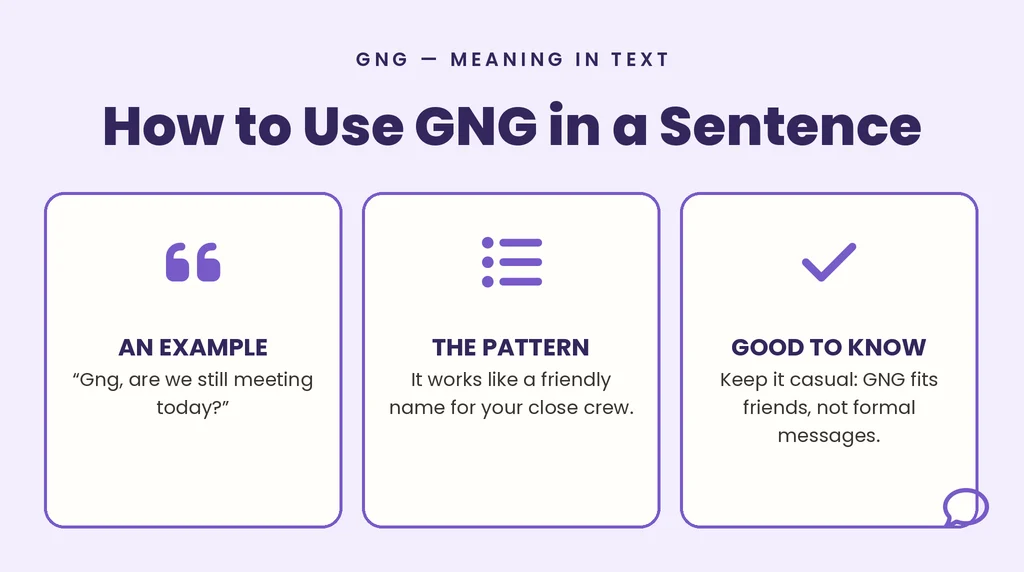
If you understand the meaning but aren’t sure how to use GNG yourself, start with the situations where you’d normally call someone “bro,” “fam,” or “friend.”
GNG usually works best in informal messages. You can place it at the beginning of a sentence to address someone, at the end to add a familiar tone, or inside a sentence when referring to your friend group.
Using GNG at the Beginning of a Message
Starting with GNG makes it clear that you’re addressing a person or group.
Examples:
- “Gng, are we still meeting today?”
- “Gng, you won’t believe what happened.”
- “Gng, send me the pictures.”
- “Gng, did you watch the match?”
- “Gng, I need your opinion.”
In each example, the word acts like a casual greeting or form of address. The main message follows immediately.
This structure works well in direct messages because it sounds conversational. However, you don’t need to include GNG in every message. Using it occasionally can feel more natural than adding it mechanically to every sentence.
Using GNG at the End of a Message
Placing GNG at the end can make a statement sound warmer, more playful, or more familiar.
Examples:
- “I’ll see you later, gng.”
- “You did a great job, gng.”
- “That’s hilarious, gng.”
- “Stay safe, gng.”
- “We made it, gng!”
In these sentences, GNG doesn’t change the basic meaning. Instead, it adds an informal social tone.
Compare “You did a great job” with “You did a great job, gng.” Both express praise. The second version sounds more like something a person might say to a familiar friend in a casual chat.
Using GNG to Refer to Your Friend Group
When you want to talk about your friends collectively, GNG can appear as a noun.
Examples:
- “I’m meeting the gng after work.”
- “The gng planned a surprise.”
- “My gng loves this restaurant.”
- “I haven’t seen the gng in weeks.”
- “The whole gng is coming over.”
Here, the term refers to the people rather than directly addressing one recipient.
This difference is useful when writing your own messages. If you’re speaking to a friend, GNG can function as a form of address. If you’re talking about your friends, it can refer to the group.
How to Use GNG Without Sounding Forced
Slang sounds natural when it fits the relationship and the situation. It can feel awkward when someone uses an expression they don’t understand or adds it to every sentence.
Follow these practical guidelines:
- Match the recipient’s style. If your friends regularly use GNG, it may fit your conversations.
- Keep the message clear. Don’t replace words that are necessary to understand your meaning.
- Use it in informal settings. Direct messages and casual group chats are usually better fits than formal emails.
- Avoid overusing it. Repeating the same slang word in every sentence can make your messages feel unnatural.
- Pay attention to the audience. A person unfamiliar with internet slang may not understand what you mean.
You don’t have to imitate every expression you see online. If “bro,” “friends,” or “everyone” feels more natural to you, those choices work just as well.
GNG Text Examples With Realistic Conversations
Short definitions help you recognize a term, but complete conversations show how it works in everyday communication. The examples below illustrate common uses without assuming that every person uses GNG identically.
These are illustrative conversations, not quotations from specific social media users.
Example: GNG as a Greeting
Alex: “Yo gng, what’s good?”
Jordan: “Not much. Just relaxing. You?”
Alex: “Same. You trying to go out later?”
Jordan: “Yeah, I’m down.”
What does GNG mean here?
Alex is using GNG as a casual way to address Jordan. The message could also begin with “bro” or “dude” without changing its basic purpose.
Example: GNG Referring to a Friend Group
Mia: “Did everyone get home safely?”
Sam: “Yeah, the whole gng made it.”
Mia: “Good. Last night was fun.”
Sam: “For real. We need to do that again.”
What does GNG mean here?
Sam is referring to the group of friends who went out together. GNG functions as a collective noun rather than a greeting.
Example: GNG as Encouragement
Chris: “I don’t think I did well on that presentation.”
Taylor: “You prepared for days. Don’t stress, gng.”
Chris: “I hope you’re right.”
Taylor: “You did your best. That’s what matters.”
What does GNG mean here?
Taylor uses GNG to make the reassurance feel personal and friendly. The supportive meaning comes from the whole message, not from the abbreviation alone.
Example: GNG in a TikTok Comment
Creator: Posts a video celebrating a personal achievement.
Commenter: “Big win for the gng 🔥”
What does GNG mean here?
The commenter is expressing excitement and may be including the creator’s friends, followers, or community in the celebration. The exact group depends on the video’s context.
Example: GNG in a Gaming Chat
Player 1: “Gng, ready for ranked?”
Player 2: “Give me two minutes.”
Player 3: “I’m already in the lobby.”
Player 1: “Bet. Let’s run it.”
What does GNG mean here?
The first player is addressing the other players as a familiar group. The gaming context makes “friends” or “teammates” a natural interpretation.
Example: GNG With a Possible Meaning of Going
Alex: “You leaving now?”
Jordan: “Yeah, I’m gng home.”
What does GNG mean here?
Jordan may be shortening “going” to explain that they’re heading home. This interpretation comes from the sentence structure. It’s less standard than using GNG to mean “gang,” so a reader should consider the sender’s usual typing style.
Example: GNG in a Friendly Compliment
Riley: “Finally finished the project!”
Morgan: “Let’s gooo, gng. Knew you could do it!”
What does GNG mean here?
Morgan is celebrating Riley’s achievement. The term reinforces a friendly tone, while the rest of the message expresses excitement and encouragement.
Example: GNG in a Group Plan
Ava: “Movie night on Friday?”
Noah: “I’m in.”
Ava: “I’ll ask the gng who else is coming.”
Noah: “Perfect. Let me know.”
What does GNG mean here?
Ava is using GNG to refer to the wider group of friends she plans to invite.
These examples demonstrate why context is more useful than memorizing a single definition. GNG can refer to one person, a group, or a possible alternative word depending on how the sender builds the sentence.
How to Reply When Someone Texts GNG
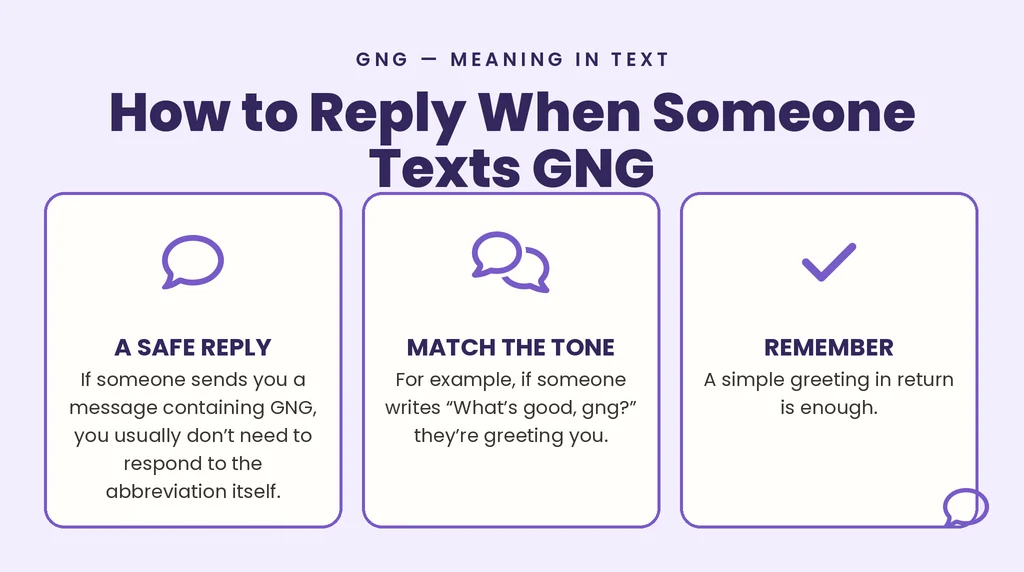
If someone sends you a message containing GNG, you usually don’t need to respond to the abbreviation itself. Focus on what the person is asking, sharing, or expressing.
For example, if someone writes “What’s good, gng?” they’re greeting you. A simple greeting in return is enough. If they write “You got this, gng,” you can acknowledge the encouragement.
Casual Replies to GNG
When someone uses GNG as a friendly greeting, keep your reply relaxed.
| Their message | Possible reply |
|---|---|
| “What’s good, gng?” | “Not much, what’s up?” |
| “Yo gng!” | “Yo! How you been?” |
| “You outside today, gng?” | “Maybe later. What’s the plan?” |
| “Gng, check this out.” | “Send it over!” |
| “Where you at, gng?” | “I’m at home right now.” |
These replies work because they address the actual message. There’s no need to repeat GNG just to prove you understand it.
Friendly Replies When Someone Shows Support
If a person uses GNG while encouraging you, acknowledge what they said.
Examples:
Message: “You got this, gng.”
Possible replies:
- “Appreciate you!”
- “Thanks, that means a lot.”
- “I’m going to give it my best.”
- “You already know!”
- “Thanks for having my back.”
Choose a response that fits your relationship. A brief thank-you is often enough.
Replies When Someone Mentions the GNG
If someone refers to a group, your reply should address the group or the plans being discussed.
Message: “The gng is meeting at 7.”
Possible replies:
- “Sounds good. I’ll be there.”
- “Who’s coming?”
- “Where are we meeting?”
- “I’ll check if I can make it.”
- “Let me know if the time changes.”
These replies show how understanding the sentence helps you respond naturally.
What If You Don’t Understand GNG?
It’s perfectly fine to ask. Slang changes across communities, and not everyone uses the same abbreviations.
You could write:
- “Wait, what does gng mean here?”
- “Do you mean gang?”
- “Is that your abbreviation for something?”
- “Just checking, are you talking about the group?”
A quick clarification is especially useful when the message affects plans or contains information you need to understand correctly.
You don’t need to know every internet abbreviation to communicate well. Reading the full sentence and asking when necessary will usually serve you better than guessing.
Is GNG Rude, Offensive, or a Positive Slang Term?
GNG is generally casual rather than inherently rude. When people use it to mean “gang,” they’re often referring to friends or a familiar group.
However, a word’s tone can change depending on the speaker, audience, and situation. A playful message between close friends may sound disrespectful when sent to someone who doesn’t welcome that style of communication.
Is GNG a Positive Word?
It can be positive when it appears in messages about friendship, support, shared experiences, or celebration.
Examples include:
- “Love my gng.”
- “Proud of the gng.”
- “The gng always comes through.”
- “Big win for the gng.”
- “Good times with the gng.”
In these sentences, the term expresses familiarity or group identity. The positive tone comes from the surrounding words and the situation.
Still, GNG isn’t automatically a compliment. A sentence such as “Gng, what are you doing?” might be neutral, surprised, or annoyed depending on the context.
Does GNG Refer to a Criminal Gang?
Not necessarily. The full English word “gang” can refer to a group of people, including a criminal organization, but casual slang frequently uses it to mean friends.
For example, “I’m going out with my gng” usually refers to a social group in an ordinary conversation. It doesn’t provide evidence that the group engages in criminal activity.
On the other hand, if a message discusses actual violence, organized crime, or criminal activity, the surrounding information deserves attention. The letters GNG alone cannot establish what kind of group someone means.
It’s important to distinguish the everyday slang use from the word’s other meanings. Interpreting the term in isolation can lead to unnecessary misunderstandings.
Can GNG Sound Disrespectful?
It can, depending on the recipient and the situation.
Some people enjoy casual slang, while others prefer being addressed by their name or with more neutral language. A term that feels friendly in one group may seem overly familiar in another.
Consider these situations:
- Close friend: GNG may sound natural and friendly.
- New acquaintance: It may sound casual, though the recipient may not understand it.
- Professional contact: The term may be too informal for the relationship.
- Formal communication: A neutral greeting or direct address is usually clearer.
The best approach is to match your language to the setting. You don’t need to avoid GNG altogether, but you should consider whether it suits the audience.
Is GNG Appropriate for School or Work?
In a private conversation with a friend from school or work, it may be perfectly fine. In a formal assignment, a professional email, or a message to a supervisor, standard language is generally a better choice.
For example:
Casual: “Gng, can you send me the notes?”
More neutral: “Hey, could you send me the notes when you have a chance?”
Both messages communicate the same request. The second is easier to understand across different audiences and doesn’t depend on familiarity with internet slang.
The distinction isn’t about banning informal language. It’s about choosing wording that helps the recipient understand you and take your message seriously when necessary.
GNG vs. Gang, Bro, Fam, Twin, GN, and GTG
Understanding similar slang terms can make online conversations easier to follow. Although GNG overlaps with several familiar expressions, these terms don’t all serve the same purpose.
GNG vs. Gang
GNG and gang are closely related because GNG is commonly used as a shortened spelling of gang.
The main difference is spelling. “Gang” is the standard English word, while “gng” is an informal version commonly seen in digital communication.
For example:
- “What’s up, gang?” uses the full word.
- “What’s up, gng?” uses the shortened spelling.
- “My gang is meeting tonight” uses the standard word as a noun.
- “My gng is meeting tonight” uses the informal spelling in the same position.
The intended meaning is usually similar. However, the full spelling is clearer for readers unfamiliar with internet slang.
GNG vs. Bro
Both GNG and bro can address a friend, but their typical emphasis differs.
Bro commonly addresses one person. GNG can address one person too, but it also frequently refers to a friend group.
| Feature | GNG | Bro |
|---|---|---|
| Common meaning | Gang, friend, or friend group | Brother or informal term for a friend |
| Can address one person? | Yes | Yes |
| Can refer to a group? | Yes | Less commonly; usually one person |
| Typical tone | Casual, familiar, sometimes playful | Casual, familiar, sometimes playful |
| Example | “What’s up, gng?” | “What’s up, bro?” |
For example, “Gng, we need to talk” and “Bro, we need to talk” can communicate a similar message. The choice often reflects the sender’s personal style.
Neither term guarantees that two people are close friends. People also use both expressions with acquaintances and online contacts.
GNG vs. Fam
Fam comes from “family,” but people often use it to refer to close friends or people they feel connected to.
GNG and fam can overlap when someone talks about their social circle. However, fam may place more emphasis on emotional closeness or a sense of belonging, depending on the speaker.
Consider these examples:
- “Love my gng.” This expresses affection for a group of friends.
- “Love my fam.” This may refer to relatives, close friends, or both.
- “What’s good, gng?” This casually addresses a friend or group.
- “What’s good, fam?” This serves a similar purpose.
The distinction isn’t absolute. Some people use the words interchangeably, while others attach different meanings to them.
GNG vs. Twin
In modern internet slang, twin can describe a close friend or someone who shares your personality, interests, or way of thinking.
For example:
“You already know what I’m thinking, twin.”
The speaker is highlighting a sense of similarity or connection.
Compare that with:
“What’s the plan, gng?”
Here, GNG is a casual address. It doesn’t necessarily suggest that the two people think alike.
Both expressions can communicate familiarity, but twin may emphasize a shared connection, while GNG often refers to a friend or group.
GNG vs. GN
GN commonly means “good night.” GNG usually means “gang” in casual slang.
This one-letter difference can change the meaning of a message.
- “GN, talk tomorrow.” The sender is saying good night.
- “What’s up, gng?” The sender is addressing a friend.
- “GN, gng.” The sender may be saying good night to a friend or group.
The last example contains both expressions. GN communicates the farewell, while GNG identifies the recipient.
GNG vs. GTG
GTG commonly means “got to go.” It signals that someone needs to leave a conversation or attend to something else.
GNG generally functions as a noun or form of address. GTG, by contrast, communicates that the sender is leaving.
For example:
“GTG, gng. Talk later!”
The sender is saying they need to go and addressing the other person as a friend. Both abbreviations appear in the same message, but each has a different role.
GNG vs. Other Common Texting Abbreviations
GNG belongs to a much larger collection of informal expressions used in online conversations. Learning a few common abbreviations can help you interpret messages without confusing their meanings.
| Term | Common meaning | Example |
|---|---|---|
| GNG | Gang; friend or friend group | “What’s up, gng?” |
| BFF | Best friends forever | “She’s my BFF.” |
| BRB | Be right back | “BRB, getting food.” |
| BTW | By the way | “BTW, I sent the file.” |
| IDK | I don’t know | “IDK what time it starts.” |
| IMO | In my opinion | “IMO, this one is better.” |
| LOL | Laughing out loud | “LOL, that’s funny.” |
| NGL | Not gonna lie | “NGL, I liked the movie.” |
| RN | Right now | “I’m busy rn.” |
| TBH | To be honest | “TBH, that was impressive.” |
| TTYL | Talk to you later | “I have to go. TTYL.” |
| GTG | Got to go | “GTG, see you later.” |
| GN | Good night | “GN, everyone.” |
These terms are not interchangeable. GNG typically identifies a person or group, while many of the others communicate a reaction, a time, a departure, or an opinion.
The simplest way to understand texting abbreviations is to identify what role each term plays in the sentence. That makes the meaning easier to recognize even when you haven’t seen the expression before.
How to Understand GNG When the Context Is Unclear
Sometimes, a message doesn’t provide enough information to determine the meaning immediately. This happens frequently with abbreviations because people often leave out punctuation, vowels, and other details when texting.
Instead of guessing, use the surrounding conversation to narrow down the possibilities.
Read the Words Around GNG
The grammar of a sentence often provides the strongest clue.
Compare these messages:
“What’s good, gng?”
The expression appears after a greeting. It most likely addresses a friend.
“I’m gng to the store.”
The letters appear where a verb would normally go. The writer may intend “going.”
“My gng is here.”
The term appears after a possessive word and before a verb. It likely refers to a group of friends.
These examples demonstrate how sentence structure can help you interpret a short expression. You don’t need to rely on the letters alone.
Consider the Sender’s Usual Style
People develop personal texting habits. One person may shorten many words, while another writes almost everything in full.
If your friend regularly uses GNG to address you, the meaning is easier to identify when it appears again. If the person rarely uses slang, you may need to examine the sentence more carefully.
The sender’s previous messages can provide helpful clues, but don’t assume that every new use must have the same meaning. A person can use the same letters differently in separate contexts.
Look at the Conversation Topic
The topic can help distinguish a casual address from a less common interpretation.
For example:
- Friendship discussion: GNG likely refers to friends or a group.
- Gaming conversation: It may refer to teammates or an online crew.
- Plans and travel: The sentence may help determine whether the writer means “gang” or has shortened “going.”
- A private group discussion: It might refer to an inside joke or a group-specific label.
These are clues, not rigid rules. The actual wording still matters.
Ask for Clarification When Necessary
If you still can’t interpret the message, ask a direct question.
A short reply such as “What do you mean by gng here?” is usually enough. You don’t need to make the exchange awkward or apologize for not recognizing an abbreviation.
Clear communication is more useful than pretending to understand slang. Most people can explain what they meant in a few words.
Why GNG and Other Internet Slang Keep Changing
Internet slang evolves because people adapt language to their social environments. A word can begin in a small community, spread through online conversations, and eventually become familiar to people who never belonged to the original group.
GNG illustrates how spelling, context, and social relationships can shape an expression’s meaning.
Shorter Words Fit Fast Conversations
Texting encourages people to communicate quickly. Although modern keyboards make typing easier than it once was, abbreviated expressions remain popular because they can feel informal and familiar.
For example, someone might write “What’s up, gng?” rather than “Hello, my friend. How are you doing today?”
The shorter message fits the tone of a quick conversation. It doesn’t necessarily save a meaningful amount of time, but it signals an informal style.
Social Media Helps Expressions Travel
People encounter slang through comments, short videos, captions, livestreams, and group chats. They may adopt a term after seeing it repeatedly in situations they understand.
However, seeing an expression on TikTok doesn’t mean TikTok created it. Platforms help slang spread, but the origin of a term may be older, community-specific, or difficult to trace.
It’s also worth distinguishing popularity from universal understanding. An expression may be familiar in one group and confusing in another.
Slang Can Signal Group Identity
Shared language can help people feel connected. Friends may use the same expressions, shorten words in similar ways, or develop private jokes that outsiders don’t immediately understand.
GNG can play this role when people use it to refer to their friends or address their circle.
Still, slang alone doesn’t establish membership in a group. Someone can learn a term from public posts without knowing the people who use it. Familiarity with an expression isn’t the same as belonging to the community where it appears.
Slang Changes With Context and Personal Preference
There is no central authority that decides how every online abbreviation must be used. People create new shorthand, reuse existing terms, and assign private meanings to familiar letters.
As a result, two users might interpret the same abbreviation differently. One may recognize GNG immediately as “gang,” while another may need to see the complete sentence.
This flexibility is normal in informal communication. It also explains why definitions should distinguish common usage from less established interpretations.
A useful rule: Learn the most common meaning first, then use context to interpret unusual examples.
Frequently Asked Questions
What does GNG mean in text messages?
GNG usually means “gang” in text messages. People use it to address a friend, refer to a group of friends, or communicate with a familiar online community. For example, “What’s up, gng?” is a casual way to greet someone. The surrounding sentence can help clarify less common uses.
What does GNG stand for in texting?
In common texting slang, GNG is a shortened spelling of “gang,” with the vowels removed. It isn’t normally an acronym formed from three separate words. Some people may create their own expansions for the letters in private conversations, but those meanings aren’t universal.
What does GNG mean on TikTok?
On TikTok, GNG usually means “gang” and may refer to friends, followers, or a familiar group. You might see it in comments, captions, or replies such as “Big win for the gng.” The platform doesn’t give the abbreviation a separate, fixed meaning.
What does GNG mean on Snapchat?
On Snapchat, GNG commonly refers to a friend or friend group. It can appear in direct messages, Story replies, and group chats. For example, “You coming with the gng?” probably means “Are you coming with the group?” Don’t confuse GNG with GN, which commonly means “good night.”
Does GNG mean gang or going?
GNG most commonly means “gang” when used as casual internet slang. In some messages, it may represent “going” if the sentence supports that interpretation. For instance, “I’m gng home” may mean “I’m going home.” Because this spelling isn’t standard, context is essential.
What does GNG mean when a guy or girl says it to you?
It usually means the person is addressing you as a friend or using familiar slang. The term alone doesn’t establish romantic interest, emotional closeness, or a special relationship. Consider the full conversation and the person’s behavior before drawing conclusions about their intentions.
Is GNG the same as bro or fam?
Not exactly, although the meanings overlap. Bro usually addresses one person, while fam can refer to family or close friends. GNG commonly refers to a friend or friend group and can also address one person. People sometimes use all three expressions in similar situations.
Is GNG appropriate to use with anyone?
GNG is generally suitable for informal conversations with friends or familiar online contacts. It may be confusing or too casual in professional emails, academic writing, or formal discussions. If you don’t know whether someone understands the term, use clearer wording or ask whether they’re familiar with the slang.
Conclusion:
The GNG meaning in text is usually “gang,” an informal term for a friend, a group of friends, or a familiar social circle. You’ll often encounter it in text messages, TikTok comments, Snapchat chats, Instagram posts, and gaming conversations. It can work as a greeting, a casual form of address, or a way to describe a group.
The most important detail is context. GNG doesn’t automatically imply criminal activity, romantic interest, or a particular relationship. Although some people may use it for other purposes, “gang” remains the main slang interpretation. Once you recognize how the letters fit into a sentence, understanding GNG and using it naturally becomes much easier.