Imagine you’re chatting with a friend about a movie when they write, “IMO, the original was much better.” You understand the sentence, but those three letters might leave you wondering what they mean. The answer is simple: IMO stands for “in my opinion.” People use it in text messages, social media comments, group chats, and online discussions to share their personal views without typing the full phrase.
The IMO meaning in text is straightforward, but the way people use it can depend on the conversation. Sometimes it introduces a friendly recommendation. Other times, it softens a disagreement or signals that a statement reflects personal taste rather than an established fact. Once you understand its meaning and tone, you’ll recognize it easily on WhatsApp, Snapchat, Instagram, and other messaging platforms. This guide explains the definition, real-life examples, related abbreviations, and the best ways to use or respond to IMO naturally.
What Does IMO Mean in Text?

IMO means “in my opinion.” It’s a common internet abbreviation that people use when expressing a personal view, preference, belief, or judgment.
For example, someone might text:
IMO, this restaurant serves the best pizza in town.
The sender isn’t necessarily claiming that everyone agrees. They’re sharing their own preference. Another person might prefer a different restaurant, and both opinions can be valid.
People use IMO because it saves time and makes the purpose of a statement clearer. Instead of typing “I personally think this is the best option,” someone can write “IMO, this is the best option.”
You’ll often see the abbreviation in:
- Text messages between friends and family
- Group chats and instant messaging apps
- Instagram comments and social media discussions
- Online gaming conversations
- Reddit threads and discussion forums
- Informal workplace messages
The abbreviation works in many settings because it communicates a simple idea: the statement represents the sender’s point of view.
What Does IMO Stand For?
IMO stands for In My Opinion. Each letter represents a word in the original phrase.
| Letter | Word | Meaning |
|---|---|---|
| I | In | Introduces the expression |
| M | My | Refers to the speaker |
| O | Opinion | A personal view or judgment |
Together, the letters form a short expression that signals an opinion.
Consider this message:
“I’m not sure about the new design. IMO, the previous version looked cleaner.”
The sender uses IMO to distinguish a personal design preference from an objective statement. The new design might work well for other people, but the sender prefers the previous version.
What Is the IMO Definition in English?
In English, an opinion is a belief or judgment that someone holds about a subject. It may come from personal experience, taste, knowledge, or interpretation.
IMO introduces that kind of statement in written communication. It doesn’t automatically prove that the opinion is correct, and it doesn’t mean the sender lacks confidence.
For instance:
- “IMO, summer is better than winter.” This expresses a personal preference.
- “IMO, the second plan is more practical.” This presents a judgment about two options.
- “IMO, you should apologize.” This offers advice based on the sender’s perspective.
In each case, the abbreviation tells the reader how to interpret the statement. The sender is presenting a view rather than simply announcing a universally accepted fact.
Is IMO Slang or an Acronym?
People often describe IMO as internet slang, but initialism is the more precise linguistic term.
An initialism uses the first letters of a series of words and pronounces them individually. IMO is generally read as three separate letters rather than as a single word.
In everyday conversations, however, you don’t need to worry about the technical label. Calling IMO a texting abbreviation, internet abbreviation, or chat initialism communicates the idea clearly.
It belongs to the same broad family of online expressions as TBH, FYI, and IMHO. These abbreviations make digital conversations quicker and help writers communicate familiar ideas with fewer characters.
How Is IMO Used in Text Messages?
The most common purpose of IMO is to introduce a personal opinion. However, the expression can serve several conversational functions depending on what follows it.
IMO for Sharing Personal Opinions
People frequently use IMO when discussing topics that don’t have one universally accepted answer.
Examples include music, movies, fashion, food, hobbies, and everyday preferences.
Example:
Alex: Which album do you like more?
Jordan: IMO, the second album has better songs.
Jordan isn’t presenting a measurable fact. They’re explaining a personal preference and leaving room for Alex to disagree.
IMO for Giving Advice
IMO can also introduce a suggestion when someone asks for help or guidance.
Example:
Friend: Should I buy the cheaper laptop or save for the expensive one?
You: IMO, save for the better one if you’ll use it for work every day.
Here, the abbreviation signals that the recommendation comes from your judgment. It doesn’t guarantee that the advice will suit every budget or situation.
IMO for Agreeing or Disagreeing
Online discussions often involve different opinions. IMO can help someone explain their position without making the conversation sound like a contest over who is right.
For example:
IMO, the sequel was entertaining, but the original had a stronger story.
This message disagrees with people who prefer the sequel while acknowledging that it has positive qualities.
However, IMO doesn’t automatically make a disagreement polite. The words that follow it still matter.
Compare these messages:
- “IMO, your idea needs a little more planning.”
- “IMO, your idea is terrible.”
Both express opinions, but the second sounds much harsher. The abbreviation doesn’t remove the sting of insulting language.
IMO for Making Recommendations
You can use IMO to recommend a product, place, activity, or course of action.
Examples:
- “IMO, these headphones offer better value.”
- “IMO, you should visit the museum early.”
- “IMO, the blue design looks better.”
- “IMO, this explanation makes more sense.”
These messages share a personal judgment without pretending the recommendation is right for everyone.
Why Do People Use IMO in Messages?
The abbreviation serves several useful purposes:
- Saves time: Three letters replace a longer phrase.
- Clarifies tone: Readers know the sender is sharing a personal view.
- Encourages discussion: It leaves room for other people to offer different perspectives.
- Softens some statements: It can make a suggestion sound less like a command.
- Fits informal communication: It feels natural in short messages and online comments.
The key is to use it when it adds clarity. If every sentence starts with IMO, the writing can become repetitive and less natural.
IMO Meaning in Chat, WhatsApp, Snapchat, and Instagram
The IMO meaning in chat generally remains the same across platforms: in my opinion. WhatsApp, Snapchat, and Instagram don’t assign the abbreviation separate standard meanings.
The difference comes from the setting, the people involved, and the subject of the conversation.
IMO Meaning on WhatsApp
On WhatsApp, people commonly use IMO in private messages, family group chats, and conversations with friends.
For example:
Sam: Should we book the restaurant for Friday?
Mia: IMO, Saturday would be better because everyone has more free time.
Mia uses IMO to explain her preference. She isn’t giving an official decision or demanding that the group follow her suggestion.
The abbreviation also works when discussing shopping, travel, entertainment, and everyday plans.
Example: “IMO, we should leave early to avoid traffic.”
In a casual WhatsApp conversation, the full phrase “in my opinion” would work just as well. IMO simply makes the message shorter.
IMO Meaning on Snapchat
On Snapchat, IMO can appear in direct messages, replies, and conversations about photos, videos, trends, or personal preferences.
For example:
Friend: Which outfit looks better?
You: IMO, the black one looks more stylish.
The sender shares a preference without turning the choice into a serious debate.
Context matters here, too. If someone asks for your honest view, IMO can introduce your answer. It doesn’t necessarily imply romantic interest, annoyance, sarcasm, or any hidden message.
IMO Meaning on Instagram
On Instagram, users may write IMO in comments, direct messages, and discussions about creators, products, entertainment, or current trends.
Examples include:
- “IMO, this is the creator’s best video.”
- “IMO, the older collection had better designs.”
- “IMO, this recipe needs less sugar.”
The abbreviation lets people state a position without repeatedly typing “in my opinion.”
In public comment sections, however, the surrounding discussion can affect how the statement sounds. A calm observation may invite discussion, while a harsh opinion may start an argument.
IMO Meaning on TikTok and Other Social Platforms
The same general definition applies on TikTok, Reddit, Discord, and other online communities.
A user might write, “IMO, the original version was funnier,” beneath a comedy clip. Someone in a gaming server might say, “IMO, the update made the game harder.”
These examples show why IMO works across different platforms. The topic changes, but the basic function stays consistent: it introduces a personal perspective.
How to Use IMO in a Sentence
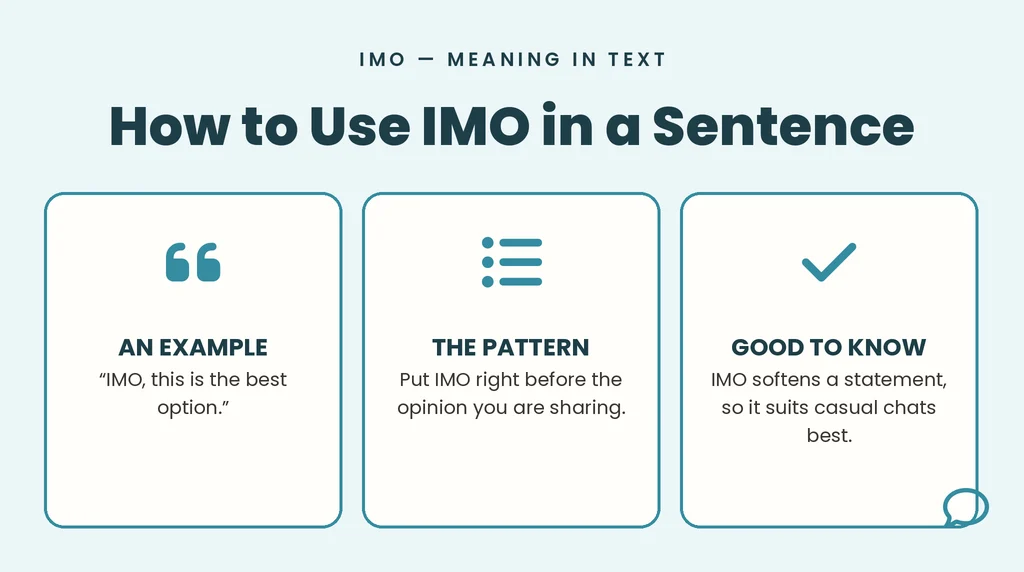
Using IMO is easy once you understand where it fits. In most casual messages, it appears at the beginning or end of a sentence. You can also place it in the middle when the sentence flows naturally.
IMO at the Beginning of a Sentence
Starting with IMO is one of the clearest ways to introduce a personal opinion. It tells the reader how to interpret the statement before they finish reading it.
Examples:
- “IMO, this is the best option.”
- “IMO, we should leave early.”
- “IMO, the second idea works better.”
- “IMO, honesty is always important.”
- “IMO, this movie deserves more attention.”
Notice that a comma usually follows IMO when it begins a sentence. This punctuation helps separate the introductory expression from the main statement.
IMO at the End of a Sentence
You can also put IMO at the end of a sentence. This placement often feels natural in casual messages because the sender states the opinion first and adds the abbreviation afterward.
Examples:
- “That restaurant is overrated, IMO.”
- “The blue design looks better, IMO.”
- “The original game was more fun, IMO.”
- “This is the easiest solution, IMO.”
The meaning doesn’t change simply because IMO appears at the end. The difference is mostly stylistic.
IMO in the Middle of a Sentence
IMO can appear within a longer sentence, although beginning or ending placement is often simpler.
Examples:
- “The new update is, IMO, a major improvement.”
- “This is IMO the most practical solution for our team.”
The first example uses commas around the inserted expression. The second reflects informal online writing, where punctuation may be less strict.
For polished writing, choose the placement that makes your sentence easiest to read. You don’t need to force the abbreviation into every message.
IMO Meaning in Texting With Examples
Sometimes the easiest way to understand a texting abbreviation is to see how people use it in real situations. The following examples cover common conversations and show what IMO communicates in each one.
| Situation | Text message | What it means |
|---|---|---|
| Movies | “IMO, this movie is amazing.” | The sender really likes the movie. |
| Advice | “IMO, you should try again.” | The sender recommends another attempt. |
| Shopping | “IMO, this is the best option.” | The sender prefers this choice. |
| School | “IMO, the second explanation is clearer.” | The sender finds the second explanation easier to understand. |
| Friendship | “IMO, you handled that situation well.” | The sender believes the person responded appropriately. |
| Gaming | “IMO, this game is overrated.” | The sender thinks the game receives more praise than it deserves. |
| Fashion | “IMO, the blue design looks better.” | The sender prefers the blue design. |
| Work | “IMO, we need more time to finish.” | The sender believes the deadline needs reconsideration. |
| Travel | “IMO, the mountains are worth visiting.” | The sender recommends visiting the mountains. |
| Food | “IMO, homemade pizza tastes better.” | The sender prefers homemade pizza. |
| Technology | “IMO, the older phone was easier to use.” | The sender prefers the older phone’s usability. |
| Online debate | “IMO, both sides make fair points.” | The sender sees merit in both arguments. |
These examples illustrate an important distinction: IMO introduces the sender’s judgment, but it doesn’t tell you how strongly they feel about it. Someone can use IMO for a casual preference or a deeply held belief.
Short IMO Text Examples
Here are some quick examples you can use to understand the abbreviation in everyday conversations.
- “IMO, that’s a great idea.”
- “Looks good to me, IMO.”
- “IMO, you’re right.”
- “That song is underrated, IMO.”
- “IMO, we should wait.”
- “This one works better, IMO.”
Each message communicates a personal view without needing a lengthy explanation.
Funny and Casual IMO Examples
IMO can also appear in humorous messages. The humor comes from the statement itself rather than the abbreviation.
- “IMO, Monday should come with a warning label.”
- “IMO, five more minutes of sleep can solve almost anything.”
- “IMO, snacks taste better when they’re someone else’s.”
- “IMO, choosing what to watch is harder than watching the actual movie.”
- “IMO, a weekend needs at least one extra day.”
These examples work because IMO introduces an exaggerated personal preference. Friends can recognize the playful tone without taking the statement literally.
IMO Examples in Conversations
Short conversations offer more context than isolated sentences. They show how IMO fits into a natural exchange.
Example: Choosing a movie
Taylor: Which one should we watch tonight?
Morgan: IMO, the comedy looks more entertaining.
Taylor: Good call. Let’s try that one.
Morgan offers a recommendation without acting as though the choice is final.
Example: Discussing a purchase
Chris: Should I buy the cheaper headphones?
Jamie: IMO, check the sound quality first. A lower price isn’t always a better deal.
Jamie uses IMO to introduce advice. The reasoning that follows makes the suggestion more useful.
Example: Friendly disagreement
Avery: I think the sequel was better.
Riley: IMO, the original had a stronger story, but the sequel was fun too.
Riley disagrees without dismissing Avery’s preference.
IMO vs. IMHO: What Is the Difference?
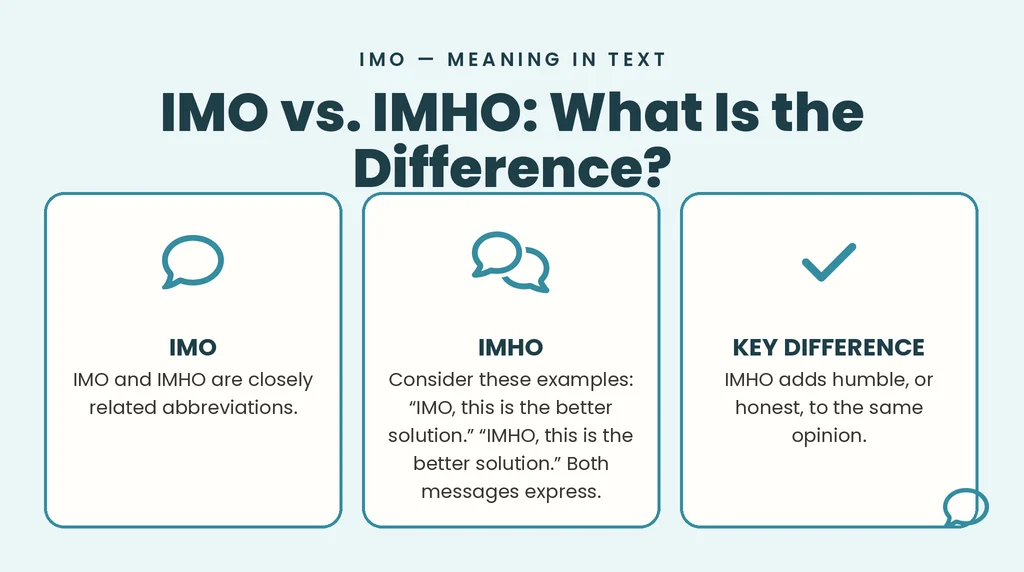
IMO and IMHO are closely related abbreviations. Both introduce a personal view, but IMHO adds another word and can carry a slightly different tone.
- IMO: In My Opinion
- IMHO: In My Humble Opinion
IMHO is also commonly expanded as “In My Honest Opinion.” The intended meaning depends on the person and context.
Consider these examples:
- “IMO, this is the better solution.”
- “IMHO, this is the better solution.”
Both messages express a preference. The second may sound more modest or self-conscious because of the word “humble.” However, some people use IMHO casually or sarcastically, so the tone isn’t guaranteed.
| Feature | IMO | IMHO |
|---|---|---|
| Full form | In My Opinion | In My Humble Opinion |
| Alternative expansion | No common alternative needed | In My Honest Opinion |
| Main purpose | Introduces a personal view | Introduces a personal view with added nuance |
| Typical tone | Neutral and informal | Informal, sometimes modest or playful |
| Best use | Everyday opinions and recommendations | Opinions where the writer wants to add a particular tone |
Which one should you use? IMO is the straightforward choice when you simply want to express your view. IMHO works when it fits your personal writing style, but you don’t need the extra letter to make an opinion understandable.
Neither abbreviation automatically makes a statement polite, accurate, or humble. The actual wording matters more.
IMO vs. TBH: Understanding the Difference
TBH stands for “to be honest.” People use it to introduce a candid thought, an honest assessment, or a statement they want to emphasize as frank.
IMO and TBH can appear in similar conversations, but they focus on different things.
For example:
- “IMO, this restaurant has the best desserts.” The sender expresses a preference.
- “TBH, I didn’t enjoy the desserts.” The sender emphasizes an honest reaction.
The first sentence highlights the speaker’s point of view. The second highlights candor.
Here’s a quick comparison:
| Abbreviation | Full form | Main purpose | Example |
|---|---|---|---|
| IMO | In My Opinion | Expressing a personal view | “IMO, this design looks better.” |
| IMHO | In My Humble Opinion | Expressing a view with added nuance | “IMHO, the first plan is safer.” |
| TBH | To Be Honest | Introducing a candid statement | “TBH, I didn’t like the ending.” |
| NGL | Not Gonna Lie | Introducing a frank or emphatic remark | “NGL, that was impressive.” |
| IME | In My Experience | Drawing on personal experience | “IME, this route gets busy early.” |
| FYI | For Your Information | Sharing information someone may need | “FYI, the meeting starts at nine.” |
| AFAIK | As Far As I Know | Qualifying a statement based on current knowledge | “AFAIK, the store closes at six.” |
| TBF | To Be Fair | Adding balance or acknowledging another side | “TBF, they had very little time.” |
| IIRC | If I Recall Correctly | Signaling uncertainty about a memory | “IIRC, we met last summer.” |
| WDYT | What Do You Think? | Asking someone for their opinion | “WDYT about this design?” |
| POV | Point of View | Describing a perspective or viewpoint | “That’s an interesting POV.” |
The key distinction is simple: IMO identifies a personal opinion, while TBH emphasizes honesty or frankness. They sometimes appear together, but they aren’t interchangeable in every sentence.
Is IMO Rude or Disrespectful?
Generally, no. IMO is a neutral, informal abbreviation. People use it to express preferences, offer advice, and share thoughts without implying that others must agree.
However, context can change how a message feels.
Compare these examples:
Constructive:
“IMO, the presentation would be stronger with fewer slides.”
Dismissive:
“IMO, your presentation was a complete waste of time.”
Both messages express opinions. The first offers a specific suggestion, while the second attacks the work without providing useful feedback.
The abbreviation doesn’t make an insult acceptable. If you want to disagree respectfully, explain your reasoning and acknowledge that someone else may see things differently.
For example:
IMO, the other option might work better because it’s simpler to maintain. I can see why you prefer this one, though.
This message states a preference and gives a reason without dismissing the other person’s view.
Does IMO Sound Passive-Aggressive?
Not by itself. Passive-aggressive communication usually involves indirect hostility, sarcasm, or a mismatch between the literal words and the intended message.
Someone might write, “IMO, you should learn how to do your job,” in a sarcastic or insulting conversation. Another person might write, “IMO, we should review the instructions together,” as a sincere suggestion.
The abbreviation is identical, but the intent differs.
If a message seems hostile, look at the full sentence, the conversation’s history, and the relationship between the people involved. Don’t assume that IMO carries a hidden meaning on its own.
IMO Meaning in Text From a Girl or a Guy
The abbreviation IMO means “in my opinion” regardless of who sends it. It doesn’t have a standard gender-specific meaning.
If a girl texts, “IMO, that movie was amazing,” she’s expressing her opinion about the movie. If a guy sends the same message, the meaning remains unchanged.
The surrounding conversation may reveal additional intent, but the abbreviation alone doesn’t establish it.
For example:
- “IMO, that outfit looks great.” This expresses a positive opinion.
- “IMO, you made the right decision.” This offers reassurance or agreement.
- “IMO, we should talk about this.” This suggests a conversation.
- “IMO, that was a bad idea.” This communicates a negative judgment.
None of these messages automatically signals flirting, anger, romantic interest, or rejection.
If you’re trying to understand someone’s intention, pay attention to the actual words, the situation, and how they communicate with you over time. Reading too much into three letters can lead to unnecessary misunderstandings.
Is IMO Formal or Informal?
IMO is primarily an informal abbreviation. It fits naturally into text messages, online discussions, social media comments, and casual workplace chats.
It’s less suitable for formal academic writing, official reports, business proposals, and professional documents where a more polished style is expected.
When IMO Works Well
Use IMO when you’re communicating with people who understand common texting abbreviations.
Examples include:
- “IMO, we should start the meeting earlier.”
- “IMO, this version is easier to navigate.”
- “IMO, the second proposal offers better value.”
- “IMO, we need another day to test the changes.”
These messages are reasonable in an informal team chat. The abbreviation keeps the wording concise without making the meaning unclear.
When to Write “In My Opinion” Instead
In a formal email or report, spelling out the phrase often sounds more professional.
Instead of:
“IMO, the new process will save time.”
Write:
“In my opinion, the new process will save time.”
For a more evidence-focused report, you might write:
“The new process may reduce the time required to complete this task.”
That last version can be even stronger when the document needs to explain an assessment rather than simply announce a personal preference.
Remember that formal writing doesn’t require removing every personal opinion. It requires presenting your reasoning clearly and supporting important claims with appropriate evidence.
When Should You Use IMO in Texting?
Use IMO when you want to make it clear that you’re sharing your perspective rather than stating an unquestionable fact.
It can be especially helpful in conversations involving preferences, recommendations, interpretations, or disagreements.
Good Situations for Using IMO
Sharing preferences: “IMO, the blue version looks cleaner.”
Offering suggestions: “IMO, we should review the plan before Friday.”
Discussing entertainment: “IMO, the first season was the strongest.”
Giving friendly advice: “IMO, you should ask for clarification before deciding.”
Joining an online debate: “IMO, both arguments raise important points.”
In each example, the abbreviation helps frame the statement as a personal judgment.
When IMO Isn’t Necessary
You don’t need to add IMO to every sentence. Sometimes the personal nature of a statement is already clear.
For example, “I prefer the blue version” communicates a preference without any abbreviation.
Likewise, “I think we should leave early” already signals that you’re expressing a view.
Using IMO repeatedly can make your writing sound hesitant or cluttered. Choose it when it improves clarity or matches the tone of the conversation.
Does Adding IMO Make a Claim True?
No. IMO identifies an opinion; it doesn’t provide evidence.
For example, writing “IMO, this medicine is completely safe for everyone” doesn’t make the claim reliable. Safety depends on evidence and individual circumstances, not the writer’s confidence.
Similarly, an opinion about a product’s quality may be useful, but it doesn’t replace verified specifications or independent testing.
A good rule is to use IMO for genuine preferences and judgments. For factual claims, rely on accurate information and explain the evidence when necessary.
Is IMO Still Used in Texting?
IMO remains a recognizable abbreviation in internet communication. It appears in casual messages, comments, online discussions, and other settings where people express opinions quickly.
Its appeal is practical. The abbreviation is short, easy to type, and widely understandable to people familiar with online English.
However, people don’t all write the same way. Some prefer IMO, while others use phrases such as “I think,” “personally,” or “in my view.” Others skip the introduction entirely and state their opinion directly.
You may also see lowercase forms such as “imo.” In casual digital communication, capitalization usually doesn’t change the intended meaning.
There’s no need to force the abbreviation into every conversation just because it’s common. Use the version that feels natural for your audience.
What Does IMO Mean Outside Texting?
Although “in my opinion” is the usual interpretation in text messages, the same initials can represent other names in specialized contexts.
One important example is the International Maritime Organization, a United Nations specialized agency concerned with international shipping safety, security, and the prevention of marine pollution from ships.
In a conversation about maritime regulations, shipping routes, or international maritime policy, IMO may refer to that organization rather than the texting abbreviation.
Compare these two examples:
- “IMO, we should choose the earlier flight.” Here, IMO means “in my opinion.”
- “The IMO develops international standards for shipping.” Here, IMO refers to the International Maritime Organization.
The surrounding words make the intended meaning clear.
In ordinary conversations about relationships, movies, shopping, or everyday plans, you can generally interpret IMO as “in my opinion.” You only need to consider specialized meanings when the subject calls for them.
How to Reply When Someone Says IMO
You don’t need a special response whenever someone uses IMO. Reply to the actual opinion or question, just as you would in a conversation without abbreviations.
Your response might agree, disagree, ask for clarification, or acknowledge the person’s perspective.
Replies When You Agree
If you share the same view, keep your response simple.
- “I agree!”
- “Same here.”
- “That’s what I think, too.”
- “Exactly. I had the same thought.”
- “Good point. That makes sense.”
Example:
Friend: IMO, the original movie was better.
You: Same here! The story felt more natural.
The reply acknowledges the opinion and adds a reason for agreement.
Replies When You Disagree
You can disagree without turning the conversation into an argument.
- “I see your point, but I prefer the sequel.”
- “Fair enough. I look at it differently.”
- “Interesting take. Here’s how I see it.”
- “I get what you mean, but I disagree.”
- “That’s understandable. I think the other option works better.”
Example:
Friend: IMO, the new design looks better.
You: I see your point, but I prefer the simpler version.
This response expresses a different preference without treating the other person’s opinion as foolish.
Replies When Someone Gives Advice
When IMO introduces advice, acknowledge the suggestion and decide whether it fits your situation.
- “Thanks for your opinion.”
- “That’s a good point. I’ll think about it.”
- “I appreciate the suggestion.”
- “That might work. Let me consider it.”
- “Thanks! I’ll keep that in mind.”
You don’t have to follow someone’s advice simply because they express it confidently. Consider the reasoning and how well it applies to your circumstances.
Replies When You Want More Information
Sometimes an opinion needs an explanation.
Try these responses:
- “What makes you think that?”
- “Can you explain why?”
- “Interesting. What’s your main reason?”
- “Which part do you think works better?”
- “What would you change?”
These questions encourage a useful conversation rather than a simple exchange of opposing statements.
Should IMO Be Capitalized?
Both IMO and imo are common in digital communication. The capitalization usually doesn’t change the meaning.
For example:
- “IMO, this is the better choice.”
- “imo this is the better choice”
Both messages are generally understood as “in my opinion.” The first follows standard capitalization and punctuation more closely, while the second uses a relaxed texting style.
In formal writing, it’s better to avoid the abbreviation and write out “in my opinion” when appropriate.
If you’re writing an article or professional document, consistent capitalization and standard punctuation will make the text easier to read.
Frequently Asked Questions
What does IMO mean in text messages?
IMO means “in my opinion.” People use it to introduce a personal view, preference, judgment, or recommendation in text messages and online conversations.
What does IMO stand for in texting slang?
IMO stands for “In My Opinion.” Although people often call it texting slang, it’s more precisely an internet abbreviation or initialism.
What does IMO mean on WhatsApp?
On WhatsApp, IMO usually means “in my opinion.” People use it in private messages and group chats to share thoughts, offer advice, or discuss different preferences.
What does IMO mean on Snapchat?
IMO has the same standard meaning on Snapchat: “in my opinion.” It may appear in direct messages or conversations about photos, videos, trends, and everyday topics.
What does IMO mean on Instagram?
On Instagram, IMO generally means “in my opinion.” Users may include it in comments, direct messages, and discussions to introduce a personal judgment.
What does IMO mean from a girl or a guy?
The meaning doesn’t change based on the sender’s gender. IMO means “in my opinion” regardless of who uses it. The surrounding message provides any additional context.
Is IMO the same as I think?
They communicate similar ideas, but they’re not identical in form. IMO means “in my opinion,” while “I think” is a direct phrase that expresses a thought or belief. Both can introduce a personal view.
What is the difference between IMO and IMHO?
IMO means “in my opinion.” IMHO usually means “in my humble opinion” and sometimes “in my honest opinion.” Both introduce personal views, but IMHO adds a possible nuance of modesty or candor.
What is the difference between IMO and TBH?
IMO introduces a personal opinion, while TBH means “to be honest” and emphasizes a candid statement. For example, “IMO, the film was great” expresses a judgment, while “TBH, I didn’t enjoy the film” emphasizes an honest reaction.
Is IMO rude or disrespectful?
No, IMO isn’t inherently rude. It’s a neutral abbreviation. However, the rest of the message can sound dismissive or insulting, so context and word choice matter.
Can I use IMO in a professional email?
You can use IMO in informal workplace chats when the tone allows it. For formal emails, reports, and proposals, writing “in my opinion” or presenting a reasoned assessment is generally more appropriate.
How do you reply when someone says IMO?
Respond to the person’s actual statement. You can agree, disagree politely, acknowledge their point, or ask for more information. For example, “I see your point, but I prefer the other option.”
Should IMO be capitalized in a text?
IMO and imo are both commonly understood. Capitalization usually doesn’t affect the meaning, although uppercase IMO is a clear choice for polished writing.
What does IMO mean at the end of a sentence?
It still means “in my opinion.” For example, “That was the best episode, IMO” communicates the same basic idea as “IMO, that was the best episode.”
Is IMO still used in texting?
Yes, IMO remains a recognizable internet abbreviation. People use it in messages, comments, forums, and other informal digital conversations, although preferences vary between individuals and communities.
Conclusion
The IMO meaning in text is simple: it stands for “in my opinion.” People use it to share preferences, offer advice, explain their point of view, and participate in online discussions. You’ll commonly see it in text messages, WhatsApp chats, Snapchat conversations, Instagram comments, and other informal settings.
IMO is easy to understand once you recognize its purpose. It doesn’t automatically make a statement true, polite, or sarcastic. The surrounding words determine the tone, while the abbreviation simply signals a personal perspective. Use it when it makes your message clearer, and remember that phrases such as “I think” and “personally” work just as well. When you understand the context, you can read IMO naturally and respond without confusion.