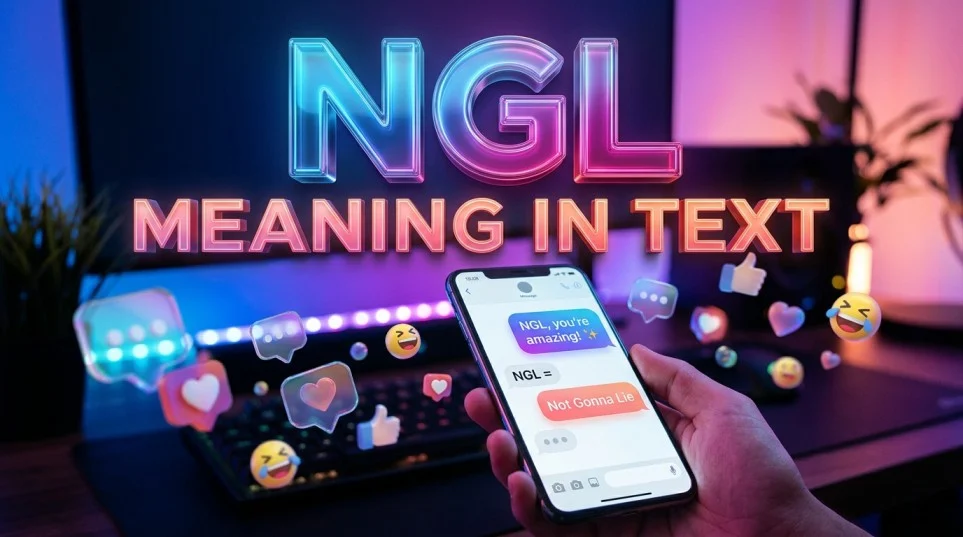
Have you ever received a message that started with “NGL” and wondered what the person was about to say? You aren’t alone. This three-letter abbreviation appears in everyday text messages, social media comments, and private conversations. It often introduces an honest opinion, a personal confession, or a reaction someone wants to share without sounding too serious.
NGL stands for “Not Gonna Lie.” People use it as a casual way to say “Honestly” or “To be honest” before expressing what they really think or feel. For example, someone might text, “NGL, that movie was amazing,” to emphasize their genuine reaction. The expression can introduce compliments, criticism, jokes, and even romantic hints. Its meaning stays the same across platforms, but the surrounding conversation helps you understand the sender’s tone.
What Does NGL Mean in Text?
NGL means “Not Gonna Lie” in text messages and online conversations. It’s an informal abbreviation people use when they want to introduce an honest thought, personal opinion, or genuine reaction.
Think of it as a shorter, more relaxed version of saying “To be honest.” Instead of typing the complete phrase, someone can simply write NGL and get straight to the point.
For example:
- “NGL, your new haircut looks amazing.”
- “NGL, I didn’t enjoy that movie.”
- “NGL, I’m nervous about tomorrow.”
- “That was the best meal I’ve had in weeks, NGL.”
In each example, the sender uses NGL to emphasize a personal reaction. It helps make the message sound direct and conversational.
However, NGL doesn’t automatically mean someone is revealing a major secret. People also use it before ordinary observations, playful comments, and everyday opinions.
NGL Meaning at a Glance
Here’s a quick breakdown of the abbreviation:
| Detail | Explanation |
|---|---|
| Abbreviation | NGL |
| Full form | Not Gonna Lie |
| Basic meaning | Honestly / To be honest |
| Category | Internet slang |
| Language style | Informal |
| Common purpose | Expressing an honest thought or reaction |
| Common platforms | Snapchat, Instagram, TikTok, WhatsApp |
| Typical audience | Friends, peers, and online communities |
| Formal usage | Generally unsuitable for formal writing |
Example: “NGL, I was expecting something better.”
This sentence communicates disappointment without making the conversation sound overly formal.
What Does NGL Stand For?
NGL stands for Not Gonna Lie. The abbreviation comes from the first letters of the three words:
- N: Not
- G: Gonna
- L: Lie
The phrase is a casual way of introducing something a person wants to present as honest or genuine.
The word “gonna” is an informal form of “going to.” People commonly use it in everyday speech and casual writing. That’s why NGL feels more relaxed than expressions such as “To be completely honest” or “To speak truthfully.”
Consider these two messages:
Formal: “To be completely honest, I don’t agree with your decision.”
Casual: “NGL, I don’t agree with your decision.”
Both communicate a similar thought. The difference lies in their tone and level of formality.
One important detail is that NGL doesn’t necessarily suggest the sender has been lying before. It’s usually a conversational expression that adds emphasis to what follows.
For example, when someone says, “NGL, I’m exhausted,” they’re probably not admitting to dishonesty. They’re simply highlighting how tired they feel.
How Is NGL Used in Text Messages?
People use NGL in several ways depending on the conversation. Sometimes it introduces a sincere compliment. Other times, it makes criticism, humor, or personal feelings sound more natural.
Here are the most common uses.
NGL to Express an Honest Opinion
One of the main reasons people use NGL is to share their genuine opinions.
It can introduce thoughts about movies, music, food, fashion, relationships, school, or almost anything people discuss casually.
Examples:
- “NGL, this song deserves more attention.”
- “NGL, I think the first season was better.”
- “NGL, that restaurant is overrated.”
- “NGL, online classes are harder than I expected.”
The abbreviation signals that the sender is sharing a personal judgment rather than presenting an unquestionable fact.
For instance, saying “NGL, this movie is boring” communicates an individual reaction. It doesn’t mean everyone else must dislike the movie.
NGL to Give Someone a Compliment
NGL also works well when someone wants to give a compliment without making the message sound rehearsed.
It adds a conversational touch to positive comments about someone’s appearance, personality, skills, or achievements.
Examples:
- “NGL, you look really good today.”
- “NGL, your photography skills are impressive.”
- “NGL, you have a great sense of humor.”
- “NGL, that outfit suits you perfectly.”
These messages sound friendly and direct. Depending on the relationship, they can also carry a little flirtation.
NGL to Admit Something
Sometimes people use NGL before admitting something they might otherwise hesitate to say.
It can introduce an embarrassing experience, a personal mistake, or an unexpected feeling.
Examples:
- “NGL, I forgot about the assignment.”
- “NGL, I was scared to call you.”
- “NGL, I haven’t watched that popular show.”
- “NGL, I thought you were upset with me.”
This usage makes small confessions feel less dramatic. It gives the sender a casual way to acknowledge something honestly.
NGL to Express Disappointment or Criticism
Not every NGL message is positive. People also use it before sharing criticism or disappointment.
The expression can soften the delivery slightly, although the actual statement may still sound blunt.
Examples:
- “NGL, I expected better from that restaurant.”
- “NGL, your explanation confused me.”
- “NGL, the ending was disappointing.”
- “NGL, I don’t think this plan will work.”
Here, NGL prepares the reader for a potentially negative opinion.
However, adding NGL doesn’t automatically make criticism polite. The wording that follows still matters.
NGL to Add Humor or Sarcasm
Another popular use involves jokes and playful exaggeration.
People often place NGL before something funny to make the statement sound like a spontaneous confession.
Examples:
- “NGL, I opened the fridge five times hoping new food would appear.”
- “NGL, my bed has a stronger hold on me than my responsibilities.”
- “NGL, I need a vacation after my vacation.”
- “NGL, I could sleep for another eight hours.”
In these situations, the abbreviation creates a humorous contrast between the idea of serious honesty and an obviously playful statement.
NGL to Express Romantic Interest
NGL can also appear in romantic conversations. Someone might use it to express attraction, affection, or interest without making a big declaration.
Examples:
- “NGL, I’ve been thinking about you.”
- “NGL, I love spending time with you.”
- “NGL, your smile makes my day.”
- “NGL, I was hoping you’d text me.”
These messages can sound flirtatious, especially when two people already share romantic interest.
Still, the abbreviation itself doesn’t prove that someone has feelings for you. Pay attention to the complete message and the relationship behind it.
NGL Meaning at the Beginning vs. End of a Sentence
Where someone places NGL can change the rhythm of a message. However, its basic meaning remains the same.
People most commonly use it at the beginning or end of a sentence.
NGL at the Beginning of a Sentence
Starting a message with NGL is one of the most natural ways to use the abbreviation.
It introduces an honest opinion before the main statement.
Examples:
- “NGL, I really enjoyed the party.”
- “NGL, you handled that situation well.”
- “NGL, I’m not ready for Monday.”
- “NGL, this is my favorite restaurant.”
This placement prepares the reader for a personal reaction. It also makes the statement sound relaxed and direct.
NGL at the End of a Sentence
People also place NGL at the end of a message to add emphasis to something they’ve already said.
Examples:
- “That was an incredible performance, NGL.”
- “I really needed that break, NGL.”
- “Your presentation was impressive, NGL.”
- “I’m exhausted after today, NGL.”
Ending with NGL can make the statement sound like a final thought or casual afterthought.
It’s particularly common in informal messages where people don’t worry about strict writing conventions.
NGL in the Middle of a Sentence
Although less common, NGL can appear within a longer conversational message.
For example:
- “I was, NGL, surprised by the announcement.”
- “That was a pretty good performance, NGL, considering the circumstances.”
However, inserting the abbreviation into the middle of a sentence can sometimes interrupt its flow.
A more natural alternative is to place it at the beginning or end:
- “NGL, I was surprised by the announcement.”
- “That was a pretty good performance, considering the circumstances, NGL.”
Writing tip: Use NGL where it sounds natural. You don’t need to insert it into every sentence to make a message feel casual.
NGL Meaning on Snapchat, Instagram, TikTok, and WhatsApp
NGL has the same basic meaning across social media platforms: Not Gonna Lie. However, people use it differently depending on the type of conversation and the content they’re discussing.
You might see it in a private message, a public comment, a story reply, or a video caption. The platform doesn’t change the abbreviation’s definition. It simply provides a different setting for using it.
NGL Meaning on Snapchat
On Snapchat, NGL commonly appears in private chats, quick replies, and reactions to snaps.
People use it to compliment friends, share honest reactions, or express feelings without making the conversation too serious.
Examples:
- “NGL, that snap was hilarious.”
- “NGL, you look really cute today.”
- “NGL, I wasn’t expecting you to reply.”
- “NGL, I miss our old conversations.”
For example, if someone sends you a picture and you reply, “NGL, you look amazing,” you’re giving them a direct compliment.
NGL Meaning on Instagram
On Instagram, people use NGL in direct messages, story replies, captions, and comment sections.
It’s particularly useful when reacting to photos, reels, outfits, achievements, and personal updates.
Examples:
- “NGL, this picture is beautiful.”
- “NGL, your content keeps getting better.”
- “NGL, this reel made my entire day.”
- “NGL, I need to visit this place.”
You might also see NGL in comments when someone wants to express an unpopular opinion about a post.
NGL Meaning on TikTok
TikTok users often use NGL when sharing opinions about videos, trends, music, challenges, and popular discussions.
It can introduce a funny observation or an opinion that other viewers might disagree with.
Examples:
- “NGL, this trend is getting boring.”
- “NGL, this creator deserves more followers.”
- “NGL, I watched this video ten times.”
- “NGL, the original version was better.”
In TikTok comments, NGL helps users express their reactions quickly without writing a long explanation.
NGL Meaning in WhatsApp
WhatsApp users commonly use NGL in individual chats and group conversations.
Friends might use it to discuss plans, share personal feelings, or make jokes about everyday situations.
Examples:
- “NGL, I’m too tired to go out tonight.”
- “NGL, our group needs another vacation.”
- “NGL, that family dinner was amazing.”
- “NGL, I forgot to send you the pictures.”
It works naturally in everyday conversations because WhatsApp messages usually have a relaxed, personal tone.
NGL Meaning on Facebook Messenger
On Facebook Messenger, NGL works just like it does in other messaging apps.
Someone might use it when reacting to an old photograph, discussing a shared memory, or expressing an opinion about something posted online.
Examples:
- “NGL, that old picture brings back memories.”
- “NGL, I haven’t laughed that hard in ages.”
- “NGL, your post made me smile.”
The main takeaway is simple: NGL doesn’t have a different definition on every social media platform. The conversation determines its exact tone.
NGL Text Examples in Different Situations
Sometimes the easiest way to understand texting slang is to see how people use it in real conversations.
NGL can fit into several situations. The following examples demonstrate its meaning in different contexts.
| Situation | NGL example | Meaning |
|---|---|---|
| Compliment | NGL, you look beautiful today. | Expressing admiration |
| Friendship | NGL, you’re an amazing friend. | Showing appreciation |
| Romance | NGL, I miss spending time with you. | Expressing affection |
| Humor | NGL, I’m professionally lazy. | Making a playful confession |
| Personal opinion | NGL, this movie is overrated. | Sharing an honest judgment |
| Admission | NGL, I forgot about the meeting. | Acknowledging a mistake |
| Disappointment | NGL, I expected more. | Expressing dissatisfaction |
| Excitement | NGL, I can’t wait for the weekend. | Sharing enthusiasm |
| Food | NGL, this pizza is incredible. | Giving a positive reaction |
| School | NGL, that exam was difficult. | Sharing an experience |
| Work | NGL, this project needs more time. | Giving honest feedback |
| Surprise | NGL, I didn’t expect that. | Expressing genuine surprise |
| Gaming | NGL, that was an impressive move. | Praising someone’s performance |
| Travel | NGL, I could stay here forever. | Expressing enjoyment |
More NGL Examples in Everyday Conversations
Here are a few short conversations that show how the abbreviation works naturally.
Example 1: Talking about a movie
- Person A: Did you enjoy the movie?
- Person B: NGL, the ending was better than I expected.
Meaning: Person B is sharing a genuine opinion about the movie.
Example 2: Giving a compliment
- Person A: I finally bought a new outfit.
- Person B: NGL, it looks amazing on you!
Meaning: Person B is expressing admiration.
Example 3: Sharing an embarrassing confession
- Person A: Did you finish the assignment?
- Person B: NGL, I completely forgot about it.
Meaning: Person B is admitting a mistake.
Example 4: Romantic conversation
- Person A: I had a really nice time yesterday.
- Person B: NGL, I wish we could do it again.
Meaning: Person B is expressing interest in spending more time together.
Example 5: Friendly disagreement
- Person A: This is the best restaurant in town.
- Person B: NGL, I think there are better places.
Meaning: Person B is politely introducing a different opinion.
These examples demonstrate that NGL doesn’t belong to one particular type of conversation. Its flexibility makes it useful in everyday digital communication.
What Does NGL Mean From a Girl or a Guy?
One common question people ask is whether NGL carries a different meaning when a girl or guy sends it.
The answer is no. NGL has the same definition regardless of the sender’s gender. It still means “Not Gonna Lie.”
However, the message following it can reveal something about the person’s feelings or intentions.
What Does NGL Mean From a Girl?
When a girl sends NGL, she might be introducing an honest opinion, compliment, confession, or playful observation.
For example:
- “NGL, you’re really funny.”
- “NGL, I enjoyed talking to you.”
- “NGL, your outfit looks great.”
- “NGL, I was waiting for your message.”
The meaning depends on the situation.
If she’s complimenting your appearance, she might simply be friendly. If she regularly expresses interest, starts conversations, and makes personal comments, the message could suggest romantic attraction.
However, one abbreviation isn’t enough to determine someone’s feelings.
What Does NGL Mean From a Guy?
A guy uses NGL in the same way. He might use it to share an opinion, admit something, or express attraction.
Examples:
- “NGL, you’re really talented.”
- “NGL, I had fun hanging out with you.”
- “NGL, I’ve missed talking to you.”
- “NGL, that was the best decision.”
If the message appears in a romantic conversation, it might be a way to express interest without making things overly serious.
Still, consider his overall behavior rather than interpreting three letters as a hidden message.
What Does NGL Mean in a Relationship?
In relationships, NGL can make personal feelings easier to express.
People might use it when discussing affection, trust, disagreements, or expectations.
For example:
- “NGL, I feel happier when you’re around.”
- “NGL, I was upset about what happened.”
- “NGL, I really appreciate everything you do.”
- “NGL, I wish we spent more time together.”
These messages introduce feelings in a casual but direct way.
One important distinction: NGL can introduce a difficult conversation, but it doesn’t replace clear communication. If someone expresses disappointment, the couple still needs to discuss the actual issue.
Is NGL Rude, Offensive, or Flirty?
NGL isn’t inherently rude or offensive. It’s a neutral abbreviation that people use to introduce an honest statement.
However, the words that follow can make the message sound friendly, critical, romantic, or sarcastic.
Is NGL Rude?
Usually, no.
For example:
“NGL, I really enjoyed your presentation.”
This is clearly positive.
However:
“NGL, your presentation was terrible.”
This sounds harsh even though the sender added NGL.
The abbreviation may prepare someone for criticism, but it doesn’t automatically make negative comments polite.
A useful rule: Pay attention to the actual statement rather than judging the message by NGL alone.
Can NGL Be Flirty?
Yes. NGL can introduce compliments and personal admissions that carry romantic interest.
Examples:
- “NGL, you’re kind of cute.”
- “NGL, I love your smile.”
- “NGL, I was hoping you’d text me.”
- “NGL, you make me nervous in a good way.”
These messages can sound flirtatious because they express personal attraction.
However, the same abbreviation can appear in completely ordinary friendships. Look at the relationship and the surrounding conversation before assuming anything.
Does NGL Always Mean Someone Is Being Honest?
Not necessarily.
Although NGL literally means “Not Gonna Lie,” people sometimes use it for humor, sarcasm, exaggeration, or emphasis.
For example:
“NGL, I’m the greatest chef in the world.”
If the sender regularly burns toast, the statement might be a joke rather than a serious claim.
The abbreviation signals an intended honest or candid tone. It doesn’t guarantee that every statement is objectively true.
How to Reply When Someone Says NGL
Your response should depend on what the person actually says after NGL.
You don’t need a special reply just because someone uses this abbreviation. Respond to the message naturally.
Here are some useful responses for different situations.
If Someone Gives You a Compliment
When someone sends a positive message, acknowledge it without overthinking the abbreviation.
Possible replies:
- “Thank you! That’s really sweet.”
- “I appreciate that!”
- “NGL, you’re pretty amazing too.”
- “You’re making me blush!”
If Someone Shares an Honest Opinion
Sometimes people use NGL to introduce an opinion you agree or disagree with.
Possible replies:
- “Fair enough.”
- “Honestly, I agree.”
- “I see what you mean.”
- “That’s an interesting point.”
- “I have a slightly different opinion.”
You can keep the conversation going by explaining your own perspective.
If Someone Makes a Personal Confession
If someone admits something embarrassing or shares personal feelings, respond with understanding.
Possible replies:
- “Thanks for being honest.”
- “I appreciate you telling me.”
- “It’s okay. These things happen.”
- “I understand completely.”
- “I’m glad you told me.”
A thoughtful response can make the conversation more comfortable.
If Someone Says Something Flirty
If you like the person and want to return the compliment, keep your reply playful.
Possible replies:
- “NGL, I was thinking the same thing.”
- “You’re making me smile.”
- “That’s actually really cute.”
- “I was waiting for you to say that.”
- “You’re not so bad yourself.”
You can also keep things friendly if you don’t share the same feelings.
If Someone Makes a Negative Comment
Not every honest opinion deserves an argument. You can acknowledge the message without agreeing with everything.
Possible replies:
- “I understand your point.”
- “I respect your honesty.”
- “That’s fair, but I see it differently.”
- “Thanks for telling me.”
- “Let’s talk about it.”
The goal is to respond to the actual concern rather than focusing on the abbreviation.
NGL vs. TBH vs. IMO vs. FR: What’s the Difference?
NGL belongs to a wider group of internet abbreviations that people use to express opinions, agreement, and honesty.
Some of these expressions have similar meanings. However, they don’t always work in exactly the same situations.
Here’s how they compare.
| Slang | Full form | Meaning | Common purpose |
|---|---|---|---|
| NGL | Not Gonna Lie | Honestly | Introducing a candid thought |
| TBH | To Be Honest | Speaking honestly | Sharing a sincere opinion |
| IMO | In My Opinion | This is my view | Expressing a personal opinion |
| IMHO | In My Humble Opinion | In my view | Sharing an opinion modestly |
| FR | For Real | Seriously / Genuinely | Showing sincerity or agreement |
| IKR | I Know, Right? | I completely agree | Expressing agreement |
| ISTG | I Swear to God | I strongly promise or insist | Adding emphasis |
| IDK | I Don’t Know | I’m unsure | Expressing uncertainty |
NGL vs. TBH
NGL and TBH are probably the closest alternatives.
Both introduce honest thoughts or personal opinions.
NGL: “NGL, I didn’t like the ending.”
TBH: “TBH, I didn’t like the ending.”
The difference is subtle. NGL often feels more casual and confessional, while TBH can sound slightly more neutral.
In many everyday conversations, people use them interchangeably.
NGL vs. IMO
These abbreviations serve slightly different purposes.
NGL emphasizes honesty, while IMO identifies a statement as someone’s personal opinion.
NGL: “NGL, this restaurant is disappointing.”
IMO: “IMO, this restaurant is disappointing.”
The first highlights candidness. The second makes it clear that the statement represents an individual judgment.
NGL vs. FR
FR stands for “For Real.”
People use it to emphasize sincerity, seriousness, or agreement.
NGL: “NGL, that was a difficult exam.”
FR: “FR, that exam was difficult.”
The first introduces an honest observation. The second reinforces that the speaker genuinely agrees with or believes something.
Understanding these differences makes it easier to interpret texting abbreviations without confusing their meanings.
Is NGL Formal or Informal?
NGL is an informal internet abbreviation. It’s suitable for relaxed conversations but generally doesn’t belong in formal writing.
You can comfortably use it when texting friends, commenting on social media, or chatting with people who understand internet slang.
However, professional and academic situations usually require clearer language.
Here’s a practical comparison:
| Situation | Is NGL appropriate? | Better approach |
|---|---|---|
| Texting friends | Yes | Use NGL naturally |
| Snapchat conversations | Yes | Casual abbreviation is fine |
| Instagram comments | Yes | Suitable for informal reactions |
| WhatsApp group chats | Yes | Works in friendly discussions |
| Casual workplace chat | Depends | Consider your team’s communication style |
| Professional emails | Generally no | Use “Honestly” or “To be frank” |
| Academic essays | No | Use formal language |
| Business reports | No | Use precise, professional wording |
| Official documents | No | Avoid texting abbreviations |
Better Alternatives to NGL in Formal Writing
If you want to express the same idea without internet slang, consider these alternatives:
- Honestly: A simple way to introduce a sincere opinion.
- To be honest: A natural alternative for everyday and professional communication.
- Frankly: Useful when expressing a direct opinion.
- Truthfully: Suitable when emphasizing accuracy or sincerity.
- In my opinion: Appropriate when presenting a personal viewpoint.
- To be transparent: Useful in professional discussions involving openness.
For example:
Instead of writing:
“NGL, this project needs more work.”
You could write:
“Honestly, this project needs additional work.”
The second version sounds more appropriate in a professional email.
Common Mistakes to Avoid When Using NGL
Although NGL is easy to understand, people sometimes misunderstand its tone or use it in awkward situations.
Here are some mistakes worth avoiding.
Using NGL in formal writing: It’s designed for informal communication. Avoid inserting it into academic papers, official reports, and formal business emails.
Assuming it always indicates romantic interest: A compliment beginning with NGL doesn’t automatically mean someone has a crush on you.
Thinking it guarantees honesty: The phrase signals a candid tone, but it doesn’t prove that the statement is true.
Confusing NGL with TBH: Both express honesty, but NGL often has a more casual, confessional feel.
Using it before every statement: Repeating the abbreviation too frequently makes messages sound unnatural.
Ignoring the surrounding context: A message can be friendly, sarcastic, or critical depending on the words that follow.
Using it to disguise hurtful comments: Adding NGL doesn’t make an insulting statement acceptable. Consider your wording before sending a potentially hurtful message.
Is NGL Still Popular in 2026?
Yes, NGL remains a recognizable abbreviation in online communication.
Its appeal comes from its simplicity. Three letters can introduce an opinion, express a feeling, or add emphasis without requiring a lengthy explanation.
You’ll still encounter it in:
- Private text messages.
- Social media comments.
- Instagram captions and story replies.
- Snapchat conversations.
- TikTok discussions.
- Online communities and group chats.
However, slang changes over time. Some expressions become less common while others gain attention through social media trends.
NGL has the advantage of being easy to understand. Its meaning is straightforward and doesn’t depend on a particular trend, meme, or platform.
It’s also not exclusive to Gen Z. People from different age groups can use or understand it when participating in online conversations.
The best way to use it is to keep things natural. If NGL fits the tone of your message, there’s no reason to avoid it.
Frequently Asked Questions
What does NGL mean in text messages?
NGL means Not Gonna Lie. People use it in text messages to introduce an honest opinion, personal confession, compliment, or genuine reaction. For example, “NGL, I really enjoyed the party” means “Honestly, I really enjoyed the party.”
What does NGL stand for in slang?
In internet slang, NGL stands for “Not Gonna Lie.” It’s an informal abbreviation commonly used in texting, social media comments, and online conversations to emphasize honesty or introduce a candid statement.
What does NGL mean from a girl?
NGL means the same thing when a girl uses it: “Not Gonna Lie.” She might use it before giving you a compliment, sharing an opinion, or expressing personal feelings. The surrounding message helps determine whether she’s being friendly, serious, or flirtatious.
What does NGL mean from a guy?
When a guy texts NGL, he’s also saying “Not Gonna Lie.” He might use it to share an honest opinion, make a confession, compliment someone, or express attraction. The abbreviation itself doesn’t reveal his romantic intentions.
What does NGL mean on Snapchat?
On Snapchat, NGL stands for “Not Gonna Lie.” People commonly use it in private chats and snap replies to share honest reactions, compliments, jokes, and personal feelings.
Is NGL rude or offensive?
No, NGL isn’t inherently rude or offensive. However, the statement following it can sound critical or disrespectful. For example, “NGL, I don’t like your idea” is a blunt opinion even though the abbreviation itself is neutral.
Is NGL the same as TBH?
NGL and TBH have very similar meanings. NGL stands for “Not Gonna Lie,” while TBH means “To Be Honest.” Both introduce candid thoughts, although NGL often sounds slightly more casual and confessional.
How do you use NGL in a sentence?
You can use NGL at the beginning or end of an informal sentence.
Examples:
- “NGL, that movie was fantastic.”
- “You did a great job, NGL.”
- “NGL, I’m really excited about tomorrow.”
It introduces an honest opinion or personal reaction.
Can NGL be used in professional conversations?
NGL is generally unsuitable for formal professional communication. In casual workplace chats, it may be acceptable if everyone uses informal language. For professional emails and reports, use alternatives such as “Honestly,” “Frankly,” or “To be transparent.”
How should you respond when someone texts NGL?
Respond according to the message that follows NGL. If someone compliments you, say “Thank you!” If they share an opinion, acknowledge it or explain your perspective. If they express romantic interest, respond honestly about your own feelings.
Conclusion
Understanding the NGL meaning in text is simple once you know its full form: Not Gonna Lie. People use this abbreviation to introduce honest opinions, personal confessions, compliments, jokes, and genuine reactions. You’ll commonly find it in Snapchat messages, Instagram comments, TikTok discussions, and everyday text conversations.
Although NGL usually signals honesty, its tone depends on the words surrounding it. It can sound friendly, funny, romantic, or even critical. So, the next time someone sends you an NGL message, look beyond the three letters and focus on what they’re actually saying. That’s the easiest way to understand their intention and respond naturally.