The word antebellum means “before the war.” It comes from Latin: ante means “before” and bellum means “war.” In general English, it can describe a period that happened before a particular war. In American history, however, antebellum most often refers to the period in the United States before the American Civil War, especially the decades before 1861.
The term appears frequently in discussions about the antebellum South, slavery, plantation society, politics, economics, architecture, and American culture. You may also see phrases such as “antebellum house,” “antebellum America,” or “antebellum society.”
Understanding the word requires more than memorizing “before the Civil War.” The antebellum period was a complicated era marked by economic growth, political conflict, westward expansion, reform movements, cultural change, and the expansion and defense of slavery. The word describes a historical period, but the history behind that period is much broader.
What Does Antebellum Mean?
Antebellum means existing or happening before a war.
In American historical writing, the word is most commonly associated with the United States before the Civil War, which began in 1861.
For example:
- Antebellum America = America before the Civil War
- Antebellum South = the Southern United States before the Civil War
- Antebellum society = society in the United States during the pre-Civil War era
- Antebellum plantation = a plantation associated with the pre-Civil War South
- Antebellum architecture = architectural styles associated with the pre-Civil War period
The important point is that antebellum does not literally mean “Southern” or “plantation.” Its basic meaning is simply before the war. The strong connection with the American South comes from the way historians commonly use the term.
Antebellum Definition in Simple English
In simple English:
Antebellum = belonging to the period before a war, especially the American Civil War.
Think of it as a historical signpost.
If someone says, “This building is an antebellum house,” they are usually telling you that the house was built before the American Civil War.
If someone says, “Antebellum politics were deeply divided,” they are talking about political conflicts in the United States before 1861.
A Simple Example
Imagine a history book says:
“The town grew rapidly during the antebellum period.”
This means the town experienced that growth before the American Civil War.
The exact dates being discussed depend on the historian and the subject. “Antebellum” is not always a perfectly fixed date range.
Where Does the Word Antebellum Come From?
Antebellum comes from Latin.
The word can be broken into two parts:
| Part | Meaning |
|---|---|
| ante | before |
| bellum | war |
So, literally:
ante + bellum = before war
The same Latin root appears in several historical and political terms.
For example, postbellum means after the war.
This gives you an easy way to remember the difference:
- Antebellum = before the war
- Postbellum = after the war
In American history, these terms are often used in relation to the Civil War.
What Was the Antebellum Period?
The antebellum period in American history generally refers to the decades leading up to the Civil War.
A commonly used timeframe is the period from the early 19th century through 1861, although historians use different starting points depending on their subject.
There was no single day when the antebellum period officially began.
That matters because history does not always fit neatly into calendar boxes.
For example, a historian studying slavery might focus on the decades before 1861. Someone studying American politics might begin earlier to examine the development of sectional conflict. Another historian might focus on the economic transformation of the 1820s through the 1850s.
So, antebellum is best understood as a historical period rather than one exact set of dates.
Why Is Antebellum Usually Connected With the American South?
This is one of the most important points to understand.
The word itself does not mean “Southern.”
It refers to the period before a war. Yet in American historical discussions, antebellum is often closely connected to the Southern United States because slavery and sectional conflict were central issues in the decades before the Civil War.
The Southern economy included major agricultural production, particularly cotton. Enslaved labor played a fundamental role in the plantation economy.
At the same time, the North and South were developing different economic, political, and social systems.
These differences did not appear overnight. They developed over decades.
By the 1850s, disputes over slavery, its expansion into western territories, federal authority, states’ rights, and political power had become increasingly intense.
That is why “antebellum” often appears in discussions of the South, even though the antebellum United States included both Northern and Southern states.
Antebellum America: What Was Happening?
The antebellum United States was a period of major transformation.
Several forces were changing American life at the same time.
Economic Expansion
American markets expanded rapidly during the 19th century.
Transportation improvements, including canals, roads, steamboats, and railroads, helped connect communities and markets.
Industrialization became increasingly important in the North, while plantation agriculture was especially significant in the South.
Cotton became one of the most important American exports, and enslaved labor was central to its production in the South.
Westward Expansion
The United States expanded geographically during the antebellum era.
New territories and states intensified arguments over whether slavery would be permitted to expand into those areas.
This transformed territorial expansion into a major political issue.
Political Conflict
American political debates became increasingly divided along sectional lines.
Questions surrounding slavery were connected to larger arguments about:
- Federal authority
- States’ rights
- Territorial expansion
- Political representation
- Economic interests
- The future of slavery
- The balance between free and slave states
The tensions eventually contributed to the outbreak of the Civil War in 1861.
Reform Movements
The period also saw significant reform activity.
Movements focused on issues such as:
- Abolition
- Women’s rights
- Education
- Temperance
- Prison reform
- Religious revival
- Social improvement
This is important because the antebellum era was not defined by only one issue. It was a period of intense social and political change.
What Does Antebellum South Mean?
The antebellum South refers to the Southern United States before the Civil War.
The phrase is particularly common in historical writing about the decades before 1861.
The antebellum South had a largely agricultural economy, with cotton becoming especially important in many areas. Enslaved African Americans were forced to provide labor on plantations, farms, and in other forms of work.
Southern society contained different social and economic groups, including wealthy slaveholding families, small farmers, poor white communities, free Black people, and the large population of enslaved Black Americans.
This makes the phrase “antebellum South” more than a description of old buildings or plantation homes. It refers to a complex society shaped by economics, race, slavery, law, politics, family life, religion, and resistance.
Antebellum and Slavery
Any serious discussion of the antebellum South needs to address slavery.
Slavery was not a minor background feature of the period. It was deeply embedded in the Southern economy and legal and social systems.
Millions of African Americans were enslaved in the United States by the time the Civil War began.
Enslaved people lived under laws and systems that denied them basic freedoms and treated human beings as property. Families could be separated through sale, and enslaved people had little legal control over their own lives.
At the same time, enslaved people resisted slavery in many ways.
Resistance could include:
- Escaping bondage
- Preserving family and community relationships
- Maintaining cultural traditions
- Slowing work
- Refusing orders
- Organizing revolts
- Seeking education
- Supporting abolitionist efforts
So, when reading the phrase antebellum society, it is useful to look beyond the image of grand plantation houses and ask who had power, who lacked freedom, and how different groups experienced the period.
Antebellum Plantation Meaning
An antebellum plantation is a plantation associated with the period before the American Civil War.
The word “plantation” describes a large agricultural estate, but the historical reality behind many famous Southern plantations involved enslaved labor.
This is especially important when the term appears in tourism, architecture, or popular culture.
An old plantation house may be visually impressive, but its historical context can include the forced labor and exploitation that supported the wealth of its owners.
A historically responsible description therefore distinguishes between:
The building:
A historic structure from the pre-Civil War period.
The system around it:
An agricultural economy in which enslaved people were often forced to work and whose labor contributed to the wealth of plantation owners.
That distinction gives the word “antebellum” more historical depth.
Antebellum Houses and Architecture
You may also encounter the phrase antebellum house.
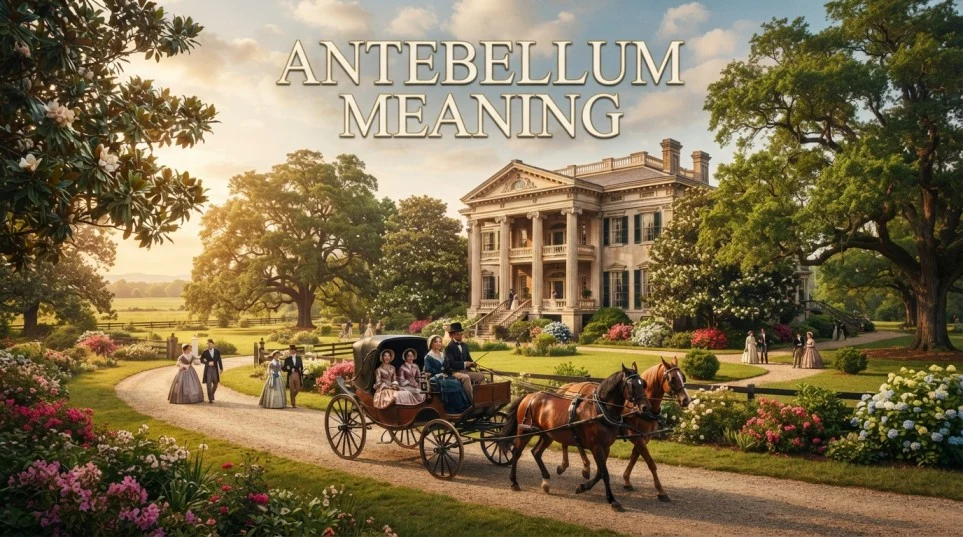
This usually refers to a house built before the Civil War, especially in the Southern United States.
Many antebellum homes associated with the South feature architectural elements such as:
- Large columns
- Symmetrical facades
- Wide verandas
- High ceilings
- Formal entrances
- Large windows
- Elaborate interiors
- Neoclassical or Greek Revival influences
However, not every old Southern house is automatically an antebellum house.
The date, architectural characteristics, and historical evidence matter.
For example, a house built in 1875 may look similar to an earlier Southern mansion, but it is postbellum, not antebellum.
Antebellum vs. Postbellum
These two words are easy to confuse, but their meanings are almost opposites.
| Term | Meaning | American historical use |
|---|---|---|
| Antebellum | Before the war | Usually before the Civil War |
| Postbellum | After the war | Usually after the Civil War |
| Pre-Civil War | Before the Civil War | Direct and clear |
| Reconstruction era | Period following the Civil War | Usually associated with rebuilding and political change after the war |
Example
“An antebellum building” means a building from before the Civil War.
“A postbellum building” means a building from after the Civil War.
This distinction becomes especially useful when reading descriptions of American architecture, literature, politics, or social history.
Antebellum vs. Pre-Civil War
The expressions antebellum and pre-Civil War can often communicate the same basic idea in American history.
The difference is style and context.
Pre-Civil War is straightforward and immediately understandable.
Antebellum is more formal and commonly appears in historical scholarship, museum descriptions, academic writing, architecture, and discussions of Southern history.
For example:
Simple:
“The house was built before the Civil War.”
Historical style:
“The house was built during the antebellum period.”
The second sentence sounds more specialized, but the first is often clearer for a general audience.
Is Antebellum Only Used for the American Civil War?
No.
The literal meaning of antebellum is “before the war,” so it can technically refer to a period before another war.
However, context matters.
In American English, antebellum strongly suggests the period before the American Civil War when no other war is specified.
For example:
“The novel explores antebellum society.”
Most readers will understand this as a reference to the United States before the Civil War.
If you were discussing another country’s history, it would be clearer to identify the war being discussed.
Antebellum in a Sentence
Here are natural examples showing how the word works.
Historical Example
“The historian examined political debates during the antebellum period.”
Meaning: The historian studied political debates before the Civil War.
Architecture Example
“The city is known for several well-preserved antebellum homes.”
Meaning: The city has homes that date from before the Civil War.
Cultural Example
“The novel portrays life in the antebellum South.”
Meaning: The novel depicts life in the Southern United States before the Civil War.
Academic Example
“Antebellum reform movements influenced American political and social thought.”
Meaning: Reform movements before the Civil War influenced American society and politics.
Casual Example
“We visited an antebellum house during our history tour.”
Meaning: They visited a historic house built before the Civil War.
Antebellum Synonyms
There is no single perfect synonym for antebellum, because the best replacement depends on context.
Useful alternatives include:
- Prewar
- Before the war
- Pre-Civil War
- Before the Civil War
- Pre-Civil War era
- Prewar period
- Earlier period
For American history, pre-Civil War is usually the clearest alternative.
Example
Antebellum America
can become:
Pre-Civil War America
Both communicate the basic idea, but “antebellum” has a more historical and specialized tone.
Antebellum Pronunciation
Antebellum is commonly pronounced:
an-tuh-BEL-um
The stress falls on BEL.
A simple pronunciation guide is:
an-tuh-BEL-um
The spelling can look intimidating at first, but the pronunciation is fairly straightforward once you divide it into parts.
Antebellum Etymology
The etymology of antebellum helps explain why the word has such a precise historical feeling.
It comes from Latin:
ante = before
bellum = war
The same Latin word bellum is connected to English words involving war.
The term became particularly prominent in American historical vocabulary because historians needed a convenient way to describe the society and culture that existed before the Civil War.
Over time, antebellum became strongly associated with the American South and the decades preceding the conflict.
Why the Word Can Be Misleading Without Context
One of the biggest problems with the word antebellum is that it can sound more neutral than the history actually was.
For example, the phrase:
“antebellum mansion”
may immediately bring an image of a large historic house with columns and gardens.
But that physical image does not tell the entire story.
A mansion’s wealth may have been connected to a plantation economy that relied on enslaved labor.
This is why historical context matters.
When you see antebellum, do not automatically translate it in your mind as:
“beautiful old Southern.”
A more accurate mental translation is:
“from the period before the American Civil War.”
Then investigate what the specific historical setting involved.
Common Misunderstandings About Antebellum
1. Antebellum Does Not Mean “Southern”
The word refers to a period, not a geographic region.
The antebellum North can also be discussed because Northern states existed during the same pre-Civil War period.
2. Antebellum Does Not Mean “Plantation”
Plantations were an important part of the antebellum Southern economy, but they are not part of the word’s literal definition.
3. Antebellum Does Not Mean “Before Any War”
In a specific historical context, it refers to the period before the relevant war.
In American historical writing, the Civil War is usually the implied conflict.
4. Antebellum Does Not Give One Exact Start Date
Historians may use different dates depending on their research topic.
The word is best treated as a broad historical label.
5. Antebellum Does Not Describe Only Wealthy People
The period included wealthy planters, small farmers, industrial workers, enslaved people, free Black communities, immigrants, reformers, politicians, laborers, women activists, and many other groups.
The experiences of these people were dramatically different.
Why Understanding Antebellum Matters in American History
The term appears in discussions of some of the most important developments in 19th-century America.
Understanding it helps you make sense of topics such as:
- Slavery
- Abolition
- The cotton economy
- Plantation society
- Westward expansion
- Sectionalism
- States’ rights
- Federal power
- Political parties
- Reform movements
- Women’s rights
- African American history
- Southern culture
- The causes of the Civil War
It also helps when reading historical novels, academic articles, museum descriptions, documentaries, and discussions about historic architecture.
The word is essentially a time marker. Once you understand that marker, the surrounding historical information becomes easier to place.
A Quick Timeline
Here is a simplified way to place the antebellum era in the larger story of the United States:
| Period | Broad historical context |
|---|---|
| Early 1800s | Economic and territorial expansion |
| 1820s to 1830s | Growing political and social conflicts |
| 1830s to 1840s | Expansion, reform movements, and increasing sectional tensions |
| 1840s to 1850s | Territorial growth and intensifying slavery debates |
| 1850s | Major political crises over slavery and federal authority |
| 1861 | Civil War begins |
| 1861 to 1865 | American Civil War |
| After 1865 | Postbellum period and Reconstruction |
This timeline is intentionally broad because historians can define periods differently depending on the question they are studying.
Antebellum Meaning in Literature
The term is also common in literary studies.
A book described as an antebellum novel may explore American life before the Civil War.
Literature from or about this period can address:
- Slavery
- Race
- Gender
- Religion
- Family
- Freedom
- Class
- Political conflict
- Social reform
- American identity
The historical setting can dramatically change how a reader understands a character’s choices.
For example, a character’s ideas about freedom, marriage, education, work, or social status may make more sense once the laws and customs of the period are understood.
Antebellum Meaning in Modern Writing
Today, writers may use antebellum in several ways.
A historian might use it precisely:
“Antebellum political debates shaped the national conversation about slavery.”
A museum might use it to describe architecture:
“The property contains an antebellum residence.”
A novelist might use it to establish historical setting:
“The story takes place in an antebellum Southern town.”
A travel writer might use it when discussing historic properties.
The word works best when the reader already knows the historical context or when the surrounding sentence makes that context clear.
How to Use Antebellum Correctly
A good rule is simple:
Use “antebellum” when you are talking about something connected to the period before a war, especially the American Civil War.
- Correct
“The museum preserves an antebellum building.”
- Correct
“The study examines antebellum American politics.”
- Correct
“The novel is set in the antebellum South.”
- Less Clear
“The city has an antebellum culture.”
This sentence is not necessarily wrong, but “antebellum culture” is broad. It is better to explain which cultural features or communities you mean.
Specific language makes historical writing stronger.
Antebellum Meaning: Quick Reference
| Question | Answer |
|---|---|
| What does antebellum mean? | Before the war |
| What does antebellum mean in U.S. history? | The period before the American Civil War |
| What does antebellum South mean? | The Southern United States before the Civil War |
| What does antebellum house mean? | A house dating from before the Civil War |
| What is the opposite of antebellum? | Postbellum |
| What is the simplest synonym? | Prewar |
| Where does antebellum come from? | Latin |
| What does ante mean? | Before |
| What does bellum mean? | War |
| Is antebellum the same as pre-Civil War? | In U.S. historical contexts, they often refer to the same broad period |
| Does antebellum mean plantation? | No |
| Does antebellum mean Southern? | Not literally |
FAQs
What does antebellum mean in simple terms?
Antebellum simply means before a war. In American history, it usually means the period before the Civil War.
What years are considered antebellum?
There is no universally fixed beginning date. Historians commonly use the term for the decades before the Civil War, which began in 1861. The exact range depends on the historical topic.
What does antebellum South mean?
The antebellum South refers to the Southern United States before the Civil War. The term is often used when discussing slavery, plantation agriculture, Southern society, politics, and culture.
Does antebellum mean before the Civil War?
In American historical writing, usually yes. The broader literal meaning is “before the war,” but the American Civil War is generally the implied war when the term appears without additional context.
What is the opposite of antebellum?
The opposite is postbellum, meaning after the war. In U.S. history, postbellum commonly refers to the period after the Civil War.
What is an antebellum house?
An antebellum house is a house associated with the period before the Civil War, particularly a historic Southern home built before 1861.
Why is antebellum associated with plantations?
Plantations were economically and socially important in the pre-Civil War South, and many plantations depended heavily on enslaved labor. This historical connection caused “antebellum” to become strongly associated with the Southern plantation era.
Is antebellum a positive or negative word?
The word itself is primarily a historical descriptor meaning before a war. Its meaning does not inherently express approval or disapproval. The historical subjects described by it, however, can involve serious issues such as slavery, racial oppression, political conflict, and resistance.
How do you pronounce antebellum?
Antebellum is commonly pronounced an-tuh-BEL-um, with the emphasis on “BEL.”
What is an easy synonym for antebellum?
Depending on the context, prewar or pre-Civil War can be used as simpler alternatives.
Final Takeaway
The simplest antebellum meaning is “before the war.” In American history, the word most commonly describes the United States during the period before the Civil War, particularly the decades leading up to 1861.
Its connection with the antebellum South is especially strong because slavery, plantation agriculture, sectional politics, and growing conflict between different visions of the country’s future were central features of the era.
The word itself is neutral as a time marker, but the period it describes was anything but simple. It included economic expansion, reform movements, territorial growth, political transformation, cultural change, and the deeply oppressive institution of slavery.
So when you encounter antebellum, remember two things: “before the war” is the literal meaning, and American historical context usually points to the years before the Civil War.