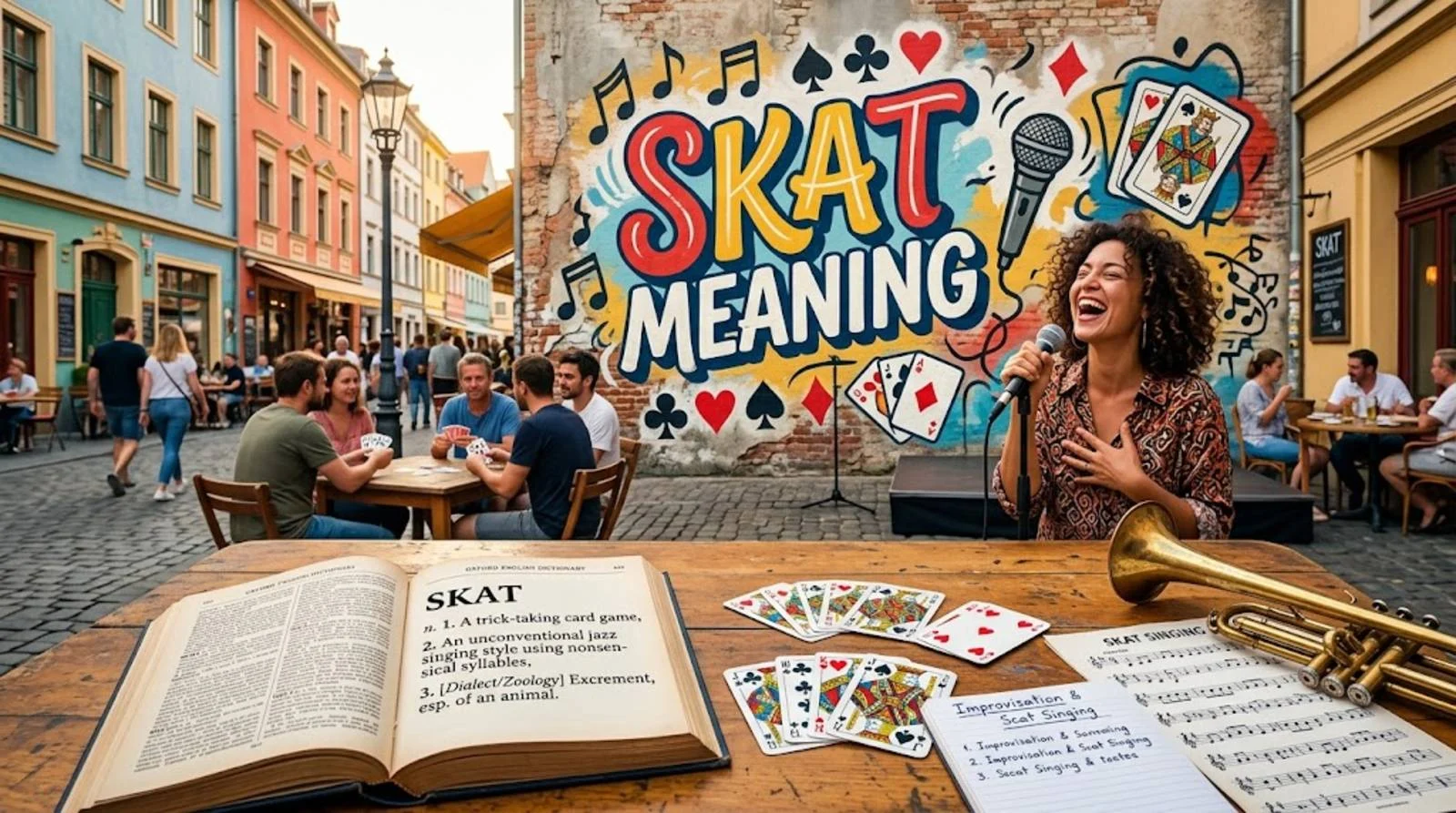
If you searched for skat meaning, you are most likely looking for the name of a traditional German card game. Skat is a three-player trick-taking card game in which players bid for the right to become the solo player, choose a game type, and then try to win enough card points to fulfill their contract. It is played with 32 cards and has a distinctive bidding system that makes strategy just as important as the cards you are dealt.
Skat is more than a simple game of winning tricks. Players have to judge the strength of their hands, calculate risk, remember cards that have already been played, and anticipate what opponents may hold. The game has a long history in German-speaking Europe and remains organized internationally through formal rules and competitive associations. The Deutscher Skatverband describes Skat as a major organized card-game tradition and notes that the game was added to Germany’s national inventory of intangible cultural heritage in 2016.
Skat Meaning in Simple English
Skat means a traditional German card game played mainly by three people.
The word Skat refers to the game itself. It is commonly described as a trick-taking card game, because players play one card at a time and the strongest qualifying card wins each trick.
The interesting part is that one player becomes the declarer, or solo player, while the other two players form the opposing side for that deal.
Before the cards are played, players go through a bidding process called bidding or “reizen.” The highest bidder becomes the declarer and chooses the type of game to play.
That decision changes the entire strategy.
In a suit game, one suit becomes trump. In a Grand, the four Jacks are the permanent trumps. A Null game works differently because the declarer tries to avoid taking tricks rather than win them.
So, when someone asks “What does Skat mean?”, the shortest useful answer is:
Skat is a German three-player card game based on bidding, contracts, tricks, and calculated strategy.
What Is Skat?
Skat is a three-player German trick-taking card game played with a 32-card deck.
Each player receives ten cards, while two cards are placed face down in the center. These two cards are called the Skat.
The Skat is one of the features that makes the game different from many ordinary trick-taking games.
The eventual declarer can usually pick up the two hidden cards, add them to their hand, and then discard two cards before announcing the final game.
This creates an important strategic question:
How much can the hidden Skat improve your hand, and what game can you realistically make with it?
That uncertainty is part of the appeal.
Basic Skat at a Glance
| Feature | Skat |
|---|---|
| Players | 3 |
| Cards | 32 |
| Cards per player | 10 |
| Hidden cards | 2, called the Skat |
| Main structure | Bidding + contract + tricks |
| Common game types | Suit, Grand, Null |
| Main skill | Strategic decision-making |
| Origin | Germany |
| Game family | Trick-taking card games |
The official German Skat organization maintains an International Skat Order and a dedicated rules system for organized play.
Where Did Skat Come From?
Skat has its roots in early nineteenth-century Germany.
According to the Deutscher Skatverband, the game was first explained in print in 1818 by Friedrich Ferdinand Hempel in the Osterländer Blätter. It then spread particularly among students at universities in Thuringia and Saxony before becoming popular across much of the German-speaking world.
As the game spread, different local versions and rules developed.
That eventually created a need for standardized rules.
A major milestone came in 1928, when the Neue Deutsche Skatordnung established a standardized framework. The modern international rules developed later, with the International Skat Order existing since 1998.
Today, Skat is not simply a historical curiosity. Organized Skat continues through clubs, tournaments, leagues, and national and international associations. The Deutscher Skatverband identifies itself as the world’s largest Skat association and maintains tournament and rules resources for players.
How Does Skat Work?
At first glance, Skat can look complicated because several decisions happen before the first trick.
The basic flow is easier to understand when broken into stages:
- Cards are dealt.
- Players bid for the right to become declarer.
- The winning player becomes the solo player.
- The declarer deals with the two hidden Skat cards according to the chosen game structure.
- A game type is announced.
- Players play ten tricks.
- The result is calculated according to the contract and scoring rules.
The biggest difference from many casual card games is that winning the most tricks is not always the goal.
In some games, the declarer wants to win tricks and enough card points.
In a Null game, the declarer wants to avoid winning tricks.
That means the same card can have very different strategic value depending on the contract.
What Is the Skat?
The Skat is the pair of cards placed face down during the deal.
Each player normally receives ten cards, leaving two cards aside as the Skat.
For the declarer, these hidden cards can be extremely important.
Imagine you receive a hand containing several strong cards in hearts but you are missing an important card needed to make your planned game comfortable.
If you become declarer and pick up the Skat, one of those hidden cards might transform the hand.
But there is a catch.
You also have to discard two cards.
That means the Skat is not simply a bonus. It creates another strategic decision.
A Simple Example
Suppose your hand already contains several strong trump cards.
You win the bidding and pick up the Skat.
You find two cards that strengthen your position.
Now you must decide which cards to put aside.
A beginner may simply discard the weakest-looking cards.
An experienced player thinks further:
- Which cards are dangerous?
- Which suit might opponents control?
- Which cards could help establish tricks later?
- Does the final hand support the game you want to announce?
- Can the contract realistically be completed?
This is one reason Skat rewards planning rather than luck alone.
What Does “Bidding” Mean in Skat?
Bidding, often called Reizen, determines who gets the opportunity to become the declarer.
Players do not simply announce a random number.
The bid represents a potential game value.
The player who ultimately holds or offers the highest valid bid becomes the declarer.
This creates one of Skat’s most important psychological and mathematical elements.
You are not only asking:
“How strong is my hand?”
You are also asking:
“How much risk can this hand support?”
Bid too conservatively and you may miss an opportunity.
Bid too aggressively and you may end up committing to a game that is difficult to win.
The official Skat rules contain detailed provisions covering bidding, game announcements, scoring, and unusual situations, which is why competitive Skat relies on standardized rules rather than informal house rules.
The Three Main Types of Skat Games
The three broad categories most useful for beginners are Suit games, Grand, and Null.
Understanding this distinction makes the entire game much easier.
Suit Games
In a suit game, one of the four suits becomes trump.
The four suits are:
- Clubs
- Spades
- Hearts
- Diamonds
The chosen trump suit changes which cards can win tricks.
For example, if hearts are trump, a heart can defeat a card from another suit when the rules allow the heart to enter the trick as trump.
The exact ranking of cards is important, so beginners should learn the official ranking rather than rely on familiar card-game assumptions.
Grand
A Grand game has a special trump structure.
The four Jacks serve as trumps.
This creates a very different strategic environment from an ordinary suit game.
A player considering Grand must evaluate the strength and distribution of the Jacks along with the rest of the hand.
Null
Null is the game type that often surprises beginners.
The declarer’s goal is not to collect valuable tricks.
Instead, the declarer must avoid taking any tricks.
That completely changes how cards are evaluated.
A strong-looking Ace can become a problem if it forces you to win a trick.
A low card can become extremely valuable because it may help you lose a trick.
This is a good example of why understanding Skat requires more than memorizing card values.
Why Card Values Matter
In many Skat games, the objective involves collecting enough card points, not simply collecting a certain number of tricks.
The standard card-point values include:
| Card | Value |
|---|---|
| Ace | 11 |
| Ten | 10 |
| King | 4 |
| Queen | 3 |
| Jack | 2 |
| Nine | 0 |
| Eight | 0 |
| Seven | 0 |
This gives a total of 120 card points in the deck.
That distinction matters.
Winning several tricks does not automatically mean you have collected the important cards.
A trick containing an Ace and Ten can be far more valuable than a trick containing several low cards.
So a player has to think about both tricks and points.
What Is a Trick in Skat?
A trick is one round in which each player contributes one card.
With three players, one trick contains three cards.
The winner of the trick takes those cards and leads the next trick.
In standard play, players must follow the suit that was led when they have a card of that suit. If they do not have that suit, they can play another card, including a trump when appropriate.
Simple Example
Imagine Player A leads with a heart.
If Player B has a heart, Player B must play a heart.
If Player C also has a heart, Player C must play a heart.
The winner depends on the game type and the trump rules.
This is where memory becomes useful.
Once cards have been played, they are no longer hidden.
Strong players pay attention to what has disappeared from each suit and what that could mean for the remaining cards.
Why Skat Is More Strategic Than It Looks
The most interesting part of Skat is the number of decisions packed into a single deal.
A player may need to think about:
- The strength of the original hand
- The likely value of the Skat
- The bidding level
- The chosen game
- Trump distribution
- Opponents’ likely holdings
- Cards already played
- Remaining tricks
- Card points
- The risk of losing the contract
This creates a game where information accumulates as you play.
At the beginning, you know only your own cards.
After several tricks, you know much more.
You can start making deductions.
For example, if an opponent repeatedly fails to follow a particular suit, that tells you something about their remaining cards.
That information can influence your next decision.
Skat vs. Other Trick-Taking Card Games
Skat belongs to the broader family of trick-taking games, but its bidding and contract system give it a distinct identity.
| Feature | Skat | Many Simple Trick-Taking Games |
|---|---|---|
| Three players | Yes | Varies |
| Bidding | Central feature | Varies |
| Solo declarer | Yes | Often no |
| Hidden cards | Two-card Skat | Varies |
| Multiple game types | Yes | Often fewer |
| Contract risk | Important | Varies |
| Avoiding tricks | Possible through Null | Depends on game |
| Formal tournament rules | Yes | Varies |
The comparison shows why someone familiar with another card game may still need time to learn Skat.
The trick-taking idea is familiar.
The contract and bidding layer is what makes Skat more complex.
Is Skat Difficult to Learn?
The basic mechanics are not especially difficult.
The deeper strategy is.
A new player can understand the basic flow fairly quickly:
deal → bid → choose game → play tricks → calculate result
The harder part is learning how to judge hands.
Beginners often make one of two mistakes.
They either bid based only on the cards that look strong, or they focus too much on winning individual tricks.
Good Skat decisions require a broader view.
You need to consider the entire contract.
A Better Beginner Mindset
Instead of asking:
“Can I win some tricks?”
ask:
“Can this hand support the complete game I am about to announce?”
That small change in thinking can make the rules much easier to understand.
Common Skat Terms You May See
Skat has its own vocabulary, and knowing the common terms makes guides and online discussions easier to follow.
| Term | Simple Meaning |
|---|---|
| Skat | The two hidden cards |
| Declarer | The player who plays alone |
| Opponents | The other two players |
| Reizen | The bidding process |
| Trick | One round of three played cards |
| Trump | Cards that outrank non-trump cards in relevant games |
| Suit game | A game using one suit as trump |
| Grand | Game in which Jacks are trumps |
| Null | Game where the declarer tries to take no tricks |
| Hand | A game played without taking the Skat |
| Schneider | A scoring condition connected to the number of card points taken |
| Schwarz | A condition involving taking no tricks for one side |
Some of these terms have precise meanings under the International Skat Order, so casual explanations should not be treated as a substitute for the official rules when playing competitively.
How Many Cards Are Used in Skat?
A standard Skat game uses 32 cards.
The deck contains seven through Ace in each of four suits:
- 7
- 8
- 9
- 10
- Jack
- Queen
- King
- Ace
Three players receive ten cards each.
That accounts for 30 cards.
The remaining two cards form the Skat.
This simple structure is worth remembering:
32 cards = 30 cards in players’ hands + 2 cards in the Skat.
How Long Does a Skat Game Take?
The length depends on how the game is being played.
A casual game can move quickly once everyone knows the rules.
Competitive sessions can take longer because players must carefully manage bidding, contracts, tricks, and scoring.
Tournament Skat is often organized through structured game sessions and formal scorekeeping rather than a single casual deal. The Deutscher Skatverband publishes official competition regulations and tournament guidelines for organized play.
Is Skat Still Played Today?
Yes.
Skat continues to have an organized playing community, particularly in Germany and among German-speaking communities.
The Deutscher Skatverband currently supports clubs, tournaments, leagues, youth activities, and other forms of organized play. It also provides a formal rule system and a rule-training resource for players.
The game’s cultural importance is also officially recognized in Germany. The DSkV states that Skat was included in the country’s inventory of intangible cultural heritage in 2016.
That gives the word Skat a cultural meaning beyond “a card game.”
It represents a long-running social tradition built around competition, memory, conversation, and shared rules.
Why Do People Find Skat So Interesting?
There is a particular tension in Skat that casual card games often lack.
You have imperfect information.
You must make a decision before you know everything.
Then the game slowly gives you more information.
Every trick changes the situation.
A card that seemed harmless five minutes ago can suddenly become important.
A bid that felt reasonable can become dangerous after the Skat is revealed.
An opponent’s strange play can reveal information about their hand.
This creates a satisfying cycle:
guess → commit → observe → adapt
That is one of the strongest reasons Skat has remained relevant for generations.
Beginner Tips for Playing Skat
If you are learning Skat for the first time, focus on fundamentals instead of trying to memorize every advanced tactic immediately.
1. Learn the Card Rankings First
Before worrying about advanced bidding, make sure you know which cards matter in each game type.
Confusing ordinary suit rankings with trump rankings can quickly lead to mistakes.
2. Understand the Difference Between Tricks and Points
A trick is not automatically valuable simply because you won it.
Look at the cards inside the trick.
Remember the high-value cards:
Ace = 11, Ten = 10, King = 4, Queen = 3, Jack = 2.
3. Do Not Bid Only Because Your Hand Looks Strong
A hand can contain several impressive cards and still be awkward for the contract you want to play.
Think about the complete game.
4. Pay Attention to What Players Cannot Follow
This is one of the easiest habits to develop.
If a player cannot follow a suit, remember it.
That information can become useful later.
5. Learn One Game Type at a Time
Trying to understand Suit games, Grand, Null, advanced scoring, and bidding mathematics simultaneously can be overwhelming.
Start with the basic structure.
Then add complexity.
6. Use Practice Tools
The Deutscher Skatverband provides learning resources and a rule trainer designed to help players understand difficult situations.
Practice is particularly useful because Skat contains many situations that are difficult to understand from definitions alone.
A Simple Skat Example
Imagine three players: Anna, Ben, and Carl.
Each receives ten cards.
Two cards are placed face down as the Skat.
The players go through the bidding process.
Anna wins the bidding.
She becomes the declarer.
She takes the Skat, considers the additional information, discards two cards, and selects her game.
Now the three players begin playing tricks.
Anna is playing alone against Ben and Carl.
If Anna has chosen a suit game, the selected suit is trump.
She needs to fulfill the conditions of her contract.
Ben and Carl work together strategically because they share the opposing side for that deal.
The game continues until all ten tricks have been played.
The final result depends on the announced game and the applicable scoring rules.
This example captures the basic idea without requiring a beginner to memorize the complete International Skat Order.
What Makes a Good Skat Player?
Good Skat play is not simply about getting lucky with strong cards.
Several skills matter.
Hand Evaluation
You need to estimate what your cards can realistically accomplish.
Risk Management
A higher bid can create a more ambitious contract. The potential reward must be balanced against the possibility of losing.
Memory
Remembering played cards can reveal what remains in opponents’ hands.
Probability
You rarely know every card.
You make decisions using incomplete information.
Adaptation
Your original plan may need to change after the first few tricks.
Patience
A player does not need to force every trick.
Sometimes the strongest move is to preserve information or avoid revealing your intentions too early.
Common Misunderstandings About Skat
“Skat Is Just a German Version of Poker”
No.
Skat is a trick-taking card game with bidding and contracts. Poker belongs to a different family of card games and uses different mechanics.
“The Goal Is Always to Win the Most Tricks”
Not exactly.
In many Skat contracts, the declarer wants to collect enough points and fulfill the contract. In Null, the goal is specifically to avoid taking tricks.
“The Skat Means Extra Cards You Keep”
Not quite.
The two Skat cards are hidden cards used within the game’s contract structure. A declarer who takes them must handle them according to the rules and discard two cards before play continues.
“Only Germans Play Skat”
Skat is strongly associated with Germany, but organized play exists beyond Germany as well. International Skat organizations and competitions support players outside the country. The DSkV also identifies Skat as an international organized activity.
What Does Skat Mean in Different Contexts?
When you see Skat with a capital S in a card-game context, it generally refers to the German card game.
Context still matters.
For example:
- “Let’s play Skat.” → The card game
- “Skat rules” → Rules for the card game
- “Skat tournament” → Organized competitive play
- “Skat player” → Someone who plays the game
- “Skat deck” → Cards used for playing Skat
This is useful when researching the word because search results can contain unrelated uses of similar-looking terms.
For an article focused on skat meaning, the card-game interpretation is the central entity.
Skat Meaning vs. Skat Game Definition
There is a small but useful distinction between these two searches.
“Skat meaning” asks what the word or name refers to.
“Skat game definition” usually asks for a fuller explanation of the actual game.
A good answer needs both.
Simply saying “Skat is a German card game” answers the dictionary-style question but leaves the reader with many unanswered questions.
A useful explanation should also tell the reader:
- How many people play
- How many cards are used
- What the Skat is
- What bidding does
- What a declarer is
- What the main game types are
- How tricks work
- Why strategy matters
That is the difference between a short definition and a genuinely useful explanation.
Frequently Asked Questions
What does Skat mean?
Skat refers primarily to a traditional German three-player trick-taking card game. It uses a 32-card deck, bidding, contracts, and a two-card hidden Skat.
What is the Skat card game?
Skat is a strategic German card game in which one player becomes the declarer after bidding and plays against the other two players. Different contracts determine how the game is played.
How many players are needed for Skat?
A standard Skat game is designed for three players. Each player receives ten cards, while two cards form the Skat.
How many cards are in a Skat deck?
A standard Skat deck contains 32 cards, using the ranks seven through Ace across four suits.
What is the Skat in the card game?
The Skat consists of two cards placed face down during the deal. These cards are an important part of the game’s bidding and contract structure.
What is a trick in Skat?
A trick is one round in which each player contributes one card. The winning card takes the trick, and the winner normally leads the next one.
What is a Grand in Skat?
Grand is a Skat contract in which the four Jacks are the trumps. It is one of the major game types in standard Skat.
What is Null in Skat?
Null is a game type in which the declarer’s objective is to take no tricks. This makes the strategy very different from contracts where the declarer wants to collect tricks and card points.
Is Skat hard to learn?
The basic rules can be learned relatively quickly, but strong play takes practice. Bidding, hand evaluation, card memory, probability, and contract management add depth.
Final Answer:
The simplest answer to “skat meaning” is:
Skat is a traditional German three-player card game based on bidding, contracts, and trick-taking.
It uses 32 cards, with ten cards dealt to each player and two cards forming the Skat. One player becomes the declarer and plays against the other two. Suit games, Grand, and Null create different strategic goals, making Skat much deeper than a basic game of collecting tricks.
Its history reaches back to nineteenth-century Germany, and standardized rules have developed over time into the international rules used for organized play.
The real appeal of Skat is the combination of luck, calculation, memory, risk, and decision-making. You never know every card, so every bid and every trick gives you another piece of the puzzle.