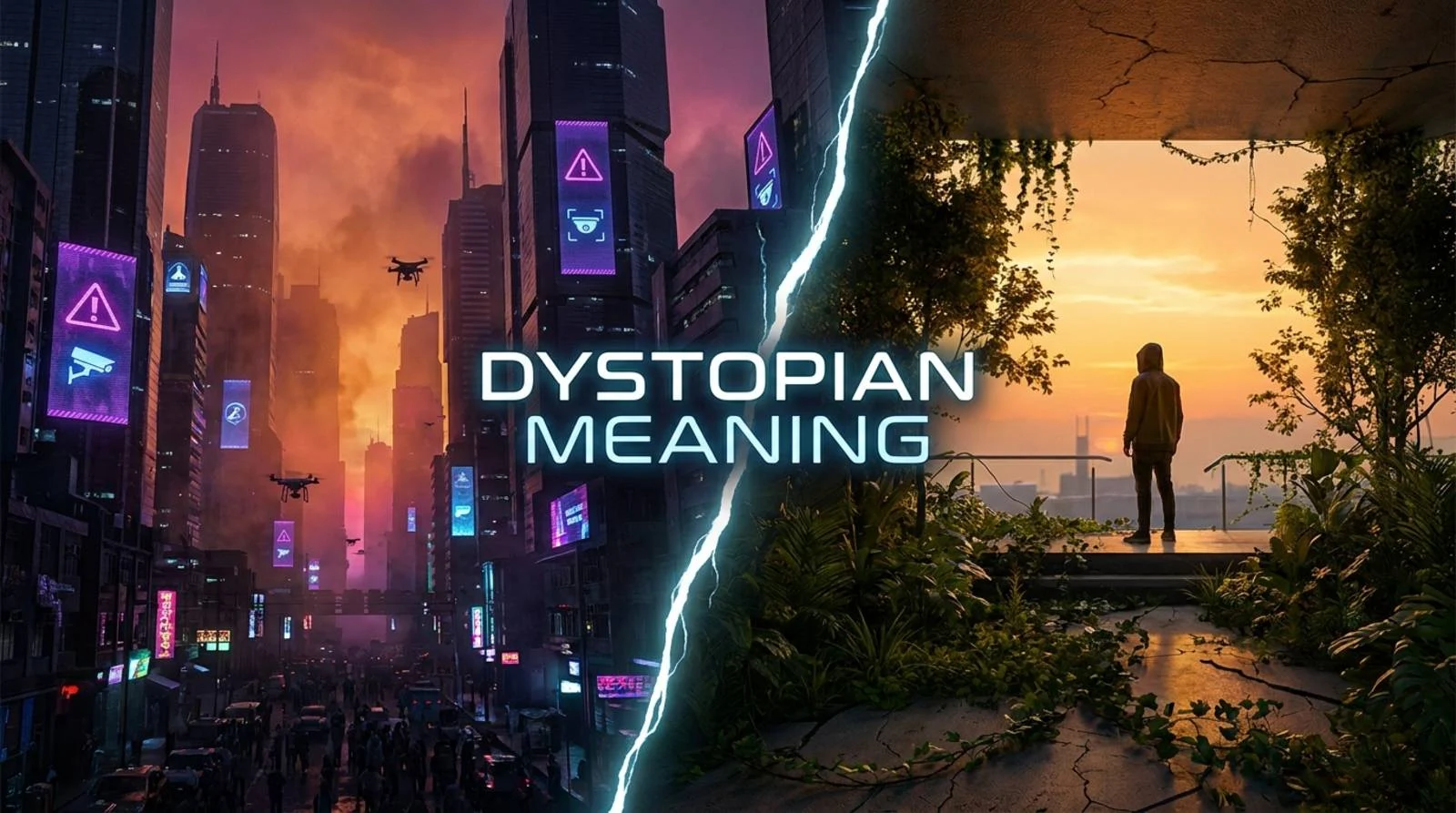
A dystopian world is not simply a dark, dangerous, or unhappy place. The word describes a society or future where life has gone seriously wrong, often because of extreme government control, inequality, surveillance, environmental destruction, technology, or the loss of personal freedom.
If a story shows citizens being constantly watched, information being controlled, independent thinking being punished, or people living under an oppressive system, you are probably looking at a dystopian society.
The word becomes especially useful when talking about books, movies, politics in fiction, technology, social problems, or imagined futures. Understanding its deeper meaning also makes it easier to recognize why famous dystopian stories feel unsettling: they often take a real-world problem and push it to an extreme.
What Does Dystopian Mean?
Dystopian means relating to an imagined society or world in which living conditions are extremely unpleasant, oppressive, frightening, or controlled.
In simple words:
Dystopian describes a world that looks like a terrible version of the future or society, where serious problems have become normal.
A dystopian setting can involve:
- Strict government control
- Constant surveillance
- Censorship
- Propaganda
- Extreme inequality
- Loss of privacy
- Restricted freedom
- Forced conformity
- Environmental disaster
- Technological control
- Social discrimination
- Fear and punishment
The important point is that dystopia is usually about society as a system, not just one person’s bad experience.
For example, a character being unhappy at work does not automatically make the workplace dystopian. But if an entire society forces people into assigned jobs, monitors their conversations, punishes independent opinions, and controls where they can live, the setting may reasonably be described as dystopian.
Dystopian Meaning in Simple English
A simple definition is:
Dystopian means describing an imagined society where people live under terrible, oppressive, or highly controlled conditions.
Here are a few easy examples:
- “The novel presents a dystopian future controlled by surveillance.”
- “The film shows a dystopian society where citizens cannot speak freely.”
- “The city becomes dystopian after technology starts controlling everyday life.”
Think of utopia as an imagined ideal society and dystopia as an imagined society where serious social problems have taken over.
What Is a Dystopia?
A dystopia is the society or world itself.
Dystopian is the adjective used to describe something connected with that world.
For example:
| Word | Meaning | Example |
|---|---|---|
| Dystopia | An oppressive or deeply troubled imagined society | The novel creates a dystopia. |
| Dystopian | Describes something belonging to such a society | It is a dystopian novel. |
| Utopia | An imagined ideal society | The story begins in a utopia. |
| Utopian | Describes something connected with an ideal society | They designed a utopian community. |
A useful way to remember the difference is:
Dystopia = the world
Dystopian = describes the world
Where Does the Word Dystopian Come From?
The word comes from dystopia, which combines the Greek prefix dys-, meaning something bad, difficult, or abnormal, with topos, meaning place.
The idea is often understood as the opposite or dark counterpart of utopia.
The term utopia became famous through Thomas More’s 1516 book Utopia, which described an imagined society. Later writers and thinkers developed darker visions of societies where attempts to create order or perfection resulted in oppression, control, or suffering.
Modern dystopian fiction often uses that contrast to ask an important question:
What happens when a society tries to solve one problem by creating an even bigger one?
That question gives the genre much of its power.
What Makes a Society Dystopian?
There is no single checklist that every dystopian story must follow. Still, many dystopian worlds share recognizable patterns.
1. Extreme Social Control
People may have little control over their daily lives.
The government, corporations, technology, or another powerful institution may decide:
- Where people work
- What they can read
- What they can say
- Who they can marry
- Where they can travel
- What information they receive
The central problem is not simply strict rules. It is the removal of meaningful personal choice.
2. Surveillance
Surveillance is one of the most recognizable dystopian themes.
Citizens might be monitored through:
- Cameras
- Tracking devices
- Digital records
- Facial recognition
- Communication monitoring
- Artificial intelligence
- Mandatory identification systems
A particularly disturbing feature is the possibility that people change their behavior simply because they believe they are being watched.
3. Censorship
A dystopian government may control access to information.
Books could be banned. News could be manipulated. Certain words might be prohibited. Historical events could be rewritten.
This creates a deeper form of control: people cannot easily challenge a system if they cannot access reliable information about it.
4. Propaganda
Propaganda presents information in a way designed to influence how people understand reality.
A dystopian society might repeatedly tell citizens:
- The government always protects them.
- The outside world is dangerous.
- Obedience creates safety.
- Questioning authority is harmful.
- The current system is the only possible system.
The power of propaganda often comes from repetition rather than one dramatic lie.
5. Loss of Individuality
Some dystopian societies demand complete conformity.
People may be expected to dress alike, behave alike, think alike, or follow predetermined social roles.
Individuality becomes suspicious.
A character who asks questions may therefore become a threat simply because independent thought challenges the system.
6. Extreme Inequality
A dystopian world may divide society into powerful and powerless groups.
One group might have:
- Wealth
- Education
- Political influence
- Better housing
- Advanced technology
- Access to food or healthcare
Another group may struggle with poverty, hunger, restricted movement, or dangerous working conditions.
The contrast makes inequality visible as part of the story’s central conflict.
7. Fear and Punishment
Fear can become a tool of social control.
Citizens may obey because they know that breaking the rules could lead to:
- Arrest
- Exile
- Loss of status
- Forced labor
- Violence
- Disappearance
- Social isolation
A dystopian story often explores what happens when fear becomes more powerful than personal freedom.
Common Dystopian Themes
Dystopian fiction is broad, but certain themes appear again and again.
| Theme | What it explores |
|---|---|
| Surveillance | Privacy and constant monitoring |
| Censorship | Control over knowledge |
| Propaganda | Manipulation of public opinion |
| Authoritarianism | Concentration of political power |
| Inequality | Unequal access to wealth and opportunity |
| Technology | The benefits and dangers of technological control |
| Environmental destruction | The consequences of ecological collapse |
| Conformity | Pressure to behave like everyone else |
| Rebellion | Resistance against oppressive systems |
| Identity | The struggle to remain an individual |
| Freedom | The value and limits of personal choice |
| Social division | Conflict between different groups |
These themes help explain why dystopian stories remain relevant across different periods. The technology or setting can change, but concerns about freedom, power, inequality, and control remain recognizable.
Dystopian Examples in Everyday Language
The word dystopian is also used outside literature.
For example:
“The empty city during the blackout looked dystopian.”
This suggests more than darkness. It creates an image of a normally busy society suddenly becoming strange, abandoned, and unsettling.
Another example:
“The idea of every conversation being recorded sounds dystopian.”
Here, dystopian describes a situation involving extreme surveillance and loss of privacy.
A third example:
“The movie imagines a dystopian future where algorithms decide people’s careers.”
This describes an imagined future in which technology has gained extraordinary control over human choices.
The word works best when the situation contains a deeper social or systemic problem.
Dystopian vs. Dark: What’s the Difference?
Something can be dark without being dystopian.
A horror story may be dark because it contains fear, death, violence, or supernatural danger.
A dystopian story usually goes further by showing a society or system that has become deeply dysfunctional, oppressive, or controlling.
For example:
Dark:
A character gets lost in an abandoned building at night.
Dystopian:
An entire city is controlled by a system that tracks every citizen and punishes anyone who leaves their assigned area.
Darkness describes the atmosphere.
Dystopia often describes the structure of society.
Dystopian vs. Post-Apocalyptic
These terms are related, but they are not interchangeable.
A post-apocalyptic story takes place after a catastrophic event such as war, disease, environmental collapse, nuclear destruction, or another civilization-changing disaster.
A dystopian story focuses on a deeply troubled society or system.
A story can be both.
For example, a novel might show civilization recovering after an environmental disaster while a powerful government controls the surviving population. The ruined world gives it a post-apocalyptic setting, while the oppressive social system gives it a dystopian dimension.
Dystopian vs. Utopian
The clearest conceptual contrast is between dystopia and utopia.
A utopian society is imagined as highly desirable or ideal. A dystopian society presents a deeply troubling version of social life.
However, the boundary can be more interesting than a simple good-versus-bad comparison.
A society may look perfect on the surface while hiding serious restrictions underneath.
For example, imagine a city where:
- Nobody is unemployed.
- Crime is almost nonexistent.
- Everyone has housing.
- Healthcare is available to everyone.
- Citizens are always safe.
At first, the society sounds ideal.
Then you discover that citizens cannot choose their careers, relationships are assigned by authorities, private conversations are monitored, and anyone who challenges the system disappears.
The apparent perfection hides the cost of control.
That tension is one of the strongest ideas in dystopian storytelling.
Examples of Dystopian Fiction
Several famous works have helped shape modern understanding of the genre.
1984 by George Orwell
George Orwell’s 1984 presents a society dominated by surveillance, propaganda, political control, and manipulation of information.
The novel explores what can happen when authorities attempt to control not only people’s actions but also their understanding of reality.
Brave New World by Aldous Huxley
Aldous Huxley’s Brave New World imagines a highly engineered society where people are conditioned from birth and social stability is maintained through technology, consumption, and pleasure.
Its approach differs from 1984. Instead of relying mainly on obvious fear and punishment, the society also maintains control through comfort and conditioning.
The Handmaid’s Tale by Margaret Atwood
Margaret Atwood’s novel depicts a society in which women’s rights and autonomy have been severely restricted.
The story uses control over reproduction, identity, language, and social roles to explore power and oppression.
Fahrenheit 451 by Ray Bradbury
Ray Bradbury’s Fahrenheit 451 explores censorship, conformity, entertainment, and the suppression of books.
The story raises questions about what happens when a society loses its appetite for difficult ideas and independent thought.
These works are useful examples because they show that dystopia does not have one single formula. Different stories focus on different fears.
Why Do Dystopian Stories Feel So Real?
The most effective dystopian fiction usually does not invent every problem from nothing.
Instead, it takes something recognizable and pushes it further.
A writer might begin with:
Surveillance → constant surveillance
Technology → technology controlling decisions
Inequality → rigid social classes
Propaganda → complete control of information
Environmental damage → civilization-threatening ecological collapse
This technique makes an imaginary world feel believable.
The reader recognizes the starting point and then sees what could happen if the problem became extreme.
That is one reason dystopian fiction can feel uncomfortable even when the story is clearly fictional.
How to Use Dystopian in a Sentence
Use dystopian as an adjective before a noun or after a linking verb.
Before a noun
- She wrote a dystopian novel.
- The film depicts a dystopian future.
- The game takes place in a dystopian city.
- They created a dystopian society ruled by artificial intelligence.
After a linking verb
- The setting feels dystopian.
- The city becomes dystopian after the government takes control.
- The fictional future is deeply dystopian.
Common phrases
- dystopian society
- dystopian world
- dystopian future
- dystopian fiction
- dystopian novel
- dystopian literature
- dystopian story
- dystopian genre
- dystopian reality
- dystopian government
Dystopian Meaning in Different Contexts
The meaning stays connected to oppression or a deeply troubled social system, but the emphasis can change depending on context.
In Literature
“Dystopian” usually refers to fiction about an oppressive or dysfunctional society.
Example:
“The novel is a classic dystopian story about government surveillance.”
In Movies
It can describe a fictional future, setting, or social system.
Example:
“The film presents a dystopian future where technology controls citizens.”
In Technology
The word can describe fears about technology becoming excessively powerful.
Example:
“Some people describe total digital surveillance as a dystopian possibility.”
This does not mean the technology itself is automatically dystopian. The description depends on how it affects society.
In Everyday Conversation
People sometimes use dystopian more loosely to describe an unsettling real-life scene.
Example:
“Seeing an empty city after the disaster felt dystopian.”
This casual use focuses on the strange or unsettling appearance of the situation.
Is Dystopian Always About the Future?
No.
Many dystopian stories are set in the future because writers use imagined futures to explore present-day concerns. But a dystopian setting does not have to be futuristic.
A fictional society can have dystopian characteristics in an alternate historical setting, an imaginary contemporary city, or a completely invented world.
The defining feature is the condition of society, not the date on the calendar.
Is Dystopian the Same as Apocalyptic?
No.
Apocalyptic generally relates to a catastrophic event or the destruction of civilization.
Dystopian focuses on a deeply troubled social order.
Consider two scenarios:
Apocalyptic:
A massive disaster destroys most major cities.
Dystopian:
After the disaster, a government creates a rigid system that controls every surviving citizen.
The first describes catastrophe. The second describes the social system that develops afterward.
A story can contain both.
What Is a Dystopian Society?
A dystopian society is an imagined social system in which serious problems such as oppression, surveillance, inequality, censorship, or loss of freedom have become part of everyday life.
One useful way to identify one is to ask:
- Who has power?
- How is that power maintained?
- What freedoms do ordinary people have?
- Who benefits from the system?
- Who suffers under it?
- What information can people access?
- What happens when someone refuses to obey?
- Can people change the system?
These questions reveal more than simply asking, “Does this world look scary?”
A dystopian society is often frightening because its problems are systematic.
Common Dystopian Story Elements
Writers often build dystopian worlds using a combination of setting, conflict, and social rules.
Controlled Information
Citizens receive carefully selected information.
Restricted Freedom
People cannot freely choose where they go, what they do, or what they say.
Powerful Institutions
A government, corporation, artificial intelligence system, religious authority, or other institution controls important aspects of life.
Social Classes
People are divided into groups with dramatically different rights or opportunities.
A Resistant Character
Many stories follow someone who begins questioning the system.
A Hidden Truth
The protagonist may discover that the society’s official story is incomplete or deliberately misleading.
A Moral Choice
The character eventually has to decide how much personal safety they are willing to sacrifice for truth, freedom, or another value.
These elements are common, but none is mandatory. A dystopian story can take many forms.
Why Is Dystopian Fiction Important?
Dystopian fiction gives writers a way to examine serious questions through imagined worlds.
Instead of directly explaining a problem, a story can show its consequences.
For example, a writer interested in privacy might create a society where every person is monitored. A writer concerned about inequality might imagine a world where social class determines every aspect of life.
This creates a useful distance between the reader and the real-world issue.
The reader can explore difficult questions through characters, choices, conflicts, and consequences.
That is why dystopian stories are often more than entertainment. They can function as social commentary, thought experiments, and warnings.
A Simple Test: Is Something Really Dystopian?
When you encounter the word online or want to use it in your own writing, ask three questions:
Is there a society or larger system?
Is that system seriously harmful, oppressive, or dysfunctional?
Does the condition affect people’s freedom, rights, choices, safety, or quality of life?
If the answer to all three is yes, dystopian may be an appropriate description.
If something is merely sad, scary, strange, or unpleasant, another word may be more precise.
That distinction makes your writing stronger.
Dystopian Meaning: Quick Summary
Dystopian describes an imagined society or world where serious social problems have become extreme, often involving oppression, surveillance, censorship, inequality, environmental destruction, or loss of freedom.
The noun dystopia refers to the troubled society itself.
The word is commonly used in literature, movies, games, and discussions about possible futures.
The easiest contrast is:
Utopia = an imagined ideal society
Dystopia = an imagined deeply troubled society
A dystopian story often takes a recognizable concern and asks what might happen if it became extreme.
FAQs
What does dystopian mean in simple words?
Dystopian means describing an imagined society where people live under oppressive, frightening, highly controlled, or deeply unfair conditions.
What is an example of dystopian?
A fictional city where cameras monitor everyone, the government controls information, citizens cannot criticize authorities, and people are punished for breaking social rules is an example of a dystopian society.
What is the difference between dystopia and dystopian?
Dystopia is the noun for the troubled or oppressive imagined society. Dystopian is the adjective used to describe something related to that society.
For example, “The novel presents a dystopia” and “The novel is dystopian.”
Is dystopian the opposite of utopian?
Dystopian and utopian are commonly treated as contrasting concepts. Utopian describes an imagined ideal society, while dystopian describes an imagined society marked by serious social problems, oppression, or loss of freedom.
What are common dystopian themes?
Common themes include surveillance, censorship, propaganda, government control, inequality, conformity, technology, environmental collapse, loss of privacy, rebellion, and individual freedom.
Is dystopian always futuristic?
No. A dystopian story can take place in the future, present, past, or an entirely fictional setting. The social conditions matter more than the time period.
Is a post-apocalyptic story dystopian?
Not necessarily. Post-apocalyptic fiction focuses on life after a civilization-changing catastrophe. It becomes dystopian when the resulting society also involves oppressive or deeply dysfunctional systems.
Can real life be called dystopian?
People sometimes use “dystopian” in everyday conversation to describe disturbing real-world situations. The word is more precise when the situation involves serious systemic problems rather than simply being unpleasant or frightening.
What is dystopian fiction?
Dystopian fiction is a genre that explores imagined societies affected by oppression, extreme control, inequality, technological domination, environmental disaster, censorship, or other major social problems.
Conclusion
The dystopian meaning goes beyond describing a dark or unpleasant world. It refers to a society where serious problems such as oppression, surveillance, inequality, censorship, or loss of freedom have become part of everyday life. That is what gives dystopian stories their deeper impact.
From novels and movies to discussions about technology and society, the word helps us describe worlds where systems meant to create order or progress have taken a harmful direction. Understanding this distinction makes it easier to recognize dystopian themes and use the word accurately in your own writing.