
The word patronize can describe two very different actions. It can mean treating someone as if they are less intelligent than you, or it can mean supporting a business by buying its products or using its services. The meaning depends on the situation, which is why the word can sometimes cause confusion.
Imagine telling a friend about a problem and hearing them reply, “Let me explain this in a way you can actually understand.” Even if they intend to help, their words may sound disrespectful. That is one example of patronizing behavior. Now imagine someone saying, “We always patronize that little bookstore on weekends.” Here, the word simply means visiting and supporting the business. Understanding these two meanings helps you recognize the word in conversations, books, workplace discussions, and everyday English.
What Does Patronize Mean?
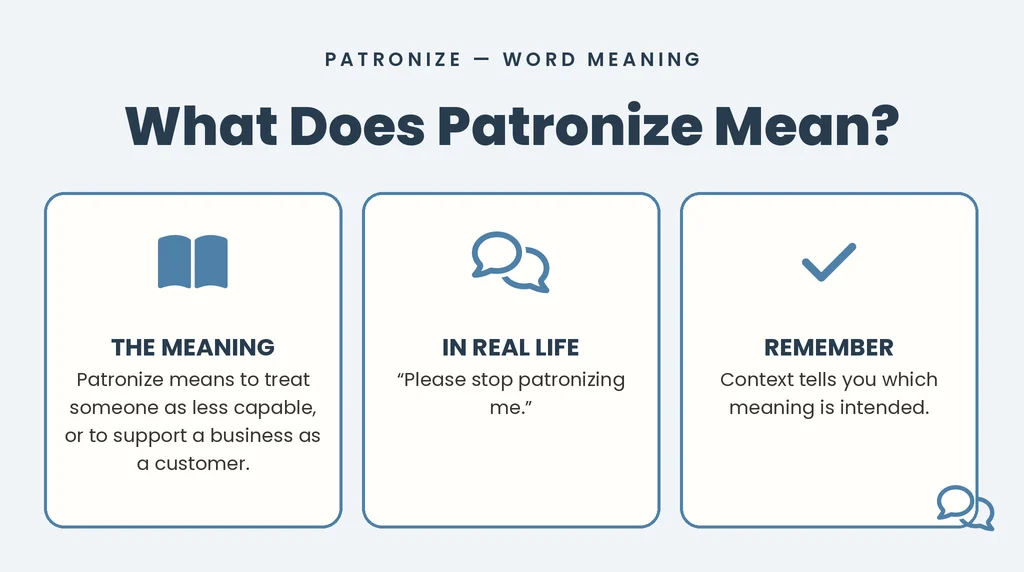
Patronize means to treat someone as if they are less capable or intelligent than you, or to support a business by being its customer. These are the two main meanings of the verb.
In everyday conversation, the negative meaning is especially noticeable when someone feels talked down to. A person may use an exaggeratedly gentle voice, explain something unnecessarily, or act as if another adult cannot make decisions independently.
For example:
- Condescending meaning: “Please stop patronizing me. I understand the situation.”
- Business meaning: “Our family patronizes the same restaurant every Friday.”
The first sentence expresses frustration with disrespectful treatment. The second describes regular customer support.
The key is context. When the word describes how a person treats another person, it may suggest superiority or disrespect. When it describes customers visiting a shop, restaurant, or service provider, it usually has a neutral or positive meaning.
The Two Main Meanings of Patronize
1. Patronize Someone: To Talk Down to Them
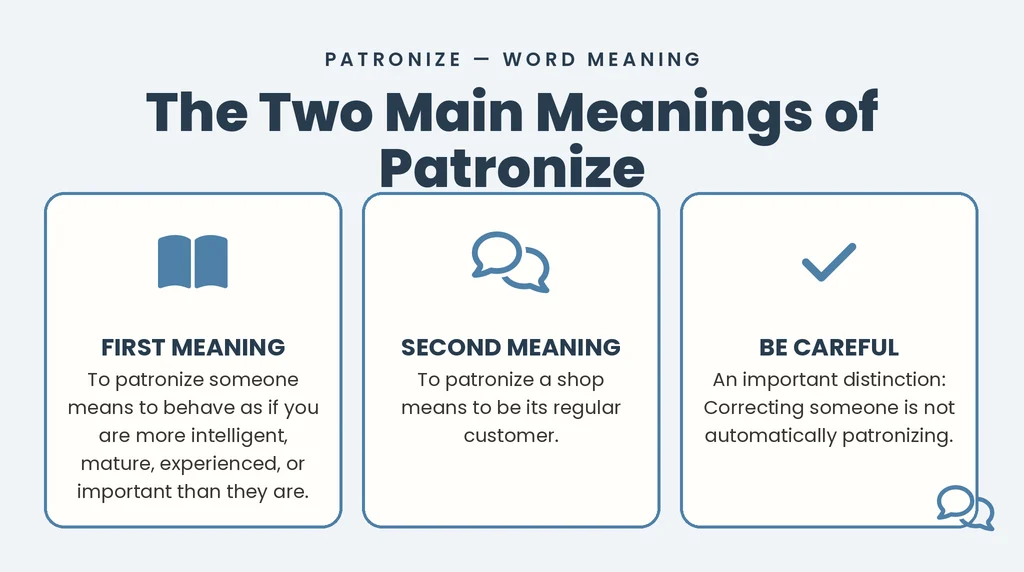
To patronize someone means to behave as if you are more intelligent, mature, experienced, or important than they are. The behavior can make the other person feel embarrassed, dismissed, or unnecessarily dependent on you.
Patronizing behavior is not always openly rude. Sometimes it sounds polite on the surface but carries an insulting message underneath.
Examples of patronizing behavior include:
- Explaining a basic task to an experienced coworker without being asked.
- Praising an adult for doing something ordinary in a childish tone.
- Interrupting someone repeatedly because you assume they do not understand.
- Saying, “That is actually quite impressive for someone like you.”
- Ignoring someone’s opinion and explaining the same point as if they have never heard it.
Consider a workplace example. A new employee suggests a useful improvement, and a senior colleague responds, “Aww, that is a cute little idea. Let the experienced people handle this.”
The colleague has not simply disagreed. The words suggest that the employee’s contribution is childish and unworthy of serious consideration. That is what makes the response patronizing.
An important distinction: Correcting someone is not automatically patronizing. Giving honest feedback, teaching a beginner, or explaining a difficult idea can be respectful. The problem arises when the speaker unnecessarily lowers the other person’s status or treats them as incapable.
2. Patronize a Business: To Support It as a Customer
The second meaning is much more straightforward. To patronize a business means to visit it, purchase its products, or use its services.
In this sense, patronize does not mean insulting or talking down to anyone. It describes customer behavior.
Examples include:
- “Local residents patronize the family-owned bakery.”
- “Tourists often patronize small businesses near the beach.”
- “I prefer to patronize independent bookstores instead of large chains.”
- “The restaurant depends on regular customers who patronize it throughout the year.”
This usage is common in formal writing, community discussions, news reports, and statements about local economies.
For instance, a community organization might encourage residents to patronize neighborhood shops. The goal is to help local businesses earn revenue and remain open.
In casual conversation, people often say support, shop at, or buy from instead. These expressions are more direct, while patronize can sound more formal.
What Does “Don’t Patronize Me” Mean?
The expression “don’t patronize me” means “don’t talk down to me or treat me as if I am less intelligent than you.”
People usually say it when they feel that someone is acting superior, giving unwanted explanations, or speaking in a fake-friendly way that feels insulting.
Here are a few realistic examples:
Example 1: Between friends
Friend A: “You need to learn how to manage your money.”
Friend B: “I know how to manage my money. Don’t patronize me.”
Friend B feels that the comment is judgmental rather than helpful.
Example 2: At work
Manager: “Good job! You finally managed to finish a simple report.”
Employee: “You don’t need to patronize me. I worked hard on that report.”
The manager’s wording turns praise into an insult by implying that the task should have been easy for the employee.
Example 3: During a disagreement
Person A: “Calm down. You clearly don’t understand the bigger picture.”
Person B: “Please don’t patronize me. I understand your point, and I disagree with it.”
Here, the second person objects to being treated as uninformed simply because they hold a different opinion.
The expression is direct and can sound confrontational. A calmer alternative is, “I understand what you’re saying, but I would appreciate it if you spoke to me as an equal.”
Patronizing Meaning: What Does It Describe?
Patronizing is the adjective commonly used to describe a tone, comment, attitude, or action that makes someone feel inferior.
For example, a person might use a patronizing tone while saying something that appears encouraging. The words alone may seem harmless, but the delivery suggests that the listener is less capable.
Compare these statements:
| Respectful statement | Patronizing statement |
|---|---|
| “Would you like help with this?” | “Let me do it. This is probably too difficult for you.” |
| “You made a mistake in this section.” | “You obviously don’t know how to do this properly.” |
| “That is a good start.” | “That is a good start for someone at your level.” |
| “I see your point, but I disagree.” | “You’ll understand when you’re older.” |
The difference is not simply politeness. It is the assumption behind the words. Respectful communication allows another person to have their own abilities and opinions. Patronizing communication often implies that the speaker knows better and the listener deserves less respect.
Common Signs of Patronizing Behavior
Patronizing behavior can be difficult to identify because it does not always involve shouting, insults, or obvious hostility. It often appears in small interactions.
Unnecessary explanations
Someone explains a familiar concept to you repeatedly, even after you have demonstrated that you understand it.
Fake or exaggerated praise
A person says, “Wow, you actually did that correctly!” The apparent compliment carries an implication that they expected you to fail.
Talking over others
A speaker interrupts, finishes another person’s sentences, or dismisses their ideas before listening to the full explanation.
Treating adults like children
Using a childish voice, overly simple language, or unwanted instructions can feel disrespectful when the other person has not asked for that kind of help.
Dismissing disagreement
Statements such as “You will understand someday” can avoid addressing an argument by suggesting that the other person is too inexperienced to have a valid opinion.
One comment alone may not prove that someone is deliberately patronizing you. People sometimes choose poor words without intending harm. Look at the broader pattern, the context, and how the person responds when you explain your concern.
Patronize in a Sentence: 12 Examples

These sentences show how the word works in different contexts.
| Sentence | Meaning |
|---|---|
| Please don’t patronize me. | Stop treating me as inferior. |
| His tone sounded patronizing. | His way of speaking seemed condescending. |
| She felt patronized during the meeting. | She felt she was being treated as less capable. |
| I dislike people who patronize others. | I dislike people who act superior to others. |
| He tried to help without patronizing her. | He offered help respectfully. |
| The teacher explained the topic without patronizing the students. | The teacher was helpful without being condescending. |
| We patronize the café near our office. | We regularly visit and spend money there. |
| Tourists patronize local restaurants. | Tourists visit and buy food from them. |
| The campaign encourages residents to patronize small businesses. | It encourages people to support local businesses. |
| Many customers patronize the shop because of its friendly service. | Many people regularly buy from the shop. |
| She thought his compliment was patronizing. | She felt the compliment was subtly insulting. |
| A good mentor guides people without patronizing them. | A good mentor helps without acting superior. |
Notice that patronize is a verb, patronizing can function as an adjective or verb form, and patronized is the past-tense form.
Patronize Synonyms and Antonyms
The best synonym depends on which meaning you want to express.
Synonyms for the condescending meaning
- Condescend: Behave as if you are superior to someone.
- Talk down to: Speak to someone as if they are less intelligent.
- Belittle: Make someone or their achievements seem unimportant.
- Disparage: Speak negatively about someone or something.
- Befriend: Not a direct synonym; it means to become friendly with someone and should not be used as a replacement for patronize in this sense.
The most useful everyday alternatives are talk down to, condescend, and belittle. They express related ideas, but they are not interchangeable in every sentence.
Synonyms for the business meaning
- Support: Help a business or organization succeed.
- Frequent: Visit a place regularly.
- Shop at: Buy products from a particular store.
- Use: Obtain a service from a business.
- Buy from: Purchase goods from a seller.
For example, “We patronize the local market” can be rewritten as “We regularly shop at the local market.”
Antonyms of patronize
For the negative meaning, useful opposites include:
- Respect
- Value
- Treat as an equal
- Take seriously
- Empower
For the business meaning, there is no single perfect antonym. Avoid, boycott, or stop buying from may express the opposite action, depending on the context.
Patronize vs. Condescend: What’s the Difference?
Patronize and condescend are closely related when they describe interpersonal behavior, but they differ in usage.
| Word | Meaning | Example |
|---|---|---|
| Patronize | Treat someone as inferior, or support a business as a customer | “He patronized his coworker during the discussion.” |
| Condescend | Act as if you are superior to another person | “She refused to condescend to her students.” |
| Patronizing | Describes behavior or language that seems superior and dismissive | “His patronizing remarks upset the team.” |
| Condescending | Describes an attitude or manner that suggests superiority | “Her condescending tone made the conversation uncomfortable.” |
In many everyday situations, patronize and condescend can communicate nearly the same idea. However, patronize has the additional business-related meaning, while condescend does not normally mean supporting a shop or restaurant.
A useful writing tip is to choose talk down to when you want simple, conversational English. Choose patronize or condescend when a more formal or precise tone suits the sentence.
How to Respond to Someone Who Patronizes You
You do not have to respond aggressively to make your point. A clear, calm statement can establish a boundary without turning the conversation into a bigger conflict.
If someone overexplains something you already know:
“I understand the basics. Could we focus on the part that needs discussion?”
If someone makes a backhanded compliment:
“I appreciate positive feedback, but that comment sounded dismissive.”
If someone repeatedly interrupts you:
“Please let me finish my point before responding.”
If a colleague treats you as inexperienced:
“I am open to feedback. I would appreciate feedback that addresses the work rather than my ability.”
If you are unsure about their intention:
“I’m not sure if you meant it this way, but that came across as patronizing.”
The last response is particularly useful because it describes the impact without automatically assuming malicious intent. It gives the other person an opportunity to clarify or change their approach.
Why Patronize Has Two Different Meanings
The two meanings developed through different uses of the same word. The business-related sense is associated with acting as a patron or customer who supports a person, institution, or establishment. The negative sense developed around the idea of someone behaving like a superior who grants attention or assistance from a position of assumed importance.
That history helps explain the apparent contradiction. A sentence about patronizing a local shop can express support, while a sentence about patronizing a coworker can express disrespect.
In modern English, context usually makes the intended meaning clear. If the object is a business, restaurant, store, or service, the word generally refers to customer support. If the object is a person, the word may refer to condescending treatment.
Frequently Asked Questions
1. What is the simple meaning of patronize?
Patronize means either to treat someone as if they are inferior or to support a business by being its customer. The surrounding sentence determines which meaning applies.
2. Is patronize a positive or negative word?
It depends on the context. When it describes talking down to someone, it is negative. When it describes supporting a business, it is generally neutral or positive.
3. What does “don’t patronize me” mean?
It means “don’t talk down to me or treat me as if I am less intelligent or capable than you.”
4. What is an example of patronizing behavior?
Telling an experienced coworker, “Let me explain this very simple task because you probably cannot handle it,” is patronizing because it unnecessarily questions the person’s ability.
5. Does patronize mean to support a business?
Yes. To patronize a business means to visit it, buy its products, or use its services. For example, “We patronize a family-owned restaurant near our home.”
6. What is the difference between patronize and patronizing?
Patronize is the base verb. Patronizing is its present participle and can also act as an adjective, as in “a patronizing comment.”
7. Is patronizing the same as being rude?
Not exactly. Rudeness includes many kinds of disrespectful behavior. Patronizing behavior specifically suggests that someone is acting superior or treating another person as less capable.
8. What are the best synonyms for patronize?
For the condescending meaning, use talk down to, condescend, or belittle. For the business meaning, use support, shop at, or buy from.
9. Can patronize be used in formal writing?
Yes. It is common in formal writing about customer behavior, local businesses, interpersonal relationships, and communication. Choose a simpler alternative if it makes the sentence easier to understand.
10. How can you tell if someone is patronizing you?
Look for repeated signs such as unnecessary explanations, dismissive compliments, interruptions, or comments that imply you are less capable. Consider the situation and the person’s overall behavior rather than judging intent from one sentence alone.
Conclusion
Understanding the meaning of patronize comes down to recognizing the situation. It can describe treating another person as if they are less intelligent or important, but it can also mean supporting a business through regular purchases or visits. Expressions such as “don’t patronize me” use the negative meaning and usually signal that someone feels talked down to. Learning the difference helps you interpret conversations accurately, choose better words, and communicate with greater respect. When using the word in your own writing, pay attention to its object and context so your intended meaning remains clear.