Nepotism meaning is simple: it refers to giving family members special treatment, especially when offering jobs, promotions, business opportunities, or positions of power. Instead of choosing someone based mainly on their skills and qualifications, a person in authority may favor a relative because of their family connection. This can create unfair advantages for some people while leaving equally capable candidates behind.
Nepotism is a common topic in workplaces, politics, entertainment, and family businesses. Sometimes, hiring a relative is a practical business decision. In other situations, it raises serious questions about fairness, trust, and equal opportunity. Understanding the difference helps you recognize nepotism in real life, use the word correctly, and understand why it can affect both individuals and entire organizations.
What Does Nepotism Mean?

Nepotism means showing favoritism toward relatives by giving them advantages, jobs, promotions, or opportunities because of their family relationship rather than their qualifications alone.
The word is often used in a negative sense because it suggests that personal connections are being placed above fairness or merit.
For example, imagine a company has two candidates for a management position. One candidate has strong experience, excellent leadership skills, and a proven record of success. The other candidate is the owner’s nephew and has little relevant experience. If the owner selects the nephew simply because of their family relationship, that decision is an example of nepotism.
However, hiring a relative does not automatically prove nepotism. A family member may genuinely be the best candidate. The important question is whether the person received unfair preferential treatment because of their relationship.
Nepotism Meaning in Simple Words
In simple words, nepotism means helping your relatives get something they might not have received through a fair selection process.
Think of it as family connections opening doors that remain closed to other equally qualified people.
Here are a few everyday examples:
- A manager gives their brother a job without considering other qualified applicants.
- A politician appoints a relative to an influential position because of their family relationship.
- A business owner promotes their daughter over a more experienced employee without a fair reason.
- A film producer gives a relative a leading role despite having stronger candidates available.
These examples share one central idea: family relationships influence decisions that should be based on relevant qualifications, performance, or transparent criteria.
What Is the Origin of the Word Nepotism?
The word nepotism comes from the Italian word nepotismo, which developed from nepote, meaning nephew or grandson. Historically, the term became associated with religious leaders, particularly certain popes, who gave influential positions and privileges to their relatives.
Some leaders appointed family members to important church offices, sometimes granting them power they might not otherwise have earned. Over time, the word expanded beyond religious institutions and came to describe favoritism toward relatives in government, business, entertainment, and other areas of public and professional life.
Today, nepotism generally refers to family-based favoritism, especially when it compromises fairness or professional standards.
Real-Life Examples of Nepotism
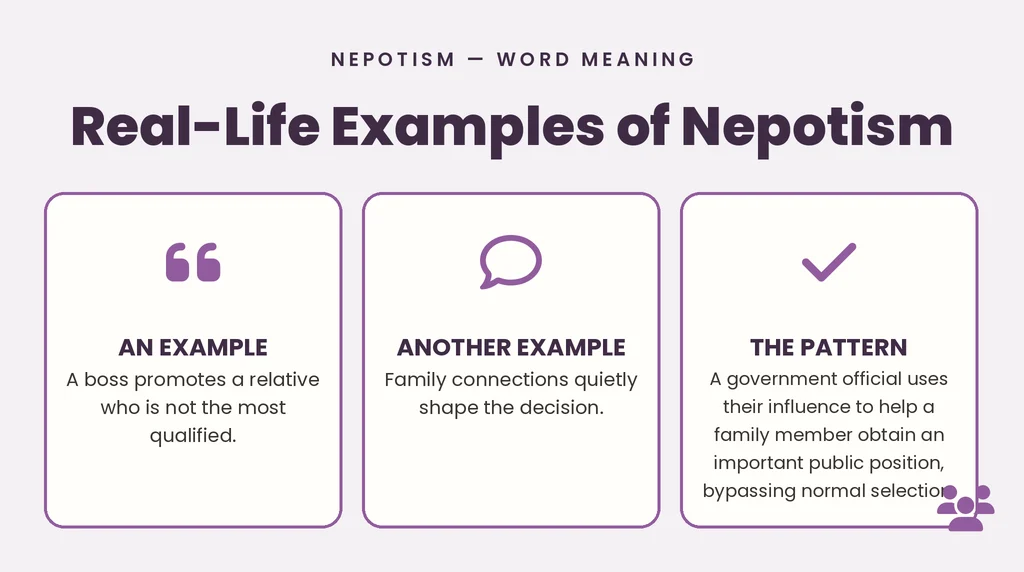
Nepotism becomes easier to understand when you see how it appears in everyday situations. The following examples are hypothetical, but they reflect common circumstances in which family connections may influence decisions.
1. Nepotism in the Workplace
A company advertises a position and receives applications from several experienced candidates. However, the manager gives the job to their cousin without conducting interviews or assessing the other applicants.
This may be workplace nepotism because the family relationship appears to determine the outcome instead of a fair evaluation.
Why it matters: Qualified employees may lose opportunities, and other workers may begin to question the company’s hiring practices.
2. Nepotism in Politics
A government official uses their influence to help a family member obtain an important public position, bypassing normal selection procedures.
This can raise concerns about accountability, public trust, and the responsible use of authority.
However, a family relationship alone does not prove wrongdoing. The selection process, legal requirements, qualifications, and applicable rules all matter.
3. Nepotism in Hollywood
Imagine a well-connected film producer helps their child secure an audition that is unavailable to other aspiring actors. The child may benefit from access, industry contacts, and early opportunities.
This situation illustrates how family connections can create advantages in the entertainment industry.
Having famous parents does not automatically mean someone lacks talent. The concern arises when access or selection is unfairly influenced by family connections.
4. Nepotism in a Family Business
A shop owner appoints their son as manager despite his lack of experience, while a long-serving employee with strong management skills is overlooked.
This could be nepotism if the son receives the position primarily because he is related to the owner.
Family businesses can also operate fairly by defining responsibilities, assessing competence, and applying clear performance standards to relatives and non-relatives alike.
5. Nepotism in Education
Suppose an administrator gives a relative preferential access to a scholarship or a position at an educational institution by bypassing established selection criteria.
This may be nepotism because the decision gives a family member an advantage in a process intended to follow fair rules.
The precise issue depends on the institution’s policies and the nature of the opportunity.
Common Signs of Nepotism
Not every decision that benefits a relative is unfair. However, certain patterns may suggest that family relationships are influencing decisions improperly.
| Possible sign | Why it raises concern |
|---|---|
| Relatives are hired without a fair assessment | Other qualified candidates may not receive equal consideration. |
| Family members receive unusually rapid promotions | Advancement may not reflect experience or performance. |
| Different standards apply to relatives | Rules may be enforced inconsistently. |
| Qualified employees are repeatedly overlooked | Personal connections may be outweighing merit. |
| Decision-makers conceal family relationships | A lack of transparency can undermine trust. |
| Relatives avoid normal accountability | Personal connections may protect them from consequences. |
One incident does not always establish nepotism. A stronger assessment looks at the decision-making process, relevant qualifications, consistent patterns, and any applicable workplace policies.
Nepotism vs. Favoritism vs. Cronyism
These terms are related, but they do not mean exactly the same thing.
| Term | Meaning | Example |
|---|---|---|
| Nepotism | Favoring relatives | A director hires their sister because she is family. |
| Favoritism | Giving someone preferential treatment for personal reasons | A supervisor repeatedly gives one employee special privileges. |
| Cronyism | Favoring friends or close associates, particularly in appointments or positions of influence | An official gives a friend a government contract because of their relationship. |
| Meritocracy | A system that emphasizes ability, achievement, and qualifications | A company selects a candidate through a consistent skills-based assessment. |
| Patronage | Providing positions or benefits, often in exchange for loyalty or political support | A political leader rewards a supporter with an appointment. |
The key distinction is the relationship involved. Nepotism specifically concerns relatives, while cronyism usually involves friends or associates. Favoritism is the broader concept and can include both.
Why Is Nepotism Considered Unfair?
Nepotism becomes a serious concern when it gives people advantages unrelated to their ability or performance. Its effects can extend beyond the person who receives the opportunity.
1. It Can Reduce Equal Opportunities
When a position is reserved informally for someone’s relative, other candidates may never receive a genuine chance to compete. This can discourage talented people who lack influential family connections.
2. It Can Damage Employee Morale
Employees expect their work, skills, and achievements to matter. If promotions consistently go to relatives of senior managers, staff may feel that hard work has little value.
3. It Can Weaken Trust in Leadership
People are more likely to trust leaders who explain their decisions and apply consistent standards. Unexplained preferential treatment can make even reasonable decisions look suspicious.
4. It Can Affect Performance
A person appointed without the necessary skills may struggle to perform the role. If poor performance goes unaddressed because of family ties, the organization may lose productivity and experienced employees.
5. It Can Reinforce Existing Privileges
Nepotism can allow advantages to pass from one generation to the next. People who already have access to wealth, influence, or professional networks may receive additional opportunities that are harder for outsiders to obtain.
These outcomes are not inevitable in every family business or organization. Their likelihood depends on how decisions are made, how performance is evaluated, and how accountability is maintained.
Is Nepotism Always a Bad Thing?
Nepotism is generally criticized when it involves unfair preferential treatment, but the wider issue requires some nuance.
A family-owned restaurant may hire a qualified relative because that person understands the business, has relevant experience, and is willing to take responsibility. This arrangement is not automatically unfair.
Similarly, a relative may be the strongest candidate for a role. The family connection does not cancel out genuine ability.
The concern grows when decision-makers:
- Ignore better-qualified candidates solely because they are not relatives.
- Bypass established hiring or promotion procedures.
- Give relatives special privileges unavailable to others.
- Protect underperforming relatives from reasonable consequences.
A fair approach is to evaluate people against the same relevant standards, disclose relationships when required, and document important decisions. These practices help distinguish legitimate family involvement from unfair nepotism.
Is Nepotism Illegal?
Nepotism is not automatically illegal in every situation. Its legality depends on the country, the type of organization, the position involved, and the circumstances of the decision.
In a private business, hiring a relative may be permitted, although company policies, contractual obligations, and applicable employment laws can impose restrictions.
Public-sector appointments may be subject to stricter recruitment requirements, conflict-of-interest rules, anti-corruption laws, or merit-based selection procedures. Certain appointments involving relatives may be prohibited or require specific safeguards.
For example, a government employee using official authority to secure an improper benefit for a family member could raise legal or disciplinary concerns. The relevant rules and evidence would determine the outcome.
If you suspect illegal favoritism, review the organization’s policies and the applicable local laws. For serious concerns, consult a qualified legal professional rather than assuming every instance of nepotism is unlawful.
Advantages and Disadvantages of Nepotism
Family involvement can offer practical benefits, but unfair favoritism can create significant problems.
| Potential advantages of hiring relatives | Potential disadvantages of nepotism |
|---|---|
| Existing family trust | Unfair access to opportunities |
| Familiarity with the business | Reduced employee morale |
| Shared long-term interests | Resentment among coworkers |
| Faster communication in some settings | Poor hiring decisions if merit is ignored |
| Continuity in a family business | Weak accountability and damaged trust |
These potential advantages relate mainly to family involvement in a business. They do not justify unfair treatment. A relative should still have the skills needed for the role and be held accountable for their performance.
Nepotism Synonyms and Antonyms
Understanding related words can help you use nepotism more accurately in conversation and writing.
Synonyms and Related Expressions
Nepotism has few exact synonyms because it specifically concerns relatives. However, these words and phrases can be useful in context:
- Family favoritism
- Preferential treatment of relatives
- Family-based favoritism
- Unfair family preference
- Partiality toward relatives
Favoritism is the closest general synonym, although it has a broader meaning.
Antonyms
There is no single perfect antonym for nepotism, but these terms express the opposite principle:
- Meritocracy
- Impartiality
- Fairness
- Equal opportunity
- Objective selection
- Fair competition
For example, a merit-based hiring process evaluates candidates using relevant skills, experience, and performance criteria rather than family connections.
How to Use Nepotism in a Sentence
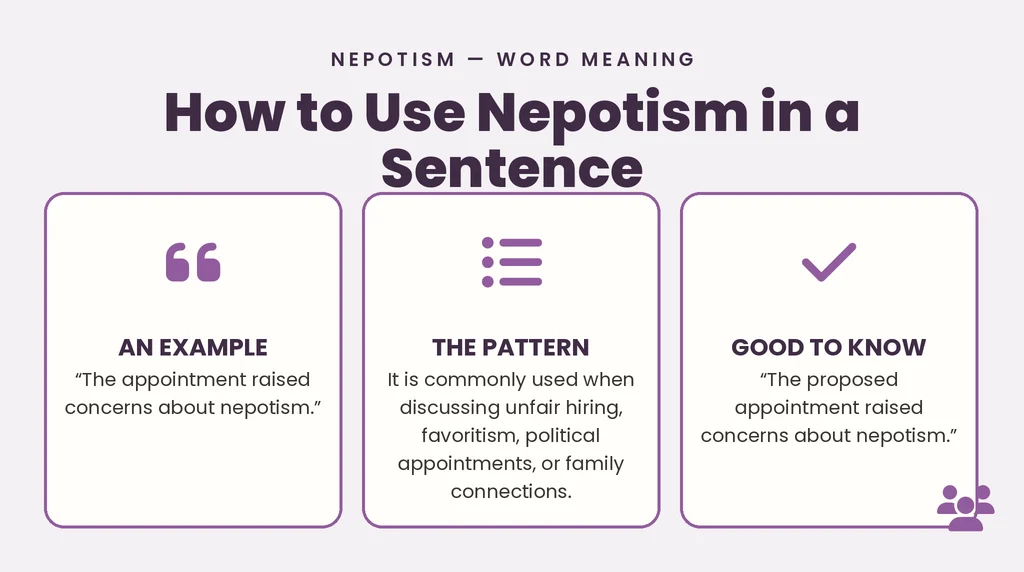
The word nepotism is a noun. It is commonly used when discussing unfair hiring, favoritism, political appointments, or family connections.
Here are some natural examples:
- Workplace: Employees complained about nepotism after the manager promoted his nephew over more experienced workers.
- Politics: The proposed appointment raised concerns about nepotism because the official had selected a close relative.
- Entertainment: The actor faced criticism over nepotism, although supporters argued that talent also played a role in the casting decision.
- Business: The company introduced transparent hiring policies to prevent nepotism from influencing recruitment.
- Education: The school investigated allegations of nepotism in its scholarship selection process.
- Everyday conversation: People suspected nepotism when the owner’s daughter received special treatment at work.
These sentences show how the word can describe an alleged problem without automatically proving that misconduct occurred.
Frequently Asked Questions
1. What is the simple meaning of nepotism?
Nepotism means favoring family members, especially by giving them jobs, promotions, or opportunities because of their family connections.
2. What is an example of nepotism?
A manager hires their unqualified brother for a position without considering other suitable applicants. If the family relationship drives the decision, it is an example of nepotism.
3. What is nepotism in the workplace?
Workplace nepotism occurs when relatives receive preferential treatment in hiring, promotions, pay, assignments, or other professional decisions because of their family relationships.
4. Is nepotism the same as favoritism?
No. Nepotism specifically involves relatives, while favoritism can involve friends, preferred employees, or other people receiving special treatment.
5. What is the difference between nepotism and cronyism?
Nepotism means favoring family members. Cronyism means favoring friends or close associates, particularly when assigning jobs, contracts, or positions of influence.
6. Is nepotism illegal?
Not always. Its legality depends on local law, the type of organization, the position involved, and the circumstances. Some public appointments and employment practices are subject to specific restrictions.
7. What is the opposite of nepotism?
Meritocracy is a useful opposite because it emphasizes qualifications, ability, and achievement. Fairness, impartiality, and equal opportunity are also relevant contrasting concepts.
8. Why is nepotism considered harmful?
Unfair nepotism can disadvantage qualified candidates, reduce employee motivation, weaken trust in leadership, and lead to poor decisions when ability is ignored.
9. Can nepotism happen in a family business?
Yes. It can occur when relatives receive positions or privileges because of family connections rather than fair criteria. However, employing a qualified relative is not automatically nepotism in the unfair sense.
10. How can a company prevent nepotism?
A company can establish clear recruitment criteria, use consistent interviews and performance evaluations, disclose relevant family relationships, and require appropriate oversight for decisions involving relatives.
Conclusion
The meaning of nepotism goes beyond simply hiring a family member. It describes a form of favoritism in which family connections influence decisions that should be made fairly. It can occur in workplaces, politics, entertainment, education, and family businesses.
The real issue is not the relationship itself but the way opportunities are distributed. When qualifications, transparent procedures, and accountability guide decisions, relatives can contribute successfully without unfairly disadvantaging others. Understanding nepotism helps people recognize the difference between legitimate family involvement and preferential treatment that undermines trust and equal opportunity.