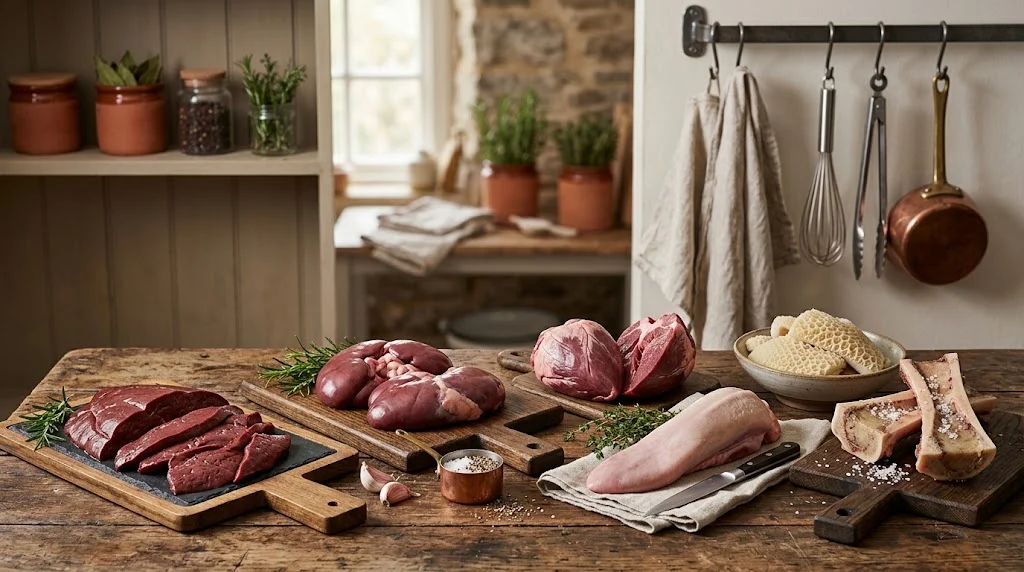
Offal means the edible internal organs and certain other edible parts of a slaughtered animal that are not usually considered ordinary muscle meat. Common examples include liver, kidneys, heart, tongue, tripe, brains, intestines, and sweetbreads.
You may have heard the word in a butcher shop, recipe, restaurant menu, or discussion about traditional food. The term can sound unfamiliar, but the idea is simple: offal refers to animal parts that can be eaten but are not usually sold as standard cuts such as steak, chops, or breast.
Different cultures have used these parts of animals for centuries. Some are prized delicacies, while others are inexpensive everyday foods. Understanding the term also helps explain dishes such as liver and onions, haggis, tripe soup, pâté, and various sausage preparations.
What Does Offal Mean?
The word offal refers broadly to the edible parts of an animal left after the main meat cuts have been removed.
In everyday food language, offal is most closely associated with organ meat. However, the two terms are not perfectly identical in every context.
For example, liver, heart, and kidneys are clearly organ meats and are commonly described as offal. Other parts, such as tripe and intestines, can also be classified as offal even though they are not organs in the same sense.
A simple way to understand it is:
Offal is a broad culinary term for edible animal organs and certain other edible parts that are not ordinary skeletal muscle meat.
The exact list can vary depending on the animal, country, butcher, and culinary tradition.
What Is Offal Meat?
Offal meat is a common informal expression for meat obtained from organs and other edible internal parts of animals.
It can come from:
- Cattle
- Sheep
- Goats
- Pigs
- Chickens
- Ducks
- Other food animals
For example, beef liver is offal, as are lamb kidneys and pork intestines.
The texture and flavor can be very different from regular muscle meat. Liver tends to have a dense, rich flavor. Tripe has a distinctive chewy texture. Heart is firm and relatively lean, while tongue becomes tender when properly cooked.
This variety is one reason offal has remained important in traditional cooking.
What Parts Are Considered Offal?
There is no single universal list that applies to every culinary tradition. Still, several parts are commonly included.
| Offal | What it is | Common culinary use |
|---|---|---|
| Liver | Large organ involved in metabolism and filtration | Fried, grilled, pâté, curries |
| Kidneys | Organs involved in filtering blood | Stews, pies, grilled dishes |
| Heart | Muscular organ that pumps blood | Grilled, roasted, stewed |
| Tongue | Muscular organ in the mouth | Boiled, braised, sliced |
| Tripe | Stomach lining, especially from cattle | Soups, stews, curries |
| Brain | Soft organ inside the skull | Fried or cooked in traditional dishes |
| Intestines | Digestive tract | Sausages, grilled dishes, stews |
| Sweetbreads | Usually thymus or pancreas | Fried, grilled, sautéed |
| Blood | Animal blood used as a food ingredient | Blood sausage and traditional dishes |
| Bone marrow | Soft tissue inside certain bones | Roasted or added to broths |
The term can also include other edible parts in particular culinary traditions.
Examples of Offal
Some types of offal are familiar even to people who rarely use the word itself.
Liver
Liver is one of the best-known forms of organ meat.
Beef, lamb, chicken, and pork liver are all eaten in different cuisines. It can be pan-fried, grilled, cooked into curries, mixed into pâté, or used in other preparations.
Liver has a strong flavor and a dense texture. Cooking it carefully matters because overcooking can make it dry and tough.
Kidneys
Kidneys have a distinctive flavor and are traditionally used in pies, stews, sauces, and grilled dishes.
They are often prepared with strong seasonings or rich sauces that complement their flavor.
Heart
Heart is technically an organ, but its structure is quite different from soft organs such as liver.
Because it is a muscular organ, heart has a firm texture. When trimmed and cooked correctly, it can be grilled, roasted, sliced, or added to stews.
Tongue
Tongue is another commonly eaten form of offal.
It is usually cooked slowly until tender. After cooking, the outer skin is removed and the meat can be sliced or incorporated into sandwiches, tacos, stews, and other dishes.
Tripe
Tripe refers to the edible lining of an animal’s stomach.
Beef tripe is particularly well known. It appears in soups, stews, noodle dishes, curries, and other traditional recipes around the world.
Tripe has a chewy texture, so preparation and cooking time can make a major difference.
Intestines
Intestines are used in many cuisines, most famously as natural sausage casings.
They can also be prepared as food themselves in certain regional dishes.
Because they are part of the digestive tract, thorough cleaning and appropriate food handling are especially important.
Sweetbreads
Despite the name, sweetbreads are not bread and are not sweet.
The culinary term usually refers to the thymus gland or pancreas of young animals.
They have a delicate texture and are often prepared by soaking, blanching, then frying, grilling, or sautéing.
Is Offal the Same as Organ Meat?
Not exactly, although the terms overlap heavily.
Organ meat specifically refers to the organs of an animal that are eaten as food. Offal is a broader culinary category that can include organs along with other edible parts.
For example:
- Liver = organ meat and offal
- Kidney = organ meat and offal
- Heart = organ meat and offal
- Brain = organ meat and offal
- Tripe = offal, but not usually described as an organ in the same way
- Intestines = offal, but generally discussed separately from organ meat
So, organ meat can be considered part of offal, but offal can cover more than organ meat alone.
This distinction is useful when reading recipes or food articles because the terminology is sometimes used loosely.
Offal vs. Regular Meat
The biggest difference is the part of the animal being eaten.
Regular meat generally refers to skeletal muscle, such as:
- Beef steak
- Lamb chops
- Chicken breast
- Pork loin
- Beef roast
Offal comes from organs or other edible internal and associated parts.
The difference is not simply about quality. Offal has its own textures, flavors, cooking methods, and culinary traditions.
In fact, some offal products can be more expensive than ordinary meat when demand is high or preparation is specialized.
Why Do People Eat Offal?
There are several reasons offal has remained part of human diets.
It Reduces Waste
Historically, using more parts of a slaughtered animal made practical sense.
If an animal had been raised and slaughtered for food, throwing away edible organs represented a loss of valuable nourishment and food.
Using different parts also allowed households to stretch limited supplies further.
It Has Distinct Flavors and Textures
Offal is not simply a substitute for steak.
Each part behaves differently during cooking. Liver, heart, tongue, and tripe all offer noticeably different eating experiences.
For people who enjoy traditional food, that variety can be part of the appeal.
It Is Important in Traditional Cuisine
Many famous dishes developed around organ meats and other forms of offal.
Examples include:
- Liver and onions
- Haggis
- Pâté
- Menudo
- Chitterlings
- Kidney pie
- Various blood sausages
- Tripe soups
- Tongue dishes
- Grilled heart
These foods show that offal is not associated with one particular country or culinary tradition.
It Can Be Economical
Some types of offal are less expensive than popular muscle cuts.
That can make them attractive to households looking for affordable ingredients.
Prices vary greatly, though. Specialty products and highly valued organs can be expensive.
Is Offal Healthy?
Offal can provide high concentrations of several nutrients, but its nutritional profile varies considerably from one type to another.
For example, liver is particularly nutrient-dense and provides nutrients such as vitamin A, vitamin B12, iron, copper, and protein.
Heart provides protein and several vitamins and minerals, while kidneys are also nutrient-rich.
However, more is not automatically better.
Some organ meats contain very high amounts of particular nutrients. Eating large amounts frequently may not be appropriate for everyone.
A balanced diet is therefore more useful than treating any single type of offal as a miracle food.
People with specific medical or dietary needs should follow advice from a qualified healthcare professional rather than relying on general nutrition claims about organ meat.
Is Offal Safe to Eat?
Offal can be safely eaten when it comes from a reliable food source and is handled, stored, and cooked properly.
This is especially important because many offal products are highly perishable.
Good food-safety practices include:
- Buy offal from a reputable food seller.
- Keep it properly refrigerated.
- Avoid leaving raw offal at room temperature for extended periods.
- Prevent raw juices from contaminating other foods.
- Clean preparation surfaces and utensils properly.
- Follow appropriate cooking guidance for the specific product.
- Take extra care with products made from organs or digestive tract material.
The safety issue is not unique to offal. Raw meat in general requires careful handling, but some organ products can spoil quickly and deserve particular attention.
How Is Offal Used in Cooking?
Different types require different cooking methods.
Quick Cooking
Some tender organs can be cooked relatively quickly.
Examples include:
- Liver
- Sweetbreads
- Thinly sliced heart
High heat can develop a browned exterior while keeping the inside from becoming excessively dry.
Slow Cooking
Other forms benefit from longer cooking.
Examples include:
- Tongue
- Tripe
- Some connective-tissue-rich cuts
Slow cooking can soften tougher textures and develop deeper flavor.
Grilling
Heart, liver, and some other offal can be grilled after suitable preparation.
The key is to match the cooking method to the structure of the particular part.
Stewing
Offal works well in stews because slow cooking can combine strong flavors and soften firmer ingredients.
This is common in many traditional food cultures.
Does Offal Taste Like Regular Meat?
Not usually.
One of the most important things to understand about offal is that there is no single “offal flavor.”
Liver can have a rich, metallic, intense taste. Heart is firmer and more similar in texture to muscle meat. Tongue is tender after slow cooking. Tripe has a relatively mild flavor but a distinctive texture.
Preparation also changes the final result.
A properly prepared dish can taste completely different from the raw ingredient.
For someone trying offal for the first time, choosing a mild preparation and a familiar dish can make the experience easier.
Offal in Different Food Cultures
Offal appears across a surprisingly wide range of cuisines.
- In British cooking, kidney pies, liver dishes, and traditional preparations of various animal parts have a long history.
- In French cuisine, organs and other less commonly used animal parts appear in classic preparations such as pâté and dishes featuring sweetbreads.
- In Mexican cuisine, tripe appears in dishes such as menudo.
Across South Asia, organ meats are commonly cooked with spices, onions, tomatoes, herbs, and other ingredients. Dishes made from liver, kidney, heart, and other parts can be found in regional cooking.
East Asian, Middle Eastern, African, and many other culinary traditions also include different forms of offal.
The ingredients and cooking methods vary, but the underlying idea is similar: parts of an animal that might be overlooked in one food culture can be valued ingredients in another.
Why Is Offal Sometimes Considered Unusual?
Modern food habits often focus on a relatively small selection of animal parts.
Supermarkets commonly display steaks, minced meat, chicken breast, pork chops, and similar cuts. Organs and other internal parts may receive far less attention.
That can make offal seem unusual to people who did not grow up eating it.
But the idea of an “unusual” food is strongly influenced by culture.
A food that feels unfamiliar in one country may be completely ordinary somewhere else.
This is one reason the word offal can carry different associations for different readers. It is a food category, but people’s reactions to it are shaped by family traditions, availability, religion, economics, and local cuisine.
Offal Meaning in British and American English
The word offal is especially common in British English and in international food writing.
In American English, people may more often use terms such as organ meat or variety meats, depending on the context.
That does not mean the meanings are completely different.
If you see “offal” in a British recipe, it may refer to organs and other edible parts of an animal. If an American food article says “organ meats,” it may be focusing more specifically on organs such as liver, heart, and kidneys.
The surrounding context usually makes the intended meaning clear.
Offal and Animal By-Products: Are They the Same?
No.
Animal by-products is a much broader term.
It can refer to materials obtained from animals that are not sold as conventional meat. Some may be edible, while others may be used for purposes outside human food.
Offal, in the culinary sense, specifically concerns edible animal parts.
So:
Offal = a food-related category
Animal by-products = a much broader category
The two terms can overlap, but they should not be treated as exact synonyms.
Common Misunderstandings About Offal
“Offal means rotten meat.”
It does not.
The word refers to particular animal parts. Fresh offal is not inherently spoiled.
“All offal is organ meat.”
Not necessarily.
Organ meat forms a major part of the category, but offal can also include parts such as tripe and intestines.
“Offal is always cheap.”
Not true.
Some products are inexpensive, but certain organs and specialty preparations can be highly valued.
“Offal is one type of meat.”
Offal is better understood as a category of edible animal parts, not one specific cut.
“Offal is only eaten in poor communities.”
This is an oversimplification.
Offal appears in home cooking, street food, traditional dishes, and fine-dining cuisine across many societies.
A Simple Example of Offal in Everyday Language
Imagine a butcher processes a cow.
The familiar muscle cuts might become:
- Steaks
- Roasts
- Minced beef
- Ribs
Other edible parts may include:
- Liver
- Kidneys
- Heart
- Tongue
- Tripe
- Bone marrow
The second group is where the term offal becomes useful.
It gives us a collective word for edible parts that fall outside the familiar category of standard muscle-meat cuts.
How to Remember the Meaning of Offal
A simple memory trick is:
Offal = edible animal parts beyond ordinary muscle meat.
If you encounter the word in a recipe, think about organs and other edible internal parts, rather than a normal steak or chop.
For example:
“The restaurant serves lamb offal.”
This means the restaurant serves edible parts of the lamb such as organs or other traditionally classified offal.
Related Terms You May See
Understanding a few related words makes food descriptions easier to follow.
| Term | Meaning |
|---|---|
| Offal | Broad culinary category covering edible organs and certain other animal parts |
| Organ meat | Meat from edible animal organs |
| Variety meats | A term sometimes used for organs and other less conventional meat parts |
| Tripe | Edible lining of an animal’s stomach |
| Sweetbreads | Culinary term commonly referring to thymus or pancreas |
| Pâté | A preparation often made with finely processed meat, liver, or other ingredients |
| Bone marrow | Soft tissue found inside certain bones |
These terms overlap in food discussions, but they do not all mean exactly the same thing.
Frequently Asked Questions
What does offal mean?
Offal means edible internal organs and certain other edible parts of a slaughtered animal that are not usually considered ordinary muscle meat. Liver, kidneys, heart, tongue, tripe, and intestines are common examples.
What is offal meat?
Offal meat is an informal term for edible animal organs and other offal used as food. It can include liver, kidney, heart, tongue, tripe, and other parts depending on the culinary context.
Is offal the same as organ meat?
No, not exactly. Organ meat specifically refers to edible organs, while offal is a broader term that can include organs as well as parts such as tripe and intestines.
What are common examples of offal?
Common examples include liver, kidneys, heart, tongue, brain, tripe, intestines, sweetbreads, and bone marrow. The exact classification can differ between culinary traditions.
Is offal safe to eat?
Offal can be safe to eat when it is sourced, stored, handled, and cooked properly. It is highly perishable, so appropriate food-safety practices are important.
Why do people eat offal?
People eat offal because it can be nutritious, economical, flavorful, and deeply connected to traditional food cultures. Using more parts of an animal can also reduce food waste.
Does offal taste different from regular meat?
Yes. Different types have very different flavors and textures. Liver can have an intense flavor, heart is firm, tongue becomes tender after slow cooking, and tripe has a distinctive chewy texture.
Is liver considered offal?
Yes. Liver is one of the most widely recognized examples of offal and is also classified as organ meat.
Is tripe considered offal?
Yes. Tripe is generally considered offal. It refers to the edible lining of an animal’s stomach, particularly in dishes made with beef tripe.
What is another word for offal?
Depending on the context, related terms include organ meat, variety meats, and edible animal organs. These terms are related but are not always exact synonyms.
Final Takeaway
The simplest offal meaning is edible animal organs and other edible parts that are not normally considered standard muscle meat.
Liver, kidneys, heart, tongue, tripe, brains, intestines, and sweetbreads are common examples. Some are nutrient-dense, some are valued for their distinctive texture and flavor, and many have a long history in traditional cuisines.
The important point is that offal is a category, not a single food. Its meaning becomes much clearer once you separate organs from ordinary muscle cuts and remember that culinary traditions can classify individual parts differently.
If you encounter the word in a recipe, menu, or food article, think of the less conventional but edible parts of an animal, especially organs and internal parts.