
Have you seen the word goy in a comment, online discussion, or conversation about Jewish culture and wondered what it actually means? The term has a long history, and its meaning can be more nuanced than a quick internet definition suggests.
Goy generally means a non-Jewish person. The word comes from Hebrew, where its original meaning is “nation” or “people.” Over time, it also developed a specific meaning in Jewish usage. You may encounter it in religious texts, everyday conversations, jokes, or online debates. Its tone depends on how it is used, who is speaking, and the situation.
Understanding the word’s background helps you distinguish an ordinary reference to someone outside the Jewish community from a sarcastic, dismissive, or offensive use. This guide explains its definition, pronunciation, origin, plural form, common examples, and role in modern internet language.
What Does Goy Mean?

The word goy usually refers to a person who is not Jewish. It is a Hebrew word that originally meant “nation” or “people,” but in later Jewish usage it came to refer to a non-Jewish person.
The word itself is not automatically an insult. In some contexts, it is used descriptively. In others, especially when delivered with contempt or used to stereotype people, it can sound derogatory.
Here is a quick overview:
| Word Detail | Explanation |
|---|---|
| Word | Goy |
| Main meaning | A non-Jewish person |
| Language of origin | Hebrew |
| Original meaning | Nation or people |
| Plural form | Goyim |
| Common context | Jewish culture, religious discussion, conversation, and online slang |
| Tone | Neutral, humorous, dismissive, or offensive depending on context |
Example: “He is a goy” may simply mean that he is not Jewish. However, the same sentence can sound disrespectful if the speaker uses it to belittle or exclude him.
What Is the Origin of the Word Goy?
The word goy comes from the Hebrew word גּוֹי, which means “nation” or “people.” Its original meaning was broader than the modern English use.
In the Hebrew Bible, the term can refer to a nation or people, including the people of Israel in certain passages. This is an important detail because the word did not originally mean only “a non-Jewish person.”
Over time, Jewish religious and everyday language increasingly used goy to refer to someone outside the Jewish community. The plural form, goyim, became familiar in Jewish contexts and later entered English usage.
The word also appears in Yiddish, a language historically spoken by many Ashkenazi Jewish communities. From there, it became more familiar to English speakers through conversation, literature, comedy, and popular culture.
Its history shows how a word can develop a more specific social meaning while retaining traces of its original definition.
What Does Goy Mean in Hebrew?
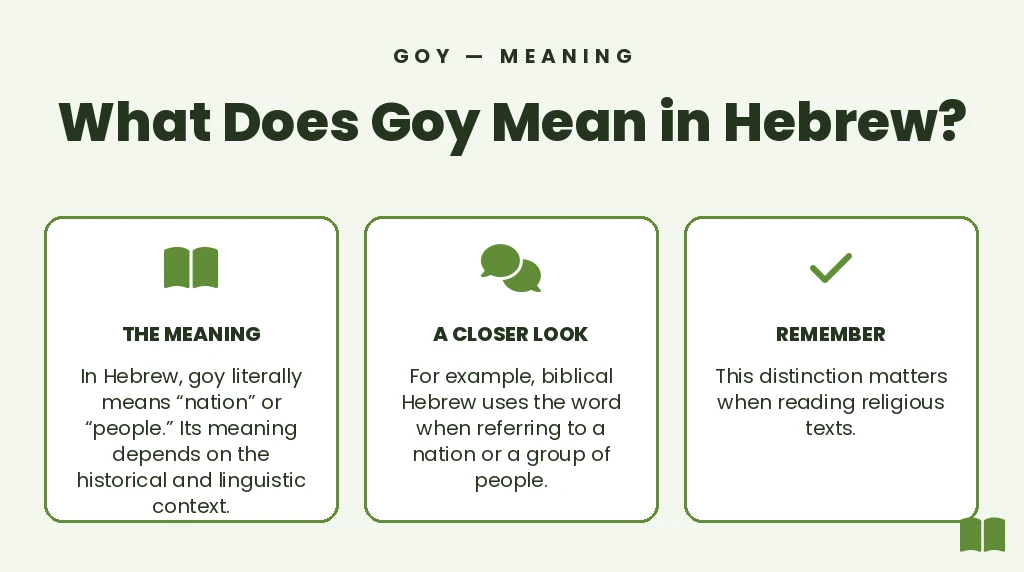
In Hebrew, goy literally means “nation” or “people.” Its meaning depends on the historical and linguistic context.
For example, biblical Hebrew uses the word when referring to a nation or a group of people. In later Jewish usage, it commonly refers to a person who is not Jewish.
This distinction matters when reading religious texts. Translating every occurrence of goy as “non-Jew” can miss the intended meaning of a passage.
In modern English conversation, however, people usually encounter the word in its more specific sense: a non-Jewish person.
What Does Goyim Mean?
Goyim is the plural form of goy. If goy refers to one non-Jewish person, goyim generally refers to multiple non-Jewish people in Jewish usage.
| Term | Meaning | Example |
|---|---|---|
| Goy | One non-Jewish person | “He is a goy.” |
| Goyim | Multiple non-Jewish people | “The discussion included references to goyim.” |
The words are closely related, but the original Hebrew meaning of goyim is “nations” or “peoples.”
You may also see goyim used in memes and online jokes. In these settings, the word can be playful, mocking, or hostile. The surrounding message is important for understanding the speaker’s intention.
Is Goy an Insult?
The word goy is not automatically an insult. Its tone depends on context, intent, and how it is directed at someone.
It can be used as a straightforward description of a person who is not Jewish. It can also be used in a joking or dismissive way. When it is used to express contempt, suggest that someone is inferior, or promote negative stereotypes, it can become offensive.
Consider these examples:
- Descriptive: “The book explains how Jewish communities historically used the word goy.”
- Casual: “My Jewish friend explained that I was a goy because I am not Jewish.”
- Dismissive: “Those people are just goyim, so their opinions do not matter.”
The third example treats people as less worthy of consideration because they are outside a group. That dismissive attitude, rather than the word alone, makes the usage offensive.
It is also important not to assume that every person who uses the term intends an insult. Some people use it neutrally, while others use it sarcastically or aggressively.
What Does Goy Mean in Slang and Online Conversations?
On social media, goy and goyim can appear in memes, political discussions, arguments, and conversations about Jewish identity.
The word generally keeps its core meaning, but the tone may change.
Common online uses include:
- Straightforward reference: Identifying someone as non-Jewish.
- Humorous use: Making a joke about differences in food, holidays, customs, or cultural knowledge.
- Self-description: A non-Jewish person using the word to describe themselves.
- Sarcasm: Mocking someone for not understanding a particular cultural or religious reference.
- Hostile use: Using the word to insult, exclude, or stereotype non-Jewish people.
Online discussions can be especially confusing because short comments often lack the context of a face-to-face conversation. A meme may use the term playfully, while a similar-looking post may use it to encourage hostility toward a group.
Do not assume that a particular meaning applies to every post. Read the full sentence, look at the surrounding conversation, and consider whether the person is describing identity or expressing contempt.
How Is Goy Used in a Sentence?

These examples show how the word can appear in different situations.
| Example Sentence | Intended Meaning or Tone |
|---|---|
| “He is a goy, not a Jewish person.” | Descriptive |
| “I learned the word goy while studying Hebrew.” | Educational |
| “The novel uses goy in a conversation about Jewish identity.” | Literary or cultural |
| “My friend jokingly called himself a goy at the holiday dinner.” | Humorous self-description |
| “They used goy as an insult during the argument.” | Derogatory |
| “The article explains the difference between goy and goyim.” | Informational |
These sentences illustrate why context matters. The same word can appear in a language lesson, a cultural discussion, or a heated argument without carrying exactly the same tone.
Goy vs. Gentile: What Is the Difference?
Goy and gentile can both refer to a person who is not Jewish, but they have different linguistic backgrounds and associations.
| Feature | Goy | Gentile |
|---|---|---|
| Origin | Hebrew | Latin |
| Common meaning | Non-Jewish person | Person who is not Jewish, particularly in Jewish contexts |
| Typical use | Jewish language, religious discussion, informal conversation, and slang | Religious writing, formal discussion, and general English |
| Tone | Can be neutral, humorous, or derogatory | Often neutral, depending on context |
| Plural | Goyim | Gentiles |
Neither term is automatically offensive in every situation. However, goy may sound more pointed or informal to some English speakers, especially when used sarcastically.
A useful rule is to choose the term that fits the context. In formal writing, “non-Jewish person” is often the clearest option when there is no reason to use a culturally specific term.
Is Goy the Same as Goyim?
No. The main difference is grammatical number.
- Goy generally refers to one non-Jewish person.
- Goyim generally refers to multiple non-Jewish people.
Both words come from Hebrew. In some religious or historical contexts, they can refer more broadly to a nation or nations.
For example, “He is a goy” refers to one person in common modern usage. “The word goyim appears in the text” refers to the plural form of the word.
Common Misunderstandings About Goy
Several misconceptions can make the word harder to understand.
1. Thinking it always means an insult
The word can be derogatory, but it is not inherently an insult in every context. Its tone depends on usage.
2. Assuming its original meaning was “non-Jew”
The original Hebrew meaning was “nation” or “people.” Its more specific meaning developed through later usage.
3. Treating goy and goyim as interchangeable
They differ in number. Goy is singular, while goyim is plural in common modern usage.
4. Assuming every online use has the same intention
A person may use the word neutrally, humorously, or aggressively. A meme or comment should be interpreted in its full context.
5. Confusing the word’s meaning with the speaker’s attitude
A term can have a descriptive meaning while still being used disrespectfully. The meaning of a word and the attitude behind its use are related, but they are not identical.
Frequently Asked Questions
1. What does goy mean in simple words?
Goy usually means a person who is not Jewish. The word comes from Hebrew and originally meant “nation” or “people.”
2. Is goy a Hebrew word?
Yes. Goy is a Hebrew word written גּוֹי. Its original meaning is “nation” or “people,” and it commonly refers to a non-Jewish person in later Jewish usage.
3. What is the plural of goy?
The plural is goyim. In common modern usage, it refers to multiple non-Jewish people. In Hebrew, the plural can also mean “nations” or “peoples.”
4. Is goy a bad word?
Not always. It can be a neutral description, a joke, or an insult. It becomes offensive when used to demean people or express prejudice.
5. What does goy mean on social media?
On social media, the term usually refers to a non-Jewish person. Depending on the post, it may be used in a cultural explanation, a meme, a joke, or a hostile comment.
6. What is the difference between goy and gentile?
Both can refer to a non-Jewish person. Goy comes from Hebrew, while gentile comes from Latin and is widely used in English religious and cultural discussions.
7. Can a non-Jewish person call themselves a goy?
Yes. Some non-Jewish people use the word to describe themselves, sometimes humorously. The appropriateness of the term still depends on the setting and the way it is used.
8. Does goy mean a foreigner?
Not exactly. Its original Hebrew meaning is “nation” or “people,” but its common modern Jewish usage refers to a non-Jewish person. A non-Jewish person does not necessarily have to be a foreigner.
9. How do you pronounce goy?
In English, it is commonly pronounced to rhyme with “boy.” Pronunciation can vary slightly by language and community.
10. Should I use goy in formal writing?
Use it when discussing Hebrew, Jewish culture, religious texts, or the term itself. In general writing, “non-Jewish person” may be clearer and less likely to be misunderstood.
Conclusion
Understanding the meaning of goy starts with its Hebrew origin, where it traditionally means a nation or people and, in Jewish religious contexts, often refers to a non-Jewish person. Today, the word can appear in religious discussions, historical texts, online conversations, and internet slang. Its meaning and tone depend on the speaker, the situation, and the way it is used.
The term is not automatically an insult, but it can sound disrespectful or offensive when used to mock or target Jewish people or non-Jews. When you encounter goy online, pay attention to the surrounding conversation instead of assuming a single meaning. Understanding its cultural background helps you interpret the word more accurately and discuss it with greater awareness and respect.