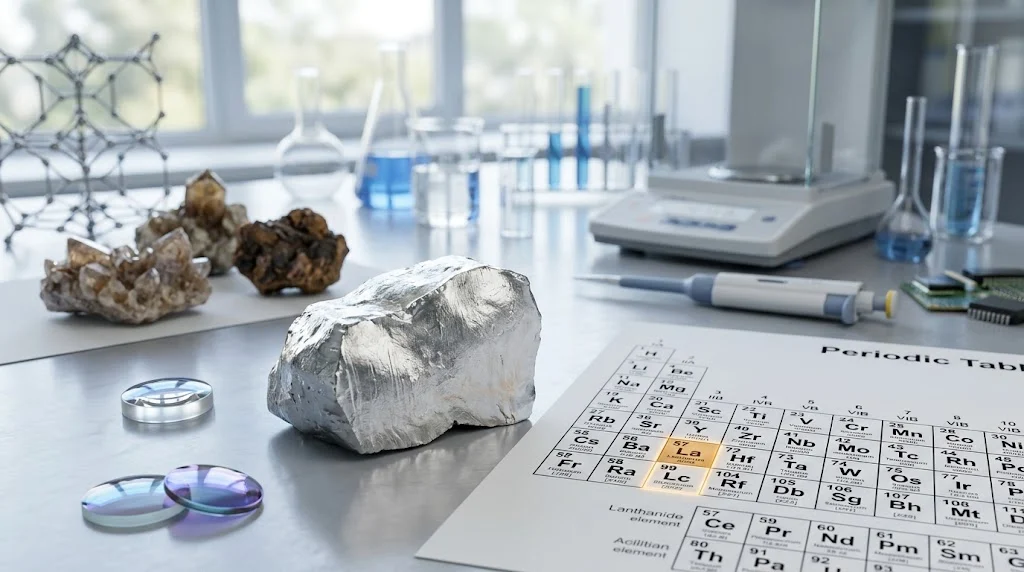
If you have come across the word lanthanum in chemistry, science, electronics, or materials research, its meaning is quite specific. Lanthanum is a chemical element with the symbol La and atomic number 57. It is a soft, silvery-white metal commonly associated with the rare-earth elements and the lanthanide series.
The word may sound unfamiliar, but lanthanum has some surprisingly practical uses. Its compounds can be found in optical glass, catalysts, batteries, ceramics, and other advanced materials. Understanding the lanthanum meaning therefore involves more than memorizing its place on the periodic table. Its properties help explain why scientists and manufacturers use it in particular technologies.
What Does Lanthanum Mean?
Lanthanum means a chemical element represented by the symbol La, with atomic number 57.
It is a soft, silvery-white metal that belongs to the group of elements commonly called rare-earth elements. Lanthanum is also closely connected with the lanthanide series, a group of chemically similar elements found near the bottom of the periodic table.
Here are the basic facts:
| Property | Information |
|---|---|
| Element | Lanthanum |
| Symbol | La |
| Atomic number | 57 |
| Atomic mass | About 138.91 u |
| Element type | Metal |
| Category | Rare-earth element |
| Series | Lanthanide series |
| Appearance | Silvery-white |
| Standard oxidation state | +3 |
| Period | 6 |
| Block | d-block |
| Chemical symbol | La |
The simplest way to remember it is:
Lanthanum is element 57, represented by La, and is a soft, reactive rare-earth metal.
Lanthanum Definition in Chemistry
In chemistry, lanthanum is defined as a metallic chemical element with 57 protons in the nucleus of each atom.
The atomic number is especially important because it identifies the element. An atom with 57 protons is lanthanum. Changing the number of protons would produce a different element.
Lanthanum commonly forms compounds in the +3 oxidation state. This means that in many of its compounds, lanthanum behaves as La³⁺.
For example, lanthanum can combine with oxygen to form lanthanum oxide, written as La₂O₃.
Its chemistry is strongly influenced by its tendency to lose electrons and form stable ionic compounds.
What Is Lanthanum on the Periodic Table?
Lanthanum has the atomic number 57 and is located in period 6 of the periodic table.
Its position is closely associated with the lanthanide elements. This is one reason you may see lanthanum discussed alongside elements such as cerium, praseodymium, neodymium, and others.
The classification can sometimes look confusing because different periodic-table arrangements treat the exact boundaries of the lanthanide series differently. In many educational contexts, lanthanum is included with the lanthanides, while some tables place it at the start of the lanthanide row and others distinguish it from the 4f-block elements.
For someone learning chemistry, the practical point is simple:
Lanthanum is a rare-earth element closely associated with the lanthanide series.
What Does the Symbol La Stand For?
The chemical symbol La stands for lanthanum.
Chemical symbols usually contain one or two letters. The first letter is capitalized, while the second letter, when present, is lowercase.
So:
- La = Lanthanum
- 57 = Atomic number
- La³⁺ = Common lanthanum ion
- La₂O₃ = Lanthanum oxide
The symbol is useful because scientific formulas often use La instead of writing the full word lanthanum.
Where Does the Name Lanthanum Come From?
The name lanthanum comes from the Greek word lanthanein, associated with the idea of being hidden or lying unnoticed.
The name was chosen because the element was initially found in association with another rare-earth material and was difficult to distinguish from it.
Lanthanum was identified in the 19th century by Swedish chemist Carl Gustaf Mosander. Its discovery reflects an interesting period in chemistry when scientists were gradually separating and identifying several closely related rare-earth elements.
The name therefore has a connection to the difficulty scientists faced when trying to separate these chemically similar substances.
Is Lanthanum a Rare-Earth Element?
Yes. Lanthanum is generally classified as a rare-earth element.
The term “rare earth” can be misleading. These elements are not necessarily extremely rare in Earth’s crust. The difficulty often lies in finding them in concentrated deposits and separating them from other elements with similar chemical behavior.
Lanthanum occurs naturally in minerals that also contain other rare-earth elements.
Important sources include:
- Monazite
- Bastnäsite
- Other rare-earth-bearing minerals
Lanthanum is usually obtained as part of the processing of rare-earth mineral deposits rather than from large deposits containing only pure lanthanum.
Is Lanthanum a Metal?
Yes. Lanthanum is a metal.
Freshly exposed lanthanum has a silvery-white appearance. It is relatively soft and can react with air and moisture.
Like many reactive metals, it can gradually develop a surface layer when exposed to the environment.
Its metallic nature also helps explain some of its applications in alloys, materials, and industrial chemistry.
Key Properties of Lanthanum
Understanding its properties makes its uses much easier to understand.
1. It Is Soft
Lanthanum is relatively soft compared with many common structural metals. This makes it different from materials such as iron or hardened steel.
2. It Is Reactive
Lanthanum readily reacts with several substances, including oxygen and water under suitable conditions.
Because of this reactivity, elemental lanthanum requires appropriate storage and handling.
3. It Commonly Forms La³⁺
The +3 oxidation state is particularly important in lanthanum chemistry.
Many lanthanum compounds contain lanthanum in this oxidation state.
4. It Has a Silvery Appearance
Fresh lanthanum metal has a bright, silvery-white appearance. Like many reactive metals, its surface can change after exposure to air.
5. It Has Atomic Number 57
This is one of the easiest facts to use when identifying the element.
Atomic number 57 = lanthanum.
Lanthanum Electron Configuration
The electron configuration of lanthanum is commonly written as:
[Xe] 5d¹ 6s²
This notation means that the electron configuration starts from the configuration of xenon and adds the outer electrons associated with lanthanum.
Electron configuration helps chemists understand how an element interacts with other atoms.
For basic learning, you do not need to memorize the configuration to understand the meaning of lanthanum. It becomes more useful when studying atomic structure, periodic trends, bonding, and the chemistry of the rare-earth elements.
What Is Lanthanum Used For?
Lanthanum has several important industrial and scientific uses. Some applications are highly specialized, while others are connected to products people may encounter indirectly.
Optical Glass and Camera Lenses
One notable use of lanthanum compounds is in specialized optical glass.
Lanthanum-containing glass can help produce optical materials with useful refractive properties. This has made lanthanum important in certain high-quality lenses and optical systems.
The connection is practical: changing the composition of glass can change how light travels through it.
Petroleum Refining
Lanthanum-containing materials can be used in catalysts for petroleum refining.
Catalysts help chemical reactions happen more efficiently without being consumed in the same way as ordinary reactants.
Lanthanum compounds can play a role in catalyst formulations used in industrial processes.
Nickel-Metal Hydride Batteries
Lanthanum has also been used in nickel-metal hydride battery materials.
Some NiMH battery designs use rare-earth-containing alloys as hydrogen-storage materials. Lanthanum can be part of these alloy systems.
This is a good example of how the chemistry of an unfamiliar element can connect to everyday technology.
Hydrogen Storage
Certain lanthanum-based alloys can absorb hydrogen.
This property has attracted interest in areas involving hydrogen storage and related materials research.
The important idea is that lanthanum does not simply “hold” hydrogen like a container. Its atomic structure and alloy chemistry allow hydrogen to interact with the material in a useful way.
Ceramics
Lanthanum compounds can be incorporated into certain advanced ceramic materials.
These materials can have specialized electrical, thermal, optical, or structural properties depending on their composition and processing.
Electronic and Advanced Materials
Lanthanum compounds are also used in research and manufacturing involving advanced materials.
For example, lanthanum-containing oxides can be studied for their dielectric, optical, catalytic, and electronic properties.
This makes lanthanum relevant to materials science far beyond traditional chemistry classrooms.
Common Lanthanum Compounds
Lanthanum rarely appears in everyday conversation as a pure metal. Its compounds are often more important in practical applications.
Here are some examples:
| Compound | Formula | General significance |
|---|---|---|
| Lanthanum oxide | La₂O₃ | Used in ceramics, glass, and materials research |
| Lanthanum carbonate | La₂(CO₃)₃ | A commercially important lanthanum compound |
| Lanthanum chloride | LaCl₃ | Used in chemical and laboratory applications |
| Lanthanum fluoride | LaF₃ | Used in optical and materials applications |
| Lanthanum hydroxide | La(OH)₃ | Used in chemical research and specialized applications |
These compounds have different properties, so the word lanthanum does not automatically mean that every material containing lanthanum behaves like elemental lanthanum metal.
That distinction matters in chemistry.
Lanthanum vs. Other Rare-Earth Elements
Lanthanum belongs to a family of elements with many similarities.
For example, lanthanum, cerium, praseodymium, and neodymium can all occur in rare-earth minerals and can show similar chemical behavior.
This similarity is one reason rare-earth separation can be technically challenging.
At the same time, each element has its own atomic structure and properties.
For example:
- Lanthanum has atomic number 57.
- Cerium has atomic number 58.
- Praseodymium has atomic number 59.
- Neodymium has atomic number 60.
A difference of just one proton changes the identity of the element.
Lanthanum vs. Lanthanides
The terms lanthanum and lanthanide are related but do not mean the same thing.
Lanthanum is the name of one specific element.
Lanthanides refers to a group or series of closely related elements in the periodic table.
This is similar to the difference between an individual member and the larger group it belongs to.
For example:
Lanthanum is an element. Lanthanides are a group of related elements.
The exact definition of the lanthanide series can vary slightly among chemistry references, especially regarding whether lanthanum or lutetium is included at the boundaries. This is why different periodic tables can look slightly different.
Where Is Lanthanum Found?
Lanthanum occurs naturally in Earth’s crust.
It is not normally found as large quantities of isolated elemental lanthanum. Instead, it is found within minerals containing mixtures of rare-earth elements.
Two important mineral sources are:
- Monazite
- Bastnäsite
These minerals can contain several rare-earth elements together.
Extracting lanthanum therefore involves processes designed to separate it from chemically similar elements. Modern rare-earth processing can involve multiple stages of mineral treatment, chemical separation, purification, and conversion into useful compounds.
Why Is Lanthanum Important?
Lanthanum is important because its chemical and physical properties make it useful in areas where ordinary materials may not provide the same performance.
Its value comes from specific characteristics rather than from simply being a rare element.
For example:
Optical properties: useful for specialized glass.
Chemical behavior: useful in catalysts and compounds.
Hydrogen interaction: useful in certain battery and storage materials.
Material properties: useful in ceramics and advanced compounds.
This is an important lesson in materials science. An element can be valuable because of a very specific property that becomes useful when the element is combined with other materials.
Is Lanthanum Dangerous?
Lanthanum and its compounds should be handled according to appropriate chemical-safety procedures.
The risk depends on the specific material, concentration, physical form, and route of exposure. Elemental lanthanum is reactive, while individual lanthanum compounds can have different hazard profiles.
For laboratory or industrial use, the relevant Safety Data Sheet (SDS) should be consulted for the exact substance being handled.
It is not accurate to treat every lanthanum-containing material as having identical safety characteristics.
Lanthanum in Simple Words
If you need a quick explanation, remember this:
Lanthanum is a soft, silvery-white chemical element with the symbol La and atomic number 57. It is a rare-earth metal closely associated with the lanthanide series and is used in materials such as specialized optical glass, catalysts, batteries, and ceramics.
That single definition covers the central meaning while leaving room to explore its chemistry and applications.
Lanthanum Meaning in Different Contexts
The word can appear in several types of scientific content.
In Chemistry
Lanthanum refers to element 57, symbol La.
In the Periodic Table
It identifies a metallic element in period 6 associated with the rare-earth and lanthanide elements.
In Materials Science
Lanthanum usually refers to an element or compound being used to modify or create materials with particular optical, electrical, catalytic, or structural properties.
In Battery Technology
Lanthanum can refer to a component of rare-earth-containing alloys used in some nickel-metal hydride battery systems.
In Optics
Lanthanum often appears in discussions of specialized glass and optical materials.
The surrounding context tells you what role lanthanum is playing.
Quick Facts About Lanthanum
- Name: Lanthanum
- Symbol: La
- Atomic number: 57
- Atomic mass: About 138.91 u
- Element type: Metal
- Classification: Rare-earth element
- Common oxidation state: +3
- Appearance: Silvery-white
- Period: 6
- Major mineral sources: Monazite and bastnäsite
- Notable uses: Optical glass, catalysts, batteries, ceramics, advanced materials
- Name origin: From a Greek term associated with being hidden or unnoticed
Common Questions
What is the meaning of lanthanum?
Lanthanum is the name of a chemical element with the symbol La and atomic number 57. It is a soft, silvery-white rare-earth metal associated with the lanthanide series.
What is the symbol of lanthanum?
The chemical symbol for lanthanum is La. The L is capitalized and the a is lowercase.
What is the atomic number of lanthanum?
Lanthanum has an atomic number of 57, meaning every lanthanum atom contains 57 protons.
Is lanthanum a rare-earth element?
Yes. Lanthanum is generally classified as a rare-earth element and is closely associated with the lanthanide series.
Is lanthanum a metal?
Yes. Lanthanum is a soft, silvery-white metal that is chemically reactive.
What is lanthanum used for?
Lanthanum is used in specialized optical glass, catalysts, battery materials, ceramics, hydrogen-storage alloys, and advanced materials.
Where is lanthanum found?
Lanthanum occurs naturally in rare-earth minerals, particularly monazite and bastnäsite, where it occurs alongside other rare-earth elements.
Why is lanthanum called lanthanum?
The name comes from the Greek lanthanein, connected with the idea of something being hidden or unnoticed. The name reflects the difficulty of recognizing and separating the element from closely related rare-earth materials.
What is the common oxidation state of lanthanum?
The most common oxidation state of lanthanum is +3. Many of its chemical compounds contain La³⁺ ions.
Final Takeaway
The lanthanum meaning is straightforward: it is a chemical element identified by La and atomic number 57. It is a soft, reactive, silvery-white metal generally grouped with the rare-earth elements and closely associated with the lanthanide series.
What makes lanthanum interesting is what happens beyond the definition. Its chemistry gives it practical roles in optical glass, catalysts, batteries, ceramics, and advanced materials. It also occurs naturally in minerals such as monazite and bastnäsite, usually alongside other rare-earth elements.
So, if you encounter “lanthanum” in a chemistry textbook, scientific article, or materials discussion, think of element 57 and a versatile rare-earth metal whose properties become especially useful when incorporated into specialized materials and compounds.