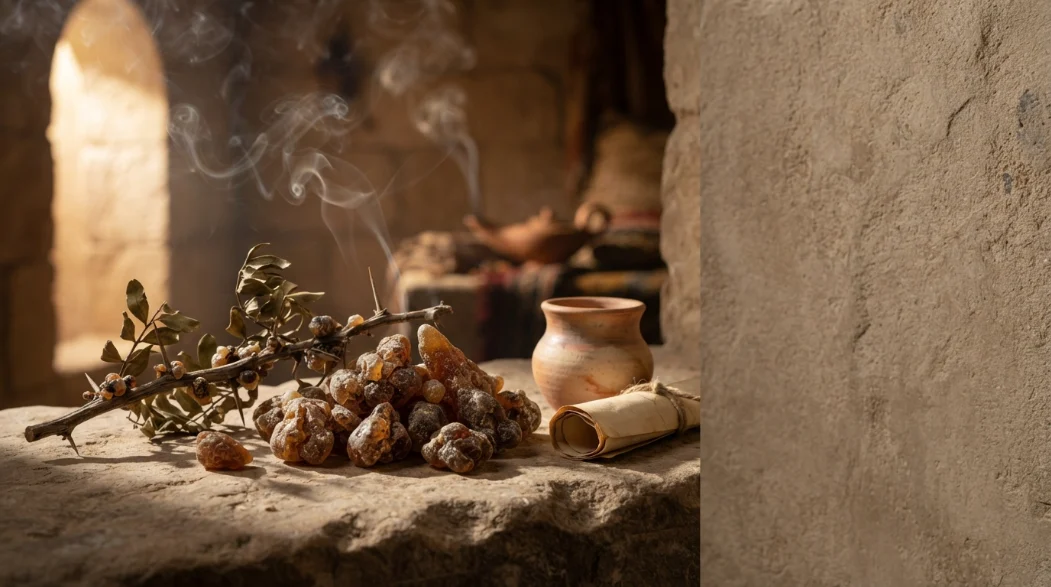
If you are looking for the myrrh meaning, myrrh is a fragrant natural resin that comes from certain Commiphora trees and shrubs. For thousands of years, people have used it in incense, perfume, traditional remedies, religious ceremonies, and burial practices.
The word carries an even deeper meaning in biblical and religious contexts. Myrrh appears several times in the Bible and is especially remembered as one of the three gifts brought to Jesus by the Magi, alongside gold and frankincense. Its connection with anointing, suffering, death, burial, and sacred fragrance gives it a rich symbolic history.
Today, myrrh can refer to the resin itself, myrrh oil, its fragrance, or the symbolism attached to it. Understanding its history makes the familiar phrase “gold, frankincense, and myrrh” much more meaningful.
What Is Myrrh?
Myrrh is an aromatic resin produced by trees and shrubs belonging mainly to the Commiphora genus. The resin comes from the plant’s natural sap and hardens into small, irregular pieces after exposure to air.
It is often brown, reddish-brown, amber-colored, or dark in appearance. Its fragrance is warm, earthy, balsamic, and slightly bitter.
Unlike a flower that releases its scent directly through petals, myrrh comes from a resinous material produced by a tree. This unusual origin is part of what made it valuable in ancient cultures.
What Does Myrrh Look Like?
Raw myrrh usually appears as hardened pieces or small lumps of resin.
Its appearance can vary depending on the species, harvesting method, and quality. Some pieces are pale and translucent, while others are darker and more opaque.
When heated or burned, myrrh produces a distinctive aromatic smoke. It can also be processed into oils, extracts, perfumes, and other preparations.
What Does Myrrh Smell Like?
Myrrh has a complex fragrance rather than a simple sweet scent.
People commonly describe it as:
- Warm
- Earthy
- Woody
- Balsamic
- Slightly smoky
- Resinous
- Bitter-sweet
- Deep and medicinal
Its scent is one reason myrrh became important in incense, perfumery, and religious ceremonies.
Myrrh Meaning in Simple Words
In simple terms, myrrh means a fragrant tree resin valued for its scent, practical uses, and religious significance.
The physical meaning is relatively straightforward. The symbolic meaning is more layered.
Across history, myrrh has been associated with:
| Meaning or association | Why it is connected with myrrh |
|---|---|
| Fragrance | Myrrh produces a distinctive aromatic scent |
| Worship | It was used in sacred and ceremonial settings |
| Anointing | Myrrh appeared in ancient anointing preparations |
| Healing | It had a history of traditional medicinal use |
| Purification | Aromatic resins were used in ritual settings |
| Burial | Myrrh was associated with preparations connected to the dead |
| Sacrifice | Its biblical symbolism can point toward suffering and death |
| Preciousness | Myrrh was a valuable trade product in the ancient world |
The exact meaning depends heavily on the context in which the word appears.
Biblical Meaning of Myrrh
The biblical meaning of myrrh is especially important because myrrh appears in several different contexts throughout Scripture.
It was not simply a pleasant-smelling substance. Myrrh was a valuable aromatic material used in perfumes, sacred preparations, and burial-related practices.
In the Bible, its associations can include beauty, love, worship, anointing, suffering, death, and burial.
This makes myrrh particularly interesting because its symbolism can shift depending on the passage.
Myrrh in the Old Testament
Myrrh appears in passages connected with fragrance, beauty, perfume, and sacred use.
For example, myrrh is mentioned in descriptions of fragrant substances and perfumes. In the Song of Solomon, it appears in poetic descriptions of love and beauty.
Myrrh was also included among the ingredients used in the sacred anointing oil described in Exodus.
This shows that myrrh had a place in both everyday luxury and religious practice.
Myrrh in the New Testament
Myrrh becomes especially significant in the New Testament because of its connection with Jesus.
The Gospel of Matthew describes the Magi bringing three gifts to Jesus:
- Gold
- Frankincense
- Myrrh
The gifts have traditionally been given symbolic interpretations. Gold is commonly connected with kingship, frankincense with worship or divinity, and myrrh with suffering, death, and burial.
The text itself does not provide a detailed explanation assigning one symbolic meaning to each gift. Those interpretations developed through Christian tradition and reflection on the broader biblical use of these substances.
That distinction matters when discussing the biblical meaning of myrrh accurately.
Why Was Myrrh Given to Jesus?
One of the most common questions about myrrh is why it was among the gifts brought by the Magi.
The Gospel of Matthew simply records myrrh as one of the gifts. It does not directly say, “myrrh represents death.”
Later Christian interpretation connected myrrh with Jesus’ future suffering and death because myrrh was associated with burial and was also used in contexts involving the body after death.
This creates a striking contrast.
The gift was presented to a newborn child, yet the substance could later be connected with his death and burial. Christian readers have therefore often viewed myrrh as a symbolic foreshadowing of Jesus’ suffering and sacrifice.
It is a theological interpretation rather than a statement explicitly explained by the Gospel of Matthew.
Gold, Frankincense, and Myrrh Meaning
The three gifts of the Magi have become one of the best-known symbolic groups in Christian tradition.
| Gift | Common traditional symbolism |
|---|---|
| Gold | Kingship, wealth, royalty |
| Frankincense | Worship, holiness, divinity |
| Myrrh | Suffering, death, burial, sacrifice |
These meanings should be understood as traditional Christian interpretations, not as a detailed explanation provided directly in the biblical passage.
The combination is powerful because each substance had a different cultural and practical value.
Gold represented wealth and kingship. Frankincense was strongly connected with worship and sacred fragrance. Myrrh carried associations with perfume, anointing, medicine, and burial.
Together, they have been interpreted as pointing toward different aspects of Jesus’ identity and mission.
Spiritual Meaning of Myrrh
The spiritual meaning of myrrh often centers on the idea that something valuable can emerge through difficult experiences.
Because of its biblical associations with anointing, suffering, and burial, myrrh can symbolize:
- Sacrifice
- Spiritual devotion
- Endurance
- Suffering with purpose
- Transformation
- Reverence
- Mortality
- Hope beyond suffering
For many Christian readers, myrrh has a particularly deep connection with sacrifice.
Its story moves from fragrance and sacred use toward the painful realities of human mortality. That makes it a natural symbol for the tension between beauty and suffering.
Myrrh as a Symbol of Sacrifice
One of the strongest traditional interpretations of myrrh is sacrifice.
Its association with Jesus’ burial makes it a reminder of the cost of his earthly mission within Christian theology.
This is why myrrh can carry a very different emotional meaning from gold. Gold naturally suggests celebration and glory. Myrrh can suggest the difficult road behind that glory.
What Does Myrrh Symbolize?
The symbolism of myrrh changes according to cultural and religious context, but several themes appear repeatedly.
Beauty and Fragrance
Myrrh was valued for its aroma, so it naturally became associated with beauty, luxury, and pleasant fragrance.
Worship and Sacred Use
Its presence in ancient religious practices gave myrrh a strong connection with worship and holiness.
Healing and Traditional Medicine
Myrrh has a long history of traditional medicinal use, contributing to its association with healing.
Suffering and Mortality
Biblical references and later Christian traditions connect myrrh with death and burial.
Sacrifice
In Christian interpretation, this association can point toward the sacrifice of Jesus.
Transformation
A tree produces resin that hardens, releases fragrance, and can be transformed into different preparations. Symbolically, this has sometimes been used to represent endurance and transformation.
What Was Myrrh Used For?
Myrrh had many uses in the ancient world. Its value was not limited to religion.
Common historical uses included:
- Incense
- Perfume
- Anointing preparations
- Burial preparations
- Traditional medicine
- Personal fragrance
- Ceremonial practices
- Trade
Its strong fragrance and preservative qualities helped make it useful in several areas of ancient life.
Myrrh in Ancient Egypt
Myrrh was known in ancient Egypt and was used in fragrance, cosmetics, religious practices, and preparations associated with death.
Ancient Egyptian culture placed great importance on aromatic materials. Fragrant resins, oils, and spices were valuable commodities and were incorporated into rituals and personal care.
Myrrh’s association with burial is especially important when considering its later biblical symbolism.
However, it is better to describe ancient uses carefully rather than assuming every ancient culture used myrrh in exactly the same way.
Myrrh and Traditional Medicine
Myrrh has a long history in traditional medicine.
Historically, preparations made from myrrh were used for various purposes involving the mouth, skin, digestion, and other conditions. Modern research has also investigated compounds found in myrrh, but traditional use should not automatically be treated as proof of medical effectiveness.
This distinction is important.
A historical record can tell us how people used myrrh. It does not automatically prove that every traditional claim about it is medically effective.
If you are considering concentrated myrrh oil, supplements, or medicinal preparations, professional medical guidance is more appropriate than relying on historical descriptions.
Myrrh Resin vs. Myrrh Oil
The terms myrrh resin and myrrh oil are related but do not mean the same thing.
| Myrrh resin | Myrrh oil |
|---|---|
| Raw aromatic resin | Concentrated aromatic oil |
| Comes directly from the plant | Produced through processing |
| Often used as incense | Common in fragrance and aromatherapy |
| Solid or semi-solid | Liquid |
| Strong natural resin scent | Concentrated aromatic profile |
This distinction is useful when reading product labels or historical descriptions.
Where Does Myrrh Come From?
Myrrh comes primarily from trees and shrubs in the Commiphora genus.
These plants are native to parts of Africa and the Arabian Peninsula.
The resin is collected after the plant produces its natural gum-resin. The material is then allowed to harden and can be traded or processed.
The exact species and quality of myrrh can vary, so “myrrh” does not always refer to one single standardized substance.
How Is Myrrh Collected?
Myrrh is obtained from the resin produced by certain trees and shrubs.
A simplified process looks like this:
- The plant’s bark is carefully opened or damaged.
- Resinous material emerges.
- The resin is exposed to air.
- It gradually hardens.
- The hardened pieces are collected and sorted.
- The material can then be used directly or processed.
This natural production process helps explain why myrrh was considered a valuable commodity in the ancient world.
Myrrh as a Symbol of Death and Burial
This is one of the most important aspects of myrrh’s biblical symbolism.
Myrrh was associated with burial practices in the ancient Mediterranean world. In the Gospel of John, myrrh is mentioned alongside another aromatic substance in connection with Jesus’ burial.
Because of this connection, Christian tradition often sees myrrh as a symbol of mortality and death.
This also explains why the gift of myrrh to the infant Jesus has attracted so much theological attention.
The same fragrant substance associated with beauty and worship could also be associated with the end of earthly life.
That contrast gives myrrh unusual symbolic depth.
Myrrh Meaning at Christmas
At Christmas, myrrh is usually understood through the story of the Magi.
The gift of myrrh can represent the darker side of the Christian story that begins with Jesus’ birth. Gold and frankincense can evoke royalty and worship, while myrrh can point toward suffering and death.
This interpretation gives the three gifts a broader narrative meaning:
Gold → who Jesus is as King
Frankincense → worship and holiness
Myrrh → suffering, death, and sacrifice
Again, these are traditional interpretations rather than meanings explicitly assigned to the gifts by the Gospel of Matthew.
Myrrh vs. Frankincense
Myrrh and frankincense are often mentioned together, but they are different aromatic resins.
| Feature | Myrrh | Frankincense |
|---|---|---|
| Plant source | Commiphora species | Boswellia species |
| Type | Aromatic resin | Aromatic resin |
| Traditional uses | Perfume, incense, medicine, burial | Incense, perfume, religious use |
| Biblical association | Suffering, burial, anointing in later tradition | Worship and sacred ritual |
| Fragrance | Earthy, warm, balsamic, bitter | Fresh, woody, resinous, often citrus-like |
Both were valuable in the ancient world, but they developed different cultural and symbolic associations.
Myrrh in Literature and Poetry
Myrrh is useful as a literary symbol because it carries several meanings at once.
A writer might use myrrh to suggest:
- Ancient wisdom
- Sacredness
- Mystery
- Mourning
- Memory
- Luxury
- Spiritual devotion
- Mortality
- Suffering
- Transformation
For example, describing a room as carrying “the scent of myrrh” can immediately create an ancient, ceremonial, or solemn atmosphere without explaining it directly.
This makes myrrh especially useful in historical fiction, poetry, religious writing, and descriptive storytelling.
How Writers Can Use the Word Myrrh
If you are writing a story, poem, essay, or speech, the word myrrh can do more than describe a fragrance.
For a Sacred Atmosphere
The temple air was heavy with myrrh and incense.
Here, myrrh helps establish a ceremonial setting.
For Grief
The scent of myrrh lingered after the mourners had gone.
The word quietly suggests mourning and burial.
For Historical Fiction
Traders carried sacks of myrrh across the desert routes.
Here, it adds historical texture.
For Symbolism
Her grief became myrrh, bitter at first but impossible to forget.
This turns the traditional associations of myrrh into a metaphor for painful transformation.
Is Myrrh Mentioned in the Bible?
Yes. Myrrh is mentioned multiple times in the Bible.
It appears in different contexts, including fragrance, perfume, sacred anointing, love poetry, and burial.
Some notable biblical references include:
- Exodus 30: Myrrh is included in the sacred anointing oil.
- Psalm 45: Myrrh appears in a description involving fragrance.
- Song of Solomon: Myrrh is repeatedly used in poetic imagery.
- Matthew 2: Myrrh is one of the gifts brought by the Magi.
- Mark 15: Myrrh is mentioned in connection with wine offered to Jesus.
- John 19: Myrrh is associated with Jesus’ burial.
Looking at these passages together gives a richer picture than focusing only on the Christmas story.
Frequently Asked Questions
What does myrrh mean?
Myrrh is an aromatic resin obtained from certain Commiphora trees and shrubs. It has been used historically for incense, perfume, traditional medicine, anointing, and burial practices. In Christian tradition, it can symbolize suffering, death, sacrifice, and devotion.
What is the biblical meaning of myrrh?
The biblical meaning of myrrh depends on the passage. It is connected with fragrance, sacred anointing, beauty, and burial. In Christian tradition, its association with Jesus’ burial has led to symbolism involving suffering, death, and sacrifice.
What does myrrh symbolize in Christianity?
Myrrh is traditionally associated with Jesus’ suffering, death, burial, and sacrifice. It is also one of the gifts brought by the Magi. These symbolic interpretations come from Christian tradition and the wider biblical use of myrrh.
Why did the Magi give Jesus myrrh?
Matthew’s Gospel records myrrh as one of the gifts given to Jesus but does not explicitly explain why it was chosen. Christian tradition later connected myrrh with suffering and burial, giving the gift a symbolic connection to Jesus’ future death.
What do gold, frankincense, and myrrh represent?
In traditional Christian interpretation, gold represents kingship, frankincense represents worship or divinity, and myrrh represents suffering, death, and sacrifice. These are traditional interpretations rather than an explanation directly provided by Matthew.
What does myrrh smell like?
Myrrh generally has a warm, earthy, woody, balsamic, resinous fragrance with a slightly bitter character. Its exact scent can vary depending on the species and preparation.
Where does myrrh come from?
Myrrh comes mainly from Commiphora trees and shrubs found in regions of Africa and the Arabian Peninsula. The plant produces a gum-resin that hardens after collection.
Is myrrh the same as frankincense?
No. Both are aromatic resins, but they come from different plant groups. Myrrh mainly comes from Commiphora species, while frankincense comes from Boswellia species. They also have different fragrances and traditional associations.
What was myrrh used for in biblical times?
Myrrh was used in fragrances, perfumes, sacred preparations, and contexts involving burial. It was a valuable aromatic substance and appears in several biblical passages.
Final Takeaway
The myrrh meaning goes far beyond the simple definition of a fragrant resin.
Physically, myrrh is an aromatic substance obtained from Commiphora plants. Historically, it was valuable for perfume, incense, traditional medicine, anointing, and burial practices.
Biblically, myrrh appears in several different settings. In Christian tradition, it became especially meaningful because it was one of the gifts brought to Jesus by the Magi and later became associated with his suffering, death, and burial.
That combination of fragrance, worship, beauty, suffering, and mortality is what gives myrrh its lasting symbolic power. It is a small word with a remarkably deep history.
Read More Related Articles:
- Serendipity Meaning | The Beautiful Art of Finding What You …
- Limerence Meaning | What It Is, How It Feels, and Why It Can …
- Lobotomy Meaning | What It Was, Why It Changed Medicine …
