The word misogynistic describes something that shows hatred, contempt, prejudice, or hostility toward women or girls. It can describe a person’s attitude, behavior, language, beliefs, comments, or actions. In simple terms, if someone treats women as inferior simply because they are women, that attitude may be described as misogynistic.
The word is connected to misogyny, which means prejudice or hostility toward women. A person who holds misogynistic views can be called a misogynist. The term often appears in discussions about sexism, gender discrimination, relationships, workplaces, media, politics, and social behavior.
Understanding the word matters because misogyny is not always expressed through obvious hatred. Sometimes it appears in jokes, stereotypes, double standards, dismissive comments, or assumptions about what women should or should not do.
This guide explains the misogynistic meaning in plain English, so the meaning of misogynistic is clear right from the start.
What Does Misogynistic Mean?
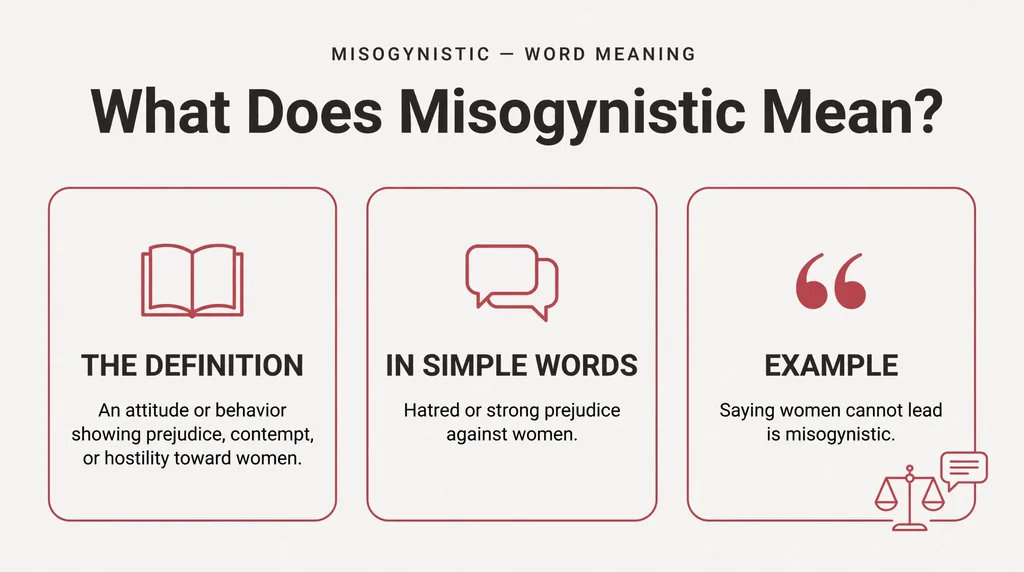
Misogynistic is an adjective used to describe an attitude, statement, action, behavior, or belief that reflects misogyny, especially prejudice, contempt, hostility, or hatred toward women.
For example:
“His comments about women being incapable of leadership were deeply misogynistic.”
Here, misogynistic describes the comments because they treat women as naturally less capable because of their gender.
Another simple example is:
“The movie was criticized for its misogynistic portrayal of female characters.”
In this sentence, the word describes a pattern of representation that presents women in a degrading, hostile, or unfair way.
Simple Definition
Misogynistic means showing prejudice, contempt, hostility, or hatred toward women or girls.
In Very Simple English
If someone has a strong negative attitude toward women simply because they are women, that attitude can be called misogynistic.
In dictionary terms, the misogynistic definition is straightforward: it describes attitudes, words, or actions that show prejudice, contempt, hostility, or hatred toward women or girls. So when someone asks what does misogynistic mean, this is the core answer.
Misogyny, Misogynist, and Misogynistic: What’s the Difference?
These three words are closely related, but they do different jobs in a sentence.
| Word | Meaning | Example |
|---|---|---|
| Misogyny | Prejudice, contempt, hostility, or hatred toward women | “Misogyny can appear in everyday language.” |
| Misogynist | A person who holds misogynistic views | “He was described as a misogynist because of his repeated comments about women.” |
| Misogynistic | Describes something that reflects misogyny | “That was a misogynistic comment.” |
A useful way to remember them is:
Misogyny = the attitude or prejudice
Misogynist = the person
Misogynistic = the description
For example:
“The misogynist expressed misogynistic views rooted in misogyny.”
That sentence sounds repetitive, but it demonstrates the grammatical relationship among the three terms.
What Is Misogyny?
Misogyny refers to attitudes, beliefs, social practices, or behaviors that express hostility, contempt, prejudice, or hatred toward women.
It can be obvious, such as openly claiming that women are inferior. It can also be subtle, such as applying one standard to men and another to women.
For example, imagine two employees make the same mistake at work. The male employee is described as “confident and ambitious,” while the female employee is called “difficult and emotional” for similar behavior.
That difference does not automatically prove misogyny. Context matters. But repeated patterns of this kind can reflect gender-based prejudice.
This distinction is important because not every disagreement involving a woman is misogynistic. The word should be used carefully and based on the actual behavior, language, or reasoning involved.
Examples of Misogynistic Behavior
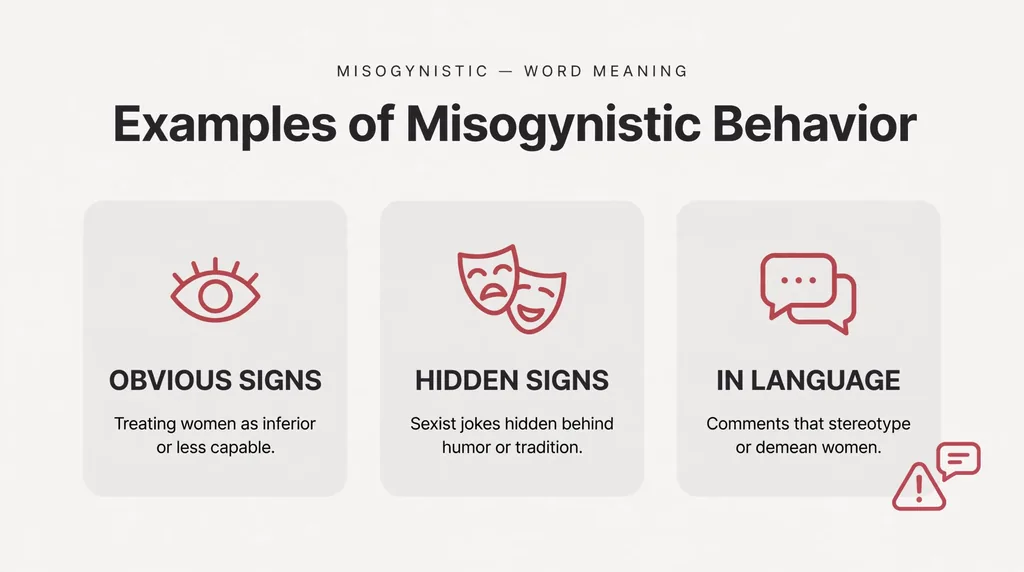
Misogynistic behavior can take many forms. Some examples are obvious, while others are hidden behind humor, tradition, or stereotypes.
Treating Women as Inferior
Statements that present women as naturally less intelligent, capable, rational, or deserving can be misogynistic.
Example:
“Women are not smart enough to make important business decisions.”
The problem is not simply that the speaker has an opinion. The statement makes a negative generalization about an entire gender.
Using Gender-Based Double Standards
A double standard occurs when similar behavior receives different judgments based on gender.
For example, a confident male manager may be praised for being assertive, while a female manager showing the same behavior is labeled aggressive or difficult.
A single incident does not establish a pattern, but repeated gender-based differences can be a sign of sexism or misogyny.
Making Degrading Jokes About Women
Humor does not automatically become harmless because someone says, “It was just a joke.”
Repeated jokes that portray women as stupid, weak, inferior, sexually available, or incapable can reinforce misogynistic ideas.
Controlling Women Because of Gender
Trying to restrict a woman’s choices simply because she is a woman can also reflect misogynistic thinking.
Examples may involve controlling:
- What she wears
- Where she goes
- Who she talks to
- Whether she works
- How she expresses herself
- What career she chooses
- How she should behave
The context matters, but gender-based control is an important area to examine.
Dismissing Women’s Experiences
Automatically treating women’s concerns as exaggerated, irrational, or unimportant can reinforce gender prejudice.
For example:
“Women always overreact when they complain.”
This statement dismisses women’s experiences through a broad gender stereotype instead of addressing the actual situation.
Examples of Misogynistic Comments
Here are some simplified examples that demonstrate the concept:
| Comment | Why It Can Be Misogynistic |
|---|---|
| “Women are too emotional to lead.” | It assumes women are naturally incapable of leadership. |
| “A woman should not have a career after marriage.” | It imposes a gender-based restriction on women’s choices. |
| “Women only succeed because men help them.” | It unfairly dismisses women’s achievements. |
| “Girls are bad at mathematics by nature.” | It presents a negative gender stereotype as fact. |
| “A woman who speaks loudly is disrespectful.” | It may apply a gender-specific expectation to normal behavior. |
Context still matters. A statement can be offensive, sexist, stereotypical, or misogynistic depending on what it communicates and why it is being said.
Misogynistic Language
Misogynistic language is language that expresses or reinforces contempt, hostility, prejudice, or harmful stereotypes toward women.
It can appear in:
- Insults directed at women as a group
- Gender-based slurs
- Statements about women’s supposed inferiority
- Degrading descriptions of women
- Claims that women deserve fewer rights or opportunities
- Stereotypes presented as unquestionable facts
- Comments that reduce women’s worth to appearance or sexuality
Language becomes especially significant when it is repeated across a workplace, online community, entertainment setting, or social environment.
One isolated phrase may reveal an attitude, but a larger pattern can provide more context.
Misogynistic vs. Sexist
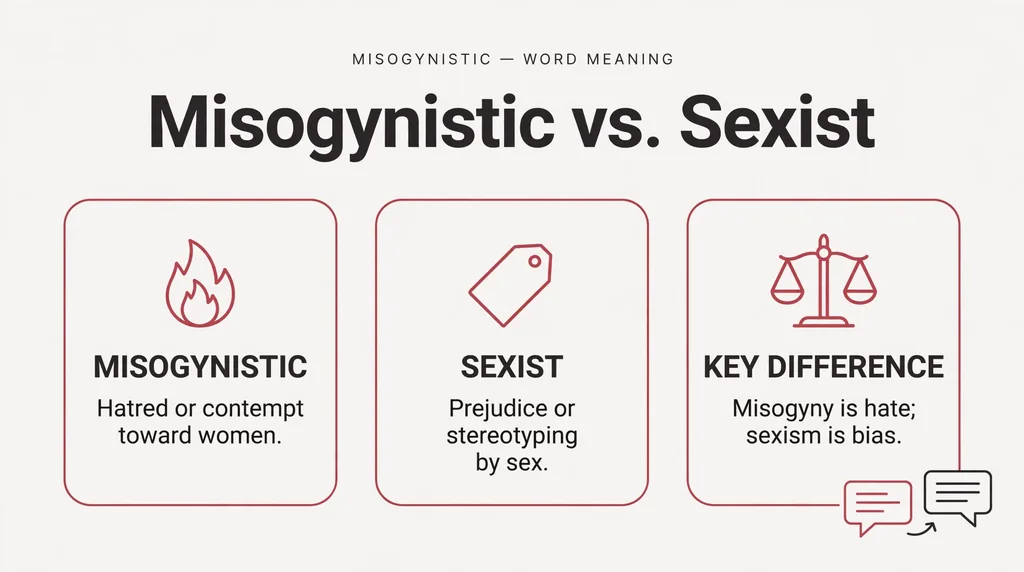
Misogynistic and sexist are related, but they are not perfect synonyms.
Sexism generally refers to prejudice, discrimination, or stereotyping based on sex or gender.
Misogyny specifically focuses on hostility, contempt, prejudice, or hatred directed toward women.
For example:
“Women are naturally worse at science.”
This is clearly sexist because it promotes a gender stereotype. It may also be misogynistic if it reflects contempt or hostility toward women.
A useful distinction is:
Sexism can involve gender-based inequality or stereotyping. Misogyny is more specifically associated with hostility, contempt, prejudice, or hatred toward women.
In everyday conversation, the two words can overlap.
Misogyny vs. Misandry
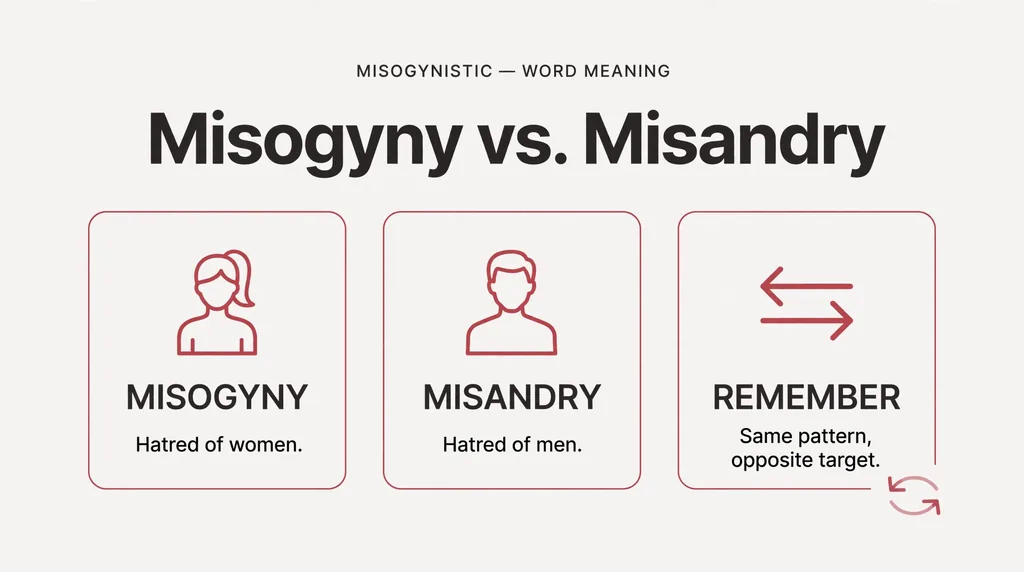
The opposite gender-directed concept often discussed alongside misogyny is misandry.
Misandry means prejudice, contempt, hostility, or hatred toward men or boys.
| Term | Refers to |
|---|---|
| Misogyny | Hostility or prejudice toward women |
| Misogynist | A person who holds misogynistic views |
| Misogynistic | Describes something expressing misogyny |
| Misandry | Hostility or prejudice toward men |
| Misandrist | A person who holds misandrist views |
The concepts are related, but they should not be confused.
How to Recognize Misogynistic Attitudes
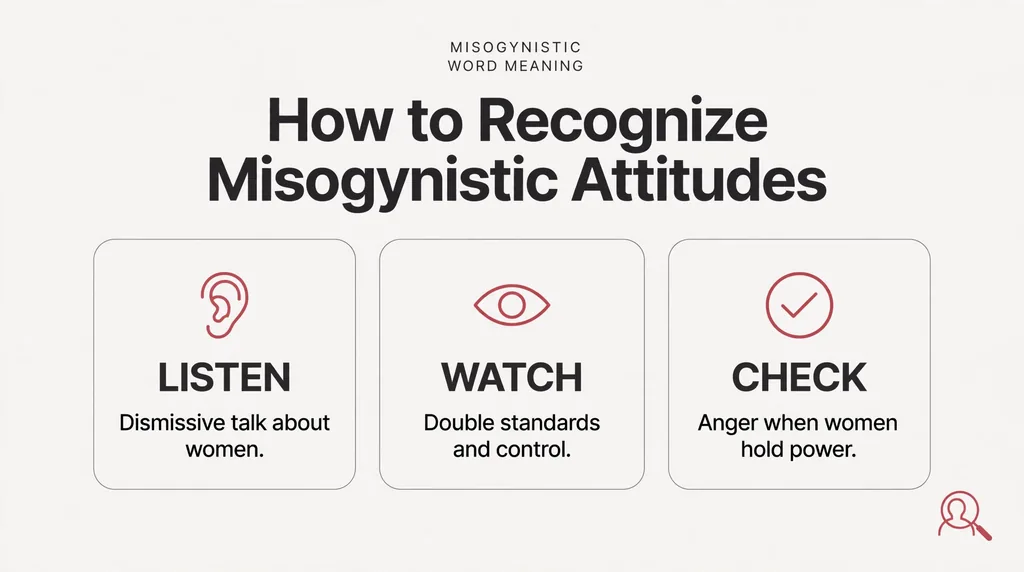
There is no single sentence or behavior that explains every situation. Still, several patterns can help identify gender-based prejudice.
Look for repeated ideas such as:
- Women are naturally inferior to men.
- Women should have fewer rights or opportunities.
- Women’s opinions matter less because they are women.
- Women deserve different rules from men.
- Women’s achievements are automatically less valuable.
- Women should follow fixed gender roles.
- Women are responsible for men’s inappropriate behavior.
- Women who challenge authority deserve punishment or humiliation.
The pattern and reasoning matter.
For example, saying “I disagree with her decision” is not misogynistic simply because the person involved is a woman.
Saying “Women should never be allowed to make decisions like this” introduces a gender-based judgment.
That distinction prevents the word from being used too broadly.
Is Every Negative Comment About a Woman Misogynistic?
No.
This is an important point when using the word accurately.
Someone can criticize a woman’s decision, personality, work, or behavior without being misogynistic.
For example:
“I think her business strategy was ineffective.”
That is criticism of a specific action.
Compare it with:
“Women are incapable of creating successful business strategies.”
The second statement makes a negative claim about women as a group.
The difference is gender-based generalization.
Calling every disagreement with a woman misogynistic can weaken the meaning of the term. Strong language is most useful when it accurately describes the behavior being discussed.
Misogynistic Meaning in a Sentence
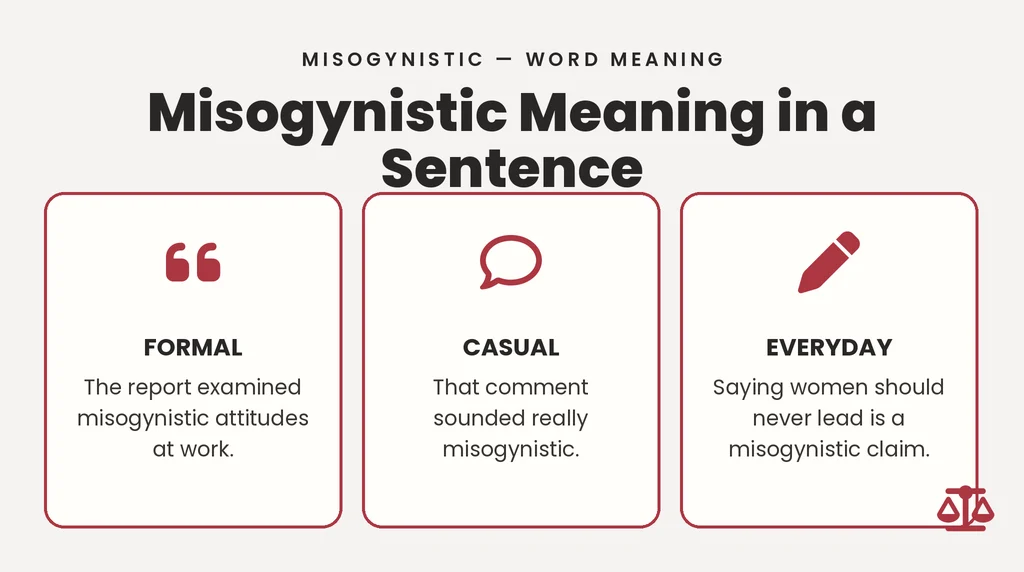
Here are several natural examples of how to use the word.
Formal Example
“The report examined how misogynistic attitudes can influence women’s experiences in professional environments.”
Casual Example
“That comment sounded really misogynistic.”
Academic Example
“The study explores the relationship between misogynistic beliefs and gender-based discrimination.”
Media Example
“Viewers criticized the show for its misogynistic treatment of female characters.”
Everyday Example
“Saying that women should never lead a team because they are too emotional is a misogynistic claim.”
Seeing the misogynistic meaning inside real sentences like these makes the word much easier to recognize and remember.
How to Use “Misogynistic” Correctly
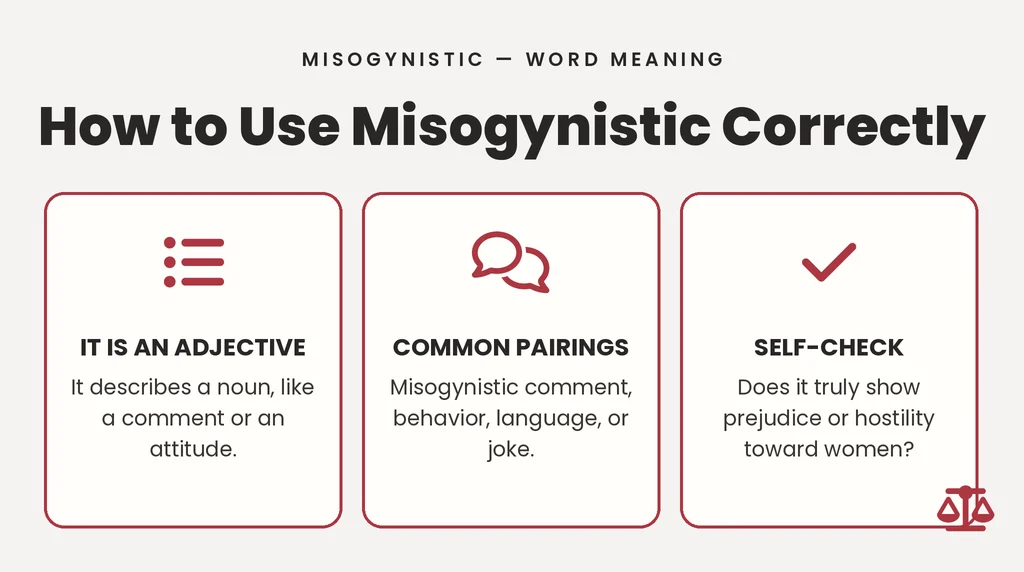
Because misogynistic is an adjective, it normally describes a noun.
Common combinations include:
- misogynistic comment
- misogynistic behavior
- misogynistic attitude
- misogynistic language
- misogynistic belief
- misogynistic statement
- misogynistic joke
- misogynistic view
- misogynistic culture
- misogynistic portrayal
Example
Incorrect or awkward:
“He is misogynistic person.”
Better:
“He is a misogynistic person.”
Or simply:
“He is misogynistic.”
Another useful structure is:
misogynistic + noun
For example:
“The speaker made a misogynistic comment.”
A quick self-check helps here: ask yourself, what does misogynistic mean in this exact situation, and does the comment or action truly show prejudice or hostility toward women?
Where the Word “Misogynistic” Commonly Appears
You may encounter this word in several contexts.
Social Media
People often use misogynistic when discussing comments, posts, memes, or online communities that target women.
Workplace Discussions
The word may appear in conversations about gender discrimination, unequal treatment, harassment, or workplace culture.
News and Politics
Journalists and commentators may use it when discussing statements, policies, public figures, or social movements involving hostility toward women.
Literature and Film
Critics may describe a character, narrative, stereotype, or portrayal as misogynistic when women are repeatedly degraded, objectified, or presented as inferior.
Everyday Conversations
Someone might use the word simply to describe a comment that shows strong prejudice against women.
Common Synonyms and Related Words
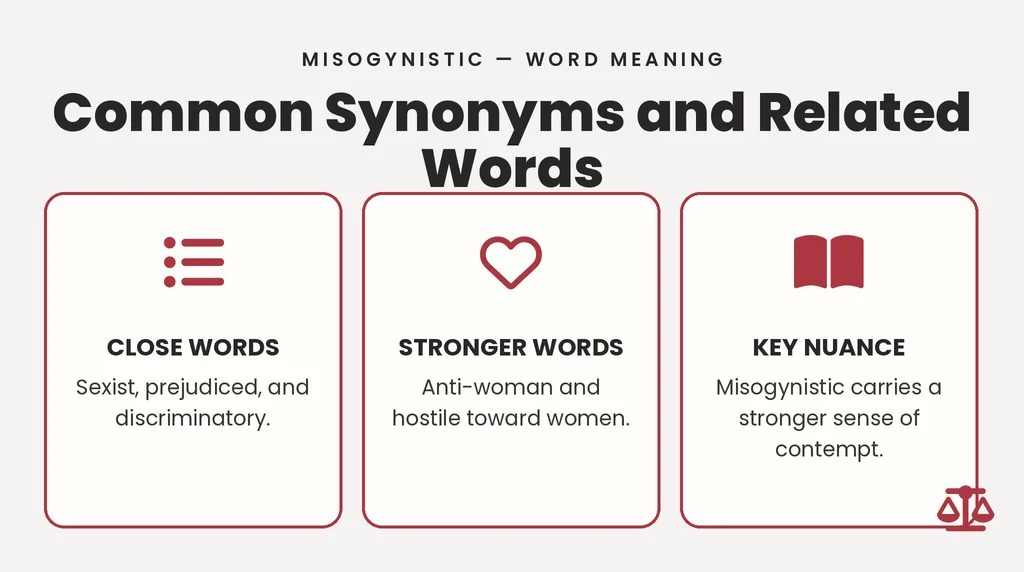
No synonym perfectly matches misogynistic, but several related words can help explain its meaning.
- Sexist
- Prejudiced
- Discriminatory
- Anti-woman
- Hostile toward women
- Woman-hating
- Gender-biased
- Gender-discriminatory
- Degrading toward women
Some of these are stronger or broader than others.
For instance, sexist is generally broader, while misogynistic can carry a stronger sense of hostility or contempt toward women.
What Is the Opposite of Misogynistic?
There is no single perfect everyday opposite of misogynistic.
Depending on the context, possible contrasting ideas include:
- Respectful toward women
- Gender-inclusive
- Gender-equal
- Egalitarian
- Non-sexist
- Supportive of gender equality
Egalitarian is particularly useful when discussing the belief that people should have equal rights and opportunities regardless of gender.
Why Understanding the Word Matters
Words such as misogynistic, sexist, and discriminatory describe serious social concepts. Using them accurately makes communication clearer.
There is also a practical reason to understand the difference.
If someone says, “That comment is misogynistic,” the listener may want to know what makes it misogynistic.
The strongest explanation points to the actual language or behavior:
“The comment is misogynistic because it assumes women are naturally less capable of leadership.”
That is more informative than simply attaching a label.
Good communication focuses on the reasoning behind the description.
A Quick Note on Spelling
This is a long word, so people often type it into search engines with the wrong spelling. Searches such as mysoginistic meaning, mysogynistic meaning, and misoginistic meaning are all looking for the same word, and some people even type the query as misogynistic.meaning with a full stop in the middle. However it is typed, the correct spelling is misogynistic, and every one of those searches leads back to the definition explained in this guide.
Frequently Asked Questions
What is the simple meaning of misogynistic?
Misogynistic means showing hatred, contempt, hostility, or prejudice toward women or girls.
What does misogynist mean?
A misogynist is a person who holds attitudes or beliefs involving misogyny, such as strong prejudice, contempt, hostility, or hatred toward women.
What is the difference between misogyny and misogynistic?
Misogyny is the noun referring to prejudice, contempt, hostility, or hatred toward women. Misogynistic is the adjective used to describe something that reflects misogyny.
For example, “misogyny” is an attitude, while “misogynistic comment” describes a comment expressing that attitude.
Is misogynistic the same as sexist?
Not exactly. Sexist is a broader term for prejudice, discrimination, or stereotyping based on sex or gender. Misogynistic specifically describes hostility, contempt, prejudice, or hatred toward women.
Can a woman be misogynistic?
Yes. The term describes an attitude or belief, not the gender of the person expressing it. A woman can hold or express misogynistic beliefs about women.
What is an example of misogynistic behavior?
Treating women as naturally inferior, claiming women should have fewer rights because of their gender, or repeatedly using degrading gender stereotypes can be examples of misogynistic behavior.
What is the opposite of misogynistic?
Depending on the context, contrasting terms include non-sexist, egalitarian, gender-inclusive, and supportive of gender equality.
What is the difference between misogyny and misandry?
Misogyny refers to hostility, contempt, prejudice, or hatred toward women. Misandry refers to hostility, contempt, prejudice, or hatred toward men.
How do you use misogynistic in a sentence?
You can use it as an adjective, such as:
“The article was criticized for its misogynistic portrayal of women.”
Is every criticism of a woman misogynistic?
No. Criticizing a woman’s actions, decisions, or work is not automatically misogynistic. The term becomes relevant when the criticism is rooted in prejudice or hostility toward women as a gender.
What is the misogynistic definition in a dictionary?
The misogynistic definition most dictionaries give describes attitudes, words, or behavior that show strong prejudice, contempt, or hatred toward women. In other words, the meaning of misogynistic always connects back to misogyny, which is the prejudice itself.
Is mysoginistic the correct spelling?
No. Mysoginistic is a common misspelling, and the same applies to searches like mysoginistic meaning, mysogynistic meaning, and misoginistic meaning. Some people also mistype the query with a full stop, as misogynistic.meaning, when searching in a hurry. The correct spelling is always misogynistic.
Final Takeaway
The misogynistic meaning is straightforward: it describes an attitude, belief, statement, or behavior that expresses prejudice, contempt, hostility, or hatred toward women or girls.
The key is to look at the actual behavior or language behind the label. A disagreement with a woman is not automatically misogynistic. Gender-based assumptions, degrading stereotypes, hostility, and unequal standards provide much stronger evidence.
Knowing the difference between misogyny, misogynist, misogynistic, sexism, and misandry also makes the word easier to use correctly. When used with care, it gives people a precise way to discuss gender-based prejudice in everyday conversation, writing, media, education, and professional settings.