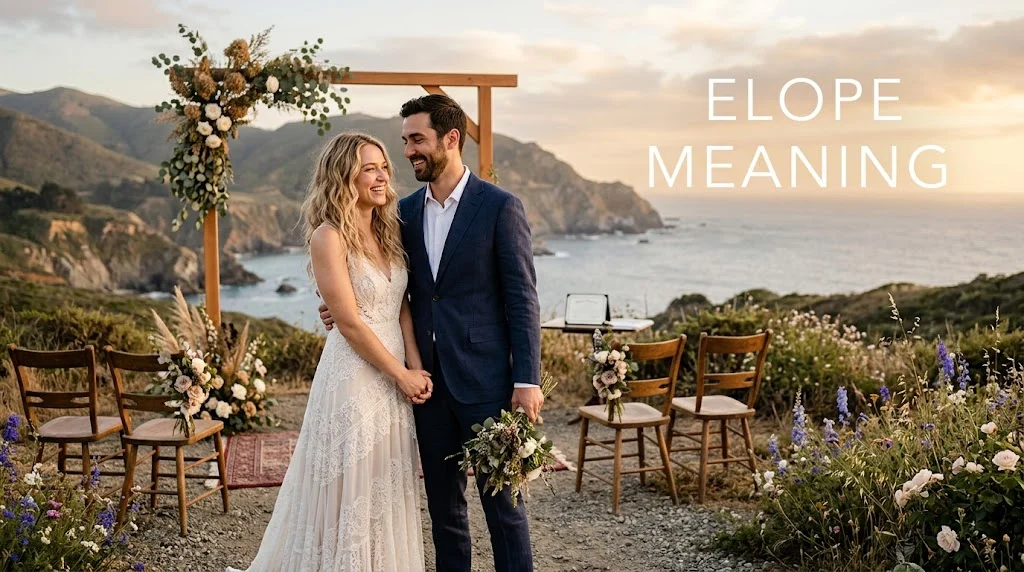
Imagine two people deciding to get married without the big guest list, elaborate venue, or months of wedding planning. They simply choose each other and leave to get married. That is where the word elope comes in.
The elope meaning is closely connected with getting married privately, often without telling family or friends beforehand. Traditionally, the word was associated with couples leaving secretly to marry. Today, its meaning has become broader. Many people use elope for a small, private, or spontaneous wedding, even when the couple is not literally running away. Understanding this difference matters because the word can carry different tones depending on the context.
In this guide, you will learn the definition and meaning of elope, its historical background, modern usage, examples, related expressions, and the answer to a common question about its supposed “full form.” The goal is simple: to make the word easy to understand and use correctly in everyday English.
Definition & Meaning of Elope
Elope is a verb that means to leave secretly or suddenly with someone, traditionally to get married without informing family or others beforehand.
In modern English, elope can also describe a couple choosing to have a private, intimate, or very small wedding, even when the marriage is not secret.
Simple meaning:
To leave and get married privately, often without a traditional wedding ceremony or large group of guests.
Example
“They decided to elope in Las Vegas.”
This means they chose to get married privately rather than have a traditional large wedding.
Full Form and Meaning of Elope
Elope does not have a full form. It is not an acronym, so there are no separate words represented by the letters E-L-O-P-E.
The word elope is an ordinary English verb with its own historical origin. It comes through French and ultimately from a Germanic source associated with the idea of running away or escaping.
So, if someone asks, “What is the full form of elope?”, the accurate answer is:
Elope has no full form. It is a complete English word, not an abbreviation.
What Does Elope Mean?
Elope is a verb that means to leave with someone and get married, traditionally in secret or without the knowledge of family.
A simple definition is:
Elope means to get married privately, often without having a large traditional wedding or informing everyone beforehand.
Here are a few examples:
- They decided to elope in Italy.
- She eloped with her longtime partner.
- The couple is planning to elope next summer.
- They eloped without telling their parents.
The exact meaning depends on context.
In an older or dramatic context, elope can suggest that a couple secretly ran away together to get married. In modern everyday English, it can simply describe a private wedding with a small guest list.
What Does Eloping Mean?
Eloping is the -ing form of elope. It describes the act or process of getting married in an elopement.
For example:
“They are eloping next month.”
This means they are planning to get married privately, often without a large traditional ceremony.
Another example:
“We spent months planning our elopement.”
Here, elopement refers to the wedding itself or the overall experience surrounding it.
Elope, Eloping, and Elopement
These three words are closely connected, but they have different grammatical roles.
| Word | Meaning | Example |
|---|---|---|
| Elope | To get married privately or secretly | They decided to elope. |
| Eloping | The act of getting married this way | They are eloping in June. |
| Eloped | Past tense of elope | They eloped last year. |
| Elopement | The private wedding or experience | Their elopement was beautiful. |
This distinction is useful when writing or speaking about marriage plans.
Does Elope Mean Getting Married Secretly?
Not always.
This is one of the most important details about the modern use of elope.
Historically, the word was strongly associated with secretly leaving home to marry, often against the wishes of parents or family members.
Today, an elopement does not necessarily have to be secret.
A couple might tell their parents, siblings, and close friends about their plans but still choose to have a very small wedding.
For example:
Traditional interpretation:
“They secretly eloped and told everyone after the wedding.”
Modern interpretation:
“We told our families that we were eloping in Hawaii.”
In the second example, the wedding is private, but it is not necessarily secret.
So, “secret marriage” can describe some elopements, but it is not a requirement.
The Historical Meaning of Elope
The word elope has a much more dramatic history than its modern use suggests.
It comes from the French éloper, which was associated with escaping or running away. In English, the word became connected with lovers leaving together, particularly when they intended to marry without family approval.
For a long time, the idea of eloping carried a strong sense of rebellion.
A young couple might leave home secretly because their families opposed the relationship. They could marry somewhere else and return afterward.
That older meaning still appears in novels, historical writing, and dramatic storytelling.
For example:
“The young lovers eloped after their families refused to approve the marriage.”
The sentence suggests secrecy, family conflict, and running away.
Modern elopement culture is different. Today, couples may choose an elopement simply because they prefer privacy, flexibility, travel, or a smaller celebration.
What Is an Elopement?
An elopement is a wedding experience centered around the couple rather than a large traditional guest list.
There is no single format that every elopement must follow.
An elopement might include:
- Just the couple
- The couple and an officiant
- A photographer
- A few close friends
- Immediate family
- A courthouse ceremony
- A destination ceremony
- A small outdoor wedding
- A private religious ceremony
For one couple, eloping could mean getting married at a courthouse.
For another, it could mean hiking to a mountain viewpoint and exchanging vows there.
The common idea is that the wedding is intentionally smaller or more private than a conventional large wedding.
Elopement vs. Traditional Wedding
The biggest difference is usually the scale and structure of the celebration.
| Elopement | Traditional Wedding |
|---|---|
| Usually small and private | Usually larger |
| Often has few guests | May have many guests |
| More flexible schedule | Often follows a formal schedule |
| Can happen at many locations | Often uses a dedicated venue |
| Usually focuses strongly on the couple | Often includes a larger social celebration |
| Can involve less planning | Can involve extensive planning |
| May be kept private | Usually publicly announced |
These are general patterns, not strict rules.
A couple can have an intimate wedding with 30 guests. Another couple can have an elopement with family members present.
The word is flexible because modern weddings themselves have become more varied.
Eloping vs. a Secret Wedding
The terms eloping and secret wedding overlap, but they are not identical.
A secret wedding specifically emphasizes keeping the marriage hidden from others.
An elopement emphasizes the private or unconventional nature of the wedding.
For example:
“They had a secret wedding.”
This suggests that other people did not know about the marriage.
But:
“They eloped in Paris.”
This tells us that they chose an intimate or unconventional wedding, but it does not tell us how many people knew about it.
The couple could have told everyone beforehand.
Why Do People Elope?
People choose elopement for many different reasons. There is no single motivation that applies to every couple.
They Want Privacy
Some couples simply prefer intimate moments over large celebrations.
Instead of exchanging vows in front of 150 people, they may want the ceremony to feel deeply personal.
They Want Less Wedding Planning
Large weddings can involve venues, catering, invitations, seating arrangements, decorations, entertainment, photography, and many other decisions.
An elopement can reduce the number of moving parts.
That does not mean an elopement requires no planning. A destination elopement can still involve travel arrangements, legal paperwork, accommodation, photography, and permits.
They Prefer Experiences Over Large Parties
Some couples would rather spend their wedding day traveling, hiking, exploring a city, or visiting a meaningful location.
For them, the wedding becomes an experience instead of a large event.
They Want a Smaller Celebration
Some people feel more comfortable with a handful of loved ones than with a large crowd.
A small wedding can allow couples to spend more meaningful time with each guest.
They Want to Avoid Family Pressure
Family expectations can sometimes make wedding planning complicated.
An elopement can give couples more control over the ceremony and its format.
That said, choosing to elope can also create difficult conversations if relatives expected to be included.
Is Eloping the Same as Running Away?
Not exactly.
The phrase “run away and get married” reflects the traditional idea of eloping, but modern elopement does not necessarily involve running away.
Consider two examples.
Example 1:
“They secretly left town and got married without telling their families.”
This fits the traditional image of eloping very closely.
Example 2:
“They told their families six months ahead of time and then had a private ceremony in the mountains.”
People may still call this an elopement today.
So, running away is part of the historical association with the word, but it is not essential to the modern meaning.
Is Eloping Legally Valid?
An elopement can be legally valid, but the answer depends on the country, state, province, or territory where the marriage takes place.
The word elope itself has no legal status. It simply describes the style or circumstances of the wedding.
Legal marriage usually involves requirements such as:
- Obtaining a marriage license
- Meeting minimum age requirements
- Providing required identification
- Having an authorized officiant
- Meeting witness requirements where applicable
- Completing and filing the marriage paperwork
- Following local marriage laws
Requirements vary considerably by location.
A couple planning to elope should check the official government requirements for the place where they intend to marry. A beautiful destination does not automatically make the marriage legally valid.
This is especially important for destination elopements, since couples may be dealing with international marriage laws.
Elopement Does Not Always Mean a Tiny Budget
It is easy to assume that eloping automatically means spending very little money.
That is not necessarily true.
A courthouse wedding may be relatively simple and inexpensive.
A destination elopement could involve:
- Flights
- Hotels
- Photography
- Clothing
- Transportation
- Venue or location fees
- Marriage paperwork
- Officiant fees
- Permits
- Meals
- Travel insurance
- Activities
A couple could spend less than they would on a large wedding, but they could also create an elaborate elopement experience.
The key difference is often how the money is spent, not simply how much is spent.
Common Types of Elopements
Modern couples use the word elopement for many different wedding styles.
Courthouse Elopement
The couple gets legally married at a courthouse or similar government location.
This can be one of the simplest forms of elopement.
Destination Elopement
The couple travels somewhere specifically for the wedding.
Popular settings can include:
- Beaches
- Mountains
- Historic cities
- National parks
- Small towns
- Resorts
- Scenic countryside
Adventure Elopement
An adventure elopement combines the wedding with an outdoor experience.
For example, a couple might exchange vows after hiking to a scenic location.
Family Elopement
The couple keeps the wedding small but invites immediate family members.
This approach can provide intimacy without making loved ones feel completely excluded.
Private Ceremony
Some couples have a private ceremony and then celebrate with friends and family afterward.
This separates the intimate wedding moment from the larger social celebration.
Examples of Elope in a Sentence
Here are natural examples showing how the word works in different contexts.
Casual
“We decided to elope instead of having a big wedding.”
Romantic
“They eloped at sunrise beside the ocean.”
Historical
“The young couple eloped after their families opposed the marriage.”
Modern
“They announced that they were eloping in the fall.”
Travel-related
“They plan to elope in Iceland.”
Past tense
“My grandparents eloped when they were young.”
With “with”
“She eloped with her childhood sweetheart.”
With a destination
“They eloped in a small Italian village.”
Elope With Someone: What Does It Mean?
The phrase “elope with someone” means to leave with that person to get married, traditionally without family approval or prior notice.
For example:
“She eloped with her boyfriend.”
This means she married her boyfriend, traditionally suggesting that the marriage happened privately or unexpectedly.
The phrase can sound slightly old-fashioned depending on the context.
In modern conversation, people are more likely to say:
“They decided to elope.”
or:
“They got married in a private ceremony.”
Elope vs. Marry
These words are related but do not mean exactly the same thing.
Marry means to enter into a legal or recognized marriage.
Elope describes the way the couple chooses to get married.
A person can marry without eloping.
A person can elope and then marry.
For example:
“They married at a large wedding.”
“They eloped and married privately.”
The first sentence focuses on the marriage.
The second focuses on the unconventional way the wedding happened.
Elope vs. Wedding
An elope is an action.
A wedding is an event or ceremony celebrating a marriage.
You can say:
- “They decided to elope.”
- “Their wedding was beautiful.”
- “They planned an elopement.”
- “Their wedding had only five guests.”
Using these words correctly makes descriptions much clearer.
Common Misunderstandings About Eloping
“Eloping Always Means Keeping It Secret”
Not anymore.
A couple can announce their elopement beforehand.
“Eloping Means You Cannot Invite Anyone”
Not necessarily.
Some elopements include parents, siblings, close friends, or a small group of guests.
“Elopements Are Always Cheap”
Not necessarily.
A destination elopement can become expensive depending on travel and other arrangements.
“Eloping Means You Are Running Away From Your Family”
That may describe some traditional uses of the word, but it does not describe every modern elopement.
“Eloping Is Not a Real Wedding”
An elopement can be a legally recognized marriage if the couple follows the applicable marriage laws.
The legal status depends on the jurisdiction, not on the label elopement.
How to Use “Elope” Correctly
The easiest way to remember the word is:
Elope = choose to get married privately or in a nontraditional way.
Here are a few useful patterns:
Elope + with someone
They eloped with their partners.
Elope + in a place
They eloped in Hawaii.
Decide to elope
We decided to elope next year.
Plan to elope
They plan to elope in October.
Have an elopement
They had a beautiful elopement in the mountains.
Avoid treating elope as a noun.
❌ “Their elope was beautiful.”
✅ “Their elopement was beautiful.”
Frequently Asked Questions
What does elope mean in simple words?
Elope means to get married privately, often without having a large traditional wedding. Historically, it often meant secretly running away with someone to get married.
What does eloping mean?
Eloping means getting married in a private, small, or unconventional way. It can be secret, but modern eloping does not always involve hiding the marriage from family or friends.
Does elope mean secretly get married?
It can, especially in older usage. In modern English, however, eloping does not have to be secret. A couple can tell their families about the plan and still describe the wedding as an elopement.
What is an elopement?
An elopement is a private or small-scale wedding experience. It might involve only the couple or include a few close relatives and friends.
Is eloping the same as running away?
Historically, the ideas were closely connected. Modern eloping does not necessarily involve running away. A couple can carefully plan an elopement months in advance.
Is eloping legally the same as getting married?
An elopement can result in a legally recognized marriage if the couple follows the marriage laws of the relevant jurisdiction. Legal requirements vary by location.
Can you elope with family present?
Yes. An elopement can include parents, siblings, close friends, or other guests. There is no universal guest limit that defines an elopement.
Is an elopement always cheaper than a wedding?
No. A simple courthouse ceremony may cost relatively little, while a destination elopement can involve significant travel and accommodation expenses.
What is the difference between eloping and having a traditional wedding?
Eloping usually involves a smaller, more private, or less conventional celebration. A traditional wedding generally involves a larger guest list and a more formal event structure.
What does “elope with someone” mean?
It means to leave with that person and get married, traditionally in secret or without family approval. Today, the phrase can simply describe marrying someone through a private or unconventional ceremony.
Final Takeaway
The simplest elope meaning is to get married privately or in a nontraditional way, often with fewer guests and less emphasis on a large wedding celebration.
The word has an older connection to secretly running away to marry, but modern usage is much broader. A couple can tell their families, carefully plan the ceremony, travel to another country, invite a few loved ones, and still call the experience an elopement.
The important idea is not simply secrecy. It is the choice to make the wedding more private, personal, or unconventional than a traditional large celebration.