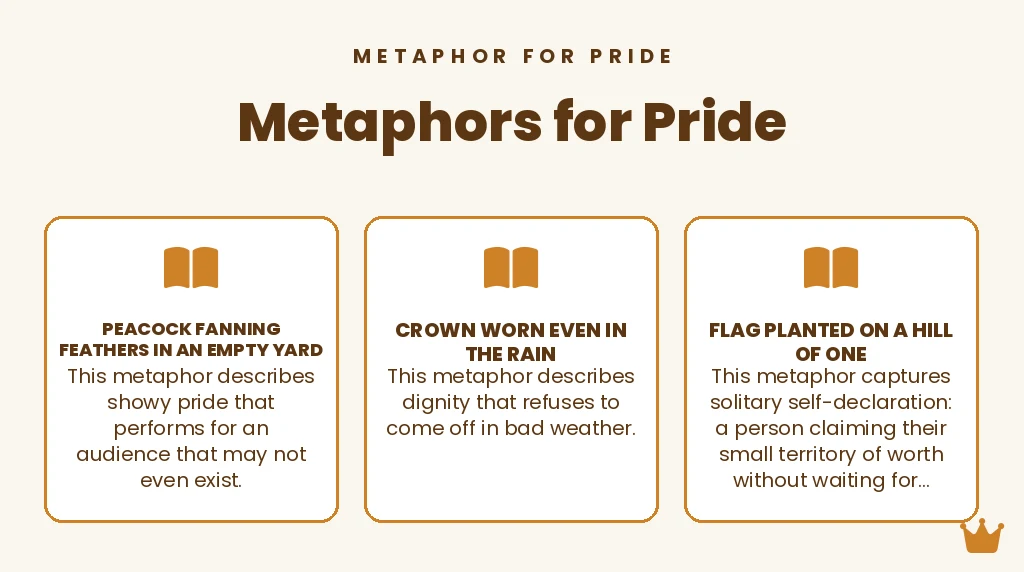
Picture this. A peacock fans its feathers in an empty yard. A flag flies on a hill built for one person. That is pride, and it can look glorious or a bit ridiculous, sometimes in the same hour. It lifts a graduate’s chin, stiffens the spine of someone wronged, and swells the chest of a fool. Which is why writers need sharp pictures for it.
Why reach for a metaphor at all? Because pride sits awkwardly between a virtue and a vice. Call it confidence and we clap. Call it arrogance and we turn away, even though the feeling inside might be the same. A good image lets readers decide. Is this a well-kept flag? Or a balloon one pin away from trouble? No lecture needed. The picture does the judging.
Below are twenty original metaphors for pride, each with a plain meaning, a note on why it works, another way to say it, and formal, casual, and creative examples. Positive and negative sets follow, plus ready-to-use sentences and advice on keeping these images natural. Student, novelist, or speaker writing about dignity and self-respect, you should find an image here that fits.
Quick Metaphors for Pride
Scan all twenty metaphors in this list before reading their detailed meanings below.
- Pride is a peacock fanning feathers in an empty yard.
- Pride is a crown worn even in the rain.
- Pride is a flag planted on a hill of one.
- Pride is a wall built around a garden.
- Pride is a lion that roars at its own shadow.
- Pride is a stiff collar that keeps the head high.
- Pride is a medal polished every morning.
- Pride is a balloon that fears the pin.
- Pride is a mountain that refuses the path.
- Pride is a mirror carried everywhere.
- Pride is a fire that warms and burns the same hands.
- Pride is a suit of armor worn to breakfast.
- Pride is a garden fence painted gold.
- Pride is a trumpet blown by its own player.
- Pride is a ship that will not take a pilot.
- Pride is a high shelf where apologies cannot reach.
- Pride is a stone carried upright through the river.
- Pride is a sunrise watched alone from a tower.
- Pride is a drum that beats loudest when empty.
- Pride is a bridge that will not bend in the storm.
Metaphors for Pride and Their Meanings
Each metaphor below gets a plain explanation, a note on why the image lands, and examples in three registers. You will notice a pattern fast. Pride keeps showing up as something displayed, carried, or defended.
1. Pride Is a Peacock Fanning Feathers in an Empty Yard

Meaning
A peacock in full display, and nobody is watching. That is the heart of it. The show is real, and honestly it is beautiful, which is why the joke does not feel cruel. The vanity is real too. Both are true at once.
Why It Works
You have seen that fan of feathers. Everyone has. So the picture clicks at once. Then the empty yard does the quiet damage: pride that craves applause it has not earned.
Alternative Expression
Or, more gently, “a rooster announcing sunrise to an empty farm.”
Examples in Writing
Formal Example: Pride is a peacock fanning feathers in an empty yard, and the minister’s memoir displays plumage long after the audience departed.
Casual Example: He retold his one good match for an hour, a peacock in an empty yard.
Creative Example: Her pride spread like a peacock’s fan in an empty yard, gorgeous, trembling, and admired by no one.
2. Pride Is a Crown Worn Even in the Rain

Meaning
Some dignity just will not come off, not even in bad weather. The crown is not about bossing others around. It’s a person’s sense of worth, worn through poverty, failure, and plain embarrassment alike.
Why It Works
Rain ruins most outfits. We all know that. So a crown that stays put stands for self-respect under pressure. It suits writing about the poor, the defeated, and the quietly honorable.
Alternative Expression
You could also say “a clean shirt worn proudly in a poor street.”
Examples in Writing
Formal Example: Pride is a crown worn even in the rain, and the dismissed teacher left the school carrying hers dry-eyed.
Casual Example: Bankrupt or not, Grandpa wears his crown in the rain; nobody pities him twice.
Creative Example: Through the rain of that ruined year she wore her crown of pride, and it did not rust.
3. Pride Is a Flag Planted on a Hill of One

Meaning
No permission slip. No waiting around. Someone claims a small patch of worth as their own. The hill belongs to one person only, which makes that flag feel both brave and a little lonely.
Why It Works
Flags don’t do subtle. They’re public, they’re clear. Add the hill of one and the scale shrinks right down. The kingdom is tiny. The claim on it? Total.
Alternative Expression
Or try this one: “a lighthouse built on a private rock.”
Examples in Writing
Formal Example: Pride is a flag planted on a hill of one, and every small nation’s anthem sings from exactly that hill.
Casual Example: She quit the firm and planted her flag on a hill of one: her own studio.
Creative Example: On his hill of one the flag of his pride snapped in the wind, visible for miles, guarded by nobody.
4. Pride Is a Wall Built Around a Garden
Meaning
Think of something tender that needs protecting. The garden is a person’s inner life, and the wall keeps careless feet off it. Fair enough, though the same wall can shut out friends and sunlight too.
Why It Works
A wall. A garden. Put them together and the trade-off is obvious: safety on one side, isolation on the other.
Alternative Expression
You might also write “a hedge grown taller than the gate.”
Examples in Writing
Formal Example: Pride is a wall built around a garden, and trauma survivors often raise it one brick of dignity at a time.
Casual Example: Her pride is a garden wall; knock politely and she might open the gate.
Creative Example: Behind the wall of his pride the garden still bloomed, unseen, unvisited, and fiercely alive.
5. Pride Is a Lion That Roars at Its Own Shadow
Meaning
All that power, and it’s roaring at nothing. A lion is genuinely mighty, yet here it wastes its voice on a shadow. Somehow that makes the insecurity look bigger than the strength.
Why It Works
There’s something funny about a huge beast fighting darkness, and that comedy nails touchy pride. Try it in satire: executives, celebrities, older brothers.
Alternative Expression
Close cousin: “a guard dog barking at its own reflection.”
Examples in Writing
Formal Example: Pride is a lion that roars at its own shadow, and the senator’s feud with a student newspaper proved it weekly.
Casual Example: One joke about his haircut and the lion roared at its shadow all evening.
Creative Example: At dusk the lion of his pride found its shadow on the wall and roared until the whole house trembled.
6. Pride Is a Stiff Collar That Keeps the Head High
Meaning
Pride as posture: uncomfortable, formal, deliberate. On days when shame, grief, or poverty would happily drag a chin down, the stiff collar holds it up anyway.
Why It Works
Clothing makes pride physical, and faintly comic too. Readers feel the tightness in their own necks, and an abstract virtue becomes a daily discipline.
Alternative Expression
You could also say “a straight back borrowed from better days.”
Examples in Writing
Formal Example: Pride is a stiff collar that keeps the head high, and the widow’s bearing at the hearing was starched with it.
Casual Example: He may be broke, but that stiff collar of pride keeps his head up.
Creative Example: All winter she wore her pride like a stiff collar, chin high, throat aching, eyes dry.
7. Pride Is a Medal Polished Every Morning
Meaning
One past win, polished daily because nothing newer has replaced it. Sound familiar? The medal is real. It’s the endless polishing habit the image quietly points at.
Why It Works
Polishing is tender, repetitive work, so the satire stays affectionate. It fits retired champions, former stars, and uncles with one famous story.
Alternative Expression
Or picture this instead: “a trophy used as a doorstop and a crown.”
Examples in Writing
Formal Example: Pride is a medal polished every morning, and institutions, like athletes, can blind themselves with yesterday’s gold.
Casual Example: Thirty years on, he still polishes that one medal every morning at breakfast.
Creative Example: The medal of his pride caught the morning light because his thumb had polished it for ten thousand dawns.
8. Pride Is a Balloon That Fears the Pin
Meaning
Big. Shiny. And terrified of one small fact. A balloon’s whole personality is its size, so one needle of criticism threatens everything it is.
Why It Works
You know how little a balloon holds, and how loudly it ends. The waiting pin adds suspense, keeping the image lively in essays and comedy alike.
Alternative Expression
You might also write “a soap bubble that calls itself a marble.”
Examples in Writing
Formal Example: Pride is a balloon that fears the pin, and the celebrity’s lawyers patrolled every interview for needles.
Casual Example: Do not tease him today; that balloon pride is floating near pins.
Creative Example: His pride swelled, bright and enormous, drifting through the party in terror of one honest pin.
9. Pride Is a Mountain That Refuses the Path
Meaning
Stubborn pride that won’t make itself approachable. Real mountains accept paths, climbers, even weather. Not this one. It refuses every route, so nobody reaches its summit or its heart.
Why It Works
The scale makes stubbornness feel monumental, not petty. It suits proud fathers, founding leaders, and nations that will not apologize.
Alternative Expression
Another angle on it: “a fortress that demolished its own bridge.”
Examples in Writing
Formal Example: Pride is a mountain that refuses the path, and the negotiations failed on its bare, pathless slopes.
Casual Example: Apologize to that mountain? It refuses paths on principle.
Creative Example: The mountain of her pride refused every path, so love stood at its foot with flowers, freezing.
10. Pride Is a Mirror Carried Everywhere
Meaning
Into every room, one question comes first: how do I look in your eyes right now? Pride like this checks itself constantly in other people’s reactions, mirror always in hand.
Why It Works
It’s portable vanity, instantly recognisable in the age of cameras and profiles.
Alternative Expression
You could also say “a portrait painter who paints only one face.”
Examples in Writing
Formal Example: Pride is a mirror carried everywhere, and approval ratings became the administration’s pocket glass.
Casual Example: She carries that mirror everywhere; every conversation becomes a check of her reflection.
Creative Example: From room to shining room he carried his mirror of pride, and never once saw the faces around him.
11. Pride Is a Fire That Warms and Burns the Same Hands
Meaning
One image, two truths. The same self-respect that warms a person through humiliation can burn their relationships when it flares too high or too close.
Why It Works
Fire won’t be only good or only bad, which is exactly how pride behaves. For balanced, adult writing, it’s the most honest image in this collection.
Alternative Expression
Think of it this way instead: “a stove that cooks dinner and scorches the careless cook.”
Examples in Writing
Formal Example: Pride is a fire that warms and burns the same hands, and the union’s history shows both seasons clearly.
Casual Example: His pride kept him standing and cost him friends; same fire, warm and burning.
Creative Example: All her life she warmed her hands at the fire of her pride, and all her life it blistered them.
12. Pride Is a Suit of Armor Worn to Breakfast
Meaning
Armor has its place. Breakfast isn’t it. Pride like this can’t relax even among friends: it clanks, spills the tea, and keeps every hug at a distance.
Why It Works
The domestic setting makes the defensiveness visible and funny rather than tragic. It suits family writing, where love and formality collide over toast.
Alternative Expression
You might also write “a helmet kept on during a haircut.”
Examples in Writing
Formal Example: Pride is a suit of armor worn to breakfast, and diplomatic households know the clank of it at every meal.
Casual Example: Even with his own kids, the armor stays on at breakfast.
Creative Example: Clanking into the kitchen came her pride, a suit of armor at the breakfast table, visor down against love.
13. Pride Is a Garden Fence Painted Gold
Meaning
Underneath, it’s just a fence doing a fence’s humble job. But the gold paint insists everyone admire it for more. That gap is the whole point.
Why It Works
Painted gold nails status display: real effort, real expense, no real change in worth. It suits satire about luxury, titles, and branding.
Alternative Expression
Or, more bluntly: “a paper crown sprayed with glitter.”
Examples in Writing
Formal Example: Pride is a garden fence painted gold, and the rebranding exercise gilded boundaries that remained stubbornly ordinary.
Casual Example: New logo, same fence, fresh gold paint; that is company pride.
Creative Example: All along the street of his life stood the fence of his pride, painted gold, peeling beautifully in the sun.
14. Pride Is a Trumpet Blown by Its Own Player
Meaning
Self-praise, announcing itself at full volume. A trumpet in an orchestra is glorious, but solo fanfares for your own entrance turn admiration into embarrassment.
Why It Works
Sound makes this pride impossible to ignore, which is precisely the complaint against boasting. Still, the image stays comic and kind enough for friendly teasing.
Alternative Expression
You could also say “a drum major marching without a band.”
Examples in Writing
Formal Example: Pride is a trumpet blown by its own player, and the annual report’s first ten pages were pure fanfare.
Casual Example: Nobody asked, but his trumpet announced his promotion three times at lunch.
Creative Example: Through every doorway of his life he entered blowing the trumpet of his pride, and the rooms learned to wince.
15. Pride Is a Ship That Will Not Take a Pilot
Meaning
Dangerous waters, local help waiting, and a captain who won’t take it. Harbor pilots exist because big ships and narrow channels are a risky mix. The proud captain steers alone anyway.
Why It Works
The stakes are high and the folly is professional, which suits leaders and experts. The waiting pilot makes the refusal look lonelier with every retelling.
Alternative Expression
The modern version runs like this: “a plane that declines the control tower.”
Examples in Writing
Formal Example: Pride is a ship that will not take a pilot, and the merger struck the harbor rocks within sight of help.
Casual Example: He would rather scrape the hull than take a pilot; classic pride.
Creative Example: The great ship of his pride swept past the pilot boat, flags flying, straight toward the shining rocks.
16. Pride Is a High Shelf Where Apologies Cannot Reach
Meaning
You can picture it in the body: chin up, shoulders back, and the words “I am sorry” stored just out of reach. The person may even want them and still not stretch.
Why It Works
Every home has a shelf like that, so a grand failing feels familiar. It’s tender enough for writing about marriages and old friendships.
Alternative Expression
You might also write “a ladder kept deliberately in the other room.”
Examples in Writing
Formal Example: Pride is a high shelf where apologies cannot reach, and restorative justice begins by building the steps.
Casual Example: The apology exists; it is just on that high shelf his pride cannot reach.
Creative Example: Dust gathered on the high shelf of his pride where the apologies waited, patient as china, unspoken for years.
17. Pride Is a Stone Carried Upright Through the River
Meaning
Mid-crossing, help offered, help refused. The stone is burden and proof at once: they’d rather wade slower than set it down or share it. Exhausting dignity, and you can feel it.
Why It Works
Water, weight, and posture combine into a scene readers feel in their shoulders. It honors endurance while quietly asking what the endurance costs.
Alternative Expression
Or hold this picture instead: “a banner held high in both hands during the storm.”
Examples in Writing
Formal Example: Pride is a stone carried upright through the river, and refugee narratives return to this posture with respect.
Casual Example: She will cross the whole river upright with that stone before she asks for help.
Creative Example: Chest-deep in the black river he carried his stone of pride upright, and the far bank watched in silence.
18. Pride Is a Sunrise Watched Alone from a Tower
Meaning
The achievement is real, the view magnificent. And nobody else is up there. The tower separates the proud person from everyone who might have shared the view and warmed the moment.
Why It Works
Beauty plus loneliness is the exact recipe of successful pride. It suits founders, champions, and eldest children who climbed without company.
Alternative Expression
You could also say “a feast for one at a table set for twelve.”
Examples in Writing
Formal Example: Pride is a sunrise watched alone from a tower, and the biography’s saddest chapters are its most successful ones.
Casual Example: Top of the company, sunrise from a tower, nobody up there with him.
Creative Example: From his tower the sunrise of his pride broke in gold, and the whole warm valley below went unwitnessed, unshared.
19. Pride Is a Drum That Beats Loudest When Empty
Meaning
Boasting, turned into acoustics: the emptier the achievement, the louder the noise about it.
Why It Works
The physics is true, which gives the insult a factual spine. It’s a sharp, memorable line for essays about publicity, politics, and social media.
Alternative Expression
Or think of “an empty can rolling downhill, outpacing the full ones in noise.”
Examples in Writing
Formal Example: Pride is a drum that beats loudest when empty, and the loudest campaign that year had the least inside it.
Casual Example: The less he has done lately, the louder the drum gets.
Creative Example: Across the square rolled the drum of his pride, loudest of all the drums, because it was perfectly, echoingly empty.
20. Pride Is a Bridge That Will Not Bend in the Storm
Meaning
Praise and a warning at once. A bridge that won’t bend can be heroic in a gale, yet engineers know total rigidity is how strong things eventually snap.
Why It Works
The bridge connects people, so unbending pride defends something valuable: connection itself. That tension makes it a thoughtful final image, not a simple insult.
Alternative Expression
You might also write “an oak that trusts its roots more than the wind.”
Examples in Writing
Formal Example: Pride is a bridge that will not bend in the storm, and constitutional courts are built in its image at their best.
Casual Example: She will not bend, that bridge; pray the storm respects it.
Creative Example: All night the storm argued with the bridge of her pride, and all night the bridge answered: I was built for this.
Positive Metaphors for Pride
Healthy pride deserves images of care, craft, and steadiness. These six positive metaphors present pride as self-respect that lifts other people instead of crushing them.
- Pride is a straight spine in a room full of whispers. It keeps a person upright when gossip invites them to shrink.
- Pride is a well-kept flag that never touches the ground. It treats hard-won honor as something to maintain daily.
- Pride is a craftsman’s signature on honest work. It says the maker stands behind every line and joint.
- Pride is a steady flame that lights the workbench. It warms the task without setting the house on fire.
- Pride is a horse that carries its rider with its head high. It moves through the world alert, willing, and unashamed.
- Pride is a clean uniform worn on the hardest shift. It respects the job enough to arrive prepared and dignified.
Negative Metaphors for Pride
When pride hardens, it isolates. These six negative metaphors describe pride that refuses help, love, and correction, however impressive it looks from a distance.
- Pride is a wall too high for friends to climb. It keeps out insults and rescuers with the same stones.
- Pride is a feast eaten alone at a long table. It serves every course to an audience of one chair.
- Pride is a locked door with the key inside. It traps the very person it was built to protect.
- Pride is a thorn hidden in a bouquet of compliments. It makes every kind word arrive with a small wound.
- Pride is an echo that answers every voice with its own. It holds conversations in which nobody else is ever heard.
- Pride is a winter coat worn in July. It insists on protection long after the weather turned kind.
Metaphors for Pride in Sentences
The table below shows six pride metaphors inside complete sentences, with the message each communicates. Borrow the sentence patterns and fit them to your own characters and occasions.
| Example sentence | What it communicates |
|---|---|
| Even after the factory closed, he wore his pride like a crown in the rain. | Dignity that survives poverty and bad luck. |
| Her pride was a wall around a garden; colleagues saw the wall and never guessed the flowers. | Protection hiding a tender inner life. |
| The director’s pride was a balloon, and the leaked report was the pin. | Inflated self-image destroyed by one fact. |
| He carried his pride like a stone through the river, refusing every offered hand. | Exhausting refusal of help during hardship. |
| The apology sat on the high shelf of her pride for eleven years. | Regret stored out of reach by stubbornness. |
| Their pride was a fire that warmed the whole movement and burned its founder. | The same pride helping and harming at once. |
How to Use Metaphors for Pride Naturally
Decide first whether your piece defends pride or warns against it, because the same word serves both armies. For dignity, choose crowns in rain, straight spines, and well-kept flags. For arrogance, choose balloons, empty drums, and peacocks. Register helps too: formal writing carries ships, bridges, and mountains, while friendly writing relaxes into collars, medals, and breakfast armor.
Ration the display. Pride metaphors are vivid, and two in one paragraph compete like peacocks of their own. Give a single image room to work, extend it a line or two if it’s earning its place, then return to plain statement. Readers remember the one crown in the rain long after a wardrobe of comparisons fades.
Revise by checking fairness. Would the person recognise themselves in the image? Have you confused confidence with vanity, or dignity with stubbornness? If the metaphor judges more harshly than your evidence allows, soften it; if it flatters a bully, sharpen it. Natural pride metaphors are accurate first, beautiful second.
Metaphor vs. Simile: What Is the Difference?
A metaphor says pride is the thing itself: a crown, a balloon, a wall. A simile says pride is like that thing, keeping like or as between the two. The metaphor’s directness suits verdicts and poetry, because it commits completely. When a novelist writes that pride is a wall, the reader lives inside the claim for a while.
The simile’s small distance is useful when you want wit without total commitment, or when teaching younger readers. Calling pride “like a stiff collar” is lighter than declaring it one, and the lightness can protect a real person’s feelings in essays and speeches. Many writers draft with similes and promote the strongest one to a metaphor in revision.
Compare the pair directly. Metaphor: “Pride is a balloon that fears the pin.” Simile: “His pride was like a balloon at a children’s party, shining bravely and flinching from every small, sharp thing.” The metaphor pops with speed. The simile takes its time, paints the party, and lets the comedy ripen.
Common Mistakes When Writing Pride Metaphors
- Mistake: Treating all pride as arrogance. A crown in the rain and a balloon near a pin are different creatures. Decide which pride you mean before choosing the animal, object, or weather for it.
- Mistake: Using an image grander than the achievement. A lion’s roar for a minor office victory invites laughter at the wrong moment. Scale the metaphor to the deed it decorates.
- Mistake: Mixing display images in one portrait. A peacock wearing a crown and blowing a trumpet is a carnival, not a character. One display metaphor per person keeps the satire sharp.
- Mistake: Forgetting pride’s victims. Walls, ships, and high shelves all affect other people. If your metaphor hides the cost to friends and family, the writing feels dishonest.
- Mistake: Repeating the same cliché about lions and peacocks without a twist. These animals are traditional for pride, so give them a fresh situation, like the empty yard or the shadow, or choose a new image entirely.
Frequently Asked Questions
What is a good metaphor for pride?
It depends which pride you mean. For healthy pride, “a crown worn even in the rain” is hard to beat: dignity surviving bad luck. For arrogant pride, “a balloon that fears the pin” is precise and memorable. Balanced writing, try “a fire that warms and burns the same hands,” which won’t let pride be simply good or bad.
What animal metaphors describe pride?
The peacock is the classic for display, especially in a fresh setting like an empty yard. The lion suits commanding pride, particularly when it roars at shadows it should ignore. Horses suggest nobler pride, carrying a rider with the head high, while guard dogs fit touchy, defensive pride that barks at reflections.
How can I describe pride in a positive way?
Choose images of care and craft: a well-kept flag, a craftsman’s signature, a clean uniform on a hard shift, or a steady flame at a workbench. These tie pride to standards and service rather than superiority.
What is the difference between pride and arrogance in metaphors?
Positive pride metaphors usually involve maintenance: polishing a flag, wearing a crown with dignity, carrying a stone honestly. Arrogance metaphors involve inflation and noise: balloons, empty drums, trumpets, gilded fences. Quick test: if your image needs an audience to survive, you’re probably describing arrogance wearing pride’s clothes.
Can pride metaphors be used in speeches and essays?
Yes, they’re among the most speech-ready images in English, because audiences judge pride instantly. Open with one vivid picture, a flag on a hill of one, return to it in your final line, and keep the middle for evidence. In essays, the same frame gives examiners a clear, memorable thread.
Conclusion
Pride will keep wearing its two faces, and your writing just needs to pick the right one for the moment. Crowns, flags, and steady flames will dignify it; balloons, drums, and empty yards will expose it. If self-belief is the brighter side you want to explore, our collection of metaphors for confidence continues the same story with a steadier heart.
Treat the feeling honestly and it becomes one of the richest subjects a writer can touch, close kin to the force examined in our metaphors for power, where crowns and storms meet on a larger stage. Pick your image carefully, let it judge quietly, and your reader will feel the chin lift or the balloon tremble exactly as you intended.