
That is where metaphors for confidence make a difference. They turn an abstract feeling into something readers can picture, understand, and remember. A confident person might be a mountain that stands firm against storms, a lighthouse guiding ships through darkness, or a seed pushing through concrete toward sunlight.
Writers use confidence metaphors in personal essays, motivational speeches, poetry, storytelling, and everyday conversations to express courage, self-belief, and inner strength. The right comparison can make a simple sentence feel meaningful without becoming overly dramatic.
In this guide, you will discover 20 powerful metaphors for confidence, their meanings, alternative expressions, and practical examples to help you write with greater clarity and emotional depth.
Quick Metaphors for Confidence
If you need a short, expressive metaphor for an essay, caption, speech, or creative writing project, these examples are a useful starting point.
- Confidence is a mountain that stands against the storm.
- Confidence is a lighthouse in the darkness.
- Confidence is a flame that refuses to die.
- Confidence is an anchor in rough waters.
- Confidence is a seed breaking through concrete.
- Confidence is a lion walking without fear.
- Confidence is a compass that points toward possibility.
- Confidence is a bridge between doubt and action.
- Confidence is armor woven from experience.
- Confidence is a sunrise after a long night.
Each metaphor expresses a slightly different quality. A mountain suggests stability, while a flame represents determination. Choosing the right image depends on the emotion you want your reader to experience.
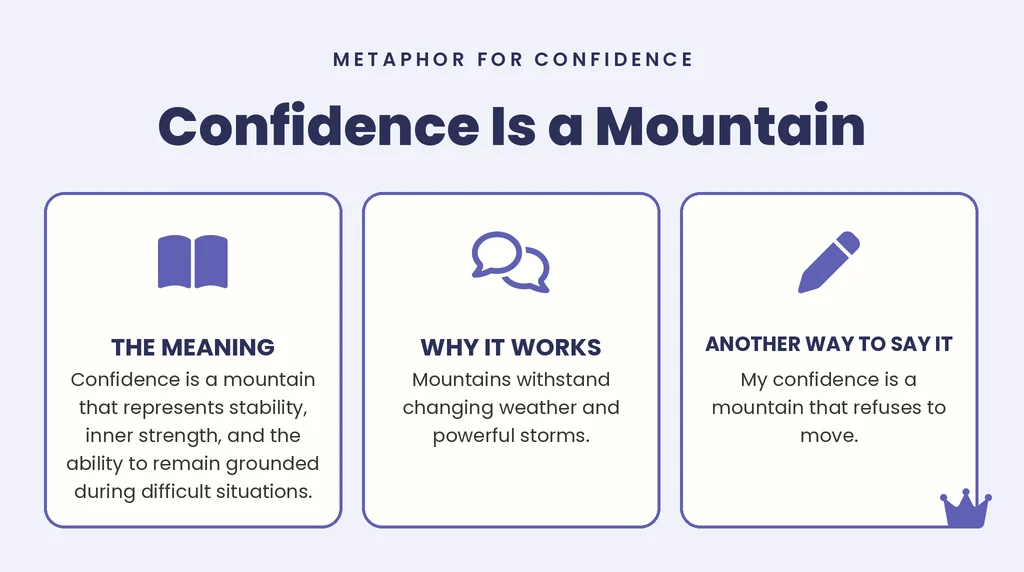
1. Confidence Is a Mountain
Meaning
Confidence is a mountain that represents stability, inner strength, and the ability to remain grounded during difficult situations.
Why It Works
Mountains withstand changing weather and powerful storms. This makes them effective symbols of someone who trusts their abilities without being easily shaken by criticism or setbacks.
This metaphor works particularly well in motivational writing, personal essays, and speeches about perseverance.
Alternative Expression
“My confidence is a mountain that refuses to move.”
Examples in Writing
Formal Example: Her confidence was a mountain that remained steady despite professional challenges.
Casual Example: When I believe in myself, my confidence feels like a mountain.
Creative Example: The winds questioned my strength, but my confidence stood like a mountain beneath the restless sky.
2. Confidence Is a Lighthouse

Meaning
Confidence is a lighthouse that helps you find direction when uncertainty surrounds you.
Why It Works
A lighthouse provides a steady point of reference in darkness. Similarly, confidence helps people make decisions, express their opinions, and move forward without needing constant approval from others.
This metaphor is especially useful for leadership speeches and writing about personal growth.
Alternative Expression
“Self-belief is a beacon cutting through the fog.”
Examples in Writing
Formal Example: Her confidence became a lighthouse that guided her through professional uncertainty.
Casual Example: I trust myself enough to find my way, even when things get confusing.
Creative Example: When doubt covered the horizon, my confidence kept one golden light burning.
3. Confidence Is a Flame That Never Goes Out

Meaning
Confidence is an inner fire that continues burning through challenges, rejection, and uncertainty.
Why It Works
A flame represents energy, warmth, and persistence. Even a small flame can survive a difficult night, making it a powerful image for quiet determination.
Use this metaphor when describing someone who continues believing in their potential after experiencing failure.
Alternative Expression
“My self-belief is an ember that survives the cold.”
Examples in Writing
Formal Example: Despite repeated setbacks, her confidence remained a flame that refused to disappear.
Casual Example: Even when things go wrong, I try to keep that little spark of belief alive.
Creative Example: The world sent its winter winds, but somewhere inside me, a small flame kept dancing.
4. Confidence Is an Anchor in Rough Waters
Meaning
Confidence keeps you emotionally steady when life becomes unpredictable.
Why It Works
An anchor prevents a boat from drifting too far in difficult waters. This image captures the stabilizing effect of trusting yourself when criticism, pressure, or uncertainty threatens to overwhelm you.
It works well in reflective essays and writing about emotional resilience.
Alternative Expression
“Self-belief is an anchor beneath restless waves.”
Examples in Writing
Formal Example: Her confidence served as an anchor during a period of personal uncertainty.
Casual Example: I remind myself what I can do when everything starts going wrong.
Creative Example: The waves rose higher, but my belief in myself held me close to shore.
5. Confidence Is a Seed Breaking Through Concrete
Meaning
Confidence is the ability to grow despite obstacles, discouragement, or difficult circumstances.
Why It Works
A tiny seed pushing through concrete represents the surprising power of persistence. It also suggests that confidence does not always begin as something strong. Sometimes it develops through small acts of courage.
This is an excellent metaphor for personal development, overcoming insecurity, and student essays.
Alternative Expression
“My confidence is a green shoot rising through stone.”
Examples in Writing
Formal Example: Her growing confidence was a seed breaking through concrete in an environment that rarely encouraged her.
Casual Example: I started believing in myself little by little, even when nobody expected much from me.
Creative Example: Between the cracks of every doubt, a stubborn green shoot reached for the sun.
6. Confidence Is a Lion Walking Through the Forest
Meaning
Confidence is courage, presence, and the willingness to occupy space without constantly seeking permission.
Why It Works
A lion symbolizes strength and commanding presence. This metaphor can describe someone who speaks clearly, makes decisions, and stands by their values.
However, confidence does not require aggression. The strongest use of this image emphasizes quiet assurance rather than intimidation.
Alternative Expression
“I carry the courage of a lion within me.”
Examples in Writing
Formal Example: He entered the interview with the confidence of a lion moving through familiar territory.
Casual Example: I walked into that presentation ready to give it my best.
Creative Example: I crossed the room like a lion beneath the open sky, carrying no apology for my presence.
7. Confidence Is a Compass
Meaning
Confidence is an inner guide that helps you choose a direction and act according to your values.
Why It Works
A compass offers direction without removing every obstacle along the journey. Likewise, self-confidence does not mean knowing every answer. It means trusting yourself enough to make decisions and learn along the way.
This metaphor works particularly well in career writing, personal reflections, and speeches about finding purpose.
Alternative Expression
“Self-belief is an inner compass pointing toward possibility.”
Examples in Writing
Formal Example: Her confidence acted as a compass, helping her navigate unfamiliar professional decisions.
Casual Example: I don’t need to know everything before taking the next step.
Creative Example: Even when the roads disappeared, my confidence kept pointing toward the horizon.
8. Confidence Is a Bridge Between Doubt and Action
Meaning
Confidence helps you move from worrying about your abilities to actually using them.
Why It Works
A bridge connects two separate places. Here, those places are hesitation and action. The metaphor captures the moment when someone stops waiting for perfect certainty and begins taking meaningful steps.
It is particularly effective in motivational writing and essays about overcoming fear.
Alternative Expression
“Confidence is the path from hesitation to possibility.”
Examples in Writing
Formal Example: Developing self-confidence became a bridge between her ambitions and her willingness to pursue them.
Casual Example: Believing in myself helped me finally apply for the job.
Creative Example: I built a bridge across my doubts and walked toward the life I once considered impossible.
9. Confidence Is Armor Woven From Experience
Meaning
Confidence protects your sense of self because you have learned from past challenges and experiences.
Why It Works
Armor represents protection, while experience provides the material from which it is made. The image suggests that confidence can develop gradually through mistakes, difficult conversations, and lessons learned.
The metaphor is especially useful for character development and reflective writing.
Alternative Expression
“My confidence is a shield forged through experience.”
Examples in Writing
Formal Example: Years of experience gave her the confidence of armor woven from hard lessons.
Casual Example: I’ve learned enough from my mistakes to trust myself more now.
Creative Example: Every failure left a thread behind, and slowly I stitched my courage into armor.
10. Confidence Is a Sunrise After a Long Night
Meaning
Confidence is the renewed belief that emerges after a period of fear, insecurity, or disappointment.
Why It Works
Sunrise symbolizes hope and a fresh beginning. This metaphor is particularly powerful when describing someone who has regained faith in themselves after a difficult experience.
It works beautifully in personal essays, inspirational writing, and poetry.
Alternative Expression
“Confidence is the first light after a season of doubt.”
Examples in Writing
Formal Example: Completing the project brought a sunrise of confidence after months of uncertainty.
Casual Example: After everything that happened, I finally started believing in myself again.
Creative Example: My doubts had ruled the night, but morning arrived quietly across the horizon.
11. Confidence Is a Tree With Deep Roots
Meaning
Confidence is a stable sense of self that does not depend entirely on other people’s opinions.
Why It Works
A tree’s roots anchor it beneath the surface. This image distinguishes deep confidence from temporary excitement or the need for constant praise.
It is useful for writing about emotional maturity, self-respect, and personal identity.
Alternative Expression
“My self-belief is rooted deeper than the wind can reach.”
Examples in Writing
Formal Example: Her confidence grew like a tree with deep roots, supported by experience rather than public approval.
Casual Example: I know who I am, so not everyone’s opinion changes how I feel about myself.
Creative Example: The branches trembled in the wind, but beneath the earth, my roots held their ground.
12. Confidence Is a Drumbeat in the Chest
Meaning
Confidence is an inner rhythm that encourages you to move forward, speak up, and take action.
Why It Works
A drumbeat suggests energy, momentum, and determination. The image makes confidence feel physical rather than abstract.
It is especially effective in spoken word poetry, dramatic storytelling, and descriptions of moments before a challenge.
Alternative Expression
“Courage is a steady rhythm beneath my ribs.”
Examples in Writing
Formal Example: She approached the competition with a confidence that beat steadily beneath her nervousness.
Casual Example: I was nervous, but I kept telling myself I could do it.
Creative Example: Fear whispered in my ears, but a stronger rhythm was beating inside my chest.
13. Confidence Is a Key That Opens Locked Doors
Meaning
Confidence gives you the courage to explore opportunities that once seemed unavailable.
Why It Works
A key represents access and possibility. The metaphor suggests that believing in yourself can help you approach new situations, introduce yourself to others, or attempt something unfamiliar.
Confidence does not guarantee success, but it can help you take the first step.
Alternative Expression
“Self-belief is the key to doors I once feared opening.”
Examples in Writing
Formal Example: Building her confidence became a key that opened new academic and professional opportunities.
Casual Example: Once I stopped doubting myself so much, I started trying new things.
Creative Example: I carried no map of what waited beyond the door, only the key to turn its lock.
14. Confidence Is a Shield Against Doubt
Meaning
Confidence helps you respond to negative thoughts and criticism without automatically accepting them as truth.
Why It Works
A shield represents protection rather than invulnerability. Healthy confidence does not mean that criticism never hurts. It means you can consider feedback without allowing every negative opinion to define your worth.
This metaphor is useful in writing about self-esteem and resilience.
Alternative Expression
“My self-belief is a shield against the arrows of insecurity.”
Examples in Writing
Formal Example: Her confidence acted as a shield against criticism that offered little constructive value.
Casual Example: I listen to feedback, but I don’t let every comment destroy my self-esteem.
Creative Example: Words flew toward me like arrows, but I learned which ones deserved to pass through.
15. Confidence Is a Sail Catching the Wind
Meaning
Confidence helps you use opportunities and move toward your goals.
Why It Works
A sail catches the wind and turns it into movement. This image presents confidence as something active that helps you make progress, rather than a feeling that simply sits inside you.
It works well in career writing, motivational speeches, and personal development articles.
Alternative Expression
“Self-belief is a sail turning possibility into motion.”
Examples in Writing
Formal Example: Her confidence became a sail that carried her ambitions into unfamiliar territory.
Casual Example: Once I trusted myself enough to try, things finally started moving.
Creative Example: The wind had always been there; I simply needed the courage to raise my sail.
16. Confidence Is a Crown You Place on Yourself
Meaning
Confidence is recognizing your worth without waiting for other people to validate it.
Why It Works
A crown symbolizes dignity, self-respect, and personal authority. This metaphor is strongest when it communicates inner worth rather than superiority over others.
It can be used in empowerment writing, speeches, and social media captions.
Alternative Expression
“Self-respect is a crown no one else needs to place on my head.”
Examples in Writing
Formal Example: She learned that confidence was a crown earned through self-respect rather than public recognition.
Casual Example: I don’t need everyone’s approval to know I bring value.
Creative Example: I stopped waiting for the world to crown me and began standing like I already knew my worth.
17. Confidence Is a Muscle That Grows With Practice
Meaning
Confidence develops through repeated effort, experience, and small acts of courage.
Why It Works
Muscles grow stronger through consistent use. Similarly, confidence often increases when people practice speaking, learn new skills, accept challenges, and recover from mistakes.
This metaphor is especially useful in educational writing and practical advice.
Alternative Expression
“Confidence is a skill strengthened through action.”
Examples in Writing
Formal Example: Regular presentations helped strengthen her confidence like a muscle developed through practice.
Casual Example: The more I practiced, the less nervous I became.
Creative Example: Every trembling attempt became another repetition, quietly building strength beneath my fear.
18. Confidence Is a Fire Forged in Failure
Meaning
Confidence grows when you learn from setbacks instead of treating them as proof that you cannot succeed.
Why It Works
Fire can represent both destruction and transformation. This metaphor shows how difficult experiences can become opportunities for learning when you reflect on them constructively.
It is particularly effective in resilience writing and stories about personal achievement.
Alternative Expression
“My failures became fuel for my determination.”
Examples in Writing
Formal Example: Each setback strengthened his confidence, creating a fire forged in failure.
Casual Example: I didn’t get it right the first time, but I learned enough to try again.
Creative Example: My failures burned away the excuses until only the courage to begin again remained.
19. Confidence Is a Window Opening to the World
Meaning
Confidence allows you to express yourself, explore new possibilities, and connect more freely with others.
Why It Works
An open window represents fresh air, visibility, and new perspectives. This metaphor is useful for describing someone who gradually becomes more comfortable sharing ideas and expressing their personality.
Alternative Expression
“Confidence is a window letting possibility into my life.”
Examples in Writing
Formal Example: Developing her confidence opened a window to opportunities she had previously avoided.
Casual Example: Once I felt more comfortable with myself, I started meeting new people.
Creative Example: I unlatched the window of my fears and let the unfamiliar morning enter.
20. Confidence Is a Torch Passed From One Generation to Another
Meaning
Confidence can be nurtured through encouragement, mentorship, and examples set by others.
Why It Works
A torch symbolizes light, responsibility, and shared knowledge. This metaphor shows how one person’s belief in another can help that person develop confidence of their own.
It works particularly well in leadership speeches, educational writing, and stories about supportive relationships.
Alternative Expression
“Self-belief is a light that grows brighter when shared.”
Examples in Writing
Formal Example: Her teacher’s encouragement became a torch that helped her approach future challenges with confidence.
Casual Example: Someone believed in me before I believed in myself, and that made a real difference.
Creative Example: She placed a small flame in my hands, and one day I carried its light into someone else’s darkness.
Positive Metaphors for Confidence
Positive confidence metaphors are useful when you want to communicate optimism, courage, or a strong belief in personal abilities.
| Metaphor | What It Expresses |
|---|---|
| Confidence is a rising sun. | Hope and fresh beginnings |
| Confidence is a mountain. | Stability and strength |
| Confidence is a flame. | Determination and passion |
| Confidence is a compass. | Direction and self-trust |
| Confidence is a tree with deep roots. | Security and self-respect |
| Confidence is a sail catching the wind. | Initiative and progress |
These metaphors are suitable for motivational speeches, personal essays, presentations, and inspirational writing.
Deep Metaphors for Confidence
Sometimes confidence is not about being fearless or commanding attention. It can mean speaking despite nervousness, accepting imperfections, or trusting yourself when the outcome remains uncertain.
Consider these deeper expressions:
- Confidence is a quiet voice that refuses to disappear. This represents self-belief without the need to dominate a conversation.
- Confidence is a bridge built plank by plank. This suggests that self-trust develops gradually through experience.
- Confidence is a steady hand in a trembling world. This conveys calmness in the middle of uncertainty.
- Confidence is a light carried through an unfamiliar forest. This represents trusting yourself even when the next step is unclear.
- Confidence is a seed that grows in imperfect soil. This suggests that personal growth can begin even when circumstances are difficult.
These metaphors are particularly effective in poetry, memoirs, and reflective essays because they allow room for vulnerability. They show that confidence can exist alongside fear, uncertainty, and imperfection.
Metaphors for Confidence in Essays and Speeches
When writing an essay or delivering a speech, choose a metaphor that supports your main point instead of distracting from it.
For example, if you are writing about overcoming public speaking anxiety, you might say:
“Confidence became a bridge between my fear of speaking and my willingness to be heard.”
This comparison connects the emotion to a specific change in behavior. It is more meaningful than simply saying, “I became confident.”
For an essay about perseverance, you might write:
“My confidence was a seed breaking through concrete, growing despite the circumstances that once made success seem impossible.”
For a leadership speech, consider:
“A confident leader is a lighthouse, offering direction without controlling every ship at sea.”
This metaphor communicates guidance while recognizing that other people need room to make their own decisions.
Writing tip: After introducing a metaphor, explain how it connects to the real experience. A vivid image becomes more persuasive when the surrounding details give it meaning.
How to Use Confidence Metaphors Naturally in Writing
A good confidence metaphor should feel connected to the situation. The aim is not to make every sentence poetic. It is to find an image that expresses the emotion more clearly than a literal description.
1. Match the Metaphor to the Type of Confidence
Different situations call for different images.
- Use a mountain for firmness and stability.
- Use a flame for passion and determination.
- Use a compass for self-trust and decision-making.
- Use a seed for developing confidence.
- Use an anchor for remaining steady under pressure.
Choosing a specific image gives your writing more precision.
2. Show Confidence Through Actions
Rather than writing, “She was extremely confident,” describe her behavior through a metaphor.
For example:
“She stepped onto the stage like a lighthouse emerging through the fog, steady enough to speak even when the audience fell silent.”
The image works because the reader can picture the moment instead of simply being told how the character feels.
3. Avoid Overused Comparisons
Expressions such as “as brave as a lion” and “strong as a mountain” are familiar. They are not necessarily wrong, but a fresh variation can make your writing more distinctive.
Instead of saying, “He was a mountain of confidence,” try:
“His confidence was a mountain with roots deep enough to survive the storm.”
The added detail gives the image a more specific emotional meaning.
4. Keep Your Imagery Consistent
Avoid combining unrelated metaphors in one sentence.
Confusing example:
“Her confidence was a mountain that sailed through the ocean and unlocked a burning door.”
Each image suggests a different scene, making the sentence difficult to visualize.
Clearer example:
“Her confidence was a mountain that remained steady through every storm.”
One coherent image creates a stronger impression.
5. Let Confidence Include Vulnerability
Confidence does not mean being fearless, perfect, or certain about everything. Sometimes the most believable description shows someone acting despite their doubts.
For example:
“My confidence was a small flame, trembling in the wind but refusing to go out.”
This image feels human because it acknowledges uncertainty without surrendering to it.
Metaphor vs. Simile: What Is the Difference?
A metaphor describes one thing as another to create a direct imaginative connection. A simile compares two things using words such as “like” or “as.”
| Feature | Metaphor | Simile |
|---|---|---|
| Example | Confidence is a lighthouse. | Confidence is like a lighthouse. |
| Style | Direct and immersive | Explicit and comparative |
| Common use | Poetry, essays, storytelling | Descriptions, dialogue, everyday writing |
| Effect | Creates a symbolic identity | Highlights a shared quality |
Both can be effective. Metaphors often feel more immediate, while similes make the comparison explicit. Choose the form that fits your writing voice and purpose.
Frequently Asked Questions
1. What is a metaphor for confidence?
A metaphor for confidence describes self-belief through an image. For example, “Confidence is a lighthouse” suggests that trusting yourself can provide direction during uncertainty.
2. What is a good metaphor for self-confidence?
“Self-confidence is a tree with deep roots” is a strong metaphor because it represents stability, self-respect, and independence from constant approval.
3. What is a positive metaphor for confidence?
“Confidence is a sunrise after a long night” is a positive metaphor that represents renewed hope, personal growth, and the return of self-belief after a difficult period.
4. What is a metaphor for being confident?
“She was a lion walking through the forest” portrays someone who moves with courage, presence, and a strong sense of personal worth.
5. How can I describe confidence in an essay?
Use an image that reflects your experience. For example, “Confidence became a bridge between my fear and my willingness to speak.” Then explain the real event that helped you overcome your hesitation.
6. What is a deep metaphor for confidence?
“Confidence is a small flame that survives the storm” expresses the idea that self-belief can remain alive even during fear, criticism, and uncertainty.
7. What is a metaphor for gaining confidence?
“Confidence is a seed breaking through concrete” represents the gradual development of self-belief despite obstacles, discouragement, or difficult circumstances.
8. Can confidence be described as an object?
Yes. Confidence can be described as an anchor, compass, key, shield, or torch. Each object represents a different quality, such as stability, direction, opportunity, protection, or encouragement.
9. What is the difference between confidence and arrogance in a metaphor?
Confidence can be represented by a deeply rooted tree that stands firm without overshadowing everything around it. Arrogance might be portrayed as a towering statue demanding everyone’s attention. The distinction is between trusting your worth and believing you are superior to others.
10. How do I create original metaphors for confidence?
Start with a real experience, such as speaking up in a meeting or trying something new. Identify the feeling, then connect it to a specific object, natural process, or action. Personal details often produce more original metaphors than familiar motivational phrases.
Conclusion
Confidence is more than a bold voice or an unshakable appearance. It can be a mountain that remains steady, a flame that survives the wind, or a small seed finding its way through concrete. These metaphors for confidence help turn an abstract quality into something vivid, emotional, and memorable.
For writers, the real value of a metaphor lies in its ability to communicate an experience rather than simply decorate a sentence. The right image can strengthen a school essay, bring a character to life, deepen a poem, or make a motivational speech feel more personal.
Experiment with different images and consider what kind of confidence you want to express. Quiet self-trust requires a different metaphor from bold ambition or courage developed through failure.
Ultimately, the most powerful metaphor is the one that feels honest. When your imagery reflects a genuine human experience, your writing becomes clearer, more expressive, and far more memorable.
5 thoughts on “Metaphor for Confidence | 25+ Powerful Images That Turn Self-Belief Into Unshakable Strength in 2026”
Comments are closed.