Picture a dry stretch of land, cracked and empty. Somewhere under it, a well goes deep, and the water stays cool. A river runs quiet and deep nearby. That’s wisdom. It doesn’t shout. It gathers slowly, out of sight beneath ordinary days, and it’s there, ready, on the one day you truly need it.
Why do writers reach for pictures at all here? Because wisdom’s even harder to see than knowledge. A person can recite every fact in the room and still choose badly, so we borrow wells, roots, captains, and candles, and the difference suddenly shows. The right image tells your reader what sort of wisdom your piece means: ancient or practical, gentle or stern, earned or inherited.
Here are twenty original metaphors for wisdom. Each gets its meaning, a note on why it works, an alternative way to say it, and examples that are formal, casual, and creative. You’ll also find positive and negative sets, a table of ready-made sentences, and advice on using these images naturally. Student, essayist, speechwriter: if you want to honor good judgment, you’ll find plenty to borrow.
Quick Metaphors for Wisdom
Want the whole collection first? Here it is, in one list, before the details begin.
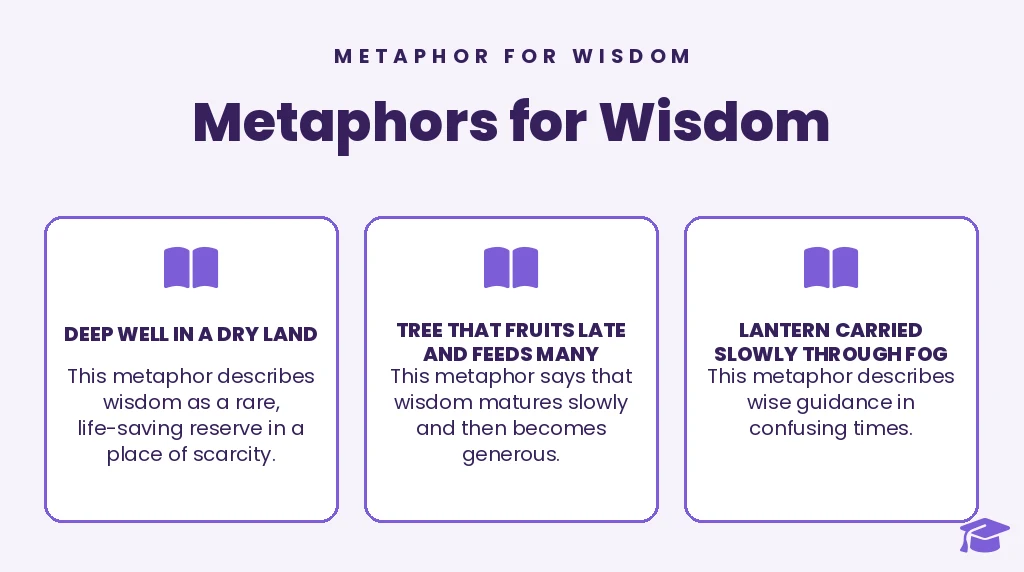
- Wisdom is a deep well in a dry land.
- Wisdom is a tree that fruits late and feeds many.
- Wisdom is a lantern carried slowly through fog.
- Wisdom is an old road that remembers every traveler.
- Wisdom is a river that runs quiet and deep.
- Wisdom is a compass calibrated by storms.
- Wisdom is a garden tended by patience.
- Wisdom is a bridge built from both banks at once.
- Wisdom is a key that waits for the right door.
- Wisdom is a mirror that shows the face behind the face.
- Wisdom is a harvest stored against a hard winter.
- Wisdom is a mountain spring, small and constant.
- Wisdom is a book read slowly and reread often.
- Wisdom is a hand on the shoulder before the fall.
- Wisdom is a net that catches what strength misses.
- Wisdom is a candle that does not fight the wind.
- Wisdom is a map drawn in pencil, not stone.
- Wisdom is a root that drinks from deep water.
- Wisdom is a door that opens only inward.
- Wisdom is a star that guides without shouting.
Metaphors for Wisdom and Their Meanings
Go through them one by one, explanation and examples together. You’ll start to notice something: wisdom keeps turning up as something slow, deep, or quietly protective. Pick the images that fit the wise person in your own writing.
1. Wisdom Is a Deep Well in a Dry Land

Meaning
In dry land, a deep well isn’t scenery. It’s survival. Opinions are puddles, gone in the first heat. A wise person’s judgment runs deep instead, and it stays sweet.
Why It Works
You can’t dig a well mid-crisis. It takes effort, done long beforehand, and judgment forms the same way. Put that well in dry land and its value needs no explaining.
Alternative Expression
Or picture it this way: “a hidden spring under cracked earth.”
Examples in Writing
Formal Example: Wisdom is a deep well in a dry land, and in the drought of the scandal, the old judge’s counsel saved the institution.
Casual Example: When the business panicked, we went to Marta; her wisdom is a deep well.
Creative Example: In the dry land of that bitter year, his wisdom was a deep well, and the whole village drank.
2. Wisdom Is a Tree That Fruits Late and Feeds Many

Meaning
Good judgment takes its time, then gives a lot away. A young tree shades almost nobody and fruits for no one. Give it years, though, and a whole neighborhood eats from it, including people it’ll never meet.
Why It Works
Trees make slowness feel honorable, not lazy. Late fruit also explains why the young underestimate elders so often: the harvest hadn’t been noticed yet. It was coming all along.
Alternative Expression
Try this instead: “an orchard planted for grandchildren.”
Examples in Writing
Formal Example: Wisdom is a tree that fruits late and feeds many, and mentorship programs exist to gather that late harvest.
Casual Example: Dad’s advice fruited late, but our whole family eats from that tree now.
Creative Example: Her wisdom was a tree that fruited late; strangers rested in its shade and children filled their pockets.
3. Wisdom Is a Lantern Carried Slowly Through Fog

Meaning
Fog changes the rules. A lantern won’t clear it, and it doesn’t try. It lights the next two steps. So the wise person walks slowly, at exactly the speed the light allows.
Why It Works
Fog is simply the weather of hard decisions, so the picture feels honest. Slowness turns into a virtue here. That’s why it suits writing about leadership during a crisis.
Alternative Expression
Another way in: “a small lamp that respects the darkness around it.”
Examples in Writing
Formal Example: Wisdom is a lantern carried slowly through fog, and the committee’s restraint that winter was exactly that pace.
Casual Example: No big answers, just her lantern through the fog, one careful step at a time.
Creative Example: Through the fog of the scandal she carried her wisdom like a lantern, slowly, and the path appeared under her feet.
4. Wisdom Is an Old Road That Remembers Every Traveler
Meaning
An old road remembers. Armies have crossed it. So have wedding parties and funeral processions. A wise mind works much the same way, carrying memories of many lives, its own mistakes very much included.
Why It Works
Roads are humble things. They serve everyone and boast to no one, and a remembering road explains something real: wise advice often shows up as a story, not a rule.
Alternative Expression
Or reach for “a bridge that has carried ten thousand mornings.”
Examples in Writing
Formal Example: Wisdom is an old road that remembers every traveler, and case law is one of its milestones.
Casual Example: Ask Uncle Ray; that old road has seen this exact accident before.
Creative Example: His wisdom was an old road that remembered every traveler, every cart of joy, every coffin, every crown.
5. Wisdom Is a River That Runs Quiet and Deep
Meaning
Shallow water makes noise. Streams chatter over stones, but a great river moves almost silently, because real depth doesn’t need announcing. Deep judgment doesn’t either.
Why It Works
Everyone gets the contrast at once: loud means shallow, quiet means deep. It’s an easy, graceful compliment. Save it for reserved leaders, grandparents, and judges.
Alternative Expression
Close, too, is “a deep pool that does not ripple for every stone.”
Examples in Writing
Formal Example: Wisdom is a river that runs quiet and deep, and the chairperson’s few words settled what hours of debate could not.
Casual Example: He barely talks in meetings; when he does, that quiet river is deep.
Creative Example: The loud men were streams over pebbles; her wisdom was the river, quiet and deep, carrying ships.
6. Wisdom Is a Compass Calibrated by Storms
Meaning
Hard experience is what makes judgment accurate. A compass tested only in calm weather may fail at sea. Someone tested by loss, failure, and recovery points true while others spin.
Why It Works
Calibration is a precise word, a technical one, and it respects both the suffering and the skill. Try it in biographies of survivors, founders, and reformers.
Alternative Expression
Or simply “a sailor’s instinct educated by weather.”
Examples in Writing
Formal Example: Wisdom is a compass calibrated by storms, and the negotiator’s two bankruptcies had made her readings exact.
Casual Example: After everything she has survived, her compass is calibrated; trust her call.
Creative Example: Storm by storm, his wisdom calibrated itself, until in the worst weather his needle never trembled.
7. Wisdom Is a Garden Tended by Patience
Meaning
Judgment, here, is grown, not found. Small acts of care, repeated. Wise people prune hasty words, pull out old grudges like weeds, and water new understanding, season after season.
Why It Works
A garden makes patience visible, then rewards it with food and beauty. The image is gentle, so it suits teachers, parents, and healers.
Alternative Expression
Or this: “a vineyard that forgives one bad season.”
Examples in Writing
Formal Example: Wisdom is a garden tended by patience, and judicial temperament is one of its slowest flowers.
Casual Example: Her wisdom did not arrive in a lightning bolt; she gardened it for forty years.
Creative Example: In the garden of her wisdom, patience held the watering can, and every grudge was pruned before spring.
8. Wisdom Is a Bridge Built from Both Banks at Once
Meaning
Wise people see a conflict from both sides. Foolishness builds from one bank and hopes. Wisdom starts construction from the other side’s position as well, and meets in the middle.
Why It Works
The engineering does the work. Fairness stops sounding soft and starts sounding like craftsmanship, which makes this one tailor-made for diplomacy, mediation, and marriage.
Alternative Expression
Or put it as “a translator fluent in two angers.”
Examples in Writing
Formal Example: Wisdom is a bridge built from both banks at once, and the mediator’s first question honored the other shore.
Casual Example: She listens to both kids before judging; that bridge gets built from both banks.
Creative Example: While the brothers shouted across the river, their grandmother’s wisdom laid stones from both banks at once.
9. Wisdom Is a Key That Waits for the Right Door
Meaning
It’s about timing, mostly. A wise person might hold the answer for years and say nothing, waiting until the moment, the person, and the question are all ready to receive it.
Why It Works
Keys break in wrong locks. So does forced advice, often enough. The waiting key flatters restraint instead, a quality readers recognize as rare.
Alternative Expression
Think of “a seed that refuses the wrong season.”
Examples in Writing
Formal Example: Wisdom is a key that waits for the right door, and the counselor’s silence all spring opened more than speeches.
Casual Example: He knew the answer in March but waited until June; right key, right door.
Creative Example: On its ring of years the key of her wisdom waited, patient and bright, for the one door shaped like now.
10. Wisdom Is a Mirror That Shows the Face Behind the Face
Meaning
Look closer. An ordinary mirror shows the expression we’ve practiced, but wisdom shows what’s standing behind it: the motive, the fear, the hope we didn’t mention.
Why It Works
That doubled face is a little mysterious. Good. Hidden things are the subject here, and the image shines in fiction, where motives matter more than speeches.
Alternative Expression
There’s also “a window cleaned from the inside.”
Examples in Writing
Formal Example: Wisdom is a mirror that shows the face behind the face, and great interviewing is simply holding it steady.
Casual Example: One question from her and I saw the face behind my own face.
Creative Example: The old woman held up her mirror of wisdom, and the proud merchant met the frightened boy behind his face.
11. Wisdom Is a Harvest Stored Against a Hard Winter
Meaning
Lessons learned in good times become food in bad ones. Wise people store experience while the harvest is plentiful, so grief, failure, or old age can’t starve them later.
Why It Works
Stored harvests make foresight feel warm and agricultural, not anxious. The hard winter helps too: it comes for every reader, sooner or later.
Alternative Expression
Or picture “a cellar of apples laid down in autumn.”
Examples in Writing
Formal Example: Wisdom is a harvest stored against a hard winter, and resilient families are those whose elders stored generously.
Casual Example: When the layoff came, his stored harvest of wisdom fed the whole house.
Creative Example: All her bright years she had stored the harvest, so when the hard winter knocked, her wisdom opened the cellar.
12. Wisdom Is a Mountain Spring, Small and Constant
Meaning
Reliability beats drama here. A mountain spring doesn’t flood, doesn’t perform, doesn’t dry up either. It just keeps offering the same clear help, in August as in April.
Why It Works
Smallness is the surprise: readers expect wisdom to be vast. Constancy becomes the virtue instead. It suits tributes to steady, unglamorous people.
Alternative Expression
How about “a tap that has never once run dry.”
Examples in Writing
Formal Example: Wisdom is a mountain spring, small and constant, and institutional memory flows from such uncelebrated sources.
Casual Example: Nothing flashy about her advice; it is a mountain spring, always there, always clear.
Creative Example: Empires drank from rivers and died of thirst, but the mountain spring of her wisdom ran small and constant.
13. Wisdom Is a Book Read Slowly and Reread Often
Meaning
Some minds reward a second look. So do some lives, and some traditions. A first reading gives you the plot. Only rereading finds the sentences that seem written for you personally.
Why It Works
Every reader knows a book that changed meaning as they aged. The image proves itself from experience, then. It flatters patience and depth over speed.
Alternative Expression
Or keep close with “a letter from an old friend, kept in the top drawer.”
Examples in Writing
Formal Example: Wisdom is a book read slowly and reread often, and classics survive because each generation rereads them profitably.
Casual Example: My grandmother is that kind of book; every visit, a new underlined sentence.
Creative Example: He was a book read slowly and reread often, and only the patient ever reached his final, golden chapter.
14. Wisdom Is a Hand on the Shoulder Before the Fall
Meaning
The warning arrives one second early. That’s the whole point. Wisdom doesn’t lecture people after they’ve fallen; it steadies the walker quietly, while there’s still time to matter.
Why It Works
The human hand keeps it tender rather than grand, and the timing adds drama. It’s ideal for writing about parents, coaches, and true friends.
Alternative Expression
Try “a railing placed exactly where the stairs turn dark.”
Examples in Writing
Formal Example: Wisdom is a hand on the shoulder before the fall, and safety training at its best institutionalizes that hand.
Casual Example: Her “are you sure?” was a hand on my shoulder one step before the fall.
Creative Example: Just as pride lifted his foot over the edge, wisdom touched his shoulder, a hand warm as his mother’s.
15. Wisdom Is a Net That Catches What Strength Misses
Meaning
Force grabs at the biggest visible problem. Judgment does something quieter: it spreads a patient net and catches the small causes drifting underneath. That’s where judgment succeeds and force fails.
Why It Works
Nets reward patience and positioning, not power. Quiet strategists will feel flattered, and the contrast with strength gives the image its satisfying argument.
Alternative Expression
Or picture “a sieve that keeps the gold and releases the sand.”
Examples in Writing
Formal Example: Wisdom is a net that catches what strength misses, and the auditor’s patience found what the raid had overlooked.
Casual Example: The strong managers shouted; her net quietly caught the real problem.
Creative Example: Strength plunged its bare hands into the river and caught nothing; wisdom spread its net and waited, silvering.
16. Wisdom Is a Candle That Does Not Fight the Wind
Meaning
Strength, here, bends. The candle lets its flame lean, shelters itself, and stays lit, while a rigid torch snaps in the same storm. Wisdom survives by adjusting. It doesn’t waste breath arguing with weather.
Why It Works
A small flame against a large wind wins instant sympathy, and respect too. It suits writing about humility, adaptation, and quiet endurance.
Alternative Expression
There’s also “a reed that bows and therefore stands.”
Examples in Writing
Formal Example: Wisdom is a candle that does not fight the wind, and the diplomat’s concessions that year were shelter, not surrender.
Casual Example: She never argues with a storm; candle wisdom, still burning after it passes.
Creative Example: The torches cursed the wind and died; the candle of her wisdom bowed, sheltered, and burned on.
17. Wisdom Is a Map Drawn in Pencil, Not Stone
Meaning
Staying correctable is the habit here. Stone maps can’t learn from new rivers. Pencil maps expect revision, so their owners keep discovering the country as it truly is.
Why It Works
The pencil is humble and erasable, a surprise for readers who expect wisdom to sound final. It’s a modern, practical image, good for science and leadership alike.
Alternative Expression
Think “a plan written on water’s edge, ready to move.”
Examples in Writing
Formal Example: Wisdom is a map drawn in pencil, not stone, and the revised guideline was an eraser’s triumph, not a defeat.
Casual Example: He holds opinions in pencil; that is why people trust his map.
Creative Example: The proud carved their maps in stone and drowned in new rivers; her pencil map simply learned the water.
18. Wisdom Is a Root That Drinks from Deep Water
Meaning
Deep sources feed this person: faith, memory, discipline, tradition. Surface rain comes and goes, as it does. But someone rooted like this stays green through public droughts.
Why It Works
Nobody can see roots. That’s why wise calm looks mysterious from the outside, until the deep water explains the hidden source so satisfyingly.
Alternative Expression
Or try “a well rope long enough for the driest year.”
Examples in Writing
Formal Example: Wisdom is a root that drinks from deep water, and the elder’s serenity during the crisis traced to sources decades old.
Casual Example: Panic never reaches her; that root drinks from deep water.
Creative Example: While shallow plants begged the sky for rain, the root of his wisdom drank in darkness from deep water.
19. Wisdom Is a Door That Opens Only Inward
Meaning
Nobody can force wisdom into another person. Teachers can knock. They can point and plead, too. But the door of understanding only opens when the learner’s own hand turns it, from inside.
Why It Works
One picture, two puzzles solved: failed lectures and sudden conversions both make sense. And because it respects the reader’s freedom, the image persuades instead of preaching.
Alternative Expression
Or picture “a seed that must crack itself to grow.”
Examples in Writing
Formal Example: Wisdom is a door that opens only inward, and the finest curriculum can do no more than knock beautifully.
Casual Example: I could not drag him to sense; that door opens inward, and one day it did.
Creative Example: A thousand teachers knocked with golden knuckles, but wisdom’s door opened only when his own hand turned, inward.
20. Wisdom Is a Star That Guides Without Shouting
Meaning
Guidance doesn’t have to chase anyone. A star is constant, distant, and silent; it never scolds the lost or runs after the traveler. It simply shines, and sailors have steered by it, gratefully, for centuries.
Why It Works
Reliability plus humility. That’s exactly the chemistry you’ll find in the wisest people, and the silence in the picture makes it a peaceful place to end the collection.
Alternative Expression
Or, wryly, “a lighthouse that never sends a bill.”
Examples in Writing
Formal Example: Wisdom is a star that guides without shouting, and the founder’s principles still steer a company she no longer visits.
Casual Example: Grandma never lectured; she was a star, and we simply navigated by her.
Creative Example: Above the noise of the age, her wisdom shone like a star, guiding without shouting, and the lost came home.
Positive Metaphors for Wisdom
Praising good judgment? Go warm. Think shelter and steady light. These six positive metaphors show wisdom as a blessing to everyone standing near it.
- Wisdom is a warm hearth on a cold night. It gathers frightened people and thaws their worst decisions.
- Wisdom is a shepherd who counts every sheep twice. It protects the smallest and the straying with the same care.
- Wisdom is a soft rain that soaks the field evenly. It refreshes every corner without flooding any.
- Wisdom is a lighthouse keeper who trims the lamp daily. It stays ready for storms long before clouds gather.
- Wisdom is a seasoned captain who respects the weather. It never confuses courage with ignoring the sky.
- Wisdom is a grandmother’s recipe, measured by memory. It feeds generations from instructions written in the heart.
Negative Metaphors for Wisdom
Wisdom has a sorrowful side, though: it’s so often ignored, hidden, or refused. These six negative metaphors cover wisdom wasted, which can be as powerful as wisdom used.
- Wisdom ignored is a letter left unopened on the table. It contained the rescue and expired unread.
- Wisdom is a locked gate when pride keeps the key. It protects an empty field while the traveler starves outside.
- Wisdom is a bitter medicine refused by a proud patient. It could have healed, so it watches the fever rise.
- Wisdom is a candle hidden under a bowl. It smothers slowly in its own smoke while the room stays dark.
- Wisdom is a map folded away in a drawer. It knew every shortcut and accompanied no journey.
- Wisdom is a well covered over by the weeds of habit. It waits under neglect, sweet water under thorns.
Metaphors for Wisdom in Sentences
Below, six of these metaphors sit inside complete sentences, each with the message it sends. Borrow a pattern. Then restyle it around your own subject.
| Example sentence | What it communicates |
|---|---|
| In the dry season of the company’s history, her wisdom was a deep well, and everyone drank. | Judgment that sustains others during scarcity. |
| He carried his wisdom like a lantern through the fog of the trial, one honest step at a time. | Careful guidance when the future is unclear. |
| Their marriage survived because both partners built the bridge from both banks at once. | Fairness and perspective inside a relationship. |
| After the defeat, the captain’s wisdom was a compass calibrated by storms. | Accuracy of judgment earned through suffering. |
| She said little in the meeting, a river running quiet and deep, and the room reorganized around her words. | Quiet depth outranking loud shallowness. |
| His only advice was a hand on the shoulder before the fall: “Send the apology tonight.” | Timely, gentle prevention of a mistake. |
How to Use Metaphors for Wisdom Naturally
Match the image to the kind of wisdom you’re praising. Wells and roots suit depth, lanterns and stars suit guidance, bridges and nets suit practical cleverness, and gardens and harvests suit patience. Register matters too. Formal tributes carry rivers and stars easily; a friendly toast can hold grandmothers’ recipes and warm hearths. If the image would embarrass the person it honors, choose a quieter one.
Use a light hand. Wisdom writing goes wrong when it starts sounding like a proverb factory, so keep the dose small: one metaphor per section is usually plenty, and one per essay can be unforgettable. Don’t stack a well, a star, and a compass into a single paragraph about the same person. Readers will admire the fireworks and forget the human being underneath.
When you revise, test every image against what the person actually does. A star has to genuinely guide. A well must really be drawn from, and a candle should bend rather than break. If the life contradicts the picture, you’ve written flattery, and readers can smell flattery a mile off. The most natural wisdom metaphors are simply accurate observations in beautiful clothes.
Metaphor vs. Simile: What Is the Difference?
A metaphor identifies wisdom with something else directly: wisdom is a well, a star, a root. A simile compares instead, using like or as: wisdom is like a well. The direct claim gives a metaphor ceremonial weight. That’s why eulogies, proverbs, and graduation speeches lean on them so heavily.
The simile’s small distance makes it friendlier and easier to qualify. Say a manager’s wisdom is like a compass, and readers accept the comparison playfully, no perfection demanded. Many writers introduce an idea as a simile, then restate it later, once readers agree, as a metaphor for the conclusion.
Same idea, both forms. Metaphor: “Wisdom is a candle that does not fight the wind.” Simile: “Wisdom is like a candle in a storm, bending its flame, sheltering itself, and refusing to go out.” Hear the difference? One feels like a proverb. The other feels like a story, and stories persuade slowly, and deeply.
Common Mistakes When Writing Wisdom Metaphors
- Mistake: Confusing wisdom with mere age or knowledge. A full warehouse is not a wise guide. Make sure your image involves judgment, timing, or restraint, not just accumulation.
- Mistake: Making wisdom sound untouchable. If every wise figure is a distant star, readers admire and never imitate. Mix in hands, gardens, and recipes to keep wisdom reachable.
- Mistake: Piling up proverbs until the person disappears. A tribute with ten metaphors and no facts honors no one. Anchor each image to a real decision the person made.
- Mistake: Choosing a violent image for a gentle soul. Swords and storms can slander a quiet counselor. Match the image’s temperament to the subject’s character.
- Mistake: Explaining the metaphor to death. After “wisdom is a deep well,” you do not need three sentences proving wells are deep. Trust the picture and move on.
Frequently Asked Questions
What is a good metaphor for wisdom?
Start with “Wisdom is a deep well in a dry land.” It’s a classic-shaped favorite, and no wonder: scarcity, effort, and life-saving depth, all at once. Need guidance instead? Try “wisdom is a lantern carried slowly through fog.” For humility, “wisdom is a map drawn in pencil, not stone” praises a mind that stays correctable.
What is the difference between wisdom and knowledge in metaphors?
Look at what the image is doing. Knowledge metaphors picture gathering: rivers filling, gardens growing, rooms opening. Wisdom metaphors picture choosing and timing: compasses pointing, keys waiting, candles bending. Ask one question. Does your image answer how much they have? That’s knowledge. How well they decide? Wisdom.
How do I describe a wise person with a metaphor?
Start from one real habit of the person. The listener becomes a mirror. The patient adviser becomes a garden, and the crisis-tested leader becomes a compass calibrated by storms. Then write that habit plainly, in the sentence before or after the image, so the metaphor crowns a fact rather than replacing it.
Can wisdom metaphors work in a graduation or retirement speech?
Honestly, they’re almost made for speeches like these. Graduates respond to keys that wait for the right door and to maps drawn in pencil. Retirees? Honor them with trees that fruit late, harvests stored with love, and stars that guide without shouting. One image is enough. Repeat it at the end and the audience will carry it home.
What are negative metaphors for wisdom?
Most of them show wisdom going to waste: a letter left unopened, a candle hidden under a bowl, a map folded away in a drawer, medicine refused by a proud patient. That’s why they hit hard in essays about regret and missed chances. The treasure existed. Nobody used it. That’s the tragedy.
Conclusion
Wisdom is the quietest kind of strength there is. Its metaphors should be quiet too: wells, roots, springs, stars. If it’s the love of learning behind wisdom that draws you, spend some time with the many metaphors for books, because every wise person you’ll ever meet was shaped by something they read slowly.
Pick one image, test it against a real life, and let it do its calm work. Writers curious about the largest source of traditional wisdom stories can also browse our metaphors for god, where guidance, patience, and mercy take their grandest forms. Until then, carry your lantern slowly. Trust the deep water.