Poetry has a way of expressing feelings that ordinary language sometimes cannot reach. A single line can hold heartbreak, hope, longing, or joy when the right words come together. Metaphors make that possible. They transform abstract emotions into images readers can see, imagine, and feel.
Think about the difference between saying “I feel lonely” and writing “I am an empty house waiting for footsteps.” Both express loneliness, but the second creates a scene that lingers in the mind. That is the beauty of metaphor in poetry.
Writers use metaphors to give their poems rhythm, symbolism, personality, and emotional depth. From a heart made of glass to time as a thief, these comparisons allow poets to communicate complex experiences through familiar images.
In this guide, you will discover creative metaphors for poetry, complete with meanings, alternative expressions, and formal, casual, and poetic examples to inspire your own writing.
Quick Metaphors for Poetry
Here are 20 metaphor ideas you can use as inspiration for poems, spoken word, song lyrics, and creative writing.
- Poetry is a window to the soul.
- Words are seeds in the garden of thought.
- My heart is a house of echoes.
- Silence is a sleeping ocean.
- Time is a thief in the night.
- Love is a bridge between two worlds.
- Grief is an ocean without a shore.
- Hope is a candle in the darkness.
- Memory is an old photograph.
- Life is an unfinished poem.
- Dreams are birds with invisible wings.
- Anger is a volcano beneath the skin.
- Loneliness is an empty train station.
- The mind is a restless ocean.
- Happiness is sunlight through the curtains.
- Fear is a locked door.
- Words are paint on the canvas of the heart.
- The past is a shadow that follows us.
- Inspiration is a spark in the dark.
- A poem is a heartbeat made visible.
Metaphors for Poetry and Their Meanings
| Metaphor | Meaning |
|---|---|
| Poetry is a window to the soul | Poetry reveals inner emotions |
| Words are seeds | Ideas grow through language |
| My heart is a house of echoes | Past feelings continue to linger |
| Silence is a sleeping ocean | Quietness holds hidden depth |
| Time is a thief | Time takes moments away |
| Love is a bridge | Love connects people |
| Grief is an ocean | Grief can feel vast and overwhelming |
| Hope is a candle | Hope provides comfort during hardship |
| Memory is an old photograph | Memories preserve moments from the past |
| Life is an unfinished poem | Life continues to evolve |
1. Poetry Is a Window to the Soul
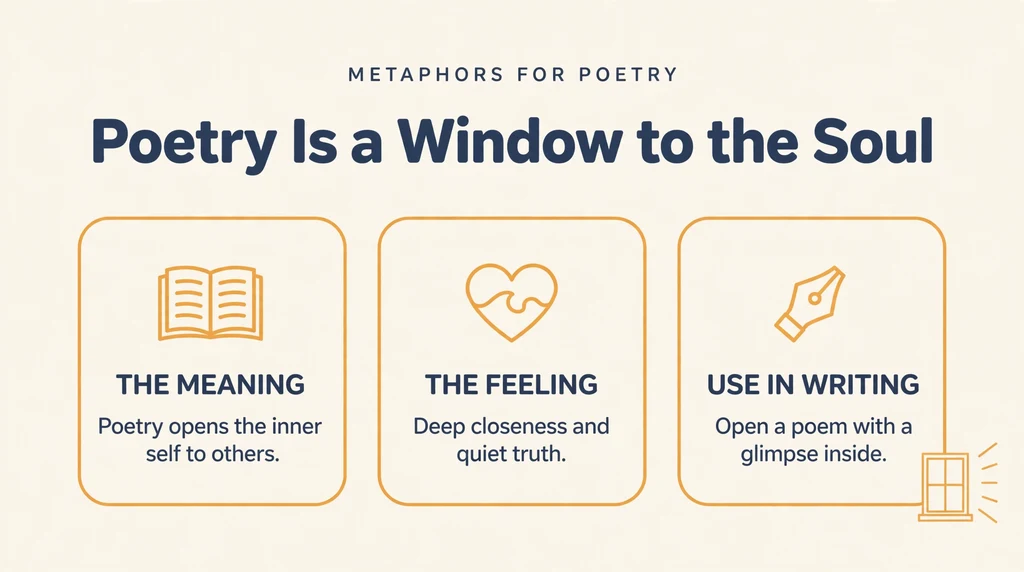
Meaning
Poetry reveals feelings, thoughts, and personal truths that may be difficult to express directly.
Why It Works
A window allows people to see what lies beyond a surface. Comparing poetry to a window suggests that a poem gives readers a glimpse into the writer’s inner world. It works especially well in reflective poetry and personal essays.
Alternative Expression
“Poetry is a mirror reflecting the hidden self.”
Examples in Writing
Formal Example
Poetry became a window to the soul, revealing emotions that ordinary conversation could not capture.
Casual Example
Writing poems feels like opening a window and letting people see what is really going on inside me.
Creative Example
My verses opened a window in the walls of my heart, letting forgotten feelings breathe again.
2. Words Are Seeds in the Garden of Thought
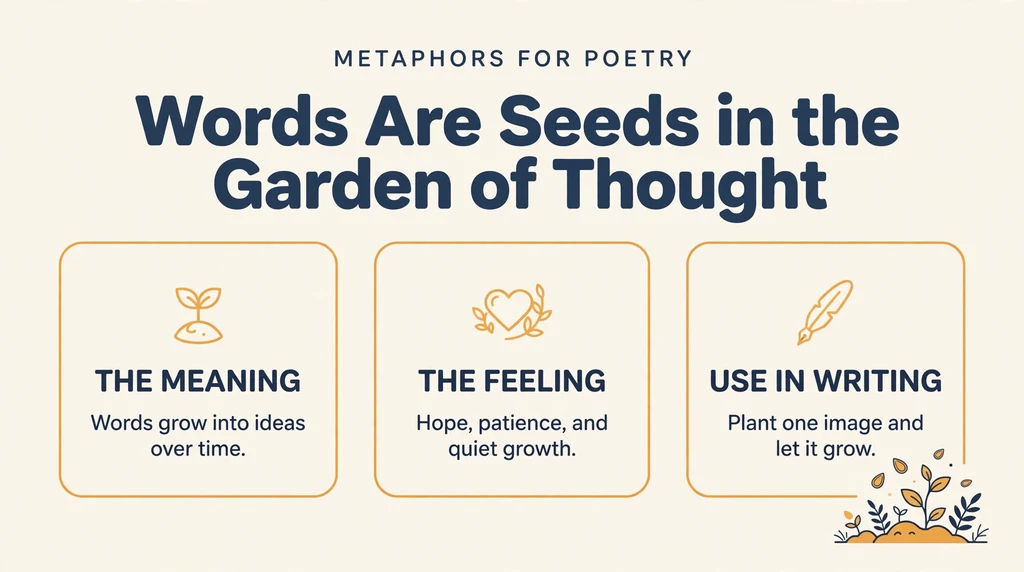
Meaning
Words are small ideas that can grow into powerful emotions, memories, or discoveries.
Why It Works
Seeds represent potential and growth. This metaphor shows how a few carefully chosen words can develop into an entire poem or inspire a reader long after reading it.
Alternative Expression
“Every word is a seed waiting for rain.”
Examples in Writing
Formal Example
The poet planted words like seeds, allowing meaning to grow through carefully crafted imagery.
Casual Example
Sometimes one little idea grows into a whole poem.
Creative Example
I buried my words beneath the soil of silence, and spring returned with verses blooming.
3. My Heart Is a House of Echoes
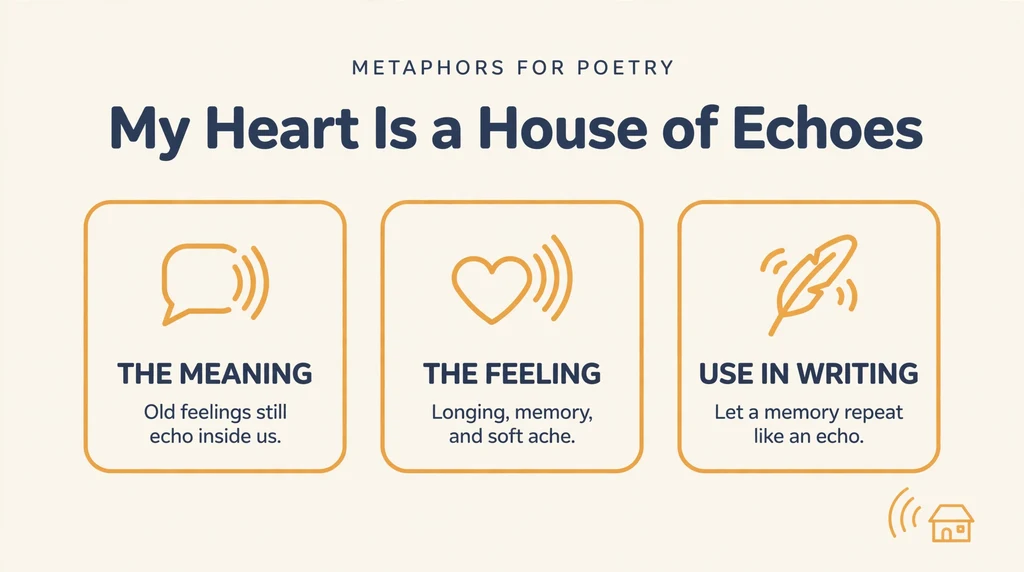
Meaning
Your heart carries memories and emotions that continue to return long after an experience has passed.
Why It Works
An echo repeats a sound after its original source disappears. This image is particularly effective for poems about heartbreak, nostalgia, regret, and lost relationships.
Alternative Expression
“My heart is a hallway filled with yesterday.”
Examples in Writing
Formal Example
Her heart became a house of echoes where memories of the past continued to resonate.
Casual Example
I keep remembering everything, as if my heart is a house full of echoes.
Creative Example
Every room inside my chest repeated your name, even after your footsteps disappeared.
4. Silence Is a Sleeping Ocean
Meaning
Silence may appear empty, but it can contain powerful emotions and unspoken thoughts.
Why It Works
An ocean looks calm at times while holding immense depth beneath its surface. This metaphor creates mystery and tension without explaining every emotion.
Alternative Expression
“Silence is a sea holding its breath.”
Examples in Writing
Formal Example
The silence between them was a sleeping ocean filled with unspoken truths.
Casual Example
Nobody said anything, but the silence felt incredibly heavy.
Creative Example
Beneath the quiet surface, a thousand unsaid words stirred like waves beneath the moon.
5. Time Is a Thief in the Night
Meaning
Time takes away moments, opportunities, and experiences before we realize they are gone.
Why It Works
A thief suggests sudden loss and something precious disappearing without permission. This metaphor works well in poems about aging, childhood, regret, and nostalgia.
Alternative Expression
“Time is a silent pickpocket.”
Examples in Writing
Formal Example
Time became a thief in the night, quietly carrying away the years of their youth.
Casual Example
It feels like time steals the good moments before I can enjoy them.
Creative Example
Time slipped through the window, stealing our summer before the flowers knew it was over.
6. Love Is a Bridge Between Two Worlds
Meaning
Love connects people with different backgrounds, personalities, or experiences.
Why It Works
A bridge joins places that would otherwise remain separated. This metaphor can express romance, friendship, family bonds, or understanding between strangers.
Alternative Expression
“Love is a road built between two hearts.”
Examples in Writing
Formal Example
Their love became a bridge between two worlds shaped by different traditions.
Casual Example
Love helped us understand each other even when we saw life differently.
Creative Example
You built a bridge across the river of my fears, and I finally found the courage to cross.
7. Grief Is an Ocean Without a Shore
Meaning
Grief can feel vast, unpredictable, and difficult to escape.
Why It Works
An ocean without a visible shore creates a sense of endlessness. The image communicates emotional magnitude without suggesting that everyone experiences grief in the same way.
Alternative Expression
“Grief is a tide that carries yesterday into today.”
Examples in Writing
Formal Example
After the loss, grief became an ocean without a shore, stretching beyond her ability to understand it.
Casual Example
Some days, missing someone feels like being lost in an endless sea.
Creative Example
I sailed through nights without a shoreline, searching for the place where sorrow learned to sleep.
8. Hope Is a Candle in the Darkness
Meaning
Hope offers comfort and direction during difficult times.
Why It Works
A candle produces a small but meaningful light in darkness. The contrast makes this metaphor useful for poems about courage, recovery, perseverance, and new beginnings.
Alternative Expression
“Hope is a match struck against the night.”
Examples in Writing
Formal Example
Her belief in a better future remained a candle in the darkness.
Casual Example
Even when things go wrong, I try to hold on to a little hope.
Creative Example
One trembling flame stood against the night, whispering that morning had not forgotten us.
9. Memory Is an Old Photograph
Meaning
Memories preserve moments, although their details and emotional meanings may change over time.
Why It Works
Photographs capture a particular instant but cannot contain everything that happened around it. This makes the metaphor effective for nostalgia, childhood memories, and relationships that have changed.
Alternative Expression
“Memory is a faded picture in the mind.”
Examples in Writing
Formal Example
His childhood remained an old photograph, softened by years of distance and reflection.
Casual Example
That day feels like an old picture I keep looking at in my mind.
Creative Example
Your laughter stayed in my memory like a photograph slowly fading beneath the sun.
10. Life Is an Unfinished Poem
Meaning
Life is an ongoing experience shaped by choices, changes, relationships, and discoveries.
Why It Works
A poem can change meaning as new lines are added. This metaphor presents life as something still being created rather than a story with a predetermined ending.
Alternative Expression
“Life is a manuscript written one day at a time.”
Examples in Writing
Formal Example
She viewed life as an unfinished poem, with every experience contributing a new line.
Casual Example
I don’t have everything figured out yet. My story is still being written.
Creative Example
I left blank spaces between my lines, trusting tomorrow to teach me another verse.
11. Dreams Are Birds with Invisible Wings
Meaning
Dreams represent possibilities and ambitions that help people imagine a different future.
Why It Works
Birds symbolize freedom, movement, and the ability to rise above limitations. Invisible wings suggest that ambition can exist before there is any visible evidence of success.
Alternative Expression
“Dreams are kites tied to the sky.”
Examples in Writing
Formal Example
Her dreams were birds with invisible wings, carrying her beyond the boundaries of her circumstances.
Casual Example
My dreams keep me moving, even when I can’t see how to reach them.
Creative Example
My dreams lifted like unseen birds, crossing skies my hands had never touched.
12. Anger Is a Volcano Beneath the Skin
Meaning
Anger can build beneath a calm exterior until it becomes difficult to contain.
Why It Works
A volcano holds pressure beneath its surface before an eruption. This comparison creates tension and suggests that visible anger may have deeper causes.
Alternative Expression
“Anger is fire locked beneath ice.”
Examples in Writing
Formal Example
Years of resentment left him with a volcano of anger beneath his composed exterior.
Casual Example
I stayed quiet, but inside I felt ready to explode.
Creative Example
Beneath my calm face, red mountains gathered their fire, waiting for the smallest crack.
13. Loneliness Is an Empty Train Station
Meaning
Loneliness is the feeling of waiting for connection that does not arrive.
Why It Works
An empty train station suggests departure, anticipation, distance, and missed connections. It is particularly effective for poems about isolation or separation.
Alternative Expression
“Loneliness is a table set for someone who never comes.”
Examples in Writing
Formal Example
After her friends moved away, the city felt like an empty train station.
Casual Example
Sometimes my life feels like I’m waiting for someone who never shows up.
Creative Example
I sat beneath the station clock, listening to footsteps that belonged to nobody.
14. The Mind Is a Restless Ocean
Meaning
Your thoughts are constantly moving, changing, and sometimes becoming overwhelming.
Why It Works
Ocean waves provide a natural image for the changing rhythm of thought. This metaphor works well in poems about overthinking, imagination, uncertainty, and inner conflict.
Alternative Expression
“My thoughts are waves that never learn to sleep.”
Examples in Writing
Formal Example
His mind was a restless ocean, crowded with questions and competing possibilities.
Casual Example
My brain never stops moving from one thought to another.
Creative Example
Thoughts rose inside me like midnight waves, crashing against shores I could not find.
15. Happiness Is Sunlight Through the Curtains
Meaning
Happiness can arrive quietly through ordinary moments.
Why It Works
Sunlight entering a room suggests warmth, comfort, and gentle renewal. The image is especially useful for poems celebrating simple pleasures and everyday gratitude.
Alternative Expression
“Happiness is morning spilling across the floor.”
Examples in Writing
Formal Example
For her, happiness was sunlight through the curtains after a difficult season.
Casual Example
A quiet morning and a good cup of tea can make my whole day.
Creative Example
Sunlight slipped through the curtains, turning an ordinary morning into a small miracle.
16. Fear Is a Locked Door
Meaning
Fear prevents you from exploring opportunities or facing difficult experiences.
Why It Works
A locked door represents an obstacle that appears difficult to cross. It can also suggest that the key to moving forward may already be within reach.
Alternative Expression
“Fear is a gate guarded by shadows.”
Examples in Writing
Formal Example
Fear became a locked door between her ambitions and her willingness to act.
Casual Example
My fear keeps me from trying things I actually want to do.
Creative Example
I stood before the locked door of tomorrow, holding a key I was afraid to turn.
17. Words Are Paint on the Canvas of the Heart
Meaning
Words create emotional pictures and give shape to experiences that might otherwise remain difficult to express.
Why It Works
Painting combines color, texture, and perspective. Comparing words to paint emphasizes how poets use language to create atmosphere and emotional meaning.
Alternative Expression
“Words are colors on the walls of memory.”
Examples in Writing
Formal Example
The poet used words as paint on the canvas of the heart, giving shape to complex emotions.
Casual Example
The right words can make people feel something they couldn’t explain before.
Creative Example
I dipped my pen into the colors of sorrow and painted a sky that finally understood me.
18. The Past Is a Shadow That Follows Us
Meaning
Past experiences continue to influence the present.
Why It Works
A shadow follows a person without being physically carried. This metaphor captures lingering memories, regret, unresolved emotions, and personal history.
Alternative Expression
“The past is an old footprint beside every new step.”
Examples in Writing
Formal Example
The past remained a shadow that followed him into every new relationship.
Casual Example
Sometimes old memories affect me more than I want them to.
Creative Example
I walked toward tomorrow, but yesterday stretched its shadow across every road.
19. Inspiration Is a Spark in the Dark
Meaning
Inspiration is a small idea that suddenly creates excitement or creative possibility.
Why It Works
A spark is brief and small, yet it can ignite something much larger. This metaphor captures the sudden arrival of an idea during writing or artistic work.
Alternative Expression
“Inspiration is a match struck inside the mind.”
Examples in Writing
Formal Example
A single observation became a spark in the dark, inspiring an entire collection of poems.
Casual Example
Sometimes one little thought is all I need to start writing.
Creative Example
A spark awakened inside the darkness of my mind, and suddenly every blank page began to glow.
20. A Poem Is a Heartbeat Made Visible
Meaning
A poem gives written form to emotions, experiences, and the rhythm of a person’s inner life.
Why It Works
A heartbeat represents life and emotional presence. Making it visible suggests that poetry allows readers to experience feelings that cannot otherwise be seen.
Alternative Expression
“A poem is the pulse of an invisible world.”
Examples in Writing
Formal Example
Her poetry became a heartbeat made visible, revealing the emotional realities behind everyday experiences.
Casual Example
When I write a poem, it feels like putting my feelings on paper.
Creative Example
Each line carried a pulse, each pause held a breath, and every stanza revealed a heart still learning to speak.
How to Use Metaphors Effectively in Poetry
A memorable metaphor does not need complicated language. It needs a clear image, a meaningful connection, and the right emotional tone. The goal is to help readers experience the feeling behind your words rather than simply understand the definition.
1. Start With an Emotion
Before choosing a metaphor, identify what your poem is trying to express. Loneliness might resemble an empty station, while hope might resemble a candle surviving a storm.
The more precisely you understand the emotion, the easier it becomes to choose an image that feels authentic.
2. Use Sensory Details
Bring your metaphors to life with details involving sound, touch, color, temperature, or movement.
Instead of writing, “My sadness is an ocean,” try describing the cold waves, distant horizon, and salt gathering on your skin. These details make the image more immersive.
3. Match the Metaphor to Your Poem’s Tone
A playful poem might describe the mind as a browser with too many tabs open. A serious poem about grief may compare it to an ocean without a shore.
The metaphor should support the mood rather than distract from it.
4. Avoid Mixing Too Many Images
Combining unrelated metaphors can confuse readers.
For example, “My heart is a burning ship climbing a mountain of broken clocks” introduces too many competing images at once.
Choose one central comparison and develop it with purpose. A poem about a burning ship could explore flames, waves, sinking, and the distant shore without suddenly changing its central image.
5. Make Familiar Metaphors Your Own
Some metaphors, such as a broken heart or a shining light, are widely used. You can still use them effectively by adding a fresh detail or unexpected perspective.
Instead of saying, “My heart is broken,” you might write, “My heart is a porcelain cup repaired with gold, still holding the warmth of your hands.”
The new detail gives the familiar emotion a more distinctive identity.
Metaphor vs. Simile in Poetry
Metaphors and similes both create comparisons, but they do so differently.
| Feature | Metaphor | Simile |
|---|---|---|
| How it works | Directly identifies one thing with another | Compares two things using words such as like or as |
| Example | My heart is an ocean. | My heart is like an ocean. |
| Effect | Often feels direct and immersive | Makes the comparison more explicit |
| Common use | Symbolism, emotional depth, imagery | Clear comparisons and descriptive details |
Both techniques are useful in poetry. A metaphor can make an image feel like part of the speaker’s identity, while a simile can help readers visualize a resemblance without making the two things identical.
Common Mistakes to Avoid When Writing Poetic Metaphors
Using a metaphor that does not fit the emotion: A cheerful image may weaken a poem about despair unless the contrast is intentional.
Explaining the metaphor too much: Once a strong image has communicated the feeling, allow readers room to interpret it.
Relying entirely on clichés: Familiar phrases can be effective, but too many make a poem predictable.
Adding imagery without purpose: Every metaphor should contribute to the poem’s mood, meaning, character, or movement.
Making every line dramatic: Quiet, ordinary details can create a stronger emotional impact than constant intensity.
Frequently Asked Questions
What is a metaphor in poetry?
A metaphor is a figure of speech that describes one thing as another to create meaning or imagery. For example, “Hope is a candle” presents hope as a source of light and comfort.
Why do poets use metaphors?
Poets use metaphors to express complex emotions, create vivid imagery, communicate symbolism, and make their writing more memorable.
What is a good metaphor for poetry itself?
“Poetry is a window to the soul” is a meaningful metaphor because it suggests that poems reveal a writer’s hidden feelings and thoughts.
What are some emotional metaphors for poems?
Examples include “grief is an ocean,” “my heart is a house of echoes,” and “loneliness is an empty train station.” Each expresses emotion through a recognizable image.
How do metaphors make poems more powerful?
Metaphors transform abstract feelings into concrete images. This helps readers visualize experiences and connect emotionally with the poem.
What is the difference between a metaphor and a simile in poetry?
A metaphor directly identifies one thing with another, such as “Time is a thief.” A simile makes an explicit comparison, such as “Time moves like a thief.”
Can a poem contain multiple metaphors?
Yes. A poem can contain several metaphors, provided they support its meaning and do not overwhelm or confuse the reader.
How can I create original metaphors for poetry?
Start with a specific feeling, then connect it to an unexpected object, place, sound, or natural element. Develop the comparison using sensory details that fit the poem.
What are simple metaphors for poetry assignments?
Useful examples include “knowledge is a key,” “hope is a light,” “life is a journey,” and “words are seeds.” They are easy to understand and adapt for school assignments.
Where can I use poetic metaphors?
You can use metaphors in poems, song lyrics, spoken word, personal essays, short stories, speeches, and creative journal entries.
Conclusion
Metaphors give poetry the ability to express more than words seem capable of holding. A candle can become hope, an empty station can represent loneliness, and an unfinished poem can capture the uncertainty of growing older. These images help readers connect with emotions that might otherwise remain difficult to explain.
The most effective metaphors for poetry are not necessarily the most complicated. They are the ones that feel honest, create a clear image, and deepen the meaning of each line. A familiar comparison can become extraordinary when you approach it from a fresh perspective.
As you write, experiment with ordinary objects, changing seasons, forgotten memories, and feelings you have struggled to describe. Let your images develop naturally, and give readers enough space to discover their own meaning.