Personality is more than a collection of traits. Some people bring warmth into every room, while others hide entire worlds behind a quiet expression. One person might be as unpredictable as a summer storm, while another offers the steady comfort of an old oak tree. Finding the right words to describe these differences can make writing much more interesting.
That is where metaphors for personality become useful. They transform abstract qualities such as kindness, confidence, stubbornness, and curiosity into images readers can picture and remember. Instead of simply calling someone brave, you can describe them as a mountain that refuses to move.
Writers use personality metaphors in fiction, poetry, school essays, character descriptions, blogs, and everyday conversations. The right comparison can reveal what makes a person unique without relying on a long list of adjectives.
Quick Metaphors for Personality
Here are some expressive metaphors you can use to describe different personality traits.
- A lighthouse in a storm: A dependable and supportive person.
- A ray of sunshine: Someone cheerful and uplifting.
- A closed book: A private or mysterious personality.
- A wildfire: Someone passionate and intense.
- An oak tree: A strong and dependable person.
- A walking encyclopedia: Someone with extensive knowledge.
- A chameleon: A person who adapts to different environments.
- A gentle breeze: Someone calm and soothing.
- A steel wall: A person who is emotionally guarded.
- A magnet: Someone naturally attractive or influential.
- A ticking clock: Someone who is always busy or impatient.
- A curious cat: Someone eager to explore and discover.
- A velvet glove: Someone gentle but influential.
- A mirror: Someone who reflects the behavior of others.
- A volcano: Someone who hides intense emotions.
- A golden thread: Someone who connects people.
- A shooting star: Someone energetic and unforgettable.
- An open window: Someone welcoming and approachable.
- A mountain: Someone steady and determined.
- A puzzle with missing pieces: Someone complex and difficult to understand.
20 Metaphors for Personality With Meanings and Examples
1. A Ray of Sunshine

Meaning: A person who brings happiness, warmth, and positivity to others.
Why It Works
Sunshine represents light, comfort, and new beginnings. Comparing someone’s personality to a ray of sunshine suggests that their presence can brighten an ordinary day. It works particularly well for cheerful friends, encouraging teachers, and characters who lift the mood of a room.
Alternative Expression: A walking sunrise.
Examples in Writing
Formal Example: Her optimistic personality was a ray of sunshine during the team’s most challenging days.
Casual Example: My little sister is a ray of sunshine who makes everyone laugh.
Creative Example: She carried a little sunshine in her smile and left brighter mornings wherever she went.
2. A Lighthouse in a Storm
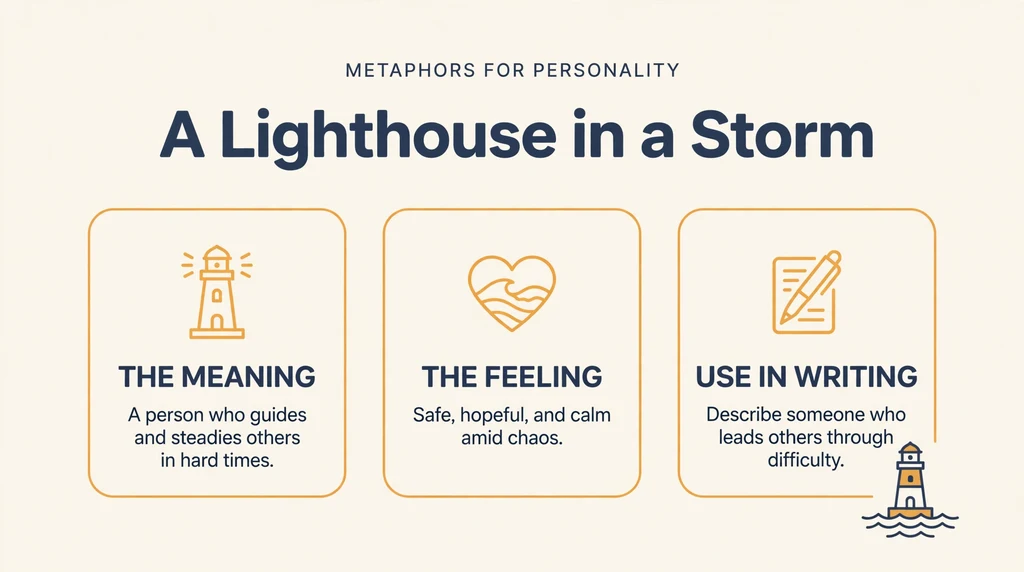
Meaning: A dependable person who helps others navigate difficult situations.
Why It Works
A lighthouse remains a visible point of guidance when the sea becomes dangerous. This metaphor suggests emotional maturity, reliability, and quiet leadership. It is especially useful when describing someone who remains calm during conflict or supports others through uncertainty.
Alternative Expression: An anchor in rough waters.
Examples in Writing
Formal Example: His steady personality made him a lighthouse in a storm for his struggling colleagues.
Casual Example: Whenever things go wrong, she’s our lighthouse.
Creative Example: While everyone chased shelter, he stood firm, a lighthouse guiding frightened hearts toward safety.
3. A Closed Book

Meaning: A person who keeps their thoughts and feelings private.
Why It Works
A closed book contains information that cannot be understood until someone opens it. This image communicates mystery without suggesting that a person necessarily has something to hide. It works well for reserved characters, quiet classmates, and people who take time to trust others.
Alternative Expression: A locked diary.
Examples in Writing
Formal Example: Despite his friendly manners, his personality remained a closed book to his colleagues.
Casual Example: My new neighbor is a closed book. I barely know anything about him.
Creative Example: Behind his quiet eyes lay chapters no stranger had been invited to read.
4. A Wildfire
Meaning: A person with intense passion, energy, or an unpredictable temperament.
Why It Works
Wildfire suggests heat, speed, and an intensity that is difficult to contain. Depending on the context, it can represent inspiring ambition or emotions that overwhelm a situation. Writers should use this metaphor when a character’s presence feels powerful rather than simply energetic.
Alternative Expression: A blazing furnace.
Examples in Writing
Formal Example: Her fiery personality spread enthusiasm through the entire organization.
Casual Example: My cousin is a wildfire whenever he gets excited about football.
Creative Example: His passion raced through the room like flames across a summer field.
5. An Oak Tree
Meaning: A person who is strong, patient, dependable, and resilient.
Why It Works
An oak tree grows through changing seasons and can withstand difficult weather. It represents strength without requiring loud confidence or aggressive behavior. This metaphor is particularly effective for describing supportive parents, wise mentors, and dependable friends.
Alternative Expression: A mountain that never moves.
Examples in Writing
Formal Example: Her personality was like an oak tree, offering stability to everyone who depended on her.
Casual Example: My grandfather is the oak tree of our family.
Creative Example: Seasons changed around him, but his steady heart remained rooted in the earth.
6. A Walking Encyclopedia
Meaning: Someone who knows a great deal about many subjects.
Why It Works
An encyclopedia stores information, facts, and explanations. Calling someone a walking encyclopedia highlights their knowledge in a familiar, memorable way. The expression can sound admiring or playful, depending on the conversation.
Alternative Expression: A library on two legs.
Examples in Writing
Formal Example: His intellectual curiosity made him a walking encyclopedia of historical events.
Casual Example: Ask Sara about space. She’s a walking encyclopedia.
Creative Example: Every question unlocked another room in the library he carried inside his mind.
7. A Chameleon
Meaning: A person who adapts easily to different people or environments.
Why It Works
A chameleon changes color to suit its surroundings. As a personality metaphor, it can suggest flexibility, social awareness, or a tendency to change behavior depending on the company. Context matters because adaptability can be a strength, while excessive adjustment may suggest difficulty expressing one’s authentic self.
Alternative Expression: A social shapeshifter.
Examples in Writing
Formal Example: Her adaptable personality made her a chameleon in unfamiliar professional environments.
Casual Example: He’s a chameleon. He fits in with almost every group.
Creative Example: He borrowed the colors of every room until he wondered which shade belonged to him.
8. A Gentle Breeze
Meaning: A calm, peaceful, and soothing personality.
Why It Works
A gentle breeze suggests comfort without force. It describes people who make others feel relaxed through their patience, kindness, and quiet presence. This metaphor suits gentle characters and reflective writing where subtle qualities matter more than dramatic gestures.
Alternative Expression: A quiet stream.
Examples in Writing
Formal Example: Her gentle personality brought a sense of calm to the tense meeting.
Casual Example: Talking to him feels like a gentle breeze after a stressful day.
Creative Example: She entered without demanding attention, leaving peace in the spaces she touched.
9. A Steel Wall
Meaning: A person who appears emotionally guarded, firm, or difficult to influence.
Why It Works
Steel suggests hardness, durability, and resistance. A wall creates a sense of distance or protection. Together, they describe someone who keeps others at arm’s length or refuses to abandon deeply held beliefs.
This metaphor works especially well for complex fictional characters whose toughness may conceal fear or vulnerability.
Alternative Expression: An iron fortress.
Examples in Writing
Formal Example: His defensive personality formed a steel wall between himself and his colleagues.
Casual Example: She’s a steel wall when it comes to talking about her feelings.
Creative Example: He built a fortress around his heart, believing no one could hurt what they could never reach.
10. A Magnet
Meaning: Someone who naturally attracts people, attention, or opportunities.
Why It Works
A magnet draws certain objects toward itself without needing to chase them. This metaphor suggests charisma, social appeal, and an engaging presence. It works well for describing popular personalities, natural leaders, and people who make others feel interested in their company.
Alternative Expression: A human spark.
Examples in Writing
Formal Example: His charismatic personality made him a magnet for creative collaborators.
Casual Example: She’s a magnet for interesting people.
Creative Example: Conversations gathered around her like iron filings finding their center.
11. A Ticking Clock
Meaning: A person who is constantly busy, impatient, or highly conscious of time.
Why It Works
A ticking clock creates a sense of urgency and continuous movement. This metaphor suits characters who struggle to relax, rush through tasks, or become frustrated when things move slowly.
It can also describe someone whose presence makes everyone else feel that time is running out.
Alternative Expression: A speeding train.
Examples in Writing
Formal Example: His restless personality made him a ticking clock in an environment that required patience.
Casual Example: My brother is a ticking clock whenever we’re getting ready to leave.
Creative Example: Every minute sounded an alarm inside her, and stillness felt like wasted time.
12. A Curious Cat
Meaning: A person who is inquisitive, observant, and eager to explore.
Why It Works
Cats are often associated with exploration and curiosity. This metaphor suggests someone who asks questions, notices small details, and wants to understand how things work.
It is useful for describing young characters, enthusiastic learners, and people who are always investigating something new.
Alternative Expression: An explorer with endless questions.
Examples in Writing
Formal Example: His curious personality encouraged him to investigate unfamiliar ideas rather than accept them immediately.
Casual Example: She’s a curious cat who always wants to know what everyone is doing.
Creative Example: Her questions opened doors that other people had walked past for years.
13. A Velvet Glove
Meaning: A person who combines gentleness with firmness or influence.
Why It Works
Velvet feels soft and pleasant, while a glove can cover and protect the hand beneath it. The familiar expression “an iron fist in a velvet glove” describes someone who exercises authority through a calm or courteous exterior.
The shorter metaphor can suggest subtle influence, but the full expression makes the contrast clearer.
Alternative Expression: A soft voice with an unshakable will.
Examples in Writing
Formal Example: The manager handled difficult negotiations with an iron fist in a velvet glove.
Casual Example: She sounds sweet, but she knows exactly how to get things done.
Creative Example: Her words felt like velvet, yet beneath their softness lived a will of iron.
14. A Mirror
Meaning: A person who reflects the attitudes, emotions, or behavior of others.
Why It Works
A mirror reflects what stands before it. As a personality metaphor, it can describe someone who naturally matches the energy of a group or helps others recognize their own behavior.
The metaphor can have different meanings. Reflection may show empathy and social awareness, but it can also suggest that someone changes too much to please others.
Alternative Expression: An emotional echo.
Examples in Writing
Formal Example: His reflective personality often mirrored the mood of the people around him.
Casual Example: She’s like a mirror. If you’re excited, she gets excited too.
Creative Example: He reflected every face he met until his own expression became difficult to recognize.
15. A Volcano
Meaning: A person who hides intense emotions beneath a calm exterior.
Why It Works
A volcano can remain quiet while pressure builds underneath its surface. This makes it a powerful metaphor for suppressed anger, frustration, or passion.
It is especially useful in fiction when a character’s controlled behavior contrasts with the emotions they struggle to express.
Alternative Expression: A fire beneath frozen ground.
Examples in Writing
Formal Example: Her reserved personality concealed a volcano of frustration.
Casual Example: He looks calm, but he’s a volcano when he gets angry.
Creative Example: Beneath his quiet expression, old grievances simmered like fire beneath a mountain.
16. A Golden Thread
Meaning: A person who connects people, experiences, or ideas.
Why It Works
A thread joins separate pieces into a larger whole. Gold adds value and warmth to the image. This metaphor describes people who bring families together, encourage cooperation, or help different personalities find common ground.
It is particularly effective in stories about friendship, community, and relationships.
Alternative Expression: The glue that holds everyone together.
Examples in Writing
Formal Example: Her compassionate personality became the golden thread connecting the different departments.
Casual Example: Grandma is the golden thread that keeps our family close.
Creative Example: Through every disagreement and reunion, her kindness stitched our scattered lives together.
17. A Shooting Star
Meaning: A person who is energetic, exciting, memorable, or briefly captivating.
Why It Works
A shooting star crosses the sky in a sudden flash of light. It suggests spontaneity, brilliance, and a presence that leaves a lasting impression.
The image can also convey a fleeting quality, making it suitable for characters whose influence is powerful but short-lived.
Alternative Expression: A spark across the night sky.
Examples in Writing
Formal Example: Her vibrant personality made her a shooting star in the local arts community.
Casual Example: He’s a shooting star at every party. He makes everything more exciting.
Creative Example: She flashed through their ordinary lives, leaving the darkness looking different.
18. An Open Window
Meaning: A person who is welcoming, honest, approachable, and receptive to others.
Why It Works
An open window allows fresh air and light to enter a room. This creates a sense of openness and emotional accessibility.
The metaphor suits people who communicate honestly, welcome different perspectives, and make others comfortable sharing their thoughts.
Alternative Expression: An open door.
Examples in Writing
Formal Example: Her approachable personality made her an open window for honest discussion.
Casual Example: He’s an open window. You can talk to him about almost anything.
Creative Example: Around her, guarded hearts loosened their locks and let the morning in.
19. A Mountain
Meaning: A person who is determined, steady, and difficult to discourage.
Why It Works
Mountains symbolize permanence, height, and endurance. This metaphor suggests someone who stands firm under pressure and remains committed to their values.
It is useful in motivational writing, character descriptions, and personal essays about overcoming challenges.
Alternative Expression: A rock against the tide.
Examples in Writing
Formal Example: Her determined personality made her a mountain in the face of adversity.
Casual Example: My mother is a mountain. Nothing easily shakes her.
Creative Example: The winds shouted around him, but he stood like a mountain remembering its roots.
20. A Puzzle with Missing Pieces
Meaning: A person whose personality is complex, layered, or difficult to understand.
Why It Works
A puzzle requires time and attention before its complete picture becomes clear. This metaphor captures the reality that people reveal different sides of themselves gradually.
It works particularly well for mysterious fictional characters, complicated relationships, and reflective writing about human behavior.
Alternative Expression: A book with hidden chapters.
Examples in Writing
Formal Example: His complex personality resembled a puzzle with missing pieces, challenging those who tried to understand him.
Casual Example: She’s a puzzle with missing pieces. Every time I think I understand her, I learn something new.
Creative Example: Each conversation revealed another fragment, yet the picture of who he was remained unfinished.
Positive Metaphors for Personality
Positive personality metaphors help communicate admirable qualities without relying on ordinary adjectives. They work well in personal essays, character introductions, speeches, and creative descriptions.
| Metaphor | Personality Trait |
|---|---|
| A ray of sunshine | Cheerful and positive |
| An oak tree | Dependable and resilient |
| A lighthouse | Supportive and reassuring |
| A golden thread | Unifying and compassionate |
| An open window | Honest and approachable |
| A mountain | Determined and steady |
| A magnet | Charismatic and engaging |
| A curious cat | Inquisitive and observant |
For example, instead of writing, “She is a kind and supportive person,” you could write, “She is a lighthouse who helps others find their way through difficult seasons.”
The second description gives the reader an image to remember.
Negative and Complex Metaphors for Personality
Not every personality metaphor needs to be flattering. More difficult comparisons can help writers portray flaws, internal conflict, or complicated behavior without making a character feel one-dimensional.
| Metaphor | Personality Trait |
|---|---|
| A steel wall | Emotionally guarded |
| A volcano | Suppressed anger |
| A ticking clock | Impatient or restless |
| A closed book | Private or mysterious |
| A chameleon | Highly adaptable or changeable |
| A mirror | Reflective or overly influenced by others |
| A puzzle with missing pieces | Complex or difficult to understand |
Writing tip: A metaphor should describe the particular behavior you want readers to notice, not define a whole person unfairly. A person who acts like a steel wall during conflict might be protecting themselves rather than lacking compassion.
That distinction makes character descriptions more realistic and emotionally intelligent.
How to Use Metaphors for Personality in Writing
Personality metaphors become most effective when they reveal something that a plain adjective cannot fully express. Here are practical ways to use them in different forms of writing.
In Fiction and Character Descriptions
Use a metaphor to introduce a character’s defining quality or create contrast between appearance and behavior.
For example:
Everyone trusted Daniel. He was an oak tree in a neighborhood full of shifting weather.
This sentence suggests reliability while establishing an atmosphere around the character.
You can also develop a metaphor throughout a story. A character initially described as a closed book might gradually become an open window as trust develops.
In Poetry and Creative Writing
Poetry allows metaphors to carry several meanings at once. A volcano might represent anger, passion, family conflict, or a long-suppressed truth.
Instead of explaining every emotion, allow the image to do some of the work.
For example:
She smiled like spring, though winter still lived behind her eyes.
The contrast between spring and winter suggests a cheerful exterior hiding sadness.
In School Essays and Personal Writing
Metaphors can make personal experiences more memorable when they are relevant to the subject.
Instead of writing, “My father always supported me during difficult times,” you might write, “My father was a lighthouse whenever I lost my way.”
The metaphor adds emotional meaning without requiring a long explanation.
For academic assignments, make sure the metaphor supports your main point rather than distracting from it.
In Everyday Conversations and Blogs
Simple metaphors often work best in casual writing.
Examples include:
- “She’s the glue that holds our group together.”
- “He’s a walking encyclopedia.”
- “My brother is a ticking clock when we’re late.”
- “She’s a ray of sunshine on difficult days.”
These expressions sound natural because the imagery is easy to understand.
Metaphor vs. Simile: What Is the Difference?
Metaphors and similes both compare things, but they express the comparison differently.
| Feature | Metaphor | Simile |
|---|---|---|
| How it works | Directly identifies one thing with another | Uses an explicit comparison |
| Common wording | Is, are, was, were | Like or as |
| Example | Her personality is sunshine. | Her personality is like sunshine. |
| Effect | Often feels direct and immersive | Often feels descriptive and explanatory |
A metaphor can make a personality trait feel like part of someone’s identity. A simile leaves more distance between the person and the image.
Both techniques are useful. Choose the one that best suits the tone and purpose of your writing.
Common Mistakes When Writing Personality Metaphors
Even a creative comparison can weaken a sentence if it is used carelessly. Avoid these common problems.
1. Choosing an Unclear Image
A metaphor should help readers understand a personality trait. If the connection is too obscure, readers may struggle to understand what you mean.
Less clear: He was a window trapped inside a thunderstorm of clocks.
Clearer: He was a ticking clock, always rushing toward the next task.
2. Using Too Many Metaphors Together
Several unrelated images can compete for attention.
Less effective: She was a volcano, a lighthouse, a river, and a locked diary.
Better: She was a volcano beneath a calm exterior, hiding feelings she rarely expressed.
One central image gives readers a clearer impression.
3. Relying on Clichés Without Adding Meaning
Common expressions can still be useful, but they become more memorable when connected to a specific situation.
Instead of simply calling someone a ray of sunshine, explain how their presence changes a difficult moment.
4. Ignoring the Character’s Context
A metaphor should fit the person and the situation. Calling a quiet, thoughtful person a wildfire may be effective if it describes their hidden passion, but confusing if no supporting detail explains the comparison.
5. Treating One Trait as an Entire Personality
People are complex. Someone can be a lighthouse to friends and a closed book to strangers. Allowing multiple qualities to coexist creates more believable writing.
Tips for Creating Original Metaphors for Personality
You do not need to rely on familiar comparisons to describe human character. You can create original metaphors by observing behavior and connecting it to concrete images.
- Start with a specific trait. Decide if you want to describe kindness, impatience, curiosity, confidence, or emotional reserve.
- Look for a physical image. Consider objects, animals, weather, landscapes, music, and everyday experiences.
- Think about movement. Does the person soothe a room, stir it up, hold it together, or change its direction?
- Add contrast. A gentle breeze hiding a thunderstorm can communicate a more complicated personality than either image alone.
- Match the tone. Humorous comparisons suit casual writing, while layered images often suit poetry and fiction.
- Test the sentence aloud. If the metaphor sounds unnatural or requires too much explanation, simplify it.
For example, someone who always notices overlooked details might be described as a magnifying glass searching an ordinary day for hidden stories. That image is more specific than simply calling the person observant.
Originality comes from choosing an image that fits the person, not from making the comparison as complicated as possible.
Frequently Asked Questions
What is a metaphor for personality?
A metaphor for personality describes someone’s character through an imaginative comparison. For example, calling a dependable person an oak tree suggests strength, stability, and resilience.
What is a good metaphor for a kind person?
A ray of sunshine is a good metaphor for someone whose kindness brings warmth and happiness to others. A lighthouse can describe someone who offers support during difficult times.
What is a metaphor for a strong personality?
A mountain or an oak tree can represent a strong personality. Both images suggest determination, resilience, and the ability to remain steady under pressure.
What is a metaphor for a shy person?
A closed book can describe someone who is private or slow to open up. A shadow in a crowded room can suggest someone who prefers to remain unnoticed.
What is a metaphor for a cheerful personality?
A ray of sunshine is a familiar metaphor for a cheerful person. It suggests warmth, optimism, and the ability to improve the mood of others.
What is a metaphor for an unpredictable person?
A wildfire can represent someone intense and unpredictable. A storm can also suggest a personality that changes quickly or brings powerful emotions into a situation.
How do metaphors describe character traits?
Metaphors connect abstract traits to concrete images. For example, a magnet suggests charisma, a ticking clock suggests impatience, and a golden thread suggests someone who brings people together.
Can I use personality metaphors in school essays?
Yes. Personality metaphors can make essays more vivid and engaging when they support your point. Use clear comparisons and explain their relevance when the assignment requires formal analysis.
What is the difference between a personality metaphor and a simile?
A personality metaphor directly identifies a person with an image, such as “He is a mountain.” A simile uses words like or as, such as “He is as steady as a mountain.”
How can I create a unique metaphor for someone’s personality?
Identify a specific trait, think of an object or natural image that represents it, and connect the two clearly. Personal observations and precise details usually produce more original metaphors than complicated wording.
Conclusion
Metaphors for personality help writers turn ordinary descriptions into memorable images. A person can become a lighthouse that offers guidance, a wildfire full of passion, a gentle breeze that brings peace, or a closed book waiting to be understood. Each comparison reveals a different part of human character.
The real value of these metaphors lies in their ability to communicate more than a single adjective. They can suggest emotions, reveal contradictions, and help readers imagine how a person behaves in everyday situations. That makes them especially useful in fiction, poetry, school essays, personal writing, and character development.
As you experiment with personality metaphors, focus on the qualities that make each person distinctive. Choose images that feel natural, support your message, and create a clear emotional impression.
The most effective metaphor is not necessarily the most elaborate one. It is the one that helps readers understand a personality in a way that feels vivid, honest, and unmistakably human.