Smoke was pouring down the stairwell when the night guard started knocking on doors. No cape, no speech. He kept moving, floor by floor, until every sleeper was out, and by morning the street called him a shield raised for others. Real heroes rarely get costumes; they get a moment, and the right metaphor honors it.
Plain praise fades fast. Tell a nurse she ‘worked bravely’ and the words slide off; call her an anchor when the ship was sinking and nobody forgets it. A strong image spares you the same tired adjectives, sentence after sentence.
Below you’ll find twenty original metaphors for heroes, each explained, with the reason it works, a fresh alternative, and formal, casual, and creative examples. Students can raid it for essays and speeches; storytellers can borrow images for tributes and rescue scenes.
Quick Metaphors for Heroes
If you need a heroic image in a hurry, start with this quick list of twenty metaphors.
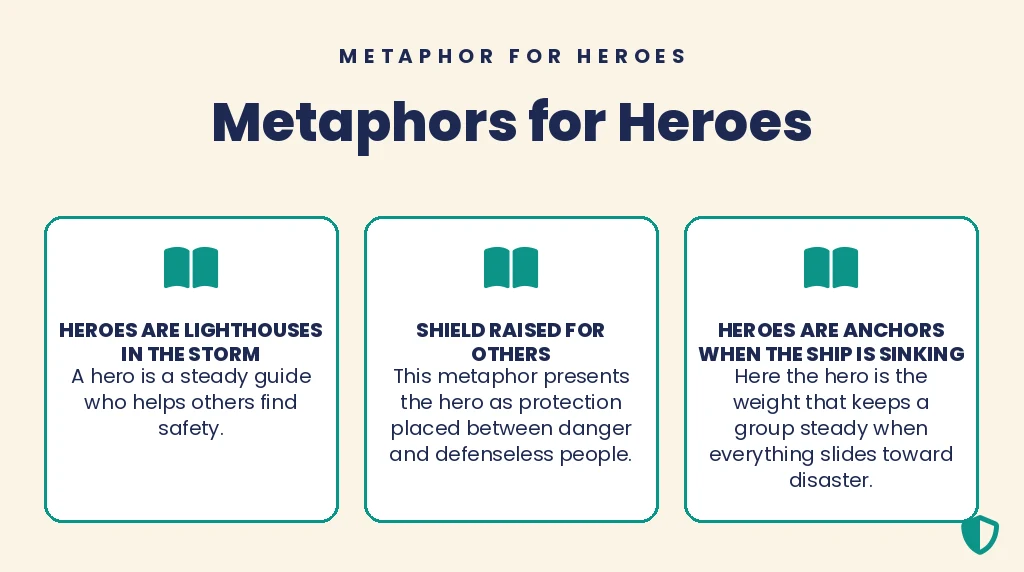
- Heroes are lighthouses in the storm.
- A hero is a shield raised for others.
- Heroes are anchors when the ship is sinking.
- A hero is a bridge built across the flood.
- Heroes are torches passed hand to hand.
- A hero is the first domino of courage.
- Heroes are oaks that shelter the field.
- A hero is a compass when every map fails.
- Heroes are drums that wake a sleeping village.
- A hero is a wall that chooses to stand.
- Heroes are embers that refuse to die.
- A hero is a key that turns toward danger.
- Heroes are mountains others climb toward.
- A hero is the calm at the center of the hurricane.
- Heroes are gardeners who plant in winter.
- A hero is a mirror that shows us our better selves.
- Heroes are sails that catch the wind for everyone.
- A hero is a bell that rings when no one else will.
- Heroes are stars that burn so others can navigate.
- A hero is a seed that cracks concrete.
Metaphors for Heroes and Their Meanings
Below, each metaphor is explained in detail, with its meaning, the reason it works, a fresh alternative, and three examples of it in real writing. Read them in order or jump to the mood you need.
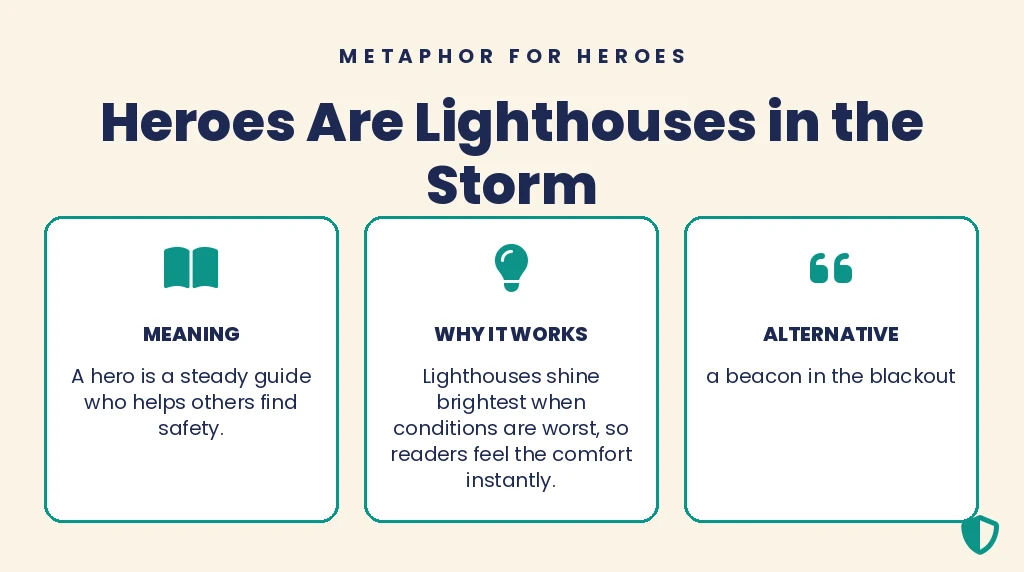
1. Heroes Are Lighthouses in the Storm
Meaning
Picture the worst night of the year at sea. The hero here stays lit: a steady guide who helps frightened people find safety. He can’t stop the storm. Nobody can. He just stands firm and shows the way through.
Why It Works
A lighthouse matters most exactly when conditions are worst, so the comfort lands instantly. There’s a compliment about reliability in it too. Lighthouses don’t wander off, don’t panic, never leave their post.
Alternative Expression
You could also call such a guide “a beacon in the blackout”.
Examples in Writing
Formal Example: When the flood cut off the town, Nurse Alvarez became a lighthouse in the storm, guiding families to the hall calmly.
Casual Example: Coach Dan was a total lighthouse in the storm during finals week, keeping everyone calm.
Creative Example: She stood on the courthouse steps, a lighthouse in the storm, and the frightened crowd steered home by her light.
2. A Hero Is a Shield Raised for Others

Meaning
Somebody has to stand in front. This hero is protection placed bodily between danger and people who can’t defend themselves, absorbing the impact so everyone behind the shield stays unharmed.
Why It Works
Everybody knows what a shield is for, so no explaining is needed. The deeper compliment is selflessness: a shield only matters when it stands in front of somebody else.
Alternative Expression
A similar idea is “a wall between the wolf and the flock”.
Examples in Writing
Formal Example: During the inquiry, the young lawyer became a shield raised for others, taking the blame so her clients could speak safely.
Casual Example: My big brother was a shield raised for others, stepping between me and the older kids.
Creative Example: He lifted his tired arms like a shield raised for others, and every stone the century threw broke against him.
3. Heroes Are Anchors When the Ship Is Sinking

Meaning
Not all heroes charge. Some hold. When everything slides toward disaster, this hero is the weight keeping the group steady. Anchors don’t look heroic, but without one a vessel drifts onto the rocks.
Why It Works
The sinking ship brings urgency readers recognize from crises at work and in families. It also praises quiet steadiness over glory, which everyday heroes run on.
Alternative Expression
You might also call such a person “the ballast of the crew”.
Examples in Writing
Formal Example: As rumors sank the share price, the chief executive remained an anchor when the ship was sinking, steady in every update.
Casual Example: Grandma was the anchor when the ship was sinking after Dad lost his job, keeping dinners and hope in place.
Creative Example: While the city argued, the harbormaster stood an anchor when the ship was sinking, and the fleet held fast.
4. A Hero Is a Bridge Built Across the Flood
Meaning
Floods cut people off, and somebody has to become the crossing. That’s this hero: his body, work, or courage laid down so others can travel from danger to safety.
Why It Works
Bridges suggest effort and sacrifice hiding under a simple crossing; somebody built that, stone by stone. Readers feel the traveler’s gratitude too, and gratitude is how communities remember heroes.
Alternative Expression
A gentler version is “a plank over the torrent” for small, personal rescues.
Examples in Writing
Formal Example: The translator became a bridge built across the flood, carrying messages between the stranded village and rescue teams daily.
Casual Example: After my parents split, my aunt was a bridge built across the flood between us kids and both families.
Creative Example: He laid his ruined career down plank by plank, a bridge across the flood, and students walked over it into daylight.
5. Heroes Are Torches Passed Hand to Hand
Meaning
Heroism here is contagious. One person carries the flame awhile, lights another’s courage from it, and passes the duty on. No single hero keeps the fire; it survives by moving.
Why It Works
The passing motion does the work: courage feels shareable rather than rare, quietly inviting readers to join in. Fire helps too, offering warmth and visibility to frightened communities.
Alternative Expression
Writers often echo it with “a relay of lanterns”.
Examples in Writing
Formal Example: The retiring firefighters were torches passed hand to hand, training recruits whose rescues would light the same streets.
Casual Example: Our captains have always been torches passed hand to hand, each senior teaching the new kids bravery.
Creative Example: From grandmother to mother to daughter, they were torches passed hand to hand, and the flame of defiance never went out.
6. A Hero Is the First Domino of Courage
Meaning
One person moves first. That’s the whole mechanism, and it’s enough. A single brave act tips the hesitation in everyone watching, starting a chain reaction that outgrows the deed itself.
Why It Works
Dominoes are visual and quick, so the chain reaction explains itself. Remember thinking, if she can do it, so can I? That’s this metaphor, already living in your memory.
Alternative Expression
A close cousin is “the first stone of the avalanche”.
Examples in Writing
Formal Example: By refusing to sign the false report, the junior auditor became the first domino of courage, and three departments spoke up.
Casual Example: When Mia stood up to the bully, she was the first domino of courage, and half the class stood too.
Creative Example: He tipped forward alone in the silent square, the first domino of courage, and a thousand held breaths fell into noise.
7. Heroes Are Oaks That Shelter the Field
Meaning
Strength doesn’t have to be loud. Like a great oak in an open field, this hero uses power for shelter: shade for the weak, food for the hungry, one gathering place for all.
Why It Works
Oaks carry centuries of associations with endurance and protection, so the meaning arrives half built. The image argues something sly, too: the greatest heroes are rooted people, almost impossible to move.
Alternative Expression
You could also praise “a roof tree for the whole village”.
Examples in Writing
Formal Example: For forty harvests the schoolmaster had been an oak that sheltered the field, funding scholarships and fighting closure plans.
Casual Example: Our neighbor Mr. Osei is an oak that shelters the field; every kid knows his porch is the safe place.
Creative Example: She grew rings of patience around her heart, an oak that shelters the field, and children played unhurt in her shade.
8. A Hero Is a Compass When Every Map Fails
Meaning
Maps fail. Plans collapse, experience runs out. This hero is direction itself when all that stops working: he can’t walk the road for others, but he can point them toward true north.
Why It Works
A compass stands for inner values constant while circumstances spin. Everyone knows that panic, the plan in pieces, and the relief when somebody calm says: this way.
Alternative Expression
A related phrase is “a north star with a heartbeat” for morally steady guides.
Examples in Writing
Formal Example: When merger talks collapsed, the founder acted as a compass when every map failed, returning the board to its first principles.
Casual Example: Lost in a new city with dead phones, we treated Priya like a compass when every map failed.
Creative Example: The old pilot laughed at the broken instruments, a compass when every map fails, and steered by the memory in his bones.
9. Heroes Are Drums That Wake a Sleeping Village
Meaning
Some heroes whisper. These ones don’t. They’re the sound that hauls people out of apathy and despair: loud, public, impossible to sleep through, calling everyone out to help.
Why It Works
Drums carry urgency in almost every culture, so the alarm needs no translation. The metaphor also praises a rarer gift: not just acting bravely, but summoning a whole community into action.
Alternative Expression
You might compare such a figure to “a bell in the fog”.
Examples in Writing
Formal Example: The striking nurses were drums that woke a sleeping village, and soon the whole region debated the hospital closures.
Casual Example: Our class president is a drum that wakes a sleeping village; one speech and the whole school volunteers.
Creative Example: He beat his empty bucket outside the mayor’s gate, a drum that wakes a sleeping village, until windows opened like sleepy eyes.
10. A Hero Is a Wall That Chooses to Stand
Meaning
The key word is chooses. Nobody forced this hero into place; he saw the gap between harm and the vulnerable, filled it, and stayed. That free decision turns stubbornness into moral courage.
Why It Works
Walls suggest permanence and refusal, which alone could feel cold. Add the choice and the picture warms: readers respect a barrier more when it was free to walk away.
Alternative Expression
For a softer tone, try “a gate that only opens inward” for protectors of safe places.
Examples in Writing
Formal Example: Ordered to abandon the checkpoint, Sergeant Ibarra remained a wall that chose to stand, and the convoy escaped through the pass.
Casual Example: When rumors started about my friend, Jess became a wall that chose to stand, and the gossip stopped reaching her.
Creative Example: The librarian locked her knees against the century, a wall that chooses to stand, while the banned books slept safely behind her.
11. Heroes Are Embers That Refuse to Die
Meaning
Defeat looks complete. The fire is out, everyone has gone home. Except one ember still glows under the ash, and one breath can bring the blaze back. This hero is hope that won’t sign the surrender.
Why It Works
Embers offer quiet, hidden strength instead of dramatic flames. The image suits veterans, survivors, and reformers, whose courage works slowly across years of discouragement.
Alternative Expression
A similar warmth appears in “a coal that remembers the fire” for patient, lasting hope.
Examples in Writing
Formal Example: Imprisoned for a decade, the editor stayed an ember that refused to die, smuggling out essays that relit the free press.
Casual Example: After three failed startups, Uncle Ray is an ember that refuses to die; one good idea and he is blazing again.
Creative Example: They buried her name in ash and silence, but she was an ember that refuses to die, glowing under the floorboards.
12. A Hero Is a Key That Turns Toward Danger
Meaning
Everyone else stares at the locked door, waiting. This hero walks straight toward it, unlocking the way out by moving toward the threat, becoming the key himself.
Why It Works
Keys promise access, solutions, and release, so the image feels practical as well as brave. Turning toward danger is the twist: heroes open the doors that frighten everyone else.
Alternative Expression
You can echo it with “a password spoken at the locked gate”.
Examples in Writing
Formal Example: With negotiations frozen, the young diplomat became a key that turned toward danger, flying in to open talks nobody dared begin.
Casual Example: When the dog got trapped in the storm drain, Dad was a key that turns toward danger, crawling straight in.
Creative Example: She slid herself into the lock of the burning city, a key that turns toward danger, and the great door swung wide.
13. Heroes Are Mountains Others Climb Toward
Meaning
You don’t have to reach the summit for a mountain to change you. This hero is an example set high to aim at, and the climbing itself makes people stronger.
Why It Works
Mountains bring permanence, scale, and honest difficulty, so praise never feels cheap. The image explains fame, too: heroes are visible from far away because they stand so high.
Alternative Expression
A humbler version is “a hill that lifts the village’s eyes” for local role models.
Examples in Writing
Formal Example: For young surgeons nationwide, Dr. Mensah remained a mountain others climb toward, publishing techniques that raised standards everywhere.
Casual Example: My older sister is a mountain others climb toward; half my study habits are me trying to keep up.
Creative Example: Buried in an unmarked grave, he rose in memory a mountain others climb toward, and climbers still plant flags of gratitude there.
14. A Hero Is the Calm at the Center of the Hurricane
Meaning
Panic loves company, and in a crisis it circles fast. This hero sits in the quiet eye of it, still while everything screams, making one clear decision at a time.
Why It Works
The eye of a storm is a real pocket of peace inside violence, so nature built the contrast for you. Readers get it instantly: leadership through calm, not volume.
Alternative Expression
A similar effect comes from “the still point of the turning room” in tense indoor scenes.
Examples in Writing
Formal Example: As the trading floor panicked, the risk manager stayed the calm at the center of the hurricane, closing positions in order.
Casual Example: Mum is the calm at the center of the hurricane in every family emergency, making tea and phone calls.
Creative Example: Around him the riot wheeled and screamed, but the medic knelt, the calm at the center of the hurricane, tying one bandage.
15. Heroes Are Gardeners Who Plant in Winter
Meaning
Planting in winter looks foolish. The ground is hard, the neighbors are skeptical, nothing shows until long after the planter may be gone. This hero plants anyway; some courage pays off in somebody else’s spring.
Why It Works
Gardening brings patience, humility, and care to a subject that usually gets warlike images. It also warns readers: some great courage looks boring while it happens.
Alternative Expression
You might also salute “a sower of seeds he will never harvest”.
Examples in Writing
Formal Example: The literacy volunteers were gardeners who planted in winter, teaching grandmothers to read long before the region celebrated results.
Casual Example: Coach believes in our worst players like a gardener who plants in winter, and two made the regional team.
Creative Example: With frost on her shovel and ridicule on her back, the teacher planted in winter, certain spring would prove her right.
16. A Hero Is a Mirror That Shows Us Our Better Selves
Meaning
Here’s a hero who gives you nothing and changes everything. Watching him, people recognize courage they already carried; he reveals bravery in others the way a mirror reveals a face.
Why It Works
Mirrors are intimate and a little too honest, which suits mentors, teachers, and quiet role models. The image flatters readers, hinting heroism is a shared possibility.
Alternative Expression
A related line is “a window polished by example”.
Examples in Writing
Formal Example: In her memoir, the rescue pilot became a mirror that showed a generation of girls their better selves, doubling flight-school applications.
Casual Example: Grandpa never lectures; he is a mirror that shows us our better selves, and we behave better around him.
Creative Example: She never raised her voice, this mirror that shows us our better selves, yet students left her classroom braver than they came.
17. Heroes Are Sails That Catch the Wind for Everyone
Meaning
The wind was already there: public anger, sudden opportunity, a ripe moment. It just wasn’t moving anything. This hero is the sail, catching an invisible force and turning it into motion for everyone.
Why It Works
A sail makes leadership look like skill rather than magic; catching wind takes nerve and timing. Organizers and reformers fit best, people who turn scattered public feeling into movement.
Alternative Expression
You can echo the idea with “a kite flown for the whole street” in lighter, playful contexts.
Examples in Writing
Formal Example: The union organizer was a sail that caught the wind for everyone, turning scattered complaints into one successful negotiation.
Casual Example: When funding arrived, our principal was a sail that catches the wind for everyone, steering every grant into new labs.
Creative Example: He hoisted his patched reputation like a sail that catches the wind for everyone, and the forgotten harbor set off behind him.
18. A Hero Is a Bell That Rings When No One Else Will
Meaning
Sometimes the bravest act lifts no weight. It makes a sound. This hero is the alarm, the one who speaks up and calls for help while everyone else decides silence is safer.
Why It Works
Bells are public, hard to ignore, and tied to warnings, worship, and celebration across history. Whistleblowers fit naturally; their whole heroism is a refusal to stay quiet.
Alternative Expression
A modern cousin is “an alarm that refuses the snooze button” for persistent campaigners.
Examples in Writing
Formal Example: The safety inspector became a bell that rang when no one else would, reporting faulty valves until the ministry investigated.
Casual Example: When the group chat turned cruel, Aisha was a bell that rings when no one else will, and told a teacher.
Creative Example: In the muffled capital, one journalist rang and rang, a bell that rings when no one else will, until the city’s conscience stirred.
19. Heroes Are Stars That Burn So Others Can Navigate
Meaning
Some heroes guide people they’ll never meet. This one spends himself, his health, his years, his name, so strangers have something fixed and bright to steer by. The light travels farther than the life.
Why It Works
Stars guided travelers for thousands of years, so the image carries shared memory. The burning adds the honest part: guidance costs the guide. It always has.
Alternative Expression
You might soften it into “a lantern hung in the family tree”.
Examples in Writing
Formal Example: The cartographer’s charts made her a star that burned so others could navigate; sailors crossed the strait safely a century later.
Casual Example: Our late music teacher is a star that burns so others can navigate; I still hear her advice onstage.
Creative Example: He spent his fortune, his health, and his name, a star that burns so others can navigate, and refugees followed his light ashore.
20. A Hero Is a Seed That Cracks Concrete
Meaning
Never bet against the seed. Concrete stands for everything immovable: bureaucracy, prejudice, despair. The seed is the underestimated hero whose persistence splits it with pressure that never lets up.
Why It Works
You’ve seen it yourself, a weed cracking a pavement on your street. Daily life already proved the image, which is why it reassures so well. Size isn’t decisive here. Patience is.
Alternative Expression
A similar hope lives in “a root working under the wall”.
Examples in Writing
Formal Example: One scholarship student became a seed that cracked concrete, graduating from the faculty that had rejected her village’s children for decades.
Casual Example: My cousin, the first girl in our family to code, is a seed that cracks concrete; the whole street is proud.
Creative Example: They poured concrete over the old well of stories, but one grandmother’s tale was a seed that cracks concrete, splitting the slab.
Positive Metaphors for Heroes
Not every heroic image needs danger. The following metaphors highlight the warmth, hope, and everyday generosity that heroes bring into ordinary life.
- A hero is a sunrise after the longest night. It promises relief and a fresh start after suffering.
- Heroes are umbrellas in a sudden storm. It praises quick, practical protection offered without any fuss.
- A hero is a warm hearth in a cold house. It suggests comfort, welcome, and safety for everyone nearby.
- Heroes are lullabies sung in a frightened ward. It honors gentleness that calms people in pain.
- A hero is a table that always has one more chair. It celebrates generosity that makes room for strangers.
- Heroes are rain on a field of dust. It describes help arriving exactly where life had dried out.
Negative Metaphors for Heroes
Heroism also has a shadow side, and honest writing should show it. These metaphors explore the cost, danger, and loneliness that can hide inside brave deeds.
- A hero is a candle that burns itself to light the room. It warns that devotion can quietly destroy the devoted.
- Heroes are targets painted in bright colors. It notes how visibility invites attack as well as praise.
- A hero is a match struck in a powder store. It suggests courage so reckless it endangers everyone nearby.
- Heroes are statues the town stops seeing. It describes how gratitude fades until sacrifice becomes invisible.
- A hero is a soldier ant the colony spends freely. It questions whether communities value heroes or merely use them.
- Heroes are lightning rods on lonely roofs. It shows how protectors attract the very strikes they absorb.
Metaphors for Heroes in Sentences
The quickest way to learn a metaphor is to watch it working inside a sentence. Here are six of this article’s images doing real jobs.
| Example sentence | What it communicates |
|---|---|
| When the ferry began to list, the deckhand became an anchor for the terrified passengers. | It shows steady leadership that keeps people calm in danger. |
| The whistleblower acted as a bell the whole company could finally hear. | It presents speaking out as a public warning that protects others. |
| After the scandal, the young mayor was a seed cracking the concrete of old corruption. | It suggests small, persistent courage defeating a rigid system. |
| Veterans described their commander as a shield raised for others. | It communicates protection and a willingness to absorb harm. |
| Her scholarship fund made her a gardener planting in winter for girls she would never meet. | It highlights selfless work whose benefits appear years later. |
| The rescue pilot was a lighthouse in the storm for every crew that followed her signals. | It portrays guidance and reliability during chaos. |
How to Use Metaphors for Heroes Naturally
Start with the feeling, not the image. What should the reader carry away? Protection calls for shields, walls, and anchors; inspiration calls for torches, stars, and first dominoes. Match image to emotion and the metaphor stays honest.
Then check the size of the deed. A neighbor who returns a lost wallet deserves a warm, modest image, not a hurricane; save storms and mountains for life-and-death rescues. Small deeds shine in small frames.
Finally, commit to one strong metaphor and let it breathe. Give it a sentence of its own, repeat it sparingly, cut any rival image in the same paragraph. Read it aloud when revising; a natural metaphor sounds inevitable, a forced one glued on.
Metaphor vs. Simile: What Is the Difference?
A metaphor says one thing is another thing; a simile only says it’s like another thing. Call a firefighter ‘a lighthouse in the storm’ and she becomes that guide. Bolder. Shorter. Harder to forget.
Similes keep a polite distance with ‘like’ or ‘as’, making them gentler and easier to explain. Metaphors close the distance and ask readers to accept the comparison completely. Choose similes for clarity in reports, metaphors for force in stories and speeches.
Watch one hero change shape: ‘The nurse was a shield for the ward’ is a metaphor, direct and absolute. ‘The nurse was like a shield for the ward’ is a simile, softer and more cautious. Both work; the metaphor lands with greater confidence.
Common Mistakes When Writing Heroes Metaphors
- Mixing rival images: Calling a hero a lighthouse, a seed, and a hurricane in one paragraph confuses readers. Pick the single picture that fits the deed and let the others go.
- Overpraising small deeds: Comparing a class monitor to a wartime general makes the writing sound silly. Match the metaphor’s size to the action’s size.
- Using clichés untouched: ‘A knight in shining armor’ has been used so often that readers barely see it. Twist a familiar image or choose a fresher one from daily life.
- Forgetting the cost: Hero metaphors that show only glory feel like advertisements. A line about fear or loss makes the courage believable.
- Explaining the metaphor to death: If you must add three sentences explaining why the image fits, it probably does not. Trust a strong metaphor to work quietly on its own.
Frequently Asked Questions
What is a good metaphor for a hero?
Try ‘a lighthouse in the storm’; it packs guidance, calm, and reliability into one picture. For a protective hero, ‘a shield raised for others’; for an inspiring one, ‘the first domino of courage’. Match it to the specific deed, not heroism in general.
How do I write a metaphor for a hero in an essay?
Work backwards from the quality. Decide what you’re praising, courage, sacrifice, calm leadership, then choose an object that behaves the same way: an anchor for steadiness, a torch for inspiration. Set it in one confident sentence, supported by a real detail.
What is the difference between a hero metaphor and a simile?
A metaphor states it outright: ‘She was a wall that chose to stand.’ A simile keeps the safety rail on: ‘She stood like a wall.’ Metaphors sound bolder and more poetic; similes sound clearer and more cautious.
Can a hero metaphor be negative?
Yes, and negative metaphors make writing more honest. ‘A candle that burns itself to light the room’ shows the cost of heroism; ‘a target painted in bright colors’ shows its dangers. Use them when your story explores sacrifice or the price of fame.
What are some metaphors for everyday heroes?
Keep them small and warm: ‘a gardener who plants in winter’ for patient teachers, ‘an umbrella in a sudden storm’ for helpful neighbors, ‘a table with one more chair’ for generous hosts. Small metaphors respect small deeds.
Conclusion
Courage in the abstract is hard to remember. Give it a shape and it sticks. Whether your hero guarded a border, a classroom, or a ward, one accurate metaphor can carry the story, and for louder, battlefield-scale bravery, explore our collection of metaphors for war, which pairs naturally with these images.
So choose the picture that matches the deed, use it once with confidence, and let the facts do the rest. If your hero’s strength ran quieter, you may also enjoy these metaphors for confidence for scenes of self-belief and steady nerve.