Laughter can fill a room with warmth, break an uncomfortable silence, or escape from someone who is trying desperately to stay serious. Sometimes it sounds like music. Sometimes it bursts like fireworks. And sometimes it hides feelings that words cannot easily explain. That is what makes laughter such an interesting subject for creative writing.
Using metaphors for laughing helps you describe more than a person’s sound. It can reveal their personality, emotional state, confidence, nervousness, or pure happiness. Instead of writing that someone laughed loudly, you might describe their laughter as a thunderstorm rolling through the room. A gentle laugh might become sunlight slipping through a window.
Writers use these comparisons in novels, poetry, personal essays, dialogue, and everyday storytelling to make scenes feel alive. The right metaphor helps readers hear the laughter and imagine the emotion behind it.
Quick Metaphors for Laughing
Here are some creative metaphors you can use when describing laughter in stories, poems, essays, and everyday writing.
- Her laughter was music to everyone’s ears.
- His laughter was a burst of fireworks.
- Her giggles were bubbles rising to the surface.
- His laughter was thunder rolling through the room.
- Her laugh was sunshine on a cloudy day.
- His laughter was a contagious melody.
- Her laughter was a river overflowing its banks.
- His giggles were popcorn popping in a pan.
- Her laughter was a silver bell ringing in the air.
- His laugh was a spark that ignited the room.
- Her laughter was a wave crashing against the shore.
- His chuckle was a warm blanket on a cold evening.
- Her laughter was a flock of birds taking flight.
- His laugh was a drumbeat of pure joy.
- Her giggles were raindrops dancing on a rooftop.
- His laughter was a rolling train gathering speed.
- Her laugh was a light breaking through the darkness.
- His laughter was a mischievous little storm.
- Her giggles were a string of pearls spilling onto the floor.
- His laughter was an open window letting happiness in.
1. Laughter Is Music to the Ears
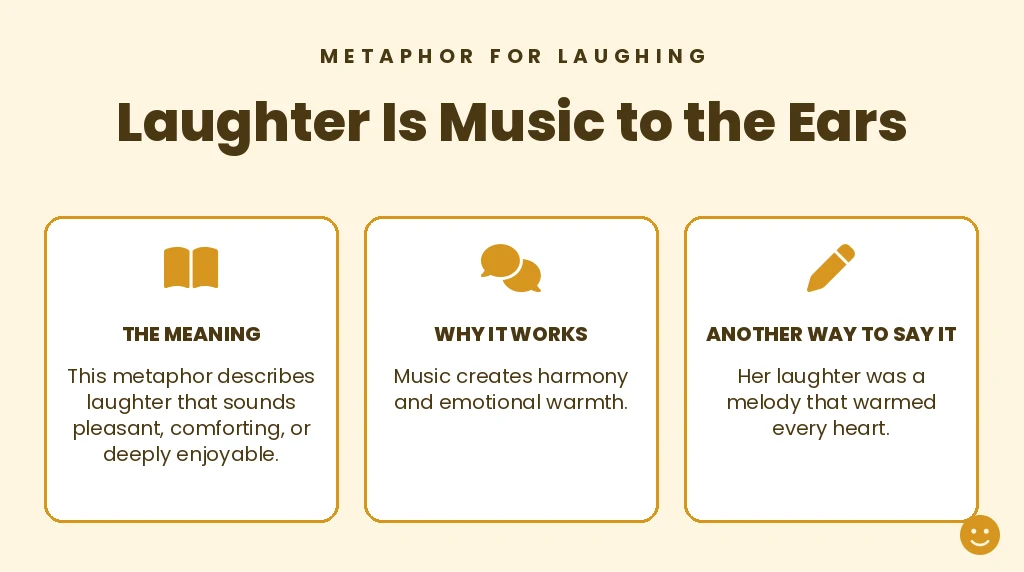
Meaning: This metaphor describes laughter that sounds pleasant, comforting, or deeply enjoyable.
Why It Works: Music creates harmony and emotional warmth. Comparing laughter to music suggests that the sound brings people together and makes an ordinary moment feel special. It works particularly well in romantic stories, family scenes, and heartfelt personal essays.
Alternative Expression: Her laughter was a melody that warmed every heart.
Examples in Writing
Formal Example: The children’s laughter was music to the ears of everyone gathered in the courtyard.
Casual Example: Your laugh is music to my ears. I could listen to it all day.
Creative Example: Her laughter floated through the kitchen like a melody nobody wanted to end.
2. Laughter Is a Burst of Fireworks
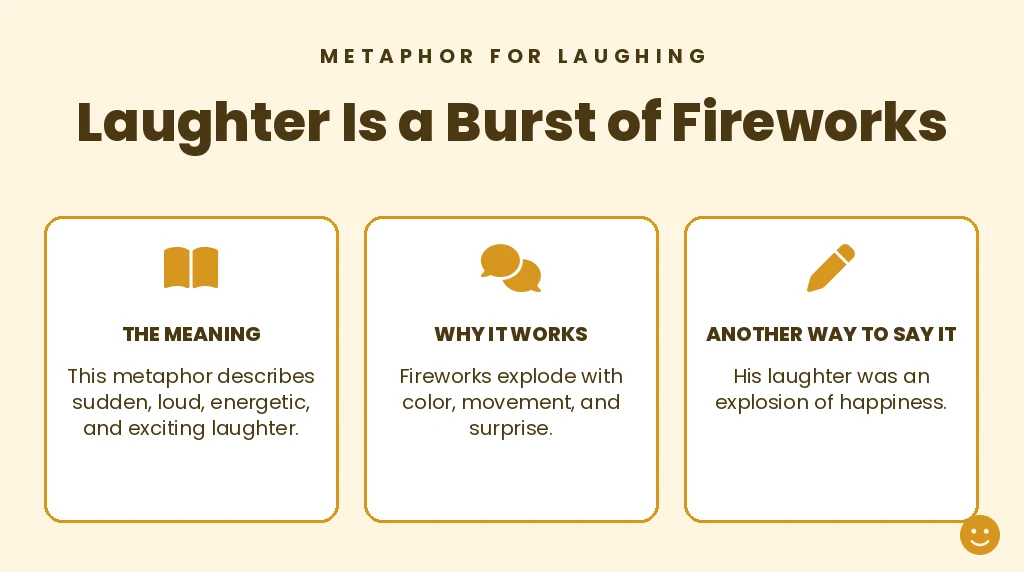
Meaning: This metaphor describes sudden, loud, energetic, and exciting laughter.
Why It Works: Fireworks explode with color, movement, and surprise. The comparison captures laughter that arrives unexpectedly and immediately attracts attention. It is especially useful for comedy scenes, celebrations, and lively group conversations.
Alternative Expression: His laughter was an explosion of happiness.
Examples in Writing
Formal Example: His laughter became a burst of fireworks that transformed the quiet gathering into a celebration.
Casual Example: When she heard that joke, her laugh went off like fireworks.
Creative Example: His laughter burst across the night like fireworks lighting a sleeping sky.
3. Giggles Are Bubbles Rising to the Surface
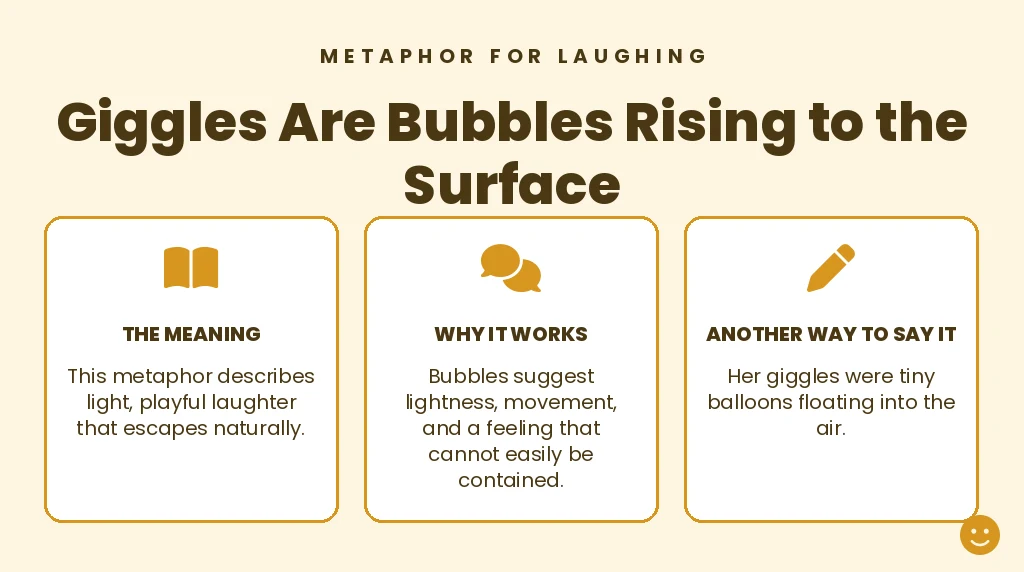
Meaning: This metaphor describes light, playful laughter that escapes naturally.
Why It Works: Bubbles suggest lightness, movement, and a feeling that cannot easily be contained. This image suits shy characters, children, playful friendships, and romantic moments.
Alternative Expression: Her giggles were tiny balloons floating into the air.
Examples in Writing
Formal Example: Her restrained amusement gradually emerged as bubbles of laughter.
Casual Example: I tried to stay serious, but the giggles just kept coming.
Creative Example: Her giggles rose like soap bubbles, each one catching a little sunlight before disappearing.
4. Laughter Is Thunder Rolling Through the Room
Meaning: This metaphor describes deep, booming, or exceptionally loud laughter.
Why It Works: Thunder is powerful and impossible to ignore. Comparing laughter to thunder creates a strong sense of sound and physical presence. It works well when describing an expressive character whose laughter dominates a gathering.
Alternative Expression: His laughter was a storm breaking loose.
Examples in Writing
Formal Example: His thunderous laughter echoed through the auditorium and interrupted the tense discussion.
Casual Example: My uncle’s laugh is basically thunder whenever he hears something funny.
Creative Example: His laughter rolled through the room, shaking the silence from every corner.
5. Laughter Is Sunshine on a Cloudy Day
Meaning: This metaphor describes laughter that brings comfort, optimism, and happiness during difficult moments.
Why It Works: Sunshine often represents hope, while clouds suggest sadness or uncertainty. The contrast makes the metaphor particularly effective for emotional storytelling.
Alternative Expression: Her laughter was a ray of light through the gloom.
Examples in Writing
Formal Example: Her gentle laughter became sunshine on a cloudy day for the students struggling with their exams.
Casual Example: Whenever I’m having a bad day, your laugh makes everything feel better.
Creative Example: Her laughter slipped through my sadness like sunshine through a curtain of rain.
6. Laughter Is a Contagious Melody
Meaning: This metaphor describes laughter that makes other people laugh along.
Why It Works: A melody can draw people into a shared rhythm. The word contagious adds the idea that one person’s amusement spreads naturally through a group.
Alternative Expression: His laughter was a happy tune that nobody could resist.
Examples in Writing
Formal Example: The teacher’s contagious laughter quickly eased the tension in the classroom.
Casual Example: Once she starts laughing, everyone around her joins in.
Creative Example: His laughter became a melody that traveled from one smiling face to another.
7. Laughter Is a River Overflowing Its Banks
Meaning: This metaphor describes uncontrollable laughter that becomes too powerful to hold back.
Why It Works: A river overflowing its banks creates an image of emotion exceeding its limits. It is ideal for scenes in which characters laugh so hard that they struggle to speak or regain their composure.
Alternative Expression: Her laughter was a flood breaking through every barrier.
Examples in Writing
Formal Example: The unexpected remark released a river of laughter that swept through the entire meeting.
Casual Example: That video was so funny that my laughter just wouldn’t stop.
Creative Example: Laughter rushed through her like a river escaping its banks after heavy rain.
8. Giggles Are Popcorn Popping in a Pan
Meaning: This metaphor describes quick, irregular bursts of playful laughter.
Why It Works: Popcorn pops unpredictably, one kernel after another. The comparison captures the rhythm of someone trying to suppress laughter but repeatedly losing control.
Alternative Expression: Her giggles were little sparks jumping out of a fire.
Examples in Writing
Formal Example: Quiet giggles popped around the classroom as the students exchanged amused glances.
Casual Example: We kept giggling like popcorn popping during the entire movie.
Creative Example: Her laughter popped through the silence, one bright little burst after another.
9. Laughter Is a Silver Bell
Meaning: This metaphor describes clear, light, sweet, and melodious laughter.
Why It Works: A silver bell produces a bright, recognizable sound. This comparison helps readers imagine laughter that feels delicate and musical rather than loud or explosive.
Alternative Expression: Her laugh was a tiny chime in the afternoon air.
Examples in Writing
Formal Example: A silver bell of laughter escaped her as she remembered the incident.
Casual Example: She has such a sweet laugh. It sounds like a little bell.
Creative Example: Her laughter rang through the garden like a silver bell welcoming the morning.
10. Laughter Is a Spark That Ignites the Room
Meaning: This metaphor describes laughter that changes the mood and encourages others to join in.
Why It Works: A spark can turn a quiet moment into something energetic. The metaphor is useful for charismatic characters, entertaining speakers, and people who naturally bring life to social gatherings.
Alternative Expression: His laugh was the match that lit the celebration.
Examples in Writing
Formal Example: Her witty observation became the spark that ignited laughter throughout the conference room.
Casual Example: He always knows how to get everyone laughing.
Creative Example: One laugh escaped his lips, and suddenly the entire room was burning with joy.
11. Laughter Is a Wave Crashing Against the Shore
Meaning: This metaphor describes powerful laughter that rises, breaks, and spreads through a group.
Why It Works: Waves build gradually before crashing with force. This movement mirrors laughter that starts with a smile, develops into chuckles, and finally becomes an uncontrollable burst.
Alternative Expression: Laughter swept through the room like a rising tide.
Examples in Writing
Formal Example: A wave of laughter crashed through the audience after the comedian delivered his final punchline.
Casual Example: One joke started it, and then laughter took over the whole table.
Creative Example: Their laughter rose like a distant tide before breaking against the shore of silence.
12. A Chuckle Is a Warm Blanket
Meaning: This metaphor describes quiet, comforting laughter that makes people feel safe and relaxed.
Why It Works: A warm blanket suggests protection, familiarity, and ease. This comparison works especially well in scenes involving close friends, grandparents, partners, or moments of reassurance.
Alternative Expression: His chuckle was a little fire on a cold evening.
Examples in Writing
Formal Example: His gentle chuckle offered a sense of comfort during the difficult conversation.
Casual Example: Grandpa’s little laugh always makes me feel at home.
Creative Example: His chuckle wrapped around the room like a warm blanket on a winter night.
13. Laughter Is a Flock of Birds Taking Flight
Meaning: This metaphor describes light, spontaneous laughter that spreads quickly and freely.
Why It Works: Birds taking flight suggest freedom, movement, and sudden energy. The metaphor is particularly effective for describing children’s laughter or a joyful moment outdoors.
Alternative Expression: Her laughter was a flock of sparrows escaping into the morning.
Examples in Writing
Formal Example: The children’s laughter rose like a flock of birds released into the open sky.
Casual Example: As soon as the teacher made the joke, laughter spread around the class.
Creative Example: Her laughter took flight, scattering the heavy silence like birds above a meadow.
14. Laughter Is a Drumbeat of Joy
Meaning: This metaphor describes strong, rhythmic laughter that expresses excitement and happiness.
Why It Works: A drumbeat has energy and rhythm. This image works when laughter comes in repeated bursts or accompanies a celebration, dance, or playful gathering.
Alternative Expression: His laughter was a rhythm that set happiness in motion.
Examples in Writing
Formal Example: The audience’s laughter became a drumbeat of joy throughout the performance.
Casual Example: His laugh comes in these loud bursts that get everyone going.
Creative Example: Her laughter beat against the afternoon like drums announcing a festival.
15. Giggles Are Raindrops Dancing on a Rooftop
Meaning: This metaphor describes delicate, frequent, and playful giggles.
Why It Works: Raindrops create a gentle, irregular rhythm. The comparison gives laughter a soft, almost musical quality without making it seem too loud or dramatic.
Alternative Expression: Her giggles were tiny drops of happiness.
Examples in Writing
Formal Example: Soft giggles danced through the room like raindrops on a rooftop.
Casual Example: She kept making little sounds of laughter every time she looked at him.
Creative Example: Her giggles tapped against the silence like rain dancing on an old tin roof.
16. Laughter Is a Rolling Train Gathering Speed
Meaning: This metaphor describes laughter that starts quietly and grows into a powerful, unstoppable fit.
Why It Works: A moving train gains momentum as it travels. This makes the comparison useful for describing friends who try to stop laughing but only become more amused.
Alternative Expression: His laughter was a snowball rolling downhill.
Examples in Writing
Formal Example: The initial chuckles developed into a rolling train of laughter that swept through the audience.
Casual Example: We started with one little laugh, and five minutes later nobody could stop.
Creative Example: Her laughter gathered speed, rattling through the room until even the quietest guest surrendered.
17. Laughter Is a Light Breaking Through Darkness
Meaning: This metaphor describes laughter that brings hope, relief, or emotional release after sadness.
Why It Works: Darkness often represents grief, uncertainty, or hardship. Light suggests comfort and renewal. Together, they create a meaningful image of laughter helping people through difficult experiences.
Alternative Expression: His laughter was a candle in a dark room.
Examples in Writing
Formal Example: Her laughter became a light breaking through the darkness of an otherwise difficult year.
Casual Example: We had been having a rough week, but that moment finally made us laugh again.
Creative Example: His laughter pierced the darkness like morning light entering a room that had been closed for years.
18. Laughter Is a Mischievous Little Storm
Meaning: This metaphor describes playful, energetic, and slightly chaotic laughter.
Why It Works: A mischievous storm combines excitement with unpredictability. It suits characters who enjoy practical jokes, playful teasing, or causing harmless trouble.
Alternative Expression: Her laughter was a whirlwind of mischief.
Examples in Writing
Formal Example: The children’s mischievous laughter filled the house as their harmless prank unfolded.
Casual Example: Whenever we get together, our laughter turns into complete chaos.
Creative Example: Her laughter swept through the hallway, a little storm carrying secrets and mischief.
19. Laughter Is a String of Pearls Spilling onto the Floor
Meaning: This metaphor describes delicate, bright, and repeated bursts of laughter.
Why It Works: Pearls suggest beauty and individuality. The image of them spilling creates movement, helping readers imagine a series of small, charming giggles.
Alternative Expression: Her laughter was a handful of tiny bells tumbling together.
Examples in Writing
Formal Example: Her delicate laughter spilled into the room like a string of pearls scattered across polished marble.
Casual Example: She has the kind of giggle that comes out in little bursts.
Creative Example: Each giggle fell from her lips like a pearl slipping from a broken necklace.
20. Laughter Is an Open Window Letting Happiness In
Meaning: This metaphor describes laughter that releases tension and welcomes a lighter mood.
Why It Works: An open window suggests fresh air, freedom, and a change of atmosphere. It is particularly useful when describing someone whose laughter helps others relax or feel comfortable.
Alternative Expression: Her laughter was a door opening into sunshine.
Examples in Writing
Formal Example: His warm laughter became an open window through which optimism entered the otherwise tense discussion.
Casual Example: Her laugh makes everyone feel comfortable, even when the room is awkwardly quiet.
Creative Example: Her laughter opened a window in the stale air, and happiness drifted in like a spring breeze.
Different Types of Metaphors for Laughing
Not every laugh communicates the same emotion. A useful metaphor should match the kind of laughter you want readers to imagine.
| Type of laughter | Suitable metaphor | Emotional effect |
|---|---|---|
| Happy laughter | Sunshine breaking through clouds | Warmth and optimism |
| Loud laughter | Thunder rolling through a room | Power and excitement |
| Nervous laughter | A trembling leaf in the wind | Uncertainty and tension |
| Uncontrollable laughter | A river overflowing its banks | Loss of restraint |
| Quiet laughter | A silver bell | Gentleness and sweetness |
| Contagious laughter | A spreading melody | Connection and shared joy |
| Mischievous laughter | A playful storm | Humor and unpredictability |
| Bitter laughter | A cracked bell | Pain and disappointment |
| Romantic laughter | Music in a quiet room | Intimacy and affection |
| Childlike laughter | Bubbles floating in the air | Innocence and playfulness |
Metaphors for Laughing in Different Writing Situations
Choosing the right metaphor depends on your audience, the scene, and the emotion you want to communicate.
Metaphors for Laughing in Stories and Novels
In fiction, laughter can reveal a character’s personality without requiring a long explanation.
For example, describing a character’s laughter as thunder suggests that the character is expressive and commanding. Describing it as a silver bell creates a gentler impression.
Try to connect the metaphor with the scene. During a joyful reunion, laughter might be a wave sweeping through a crowded room. During an awkward dinner, a single nervous chuckle might sound like a glass cracking in the silence.
Metaphors for Laughing in Poetry
Poetry allows more imaginative and symbolic comparisons. Laughter can represent freedom, healing, romance, memory, or even grief.
Consider this line:
Her laughter was sunlight spilling over the ruins of yesterday.
The image suggests that happiness can return after a difficult experience. This kind of metaphor works best when the surrounding poem supports the same emotional theme.
Metaphors for Laughing in Essays
In personal essays, metaphors can make memories more vivid without overwhelming the reader.
Instead of writing, “Everyone laughed at the family dinner,” you could write, “Laughter rolled around the dinner table like a summer storm.”
The second version creates a stronger sense of sound and atmosphere. Use this technique selectively so that the important details remain clear.
Metaphors for Laughing in Dialogue
Dialogue should sound natural for the character speaking. People rarely use elaborate metaphors in every conversation.
A casual line such as “His laugh was a fire alarm” can work in a humorous story because it communicates that his laughter is loud and impossible to ignore.
In a serious conversation, a simple description may be more effective than a poetic comparison. Let the character’s personality determine how expressive the language should be.
How to Write Better Metaphors for Laughing
Creating original metaphors becomes easier when you focus on the sound, movement, and emotional meaning of laughter.
1. Think About the Sound
Ask yourself what the laugh actually sounds like.
A deep, booming laugh might resemble thunder. A light giggle might sound like a silver bell. A series of quick chuckles might resemble popcorn popping.
The more closely the image matches the sound, the easier it becomes for readers to imagine it.
2. Match the Metaphor to the Emotion
Laughter can express happiness, embarrassment, nervousness, relief, sarcasm, or discomfort.
For example, “sunshine through clouds” suggests relief and warmth, while “a cracked bell” could suggest laughter that sounds bitter or forced.
Avoid choosing a cheerful metaphor when the character is laughing to hide pain unless that contrast is intentional.
3. Use Familiar Images Creatively
Everyday objects can produce vivid comparisons. Think about a kettle beginning to whistle, a door swinging open, rain tapping on a window, or a match catching fire.
These images can make a description feel fresh because readers can easily picture the action.
4. Avoid Overused Comparisons
Phrases such as “laughing like crazy” or “bursting with laughter” are familiar and useful in everyday language, but they may not create a distinctive image.
Try giving the comparison a specific detail.
Instead of “Her laughter was loud,” write, “Her laughter rolled down the hallway like thunder chasing the rain.”
The extra imagery creates a clearer scene.
5. Do Not Overload One Sentence
A metaphor should sharpen the reader’s mental picture, not confuse it.
For example, “His laughter was thunder, sunshine, a river, and a flock of birds” gives readers too many unrelated images at once.
Choose one comparison that captures the dominant feeling. You can introduce another image later if the scene needs it.
Metaphor vs. Simile for Laughing
A metaphor describes laughter by stating that it is something else. A simile compares laughter to something using words such as “like” or “as.”
| Metaphor | Simile |
|---|---|
| Her laughter was music. | Her laughter sounded like music. |
| His laugh was thunder. | His laugh boomed like thunder. |
| Her giggles were bubbles. | Her giggles floated like bubbles. |
| His laughter was a wildfire. | His laughter spread like wildfire. |
| Her laugh was sunshine. | Her laugh shone like sunshine. |
Both literary devices make writing more descriptive. Metaphors often feel more direct and symbolic, while similes make the comparison explicit.
Choose whichever fits the voice and rhythm of your sentence.
Common Mistakes When Using Metaphors for Laughing
Even a creative metaphor can weaken a sentence if it does not fit the scene.
- Using the wrong emotional tone: Comparing nervous laughter to sunshine can confuse the intended mood unless you are deliberately creating contrast.
- Repeating the same imagery: Using fire, sparks, flames, and wildfires in every paragraph can make the article or story feel repetitive.
- Making comparisons too complicated: A long metaphor can distract readers from the character or action.
- Using metaphors in every sentence: Direct descriptions are sometimes more powerful. Not every laugh needs a symbolic comparison.
- Ignoring context: A metaphor that works in poetry may sound unnatural in everyday dialogue.
- Confusing a metaphor with a simile: “Her laughter was music” is a metaphor, while “her laughter was like music” is a simile.
The goal is not to make every sentence sound poetic. It is to choose imagery that helps the reader experience the moment more clearly.
Frequently Asked Questions
1. What is a metaphor for laughing?
A metaphor for laughing describes laughter by comparing it directly to something else. For example, “Her laughter was music to my ears” compares the sound of laughter to music to express how pleasant and comforting it feels.
2. What are some good metaphors for laughing?
Some effective examples include “laughter is sunshine on a cloudy day,” “his laughter was thunder,” and “her giggles were bubbles.” Each metaphor communicates a different sound, intensity, or emotional quality.
3. What is a metaphor for loud laughter?
“Laughter was thunder rolling through the room” is a strong metaphor for loud laughter. It helps readers imagine a deep, booming sound that fills a space and attracts everyone’s attention.
4. What is a metaphor for uncontrollable laughter?
“Laughter was a river overflowing its banks” describes laughter that becomes impossible to contain. The image suggests that amusement has grown beyond the person’s ability to control it.
5. What is a metaphor for happy laughter?
“Laughter is sunshine breaking through the clouds” is an effective metaphor for happy laughter. It communicates warmth, optimism, and the way a joyful moment can improve someone’s mood.
6. What is a metaphor for nervous laughter?
“Nervous laughter is a loose thread unraveling in silence” can describe laughter that escapes when someone feels uncomfortable. This kind of image works well in tense scenes, awkward conversations, and stories about social anxiety.
7. How do you describe laughter metaphorically in poetry?
Use imagery that connects laughter with sound, movement, nature, or emotion. For example, “Her laughter scattered like sunlight across the sleeping garden” creates a gentle, uplifting atmosphere suitable for lyrical writing.
8. What is the difference between a metaphor and a simile for laughing?
A metaphor states that laughter is something else, such as “His laughter was thunder.” A simile uses a comparison word, as in “His laughter boomed like thunder.” Both help readers imagine the sound.
9. Can metaphors describe sarcastic or bitter laughter?
Yes. A metaphor such as “His laughter was a cracked bell” can suggest bitterness, disappointment, or emotional pain. The surrounding context should make the intended meaning clear.
10. How can I create an original metaphor for laughing?
Start by identifying the type of laughter you want to describe. Think about its volume, rhythm, emotional tone, and effect on other people. Then compare it to a familiar image, such as a bouncing ball, a flickering candle, or rain against a window.
Conclusion
Laughter is much more than a sound. It can express happiness, reveal nervousness, ease tension, strengthen relationships, or conceal feelings that someone cannot explain. That is why metaphors for laughing are so useful in creative writing. They turn a simple action into an experience readers can hear, picture, and feel.
From thunder rolling through a room to sunlight breaking through the clouds, each metaphor creates a different emotional atmosphere. The best choice depends on the character, the situation, and the feeling you want to leave with your reader.
When writing stories, poems, essays, or everyday descriptions, experiment with comparisons drawn from nature, music, weather, and ordinary life. Keep the imagery clear, avoid unnecessary repetition, and let the emotion guide your choice.