Twenty minutes left in the lecture. And suddenly boredom is a clock whose hands move through honey, each tick arriving slower than the last. Or picture a waiting room. Last year’s magazines, chairs bolted down, and your name? It’s never called.
Writing about boredom is tricky. On the surface, nothing’s happening. Inside, though, time stretches out, the senses dull, and tiny things swell huge: a humming light, a phrase repeated once too often. A good metaphor gives that emptiness a texture. You don’t just say a character was bored. You show the day thickening around them.
Below, you’ll find twenty original metaphors for boredom, from dull meetings to empty Sundays. Each one comes with its meaning explained, an alternative, and examples. There’s more: positive and negative angles, plus ready-made sentences for students, novelists, and speakers.
Quick Metaphors for Boredom
If you need a strong image fast, start with this list of twenty metaphors for boredom.
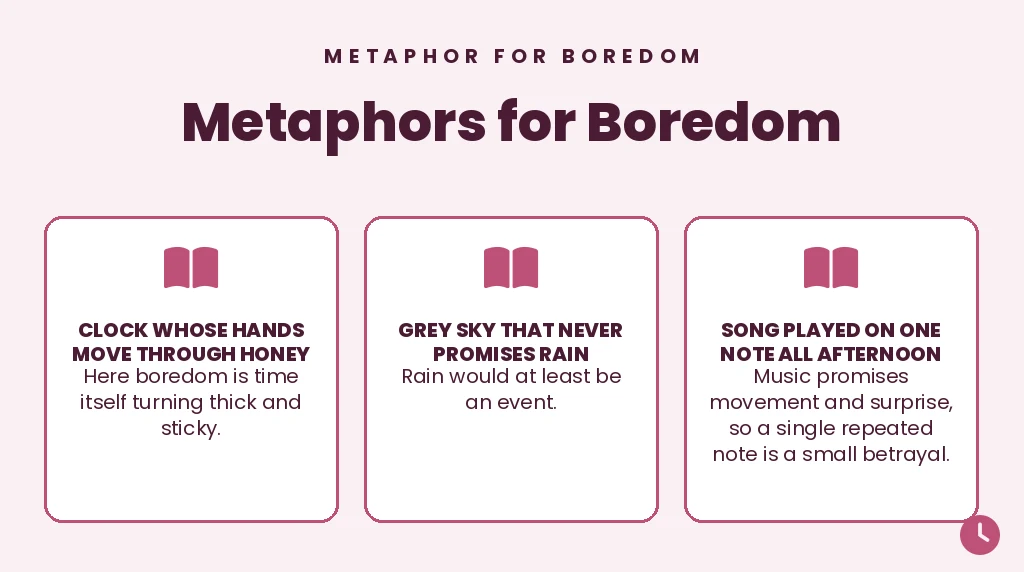
- Boredom is a clock whose hands move through honey.
- Boredom is a grey sky that never promises rain.
- Boredom is a song played on one note all afternoon.
- Boredom is a waiting room with last year’s magazines.
- Boredom is a train stopped between two stations.
- Boredom is plain rice served at every meal.
- Boredom is a hamster wheel painted to look like a road.
- Boredom is a movie you have already memorized.
- Boredom is a room where the wallpaper is the only view.
- Boredom is a battery draining on a blank screen.
- Boredom is a desert with no wind and no dunes.
- Boredom is a conversation with a wall.
- Boredom is a book whose pages are all blank.
- Boredom is a yawn that spreads through the whole day.
- Boredom is a kettle that never quite boils.
- Boredom is a corridor of identical doors.
- Boredom is a pond with no ripples and no fish.
- Boredom is a suitcase packed with nothing to wear.
- Boredom is an elevator music loop in an empty building.
- Boredom is a pencil drawing the same circle all day.
Metaphors for Boredom and Their Meanings
Each metaphor below comes with a plain explanation, a note on why it works, an alternative expression, and three short examples. Jump to the ones matching your feeling.
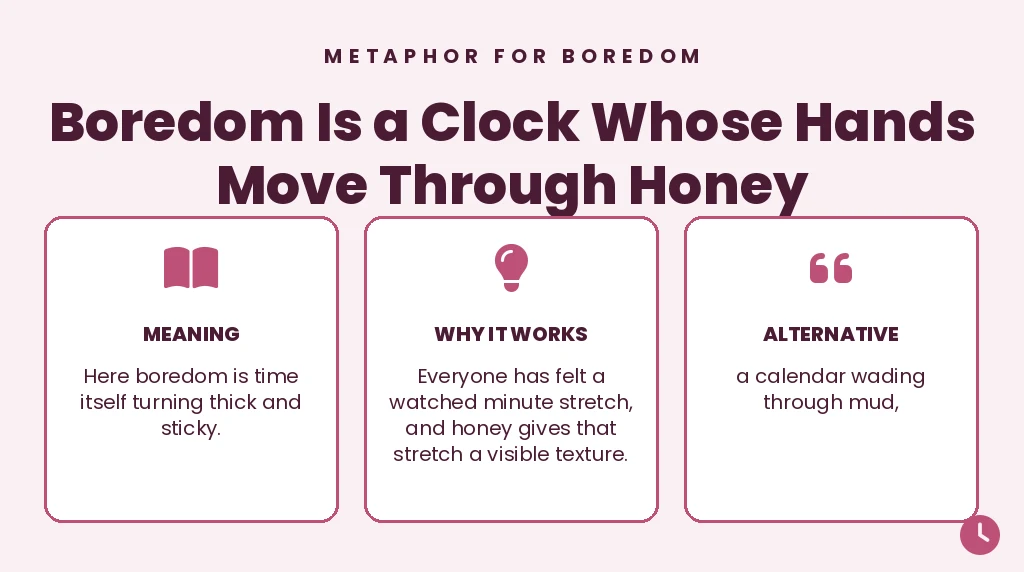
1. Boredom Is a Clock Whose Hands Move Through Honey
Meaning
Time itself turns thick here. Sticky, too. The clock hasn’t broken, the hands still move, but every minute has to drag itself through a sweetness that just won’t let go.
Why It Works
We’ve all watched a minute stretch. Honey gives that stretch something you can see, almost touch. Use it for classrooms, waiting rooms, ceremonies, anywhere the end’s certain but painfully far off.
Alternative Expression
Or call it “a calendar wading through mud,” the same slowness in bigger steps.
Examples in Writing
Formal Example: The memoir describes the asylum’s afternoons as a clock whose hands moved through honey, year after identical year.
Casual Example: This training video has been a clock in honey; forty minutes in, we are on slide three.
Creative Example: The hands of the courthouse clock stirred their honey, and the whole town waited for a sound.
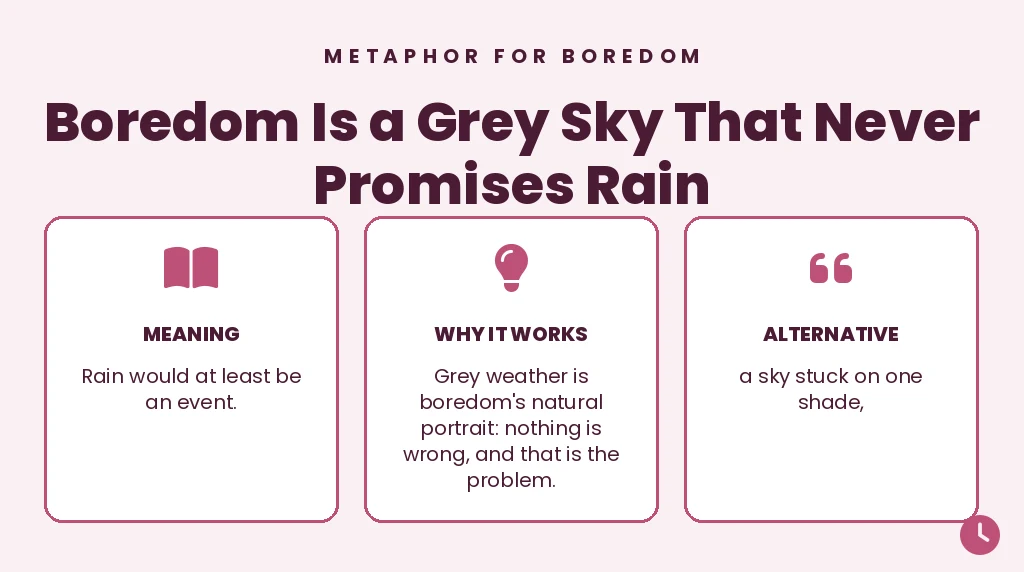
2. Boredom Is a Grey Sky That Never Promises Rain
Meaning
Rain would at least be something. An event. Instead you get neither sunshine nor storm, just a flat, featureless mood and the same pale light, morning to evening.
Why It Works
Grey weather is boredom’s natural portrait. Nothing’s actually wrong. And that’s exactly the problem. It fits routines, offices, long illnesses, anywhere days lose their edges and blur into one.
Alternative Expression
There’s also “a sky stuck on one shade,” the same flatness without the weather forecast.
Examples in Writing
Formal Example: Her letters from the sanatorium describe a grey sky that never promised rain, week after unbroken week.
Casual Example: My whole winter break was a grey sky that never promised rain; nothing bad, nothing at all.
Creative Example: Above the village the sky kept its one grey thought from dawn to dusk, and shared it with everyone.
3. Boredom Is a Song Played on One Note All Afternoon

Meaning
Music promises movement. Surprise, too. So one note, played over and over, feels like a small betrayal. It’s boredom built from sameness: one task, one voice, one topic, repeated past endurance.
Why It Works
You can’t switch sound off, and that’s why this one feels physical rather than abstract. It suits lectures, machinery, relatives’ stories, anything whose boredom arrives through the ears in a loop.
Alternative Expression
Or put it as “a drum beating one beat forever,” trading melody for rhythm.
Examples in Writing
Formal Example: The transcript reads like a song played on one note all afternoon, forty pages of the same assurance.
Casual Example: Grandpa’s fishing story is a one-note song by now, and it lasts the whole afternoon, every visit.
Creative Example: The factory hummed its single note through the shift, through the year, through the men’s dreams.
4. Boredom Is a Waiting Room With Last Year’s Magazines
Meaning
Picture the furniture. That’s where this boredom lives, and last year’s magazines are the perfect detail. Time’s suspended here. Life’s happening elsewhere, to other people, while you sit and flip pages.
Why It Works
We’ve all sat in that room. That’s why it lands instantly, and why it’s slightly comic. It suits delays, visa offices, stalled careers, anywhere the wait itself becomes the story.
Alternative Expression
Sharper still: “a queue that forgot to move,” dropping the room and keeping the wait.
Examples in Writing
Formal Example: For rejected applicants, the process became a waiting room with last year’s magazines, its call forever delayed.
Casual Example: This internship search is one long waiting room with last year’s magazines at this point.
Creative Example: She had read the same quiz about film stars eleven times when the nurse finally mispronounced her name.
5. Boredom Is a Train Stopped Between Two Stations
Meaning
The train promised motion. Then it took the promise back. You’re stuck mid-journey: you’ve left somewhere, you haven’t arrived, and the view outside simply refuses to change.
Why It Works
Stillness between stations frustrates like nothing else. You can’t get out. Nobody tells you anything. Use it for stalled projects, long recoveries, stories of people trapped mid-transition.
Alternative Expression
Or write it as “a flight circling a closed airport,” the same suspension with higher stakes.
Examples in Writing
Formal Example: The committee’s inquiry sat like a train stopped between two stations, its passengers reading the same fields for months.
Casual Example: My thesis is a train stopped between stations; I left the topic ages ago and arrived nowhere.
Creative Example: Through the window, the same hedge. Through the speakers, the same apology. The train dreamed of stations.
6. Boredom Is Plain Rice Served at Every Meal
Meaning
Plain rice is good food that repetition turns into a punishment. Nothing’s bad here. Nothing’s missing, either. Except variety itself, and that’s the whole boredom of adequacy.
Why It Works
Taste is intimate. So readers don’t picture this boredom, they feel it in the mouth. It suits marriages, jobs, small towns: any life where the problem isn’t pain, it’s sameness, served daily.
Alternative Expression
Or reach for “unseasoned soup at every table,” keeping the blandness in another bowl.
Examples in Writing
Formal Example: The novel’s suburb serves its residents plain rice at every meal: safe, sufficient, and slowly unbearable.
Casual Example: I like my job, honestly, but lately it is plain rice at every meal, every single day.
Creative Example: Breakfast, the bowl. Lunch, the bowl. The spoon began to dream of chili, of lemon, of anything red.
7. Boredom Is a Hamster Wheel Painted to Look Like a Road
Meaning
It’s all effort, no progress. Someone’s painted scenery on the wheel to hide what’s true, and it’s simple: run all day, sweating and sincere, and you’ll finish exactly where you started.
Why It Works
The painted road is the sting. Plain repetition doesn’t deceive anyone, but this does. It suits busywork, dead-end jobs, fitness ruts, anywhere activity hides the absence of movement.
Alternative Expression
Or frame it as “a treadmill facing a poster of mountains,” the same joke in a gym.
Examples in Writing
Formal Example: The audit called the program a hamster wheel painted to look like a road, rich in reports and poor in results.
Casual Example: My inbox is a hamster wheel painted like a road; I run all day and arrive at my desk.
Creative Example: Someone had painted little trees along the wheel, and birds, so the running would feel like travel.
8. Boredom Is a Movie You Have Already Memorized
Meaning
A film you’ve memorized can still be a good film. It just can’t surprise you anymore. That’s boredom inside good things repeated too often: rituals, routes, conversations whose lines you can mouth along with.
Why It Works
Here’s the distinction it gives you: quality isn’t freshness. Many boredom scenes need it. And readers know the feeling, that strange sadness of reciting a favorite film and feeling nothing left.
Alternative Expression
Or scale it down to “a joke told for the hundredth time,” shrinking the film to one scene.
Examples in Writing
Formal Example: After a decade of ceremonies, the anthem became a movie the conductor had already memorized, note by dutiful note.
Casual Example: Family dinners are a movie I have memorized; I even know when Uncle will do the voice.
Creative Example: She spoke the town’s small talk along with the speakers, line by line, like an actor in the audience.
9. Boredom Is a Room Where the Wallpaper Is the Only View
Meaning
Boredom becomes a room here. It’s comfortable enough, but there’s nothing to look at except the wallpaper, so the eye studies one pattern, again and again, almost to madness.
Why It Works
Notice what happens: boredom doesn’t empty the world, it shrinks it. The image suits sickrooms, lockdowns, desk jobs. And it’s a gift for detail, because a wallpaper pattern is easy to describe obsessively.
Alternative Expression
Or try “a window bricked up and painted with a window,” a darker, funnier confinement.
Examples in Writing
Formal Example: The prison diary describes a room where the wallpaper was the only view, its roses counted into the thousands.
Casual Example: Quarantine week two: my room is just wallpaper as the only view, and I have named the patterns.
Creative Example: The roses on the wall repeated every eleven inches, and by March he hated each one personally.
10. Boredom Is a Battery Draining on a Blank Screen
Meaning
Your phone’s showing nothing. It’s still losing charge. People work the same way: energy quietly spent on nothing, until you’re tired and there’s no achievement anywhere to explain why.
Why It Works
Here’s boredom’s strangest puzzle: why does doing nothing leave us exhausted? The blank screen feels modern and exact, because so much boredom happens in front of glowing rectangles that offer everything and engage nothing.
Alternative Expression
Or hear it as “an engine idling in an empty street,” the same waste with noise.
Examples in Writing
Formal Example: The study compares long unemployment to a battery draining on a blank screen, depleted without use.
Casual Example: I did nothing all weekend and somehow I am a battery drained on a blank screen.
Creative Example: His percentage fell through the empty hours, one green bar at a time, lighting nothing.
11. Boredom Is a Desert With No Wind and No Dunes
Meaning
Deserts usually bring drama. Heat. Dunes. Wind. Strip all of that away and you’re left with flat sameness in every direction, the purest landscape of boredom there is.
Why It Works
It’s the double absence that does it. No wind. No dunes. The emptiness feels engineered, not accidental, and it suits long, landmark-free stretches of life: unemployment, convalescence, a summer with no plans.
Alternative Expression
There’s a wetter version: “an ocean with no weather,” trading sand for an equally eventless sea.
Examples in Writing
Formal Example: The memoir’s middle years form a desert with no wind and no dunes, crossed without incident or landmark.
Casual Example: August at my parents’ place is a desert with no wind and no dunes, honestly, every year.
Creative Example: Nothing moved in that country of afternoons, not a flag, not a lizard, not a thought worth following.
12. Boredom Is a Conversation With a Wall
Meaning
Conversation promises exchange. A wall? Nothing back. So this one’s about the boredom of being unheard: lectures nobody absorbs, meetings nobody joins, small talk that dies on contact.
Why It Works
It names the social ache hiding inside so much boredom: you’re talking into a void. Writers, keep it for teachers, parents, performers, anyone whose audience has quietly slipped out of the room.
Alternative Expression
Or slow it down into “a letter written to an empty house,” the same one-way effort, slower.
Examples in Writing
Formal Example: The lecturer described the silent hall as a conversation with a wall, his questions returning unanswered weekly.
Casual Example: Explaining the rules to my little cousins is a conversation with a wall, a cute wall, but a wall.
Creative Example: He told the wall his plans, his prices, his sorrows, and the wall, politely, remained a wall.
13. Boredom Is a Book Whose Pages Are All Blank
Meaning
Books promise stories. So blank pages feel like a quiet betrayal, and they capture time that should’ve been full, holidays, weekends, youth itself, arriving empty of content.
Why It Works
This one’s about disappointment, not dullness. The cover promised more. It flatters writers and readers, too, since we instinctively measure our lives in chapters and pages.
Alternative Expression
Make it personal with “a diary with nothing to record,” making the emptiness personal and dated.
Examples in Writing
Formal Example: The essay calls retirement, for the unprepared, a book whose pages are all blank, bound beautifully and empty.
Casual Example: My gap year so far is a book whose pages are all blank, which was not the plan.
Creative Example: She kept turning pages out of habit, politely, as if print might still be hiding somewhere ahead.
14. Boredom Is a Yawn That Spreads Through the Whole Day
Meaning
Yawns spread. One jumps from person to person, and here a dull hour does the same to a schedule, until even good plans start yawning back at you.
Why It Works
It works because boredom gets a mechanism, contagion, and a body: breath, jaw, watering eyes. It suits group settings, classrooms and offices, where one person’s slump quietly lowers the whole room.
Alternative Expression
Or picture “a slow wave moving down a row of seats,” keeping the spread, dropping the yawn.
Examples in Writing
Formal Example: The documentary shows the night shift’s boredom as a yawn spreading through the whole day of the town.
Casual Example: Rainy Sunday started as one yawn and spread through the whole day by lunch.
Creative Example: The yawn traveled desk to desk like gossip, and by three o’clock the whole office was fluent in it.
15. Boredom Is a Kettle That Never Quite Boils
Meaning
Picture a kettle that never boils. Anticipation, permanently postponed. It’s boredom built from almosts: plans nearly made, news nearly delivered, lives nearly started, all simmering and never arriving.
Why It Works
It separates expectant boredom from empty boredom, which helps in stories of waiting for results, letters, permission. The domestic scale keeps it comic. The endless simmer keeps it sad.
Alternative Expression
There’s a kitchen version: “an oven warming a meal that never comes,” the same delay in another appliance.
Examples in Writing
Formal Example: For the junior staff, promotion season was a kettle that never quite boiled, all steam and no whistle.
Casual Example: This group project is a kettle that never boils; lots of simmering, zero tea, for weeks.
Creative Example: The kettle of their engagement sang below boiling for seven years, and the cups stayed dry.
16. Boredom Is a Corridor of Identical Doors
Meaning
Doors promise difference. Rooms, people, chances. When every door is identical, choice itself becomes boring, and that’s boredom made for institutions: schools, hospitals, hotels, bureaucracies with endless same options.
Why It Works
Now boredom’s architectural. Slightly eerie, too, and that freshness helps. There’s walking in it: your character keeps moving, keeps choosing, and still nothing ever changes. Which is the definition of monotony.
Alternative Expression
Or double it with “a hallway of mirrors facing mirrors,” the same sameness made infinite.
Examples in Writing
Formal Example: The report describes the ministry as a corridor of identical doors, behind each of which sits the same form.
Casual Example: Apartment hunting in this city is a corridor of identical doors, all beige, all overpriced.
Creative Example: He opened doors out of politeness by the end, certain each room would wear the same grey chair.
17. Boredom Is a Pond With No Ripples and No Fish
Meaning
A living pond is never still. Insects land, fish rise, rings spread. Take that away and you’re left with water that reflects nothing and hides nothing: boredom as a stalled ecosystem.
Why It Works
You can measure this stillness. Count the missing ripples, if you like. That’s what makes it vivid, and it works for minds and communities alike, anywhere nothing new ever surfaces.
Alternative Expression
Or write “a lake practicing being a photograph,” stillness with a hint of performance.
Examples in Writing
Formal Example: The village in the novel is a pond with no ripples and no fish, its young people long departed.
Casual Example: This town in winter is a pond with no ripples and no fish; even the cafe closes at six.
Creative Example: The pond had forgotten rain, forgotten frogs, and practiced its one expression: flat, grey, patient.
18. Boredom Is a Suitcase Packed With Nothing to Wear
Meaning
Packing means departure. Occasion. So finding an empty wardrobe inside is a small tragedy, and it captures boredom after preparation: holidays with no plans, skills with no stage, a summer with no story.
Why It Works
One object, two feelings: anticipation and disappointment, joined together. Readers can hold that. It works for characters whose lives are ready, education done, savings made, and yet somehow never begin.
Alternative Expression
There’s also the paper version: “a ticket to a cancelled show,” keeping the wasted readiness in paper form.
Examples in Writing
Formal Example: The graduate’s first year became a suitcase packed with nothing to wear, credentials ready and occasions absent.
Casual Example: I learned guitar, bought the amp, and my band is still a suitcase packed with nothing to wear.
Creative Example: The case sat zipped by the door all summer, full of folds and intentions, waiting for weather.
19. Boredom Is an Elevator Music Loop in an Empty Building
Meaning
Elevator music exists to be ignored. Now loop it in an empty building, where it plays for nobody at all, and you’ve got background life: routines run on autopilot, heard by no one, not even yourself.
Why It Works
It’s doubly pointless. Bland music. No audience. Funny and bleak in the same breath, it suits modern offices, retail jobs, any place where cheerfulness gets piped in by policy.
Alternative Expression
Or say “a jingle playing to an empty shop,” the same loop at street level.
Examples in Writing
Formal Example: The essay portrays the call center as an elevator music loop in an empty building, scripted cheer without listeners.
Casual Example: Night shifts here are an elevator music loop in an empty building, and I am the building.
Creative Example: The speakers hummed their cheerful loop to the mop, the chairs, and the sleeping security guard.
20. Boredom Is a Pencil Drawing the Same Circle All Day
Meaning
Hand and mind, both stuck in a loop. The pencil moves, effort is spent, yet the drawing never becomes anything, which makes it the perfect closing emblem of fidgety, unproductive boredom.
Why It Works
You’ve done it: doodled circles in a margin during a long meeting. Everyone has, so recognition is instant. And there’s a quiet sadness, because the circle darkens with each pass and still means nothing.
Alternative Expression
Or, more precisely, “a compass married to one spot,” the same circling with a tool’s precision.
Examples in Writing
Formal Example: The student’s notebook margins reveal a pencil drawing the same circle all day, the lecture’s true record.
Casual Example: Three hours into this webinar, I am just a pencil drawing the same circle, darker and darker.
Creative Example: The circle thickened like a ring, like a noose, like a halo for an empty hour.
Positive Metaphors for Boredom
Boredom is not always a defect. In the right dose it rests the mind, clears noise, and quietly invites curiosity back. These six metaphors show that restorative side.
- Boredom is a fallow field resting before spring. It lets tired soil, and tired minds, recover their strength.
- Boredom is a blank page inviting a first line. It offers the one gift busy days never do: a start.
- Boredom is a quiet room where ideas knock softly. It lets thoughts arrive that noise usually scares away.
- Boredom is a reset button for an overloaded mind. It clears the clutter so attention can work again.
- Boredom is slow soil where daydreams take root. It grows the wishes that later become plans.
- Boredom is a door left ajar to curiosity. It invites the mind to wander somewhere new.
Negative Metaphors for Boredom
When boredom settles in for months, it stops resting the mind and starts rusting it. These six metaphors describe that heavier side, where dullness dulls the person.
- Boredom is rust forming on an unused mind. It dulls bright faculties left sitting too long.
- Boredom is a slow leak in the tire of a day. It flattens hours until nothing rolls anywhere.
- Boredom is dust settling on a favorite guitar. It buries loved things under quiet neglect.
- Boredom is a cage with the door wide open. It traps people who simply never think to leave.
- Boredom is fog that flattens every color to grey. It makes even pleasures look the same as chores.
- Boredom is a clock eating hours without hunger. It consumes the day and gives nothing back.
Metaphors for Boredom in Sentences
The table below shows six metaphors in sentences, with a note on what each communicates.
| Example sentence | What it communicates |
|---|---|
| During the safety lecture, time became a clock whose hands moved through honey. | Minutes stretching painfully in a dull setting. |
| His sabbatical felt like a waiting room with last year’s magazines. | Suspended time with nothing current to hold attention. |
| The data-entry job was a hamster wheel painted to look like a road. | Effort and busyness without any progress. |
| By week three, the seminar was a song played on one note. | Sameness repeated until it becomes unbearable. |
| She stared at the book whose pages were all blank and sighed. | Expected fullness arriving completely empty. |
| The ministry’s lobby was a corridor of identical doors, each with the same form behind it. | Choice without difference, the institutional kind of dull. |
How to Use Metaphors for Boredom Naturally
Start with the cause in your scene. Stretched time wants the honey clock or the stopped train, sameness wants the one-note song or the plain rice, and confinement wants the wallpaper room or the identical doors. Match image to cause. That’s most of using it naturally.
Next, don’t infect your reader. You’re describing boredom, and your prose has to work harder because of it, not less: shorter sentences, sharper details, a pattern counted, a clock watched. Add one vivid image, then move. The feeling stays real, and the writing never goes flat.
Finally, contrast. Give the dullness an edge to rub against: one interruption will do it, a ringing phone, a bird at the window. And if two metaphors are fighting in the same sentence, cut one. Read the line aloud. Keep whichever image your ear can still hear after one reading.
Metaphor vs. Simile: What Is the Difference?
Here’s the split. A metaphor says one thing is another thing, while a simile compares with like or as. Call boredom a clock whose hands move through honey and you’ve written a metaphor: feeling and clock fuse into one image, and time itself turns sticky.
A simile keeps its distance. That distance often suits boredom’s comic side, because bored narrators tend to be wry. Metaphors feel heavier. More trapped. Similes let the writer wink, so ask yourself: is this scene a prison, or a joke about a prison?
Same idea, both ways. Metaphor: boredom is a clock whose hands move through honey. Simile: the afternoon dragged like a clock whose hands moved through honey. See the difference? The metaphor replaces time itself. The simile only reports how the afternoon felt.
Common Mistakes When Writing Boredom Metaphors
- Making the prose boring too: Describing boredom in flat, endless sentences proves the feeling by inflicting it. Keep sentences short and details sharp, so readers feel dullness without catching it.
- Confusing boredom with sadness: Sadness aches; boredom itches for change. Images of weight and grief miss boredom’s restless wish for anything to happen.
- Confusing boredom with laziness: A bored character may be desperate to act and simply has nothing worthy to do. The stopped train is eager to move; it is the track that fails it.
- Overloading dull details: Ten grey details in a row numb the reader instead of painting monotony. Choose the two most telling, the old magazine, the identical door, and move on.
- Forgetting contrast: Pure sameness is invisible. A remembered lively day, or one sudden interruption, gives the reader a ruler to measure the dullness against.
Frequently Asked Questions
What is a good metaphor for boredom?
One of the strongest is the honey clock: boredom is a clock whose hands move through honey. It makes stretched time visible. Physical, even. For a setting, try a waiting room with last year’s magazines, which everyone recognizes instantly. Choose by cause: slow time, sameness, or confinement.
How do you describe boredom in creative writing?
Show the small obsessions boredom creates. Clocks watched. Patterns counted. Magazines reread. Then give the emptiness one concrete texture, honey, wallpaper, plain rice, and keep your own sentences brisk and varied. Readers should recognize the feeling quickly and enjoy the writing that delivers it. That’s the trick of the topic.
What is the difference between boredom and apathy?
They’re not the same. Boredom still wants something, it’s appetite without a menu, while apathy has stopped wanting altogether, which makes it colder and more serious. In images: boredom is a stopped train straining to move, or a kettle waiting to boil. Apathy? An engine with no fuel and no driver.
Can boredom ever be good for you?
Yes. Unfilled time lets the mind rest, wander, and recombine ideas, and that’s why solutions turn up in showers and on walks. Think of boredom as a fallow field or a blank page, empty on the surface and preparatory underneath. It turns harmful mainly when it becomes permanent and chosen.
What are metaphors for boredom in poetry?
Poets reach for still water. Grey weather. Empty rooms. A pond with no ripples and no fish, a sky that never promises rain: they hold a whole mood in one breath, which is what a stanza needs. Verse loves sound loops too, a single note sustained until the note becomes the subject.
Conclusion
Boredom is the mind protesting against wasted time. And its images are secretly about speed: how slowly an hour can crawl, and how fast a year can vanish inside sameness. If you enjoy this territory, explore slow things next, because boredom and slowness share the same stretched, honeyed clock.
Then the waiting room finally empties. The day ends. And boredom’s closest cousin moves in: the flat, suspended mood of night in a town where nothing happens after dark. So pick the image that fits your scene’s cause, stretched time, sameness, or confinement, and let one honest metaphor do the work.